
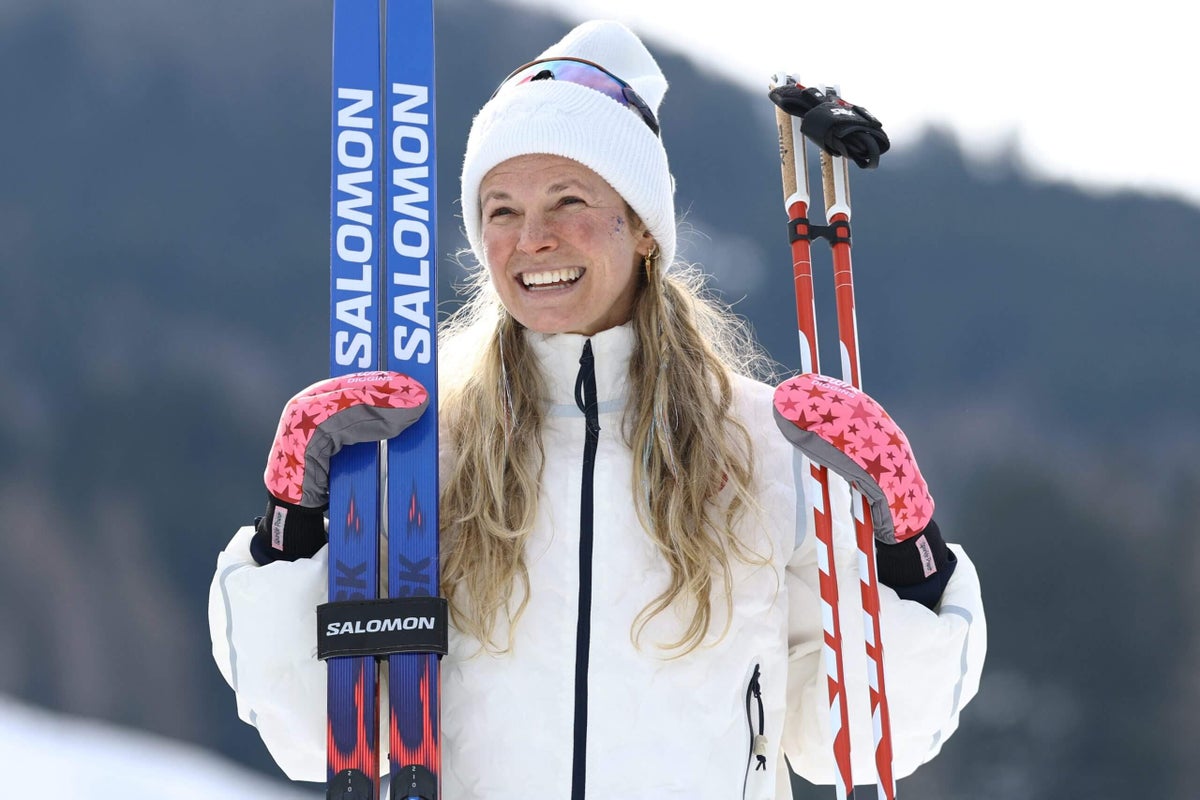
Jessie Diggins is going out on top.
The American cross-country skiing star clinched the crystal globes as both the World Cup distance and overall season champion on Friday, finishing fifth in the women’s 10-kilometer classic in Lake Placid, N.Y. It’s the third straight and fourth career World Cup title for Diggins, 34, who is retiring after this weekend.
Diggins entered the season’s final set of races with a 342-point lead over second-place Moa Ilar of Sweden, making it all but certain she’d wrap up the crown early in the weekend. Ilar would’ve needed to win all three races over three days and pick up all available bonus points, plus have Diggins not earn more than three points all weekend, to take the title.
On a day of heavy snow Friday in the Adirondacks, Diggins left no drama. Ilar went out 40th in the interval start race and was third when she finished, slipping back to eighth by the end. Diggins started 58th and was ahead of Ilar’s pace through most of the race, finishing in fifth in 29 minutes, 36.9 seconds. The combination of results was more than enough for Diggins to clinch the title.
Sweden took the top two spots with Linn Svahn winning in 29:04.4 and Frida Karlsson taking second in 29:05.8. Norway’s Heidi Weng rounded out the podium in third, finishing in 29:26.5.
The race was the first of three women’s events scheduled at the World Cup finals, the culminating event of the year. A sprint race is set for Saturday and a 30-kilometer for Sunday. The men’s events follow the same schedule.
Norwegian great Johannes Høsflot Klæbo, who swept all six gold medals last month at the 2026 Milan Cortina Olympics, had already secured the men’s title, his fourth in five years and sixth overall. The men’s 10-kilometer was later Friday.
In 15 seasons on the sport’s top circuit, Diggins has totaled 31 individual World Cup victories and 79 individual podiums, both ninth-best in the sport’s history, men or women. She’s the only non-European in the top 35 of either list.
This season, she took the yellow bib as the overall leader after three races — finishing fifth, 10th and second in the opening weekend in Ruka, Finland, in late November — and never gave it back. Along the way, she won three races, finished on the podium seven other times, and won the prestigious, weeklong Tour de Ski.
In eight trips to the biennial world championships, Diggins won seven medals, including two golds — a team sprint gold in 2013, with teammate Kikkan Randall, when she was 21, and an individual gold in 2023.
She’s best known for her memorable final push in the team sprint event at the 2018 Olympics, lifting her and Randall to the Americans’ first-ever cross-country Olympic gold medal. Trailing Sweden’s Stina Nilsson into the final stretch, Diggins made a huge surge — accompanied by an iconic broadcast call on NBC — to edge Nilsson for gold.
Four years later, in Beijing, she added a silver medal in the 30-kilometer freestyle and a bronze in the individual sprint. Last month at the 2026 Olympics, she suffered a rib injury in her first race but still managed to win bronze in the 10-kilometer freestyle.
“I think I’m the most grateful, happiest bronze medalist in the history of the world,” she said then.
In November, Diggins revealed to The Athletic’s Matt Futterman that she planned to retire after this season. Married in 2022, Diggins is ready to spend more time at home and said she felt like she “kind of lost my edge” while racing in recent years.
“I’m ready in my heart and my soul,” she said of retiring.
In her historic career, Diggins helped awaken U.S. cross-country from a long dormant spell. Bill Koch’s silver in 1976 in Innsbruck, Austria, stood as the lone American Olympic medal in the sport before Diggins and Randall changed that in 2018. In Milan Cortina, Ben Ogden and Gus Schumacher — two rising stars on the U.S. team who grew up watching Diggins reset the possibilities — both won medals, becoming the first U.S. men since Koch to do so.
As Diggins prepares to leave the sport, she spoke to The Athletic this week about leaving the U.S. team better than she found it.
“People have to intentionally put focus on being a good teammate and putting energy into the team,” she said, “but it really comes back.”