
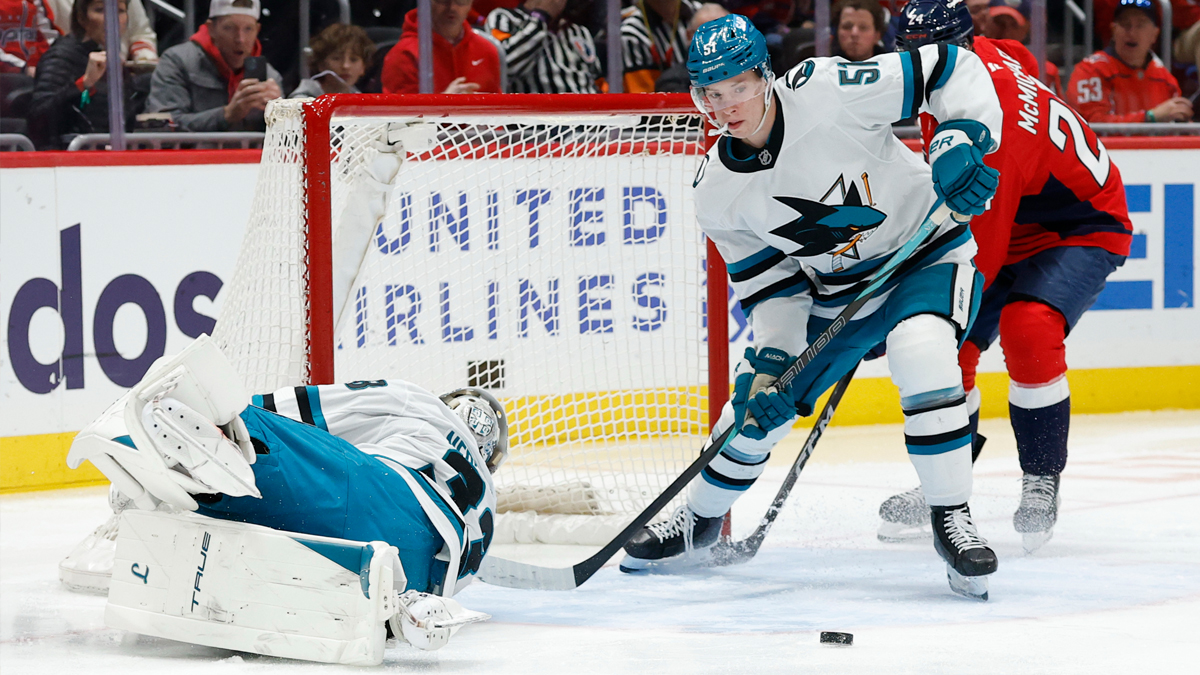
Collin Graf’s emergence as an impact NHL player is a tribute to every level of the Sharks’ scouting, development and coaching.
And of course, to Graf himself.
The undrafted college free agent has been perhaps the biggest surprise on the Sharks this season, blossoming into a 20-goal scorer (Graf has 19 goals entering Tuesday’s game against the Nashville Predators) and the most-trusted penalty killer in just his sophomore campaign.
As much as San Jose’s unexpected success this year can be attributed to Macklin Celebrini’s ascension from Calder Trophy finalist to Hart Trophy contender, Graf’s rise looms large, too.
Here’s how Graf went from college free agent to developing in the minors to major player — with insights from Graf, general manager Mike Grier, head coach Ryan Warsofsky and San Jose Barracuda assistant coach Louis Mass.
Choosing the Sharks
Why did Graf choose to sign with the Sharks?
Graf, after going undrafted, began making waves as a 20-year-old at Quinnipiac.
Grier says director of player personnel Scott Fitzgerald, who heads NCAA scouting for the organization, identified Graf as someone that the Sharks should sign. Fitzgerald, famously, led the Boston Bruins’ signing of college free agent Torey Krug in 2012.
Graf, in his last two seasons with the Bobcats, amassed 43 goals and 108 points in just 75 games, winning a national championship in 2023. Graf was a top-10 Hobey Baker finalist in those two years, and was the most sought-after college free agent at the end of the 2023-24 campaign. Twenty-eight teams were interested in signing him.
Two things that the Sharks offered Graf stood out.
“They were honest,” Graf said, adding, “just the opportunity, and then just trying to, at the time, to get in with the young guys and trying to build something here.”
The rebuilding Sharks, especially before the 2024 draft, offered an obvious path to NHL playing time, not just at the time of signing, but in the coming years.
But their honesty stood out to Graf, too.
Ex-Sharks head coach David Quinn was part of the recruitment.
“One thing we used to talk about, wherever I worked in college, was if anyone’s telling you you’re going to be on the first power play, the first line, run away,” Quinn said about recruiting Graf in 2024. “In our conversations, we talked about the fact that nothing is guaranteed. The only thing I promise you is an opportunity. What you make of it is up to you.”
Some teams did promise the moon and the stars to Graf, but something illuminating about him, he saw through it, even as a 21-year-old.
“Teams pitched in a bunch of different ways,” Graf recalled recently. “There were ones where we didn’t even talk about hockey, there were ones sort of like what you said [about overpromising], there were ones where they wanted me to switch to center. There were a lot of different ways that teams sort of went after it.”
But Graf knew who to stay away from.
“I don’t think it’s possible to give a guarantee,” Graf said.
In April 2024, Graf signed a three-year entry-level contract with the Sharks, which included the 2023-24 season. That gave the Sharks development staff essentially two full seasons to figure out what they had in Graf.
Transforming Graf
Graf has become a first-choice penalty killer for the Sharks, an unlikelihood, considering his college profile.
“I don’t think a single team saw me as a penalty killer,” Graf said of his free agent recruiting process. “I don’t think the Sharks saw me as a penalty killer.”
Graf, after all, hadn’t killed penalties at Quinnipiac.
“It was one random [2024] training camp practice, and I might have broke up two passes on one rep, and they’re like, ‘Oh, maybe we’ll try him.’ ” Graf said. “I’m pretty sure, yeah — I mean, I don’t obviously go to those meetings, but I’m pretty sure that’s how it was, because I never talked about it with anyone.
“I don’t know what would have happened — if I wasn’t good that day, I probably wouldn’t be killing.”
That’s not quite how Grier remembers it.
He says the Sharks noticed Graf’s defensive promise in his brief cup of coffee after signing. In seven games, Graf notched two assists at the end of the 2023-24 season.
“Unfortunately, there isn’t a great story behind it,” Grier said. “He has a high hockey IQ and played a good two-way game while still being an offensive player in college. We thought he did a good job being disruptive in his brief cameo with us after signing.”
At the beginning of 2024-25 training camp, the Sharks already had identified Graf as a future NHL penalty killer.
“We think through development goals and roles for our prospects with the Cuda to begin each season. We thought we should try him on the PK,” Grier said. “Same with [Igor] Chernyshov this year. Credit to [Graf] for running with it.”
Assistant coach Louis Mass, who runs the San Jose Barracuda penalty kill, was tasked with teaching Graf how to kill penalties.
“I don’t recall exactly how those conversations went, but I remember being kind of guided that they saw potential in him as a penalty-killing player and that he was a guy that we wanted to try and develop that skill for,” Mass said.
Of course, the organization and the player have to be on the same page.
“It’s typical for guys to come in and just see themselves as point-producing power play guys,” Mass said. “Penalty killing is less glamorous, and there’s some elements of it that are hard — where you’re having to block shots or win battles and play in areas that are hard. It’s not as sexy. Those things don’t show up [on] stat lines. You’re not out there getting points, you’re out there doing things that sometimes don’t get recognized the same way, so it takes a special type of kid, you know?”
Graf was that special type.
“He’s a smart kid. I think he recognized that it was an opportunity for him to add something that may help him break through the next level, because it’s pretty hard to step into an NHL power play,” Mass said. “I think it’s easier for players, if they really embrace it, to find an opportunity as a killer, if they have the tools. He already had the tools, he’s a strong skater, and he’s really intelligent. So when you combine that with his defensive IQ and his commitment to expanding his knowledge base there, of all the guys I’ve had here, he’s probably the [forward] for penalty kill that was the most committed to spending time on it.”
For example?
“I didn’t have to go find him,” Mass said. “He’d come and knock on my door, ‘Hey, let’s watch my PK.’ ”
And?
“Collin would want to watch everybody’s minutes — he didn’t really want to watch just his, he’d want to watch the full kill, which is unusual. Some guys just want to watch their stuff,” Mass said.
“It’s fun to watch the whole kill,” Graf said. “There might be some things that I’m trying to improve on in terms of neutral zone — when they’re trying to break in, stuff like that, trying to lead guys a certain way, or trying to sort of see what kind of reads they have and maybe predict them.”
“He’s learning from other people’s mistakes, not just his, which just takes a little more commitment, but that’s how he was,” Mass said. “He was very into it, it was meaningful to him.”
In addition?
Mass would also encourage 6-foot-1 Graf to watch Ryan Nugent-Hopkins, same height, kill penalties. Claude Giroux and Mitch Marner, both smaller, were also to be emulated.
“They’re not the biggest, but they’re really effective on the kill and defensively, just because of their skill and their brain. That’s sort of how I want to be,” Graf said. “I’m never going to be the biggest guy, I’m never going to cover the most ground, but just pick my spots, put out my stick in good spots, and just try to deflect stuff, or even just interfere with what the power play guys are thinking, make them go to their second or third option. They’re good guys to watch.”
“He studies film, he works,” Mass said, a clear understatement about Graf. “I post pre-scout sheets, and I could ask him any question from those sheets — they go up early in the morning — I could ask him before we’ve met as a team what other teams are running or who’s where and he would know all that stuff.”
Graf returned the compliment to Mass.
“It was just him taking the time to talk to me everyday and try to help me learn,” Graf said. “I would say it’s mostly just the time spent is what helped the most. Mostly in video, and then obviously in the game, little adjustments, but most of the time, just using the to figure out tendencies or stick placement, stuff like that.”
It’s not just Mass who helped Graf learn to kill penalties with the Barracuda.
Mass would intentionally pair Graf with veteran Colin White on the PK, to encourage on-ice chemistry and mentorship.
“Just details, just the little things,” Graf said about what he picked up from White. “Pretty familiar with him, being from Boston, and knew him a little bit before. He’s been around, he’s played for a lot of programs, a lot of NHL games, helped me out at the start, and honestly throughout the whole year.”
Graf began the 2024-25 campaign with the Barracuda, but with the way head coach John McCarthy gushed about him, you could tell that he wasn’t long for the AHL. And it wasn’t just the point-per-game pace that Graf was on.
“What’s more impressive is,” McCarthy said of Graf in Dec. 2024, “his tenacity, his penalty killing, things like that. Tools that he’s added to his toolbelt that make him more recallable. He’s been one of our most engaged guys, night in and night out. Showing up in the identity areas: Puck battles, tracks, playing hard.”
Graf was recalled midseason, and the Sharks used him on the PK. Graf notched five goals and 11 points in 33 NHL games, a solid rookie debut.
But this was just a tease for Graf’s coming out party this year.
The Leap
Remember, one great AHL season doesn’t make you an NHL player. You got to take another giant leap from there.
No doubt, Graf has done that this year.
Graf wasn’t handed anything. In the offseason, the Sharks added veteran forwards Jeff Skinner, Adam Gaudette, Philipp Kurashev and Ryan Reaves, and made Michael Misa the No. 2 pick of the 2025 NHL Draft. Graf, still waiver-exempt, could’ve made the decision easy for the Sharks and been sent back to the Barracuda.
Graf, instead, cracked the Opening Night roster with a strong training camp.
“I think it started last year, we had a pretty good idea that he was going to be on our team to break training camp. And he did, had a good training camp. He earned that by the way he worked in the off-season, worked on his skating, worked on the strength,” Warsofsky said.
It wasn’t smooth sailing from there, though: Early in the season, Graf was on the fourth line and was even a healthy scratch for a night. In his first 12 appearances, Graf had just one goal and three points.
“Sometimes to help develop players, they have to come out of the lineup, they have to watch, and they have to learn,” Warsofsky said. “If you just hand players everything they want, then there’s gonna be zero growth. So you got to really have a balance of that.”
Since Nov. 5 though, and this short-handed assist to Ty Dellandrea, Graf is tied for second on the Sharks with Tyler Toffoli with 37 points in 55 games, fifth among forwards at 16:57, and is their most-used penalty killer.
That Graf’s game has taken off since this date is no coincidence.
Graf revealed that he and Warsofsky met shortly before Nov. 5.
“He was honest about what he thought of my game at the time, some things to work on if I wanted to play more,” Graf said.
Things like?
“To [be] harder, play more inside, be harder to play against,” Graf said.
Add this to his continuing improvement as a penalty killer, which Mass has monitored closely.
“He really studies pre-scouts, so he knows who’s on the ice,” Mass said. “He understands their hands, and he understands their tendencies, and he’s got a really good stick. He just has a real knack for knowing where the puck is gonna go. He knows how to make reads on another player’s body language. To me, there’s a talent for that. You couple that with his homework that he does, and that’s what makes you really good.”
All this has turned Graf into what Warsofsky calls an everyday’er, an everyday NHL player.
“At the end of the day, it doesn’t matter the sport, coaches put out people, whether it’s on the court, on the field, on the ice, who they trust the most,” Warsofsky said. “And Collin has earned our trust in the way he stacked games together and in high-pressure situations. Whether that’s 5-on-6, that’s the penalty kill, that’s late in the game, he has a great feel for how to play in those situations, and he’s earned a lot of trust.”
In a nutshell, that’s why Graf has earned a job over bigger-name veterans and prospects.
And in the grand scheme of things, that is Grier’s plan.
“Management sees potential in guys in certain areas,” Mass said. “We work hand in glove on how those things get from an idea to fruition. The success that Collin’s having as a player, that’s stuff that’s been mapped out. Management and the scouting staff see those things. I don’t think it surprised anybody that he’s done well.”
Download and follow the San Jose Hockey Now podcast