
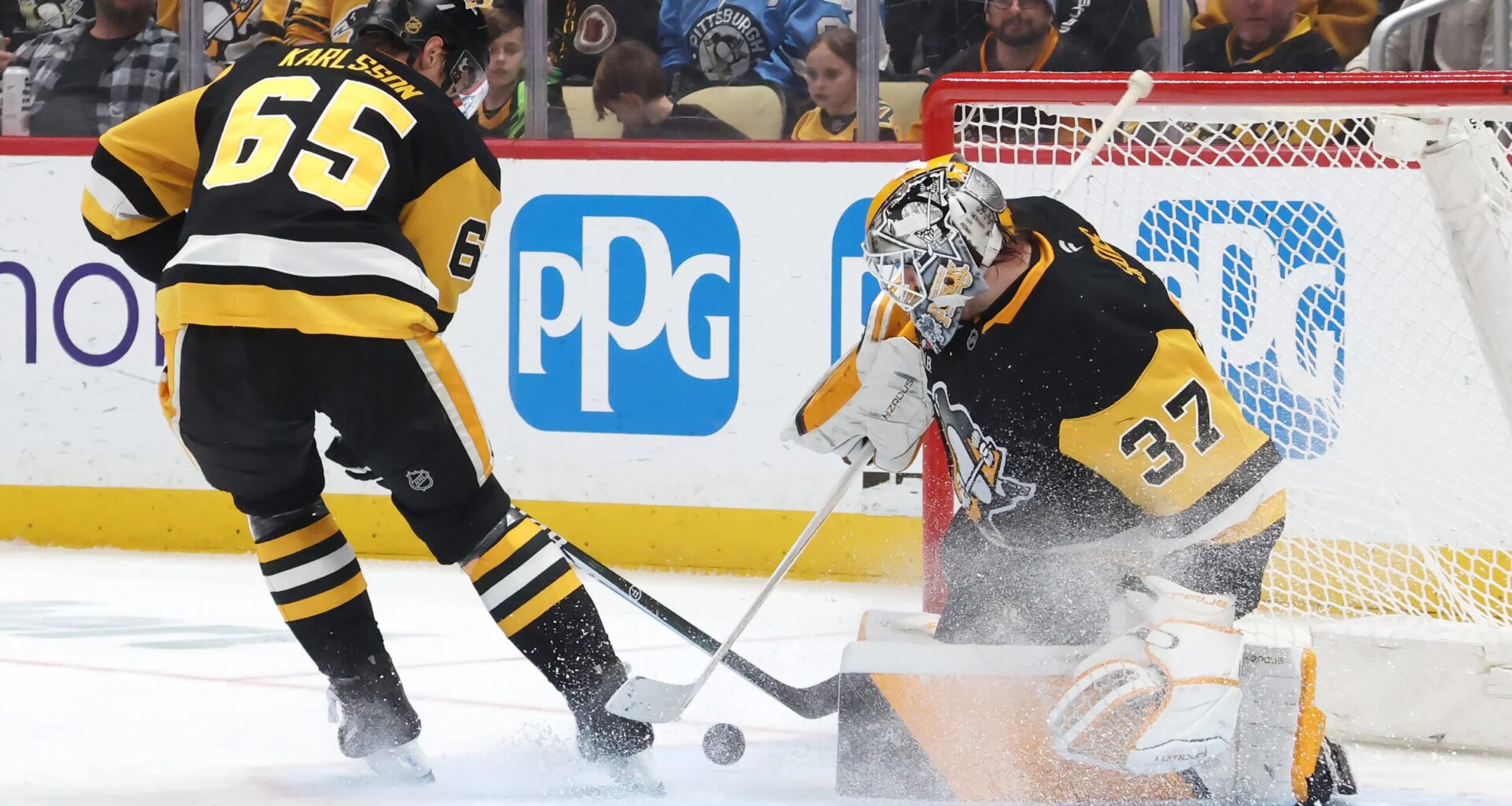
For the second time in a week, the Pittsburgh Penguins were the better team against the Colorado Avalanche, at least in the first period.
Unlike a week ago, the Penguins did not get the breaks or quick strike goals. Instead, Penguins goalie Arturs Silovs was soft in the first period, and a couple of Penguins’ coverages broke down, leading to three goals in 1:55. It also led to an early Penguins’ demise.
By the end of the first period, the Penguins trailed 4-1. By the end, it was a lifeless 5-2 loss to Colorado at PPG Paints Arena.
In the middle of the second period, the Penguins scored–or thought they scored–their second goal. But in the running season-long gag reel, the NHL situation room overturned the goal on what could only be described as another wildly confusing (or confused) goaltender interference.
While the Penguins have had far worse examples of interference upheld as goals, Colorado coach Jared Bednar, in his 10th season as Colorado’s head coach, got the break, and then the Penguins deflated like a week old Mylar birthday balloon.
The game went from 4-2 with a pending Penguins power play to 4-1 with the sign hanging above Dante’s vestibule to Hell, abandon hope all ye who enter.
Make no mistake, the Penguins deserved their 4-1 fate.
“It wasn’t our best structure that we’ve had, but it definitely felt like we had a lot of good looks, especially in the first period, and honestly throughout the whole game,” said Rickard Rakell. “But yeah, we’ve just got to bear down. And I mean, to beat this team, you’ve got to put the puck in the net.”
But they also deserved to be back in the game with a real chance to make it 4-3, too. The cascading losses mean the Penguins’ playoff cushion is gone. The first two teams out of the playoffs are one evening away from dropping the Penguins out of the playoff seeds.
The Ottawa Senators are just one point behind, and the Detroit Red Wings are two points behind. The loss also dropped the Penguins to third place in the Metro Division.
Goaltender Interference
Tuesday, by a very strict–but only a very strict–interpretation of the rulebook, a case could be made that Penguins winger Justin Brazeau interfered with Colorado goalie Scott Wedegewood. Brazeau did skate near the crease, and as defenseman Devon Toews contacted him, Brazeau contacted Wedgewood. Replays were clear that Toews made first contact and maintained physical contact toward the net.
By the overwhelming predominance of precedents this season, that’s a goal because the defenseman reasonably created the contact. While technically Brazeau’s skates entered the crease after contacting Toews, his skates did not contact Wedgewood, though he contacted the goalie … with help.
The overturn was just the latest moment of biting irony in the Penguins saga of GI calls. Last week, Muse, who is 0-for-8 on goaltender interference challenges, said he would keep challenging and use the rulebook–not the recent subjective nature of calls–as his guide. This time, it wasn’t the Penguins who challenged this one, which only deepened the irony.
A frustrated Penguins bench had to watch as their opponents got the call they’ve badly wanted or needed or deserved in several previous instances.
Postgame, Muse turned soft-spoken, the exasperation sitting like a stack of led weights on his shoulders as he looked down and shook his head in some effort to explain not just the call, but just the fallout.
“I mean, did it impact the game? Yeah. I mean, we could have…I felt like…it doesn’t matter what I felt. At the end of the day, we’ve got to respond,” said Muse. “I feel like if that goal goes in and we get a power play because they challenge. It could be very different. I felt differently than the league on that one, but that’s how it goes.”
Adding insult, the NHL broke its policy of upholding the call on the ice unless there was clear and irrefutable evidence to overturn. And even the NHL’s statement got the details wrong and omitted the contact by the defenseman, which has been a guidepost for previous rulings.
“Video review determined Pittsburgh’s Justin Brazeau contacted Scott Wedgewood in the crease and impaired his ability to play his position prior to the goal. The decision was made in accordance with Rule 69.1, which states in part, “Goals should be disallowed only if: (1) an attacking player, either by his positioning or by contact, impairs the goalkeeper’s ability to move freely within his crease or defend his goal.”
Don’t forget, on Saturday following an unsuccessful challenge in which Winnipeg Jets forward Morgan Barron’s goal was upheld after he bowled through defenseman Erik Karlsson, pushing him onto Silovs, the Penguins embarrassed the league. The team handed out a full page printout of the goalie interference rules to those in the press box. As the Penguins intended, the photos of it went viral, as the team also highlighted the part of the rule that most felt should have applied, but did not, in the challenge.
For extraordinary context, the league average for successful challenges overturning goals is 33%. Challenges against the Penguins are 80% (4-for-5) and the Penguins are 0.00%.
Tuesday, it surely seemed like the league sent its own little message with another call that defied all previous rulings.
The Penguins have their 2nd goal waved off for goaltender interference 😬 pic.twitter.com/aDAlZaJ8pv
— Gino Hard (@GinoHard_) March 25, 2026
The Penguins were never again in the game, including a following four-minute power play and a 5v3 power play early in the third.
Penguins Analysis
The Penguins were quite good in the first period. They had their legs and an energetic attack, which allowed them to control more territory, and they did so with aggressive intent.
The Penguins were playing well.
Tactically, their breakouts were on point. The third and fourth forwards were accessible to the defensemen who made the easy up-passes to generate speed out of the zone with pace.
Besides breakouts which eased pressure from the typically oppressive Colorado forecheck, the Penguins’ neutral zone puck support was tight and, to borrow Muse’s term, connected.
Short, little passes created controlled zone entries and offensive zone time. Oh, they had chances and more chances.
However, the Penguins’ undoing was … themselves.
“Yeah, the quality (gap) is too wide. Referencing a couple games ago, i’s just too loud. You know, it’s not chances to the outside, it’s plays into the slot. Guys are open there,” Muse said. “Some of them are on odd-man rushes, whether it’s breakaways or some of the other ones that we gave up tonight. And so we got to do a better job there in terms of cleaning that up. I think there’s some things that we’ll address. I thought you saw good signs, but this time of year, it’s not good enough.”
It was not the defensemen that put them in the first period hole, but some soft goals by Arturs Silovs. A long-range shot escaped the Penguins’ goalie, and he lost his angle on a tight wrister that capped three goals in 1:55.
Very quickly, a 1-1 game was 4-1.
The Penguins intermittently pressed in the final 40 minutes, but never had the same life as they did leading to the erased goal.
Penguins Report Card
Team: C
Rakell lamented the Penguins’ chances that they didn’t finish. Muse lamented the high volume of chances the team has been giving up. The team is unraveling at the worst possible time.
The Penguins lost their snap after the overturned goal. Their power play failed to generate momentum.
They played the best team in the league on Tuesday, but they had a genuine chance and opportunity to win. Their playoff hopes are quickly becoming perilous with 11 games remaining.
Best Performances
Egor Chinakhov: He played hard through the entire 60 minutes, even adding a physical component. He was dangerous in the offensive zone, though Colorado made a point to closely guard him.
Ben Kindel: He elevated his game and intensely attacked in the second period. As the Penguins floundered, he pushed. Kindel made a few strong dishes in the O-Zone and had a couple of high-danger scoring chances, too.
Noel Acciari: The Penguins’ fourth liner was notably present, retrieving several pucks in the offensive zone then turning them into scoring chances with deft passes.
Rough Games
Tommy Novak: The Penguins center is tailing off quickly with just one point in his last eight games. He made little impact on the game Tuesday and turned over a few possessions.
Ville Koivunen: Time is slipping away from the Penguins prospect. The team recalled him Tuesday, and he played on the third line with Kindel and Brazeau. However, he had zero shot attempts and was invisible. The Penguins need him to find his confidence quickly and play with the playmaking aplomb and physical edge he showed last season.
Arturs Silovs: Three of the five Colorado goals were stoppable, including all three of Colorado’s quick strike goals in 1:55. Sam Malinkski’s long-wrister was not deflected and made it 2-1. Silovs didn’t track the cross-ice pass to Martin Necas and was slow to the post on the goal that made it 3-1, and his shoulders were not square to the shooter, leaving a large amount of net for Parker Kelly.
Even the fifth goal was not his best, as he popped out a juicy rebound from a long-range shot at Necas’s feet late in the second.
Tags: Colorado Avalanche Penguins game Pittsburgh Penguins
Categorized:Penguins Analysis