
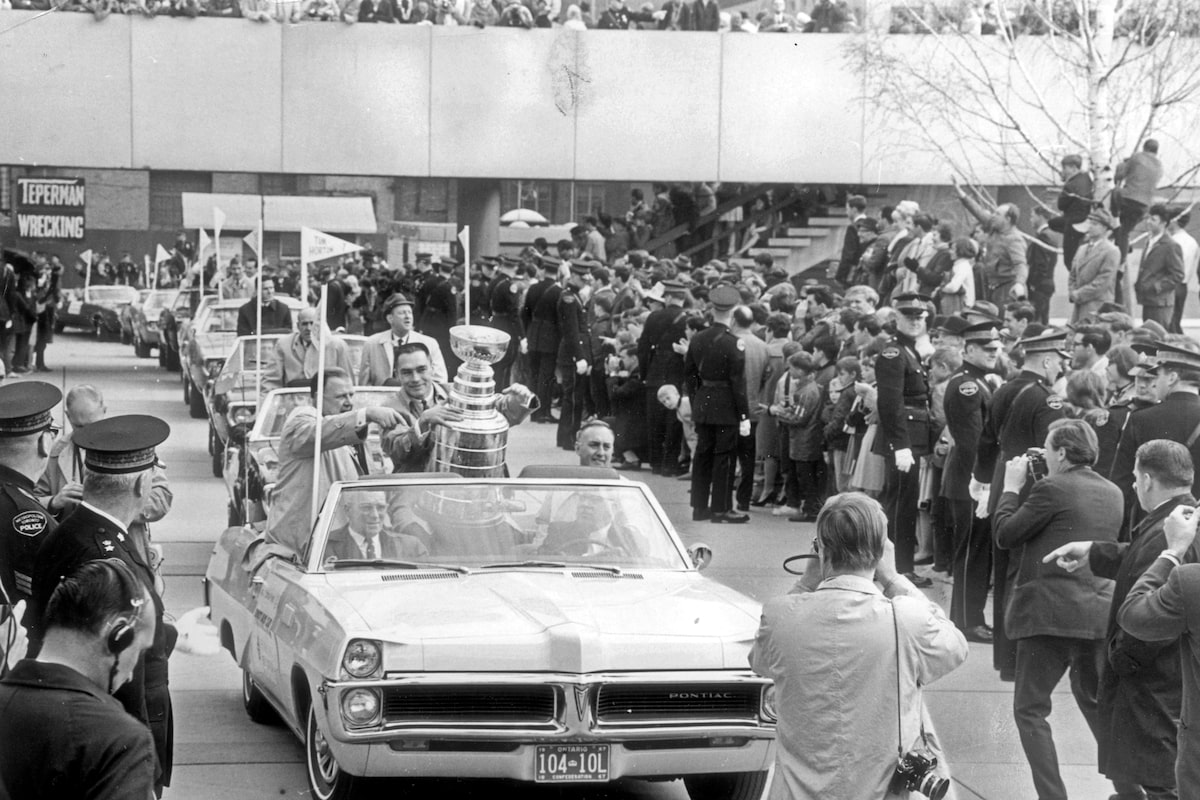
Toronto Maple Leafs captain George Armstrong carries the Stanley Cup as the victory parade reaches Toronto City Hall on May 5, 1967. Seated to his right is Harold Ballard, a Maple Leaf Gardens executive who would go on to become team owner and, some will insist, bringer of the curse that has prevented the Leafs from winning another championship.Harold Robinson/The Globe and Mail
David Macfarlane’s most recent book is On Sports.
A disappointment of Maple Leafs is a collective noun of local origin that describes a phenomenon that is entirely unanticipated and drearily regular. How so? Nobody knows. Why does it snow every April in Toronto even though everybody in Toronto swears it never snows, in April, in Toronto?
This misalignment of facts and hope is a duplicity to which Toronto Maple Leafs fans are understandably prone. Who can blame them? It’s been (checks notes) 59 years since the team won the Stanley Cup. Even by Metrolinx standards, that’s a long time for a city to wait. And not that I wish to appear impatient, but if there is no rational explanation for the Leafs being in the cellar in the Atlantic Division in 2026, and if fans have gone from being really worried to being really angry (again), perhaps an irrational explanation should be considered. Maybe it’s time to face the possibility that there really is a curse.
Toronto has not won the championship since Elvis married Priscilla. And in case you’ve lost track, Elvis is a great-grandfather now, posthumously speaking. The nasty cloud of bad hockey karma that is currently over Toronto has been in the air for a long time – so long you have to think there’s a reason.
Cathal Kelly: Half-hearted Maple Leafs commit to the tank. For now
From decade to decade, and from generation unto generation, Toronto has faced no apparent impediment to hockey success. There is money here. There’s media. There are ad firms, and sports bars, and the $25 admission to the Hockey Hall of Fame. There’s the mythology of the Maple Leafs. There’s even ice. Unlike many cities in the NHL, Toronto actually undergoes the classic, old-fashioned winters that hockey rinks evoke. As hockey cities go, Toronto is out of central casting.
But something always gets in the way of the playoffs and cups and victory parades. Something stops the teams that have been very good, just as something stops teams that have not. Great players and mediocrities alike have been stymied. Toronto fans will tell you why. They are cursed.
The space between superstition and rationality is most naturally occupied by gamblers, actors, sports fans and athletes. Superstition is not only tolerated in these activities, it’s widely practised at the highest professional level. The prominent, semi-official role of object worship, ritual incantation and prayerful offering in professional sports stands in contrast, one hopes, to the role of magic wands and lucky underwear in disciplines such as cardiology or structural engineering.
Cathal Kelly: Leafs should trade Matthews, but their addiction to being a contender means they won’t
This may be because sports fans, being intelligent and complex souls, are adept at holding to a central contradiction: that winning a game is all-important and that it’s not important at all because it’s just a game. Into this paradox, like fog in horror movies, seep jinxes and omens and auguries and fate. Ooga-booga, as a friend of mine likes to say.
Skipping religion (a big skip, I admit), sports are among the last misty peaks of superstition poking above the dull grey flood waters of rationalism. In what other multibillion-dollar industry are talismans given such credibility? Trophies fetishized? Good luck rituals honoured? Heroes worshipped? Curses flung down? From on high. Like lightning bolts.
There should be a reason for a curse, although it’s not really a requirement in sports. The bar owner who put a curse on the Chicago Cubs in 1945 (it lasted until 2016) didn’t have a very convincing gripe. He was ordered to leave a ball game at Wrigley Field because the people in the seats around him objected to the smell of his goat. Not an unreasonable complaint, you’d think.
In 2004, led by slugger David Ortiz, the Boston Red Sox found a way to overcome the 86-year-long Curse of the Bambino triggered, some say, by the sale of Babe Ruth to the Yankees.BARRY CHIN/The New York Times
Other curses are more justified, as curses go. Boston Red Sox owner Harry Frazee selling Babe Ruth to the New York Yankees put the kibosh on Boston championships for more than eight decades; a municipal stadium that was built in Birmingham in 1906 on land used by Romani people resulted in a blast of evil eye on the local football club that lasted a century; in 1969, the Australian national men’s soccer team hired a shaman to put a hex on their opposition. It seemed to work. Until they stiffed the shaman.
Throughout the years of Maple Leafs woe, season by lacklustre season, with defeat snatched from the jaws of victory time and time again, the black-and-white photos of the 1967 victory parade became steadily more antique-looking: crew cuts like astronauts and convertibles the size of troop carriers. As anyone who was alive then can tell you, 1967 wasn’t yesterday. How long can this keep going on?
I have two friends who have been Maple Leafs fans far longer than any current Leaf has been alive, and my friends are among those who believe a curse – a bona fide hex – has played a role in the history of the team. They are perfectly reasonable fellows, neither overtly religious nor made anxious by ladders or by cracks in the sidewalk. But when they talk about the Leafs, the word “curse” comes up frequently. There have been occasions – around game seven, usually – when there does seem to be no other explanation.
My non-superstitious friends are surprisingly superstitious about the cause of this malocchio. They blame the awfulness of Harold Ballard (co-owner of the Toronto Maple Leafs from 1961 to 1972 and then sole owner until 1990) for everything. Every catastrophic deflection. Every unlucky bounce of the puck. Every latest injury, new coach, old general manager, benched goalie, fumbled trade. Every doomed season. Crazy, huh? But having once interviewed Harold Ballard in the creepy pad he kept in Maple Leaf Gardens, I’m inclined to think my friends are right.
“Zeus set an evil lot upon us all, to make us topics of a singer’s tale for people in the future still unborn.” This comes from Emily Wilson’s majestic translation of The Iliad. And while my friends, of a less classical bent than I am, don’t exactly picture an Olympian god hurling thunderbolts of game seven collapses on poor, innocent Toronto, they do believe that there are villainous legacies that can reach into the future like a racehorse’s bloodline. Like a bad smell that lingers. And lingers. There are people (perhaps someone comes to mind) whose awfulness is so awful it continues long after they’re gone.
Are we out of the woods? Based on my impression of the late Mr. Ballard, I think not. But stick around. One of these years the Maple Leafs will get lucky again. It’s bound to happen. Fingers crossed.