
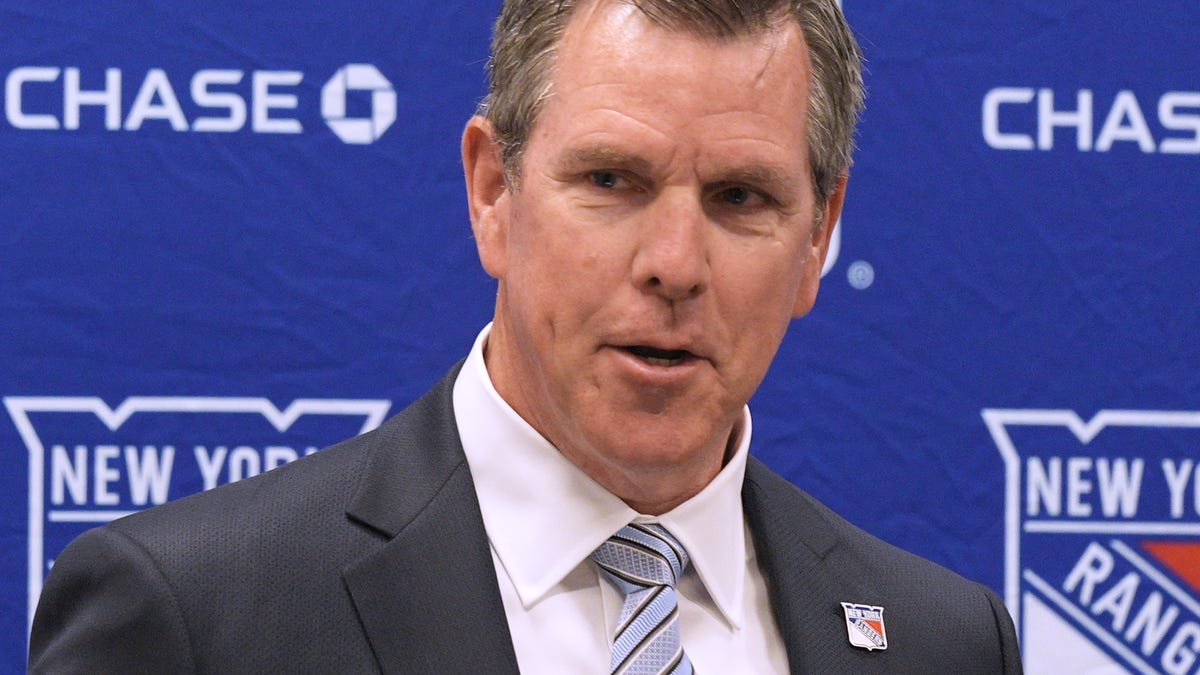


NY Rangers head coach Mike Sullivan introduced in Tarrytown
Rangers head coach Mike Sullivan is introduced during a press conference at the MSG Training Center in Tarrytown, New York, May 8, 2025.
It was late June of 2006 and 38-year-old Mike Sullivan was days away from being fired from his first NHL head coaching gig with the Boston Bruins.
The uncertainty surrounding his job status must have felt all-consuming as he boarded a flight to Vancouver for that year’s draft, but that didn’t stop then-Carolina Hurricanes executive Jim Rutherford from extending a comforting hand.
“I was going down the aisle, passing by – and I think he knew what was going to happen, but he was still waiting to hear from the Bruins – and I introduced myself,” Rutherford said by phone on May 28. “I said, ‘Mike, for what it’s worth, I really thought that you’ve done a really good job in Boston.’”
Sullivan would spend the next nine-and-a-half seasons bouncing around with five different organizations and working his way back up in various coaching capacities. Rutherford would later transition from Carolina to Pittsburgh, where he inherited a talented Penguins team that was struggling to fulfill their promise in the wake of a 2009 championship.
Nearly a decade after their brief-but-meaningful introduction, the two would meet again and make hockey history. Rutherford backed up his words of confidence by giving Sullivan his second chance as an NHL head coach in 2015, resulting in back-to-back Stanley Cups and a 10-year run in Pittsburgh that left Sullivan as the winningest coach in franchise history.
That tenure finally came to an end April 28, with current Pens general manager Kyle Dubas opting to let Sullivan go and rebuild an aging roster following three straight seasons of missing the playoffs. But the 57-year-old was in a much stronger position to rebound this time around. Sullivan immediately became the most coveted bench boss on the market and accepted an offer from the New York Rangers that reportedly made him the highest-paid coach in league history.
As he embarks on this next chapter, those who have worked with and played for Sullivan over the years detailed his rise to become one of the NHL’s premier coaches to lohud.com, part of the USA TODAY Network.
“He’s very smart, he’s a great communicator, and he understands the game,” said Rutherford, who now serves as the Vancouver Canucks’ president of hockey operations. “But more importantly, he understands people. He’s almost like a sports psychologist in a lot of ways, and he’s willing to learn all the time.”
‘A terrific leader’
In 40 seasons as head coach at Boston University, Jack Parker had one overarching philosophy when it came to player recruitment.
“I used to tell my assistants this all the time, ‘When you’re recruiting somebody, make sure you talk to the parents, because most of the time the kid’s not going to tell you who he really is,’” the retired 80-year-old said by phone on May 21. “But when you talk to the old man, you get a feel for who he is.”
“If the father is a mook, you probably don’t want the kid,” Parker added with his thick New England accent and a chuckle.
That rule certainly applied in the mid-1980s, when he was drawn to a Boston College High School standout and made a point of meeting his parents, George and Myrna Sullivan.
“I thought they were fabulous people,” Parker recalled. “And Mike was great. I already liked him because of his hockey. Now I could tell this was a kid you really wanted in your dressing room, representing your team, etc. He was everything and more in that regard.
“The thing that stuck with me was their sincerity.”
It didn’t take long to recognize how well Sullivan’s parents had ingrained that trait in their son, who came to be what Parker described as “one of the best captains we’ve ever had, no question.”
In a bit of foreshadowing, Sullivan was selected by the Rangers with pick No. 69 overall in the fourth round of the 1987 NHL Draft following his freshman season. But he was committed to seeing things through at BU and chose to stay in school for three more years.
Parker recalled Sullivan’s intense training aimed at improving his skating, which had been a knock during the recruiting process but developed into a strength. That was a critical piece in preparing the Marshfield, Mass. native to eventually make the jump to the pros, but Parker also observed a selfless, team-first attitude that would shape Sullivan’s coaching future.
“He was fairly vocal in the dressing room, but also a quiet leader individually with the younger players. Sometimes I’d have to get on somebody, and you’d see him talking to them afterwards,” he said. “He was devoid of ego. He didn’t think about, ‘Do you know who I am now? I don’t have to worry about that little stuff.’ He was willing to get better all the time, and he certainly did. And he was a terrific leader.”
A winding path
After completing his senior season, Sullivan signed with the San Jose Sharks and played 11 NHL seasons with four different teams. He was never a star, with a modest 136 points (54 goals and 82 assists) across 709 career games. But he was valued as a hard-working, defensively responsible center with a keen understanding of the game.
“Mike Sullivan had what I referred to as ‘Larry Bird court sense,'” Parker said. “He knew what was going on out there. He knew where everybody was. He had court sense on the defensive end, as well. It wasn’t just from the red line in. He was a really, really smart player in all three zones – playing power play, killing penalties, taking a big faceoff, all that type of stuff.”
Sullivan’s high hockey IQ, coupled with the leadership skills he honed at BU, put him on the coaching fast track after his final season as a player in 2001-02.
He spent his first year after retirement as the head coach of the Providence Bruins in the American Hockey League and was promoted to lead the NHL Bruins the very next season at the age of 35. Year 1 was a success, with the 2003-04 Bruins racking up 104 points while winning the Northeast Division. But a lockout wiped out the 2004-05 season and the team missed the playoffs entirely when play resumed in 2005-06.
Boston ownership responded by firing the GM who hired Sullivan − Mike O’Connell − which led to an inevitable change behind the bench, as well. A rapid rise had fizzled quickly, sending Sullivan down a winding path that included stints as a player development coach, AHL head coach and NHL assistant, most notably with the Rangers under John Tortorella from 2009-13.
He was eventually tapped to coach the Penguins’ AHL affiliate in Wilkes-Barre/Scranton in 2015, setting the stage for a successful jump back to the highest level. Rutherford credited former assistant and current Seattle Kraken GM Jason Botterill for picking out Sullivan among the finalists, but they were both convinced they had someone ready to assume the reins with the big club, if needed.
“When we talked and set the criteria, one of the things that we talked about was, ‘Let’s hire somebody that’s capable of being an NHL coach,'” Rutherford said.
That moment came just six months later, when Mike Johnston was fired 28 games into the 2015-16 season and Sullivan was charged with taking over a star-studded roster amid a seven-year championship drought.
‘Clear and concise’ communication
Jacques Martin was an assistant on that 2015-16 staff and vividly recalls Sullivan’s first address to the team.
His message got right to the point: The Penguins could not win on talent alone. Instead, they must embrace a collective approach to get back on top.
“He talked about the importance of having star players, because we did have star players in (Sidney) Crosby and (Evgeni) Malkin and (Kris) Letang, but also the importance of having a team,” said Martin, who would spend the next five seasons coaching defensemen and penalty kill under Sullivan. “You need to have star players, but you need to play as a team. It’s always kind of stuck with me.”
That speech seemed to awaken a sleeping giant and set the tone for back-to-back Stanley Cup runs in Sullivan’s first two seasons.
Their success was rooted in direct, honest communication that ensured every member of the team knew what was expected of them, with Martin pointing to three keys that made Sullivan effective in that regard.
“No. 1, he has a presence in the dressing room,” he said. “No. 2, I think he’s very clear and precise in his explanation of systems and feedback and details of the game that you need to play with in order to be a winning team. He communicates that information very (well). I find that his meetings are very effective. And then I think the fact that he takes the time to make sure that everybody on the team is communicated with, whether it’s through him or through his assistant coaches.”
Each day began with a coaches’ meeting, with every member of the staff assigned to speak to a handful of players and relay specific talking points. Sullivan would take “four or five” himself and carve out time to chat with them individually.
Players relished those give-and-take conversations as a chance to voice their concerns and receive constructive feedback.
“One of the things that I tell people that I like the best about Mike is when he has those one-on-one meetings with the players,” Rutherford said. “You have a player that feels very strong about their position, and of course, a coach that feels very strong. And he’ll let that player talk and talk and talk through why the player feels he’s right. And even if Sully doesn’t agree with the player, he’ll always say to them, ‘Just meet me halfway. I’m going to meet you halfway here.’
“The player leaves that meeting knowing that the coach listened to him and that there’s a chance that the coach is going to move his way a little bit. That was so impressive to me, and I think it’s really impressive to the players, because the players know that the coach respects them.”
Defenseman Chad Ruhwedel arrived in 2016, where he would earn a ring as part of the 2016-17 championship squad and spend the next eight seasons. Only Crosby, Malkin, Letang and a couple others logged as many years playing for Sullivan.
Ruhwedel’s experience was unique because unlike those future Hall of Famers, he entered every season with no assurances about ice time. Yet, he rarely grew frustrated with his situation because Sullivan took the time to develop a relationship and explain his decisions.
“When there’s a lack of communication, it leaves you wondering why,” Ruhwedel said. “It leaves the player running every scenario, every shift, every play he had in the last game through his mind, wondering why he got taken out.”
“I was definitely in and out of the lineup – in the lineup more so at certain times; definitely more towards the end of my time there – and we had plenty of meetings,” he added. “He respected me as a person, as a player. When I was doing my job right, he tried to get the most out of that and tried to play me to those abilities.”
‘Forwards drive the bus’
Under Sullivan, the Penguins’ coaching staff started a tradition of going away together before the start of training camp.
They’d stay at a resort for three or four days to bond and play a few rounds of golf, but much of their time was devoted to prepping for the new season. That included reviewing film of opposing teams who finished top five the previous season in power play and penalty kill to see if there were strategies they could pull from, as well as internal reviews that coaches were asked to prepare in advance.
“Each coach had some assignment, had some presentations to do, and then we’d have some discussions as a coaching staff – not just the NHL, but the American League coaches and the East Coast League coaches, as well,” Martin said. “Everybody was involved and had a chance to give their input before we decided on exactly what would be the system or the strategy that we wanted to deploy.”
That analysis would generally lead to what Martin described as “adaptations” based on trends and personnel, but the principles of Sullivan’s system remained consistent throughout his 10 seasons in Pittsburgh.
“I would categorize Mike as a very aggressive coach – a coach that likes to play like a fast game, a high-tempo game, and likes to employ a lot of pressure, whether it’s in the offensive zone or neutral zone or defensive zone,” Martin said. “It’s not a sit-back system.”
It starts with a 1-2-2 forecheck that many teams employ, but Sullivan’s is considered more nuanced than most.
The aim is to apply waves of pressure through a layered approach that requires all five skaters to react and support. If the leading forechecker − the “F1,” as they’re commonly referred to − gets beat, it’s incumbent on the forwards at the next level to aggressively fill gaps.
Even when F1 is well-positioned and on top of the play, F2 and F3 aren’t sitting back in the neutral zone. They’re tasked with pressing ahead, identifying a man to cover and taking away passing options. If one isn’t hustling or loses positioning, the whole structure can easily crumble and leave gaping holes for the opposition to exploit.
Defensemen are also expected to push forward and deny easy entries at the defensive blue line, but as Ruhwedel put it, “the forwards drive the bus.”
“When the forwards are skating, moving, forechecking, it makes life on everybody – including themselves – much easier,” he said. “When you forecheck hard, the other team can’t forecheck you hard, so your breakouts are then easier. When they’re skating and turning pucks over, it allows the defensemen to get up into the rush and get in on the forecheck down the walls.”
The goal is to swarm opposing teams and force them into mistakes that swing possession and fuel a strong transition game. The resulting odd-man rushes will lead to more high-danger scoring chances, which has become the ultimate stat for predicting success.
“That’s what you live by,” Ruhwedel said. “If the team gets X amount of odd-man rushes per game, it can be a pretty strong tell as to what the outcome is going to be. … Our offense was just flourishing because of those opportunities.”
Sullivan also emphasizes quick puck movement on breakouts and prefers zone coverage on defense. That should be a welcome change after the Rangers struggled mightily with previous coach Peter Laviolette’s man-to-man scheme and allowed the fifth-most HD chances in the league, according to Clear Sight Analytics.
Ruhwedel described a structured, connected system that won’t leave defenders on an island and should cut down on the glaring D-zone breakdowns that plagued New York last season.
“You’ve got to win your one-on-one battles, but we usually have layers of support,” he said. “So, if it’s a defenseman going into the corner, the center is backing them up, potentially looking for a chance to double up on the forward before they make a play. If the puck goes low to high and there’s going to be a point shot, that’s the only time it’s a brief man-on-man. You get your guy, tie up his stick, and don’t let him get to the net or tip pucks. It’s a form of zone or quadrant defending. It’s not man-on-man where you just follow your guy around the ice.”
Coaching alone won’t be enough to plug all of the Rangers’ defensive holes, putting the onus on team president Chris Drury to add roster pieces who fit Sullivan’s style of play. But at the very least, his systemic changes could cover up some of the Blueshirts’ warts − much like they did when he first took over in Pittsburgh.
“The up-tempo game of our offense offset any shortcomings we may have had on defense,” Rutherford said. “We played the game in the offensive zone most of the night, which relieves a lot of pressure on the defensive side of the game.”
‘It’s about winning’
Crosby was already considered the greatest player of his generation when Sullivan showed up, but he would finish in the top 10 for the Selke Trophy, awarded to the NHL’s best defensive forward, in each of the next four seasons.
Rutherford credited the coach for not only pushing his best player to bear down, but presenting it in a way that appealed to No. 87’s interests.
“It’s about winning championships for (Crosby),” Rutherford explained. “He recognized through talking to Mike that playing a full, 200-foot game – an all-around game – gave the Penguins a better chance to win the Stanley Cup. That’s where his game went to. … It’s not that he wasn’t playing it before, but I think he was more aware of playing the all-around game under Mike. And then, of course, you saw what happened. It was two Stanley Cups.”
If Crosby was willing to do the dirty work, no one else had any excuses. From the top to the bottom, the Penguins of the mid-to-late 2010s recognized their identity and embraced what it took to achieve it.
The question is, can Sullivan have a similar influence on the top players in New York?
Multiple coaches have tried, with fleeting results. None have been able to get Adam Fox, Artemi Panarin, Mika Zibanejad and a host of others to forecheck, defend and attack the high-danger areas with enough consistency. A stubborn core eventually tuned each of them out, with the low point coming this past season and costing Laviolette his job.
There’s a long list of reasons to doubt whether any coach can overcome the flaws that have been exposed − but if anyone can do it, Parker believes it’s Sullivan.
“Mike has the philosophy of, ‘Don’t try to get noticed out there. Try to do the right thing,'” said Sullivan’s mentor, who noted they still talk several times a year. “When you go out there trying to get noticed, you get noticed the wrong way. But when you go out there and play the right way, everyone will notice you because you have talent.”
“When they’re coming up on the attacking blue line, if it’s a three-on-two, make a play,” Parker added. “But if it’s not a three-on-two – if it’s three-on-three, or if it’s a three-on-four or two-on-four – dump it in and go forecheck. Go pound them. Mike has had some terrific players on his teams, obviously, that can create things on their own. But he also got them to realize that sometimes, there’s nothing to create. You gotta make the plays behind the defensemen, not in front of them. I always thought he carried that on from his days in college hockey, and he always got them to buy into that.”
He accomplished that, according to Martin, by making sure players knew “they had a voice and they had some input on a lot of the decisions.” Once those collaborative lines of communication were established, everyone took ownership of the message.
It’s a fairly simple concept, but it requires the right voice − and an active listener − to truly make it stick.
“It goes back to the sincerity of the mother and father that jumped out at me,” Parker said. “Players recognize that Mike is sincerely trying to make them better. Sometimes he’s going to tell you stuff to sincerely try and make you better that you don’t want to hear. But you’ve got to listen and take it to heart. I think players at any level can see through guys that are being phonies. Mike is sincere. ‘This is the way it is. This is what I expect from you – and you’ll get plenty of ice time if you do that.’”
Vincent Z. Mercogliano is the New York Rangers beat reporter for the USA TODAY Network. Read more of his work at lohud.com/sports/rangers/ and follow him on Twitter @vzmercogliano.