
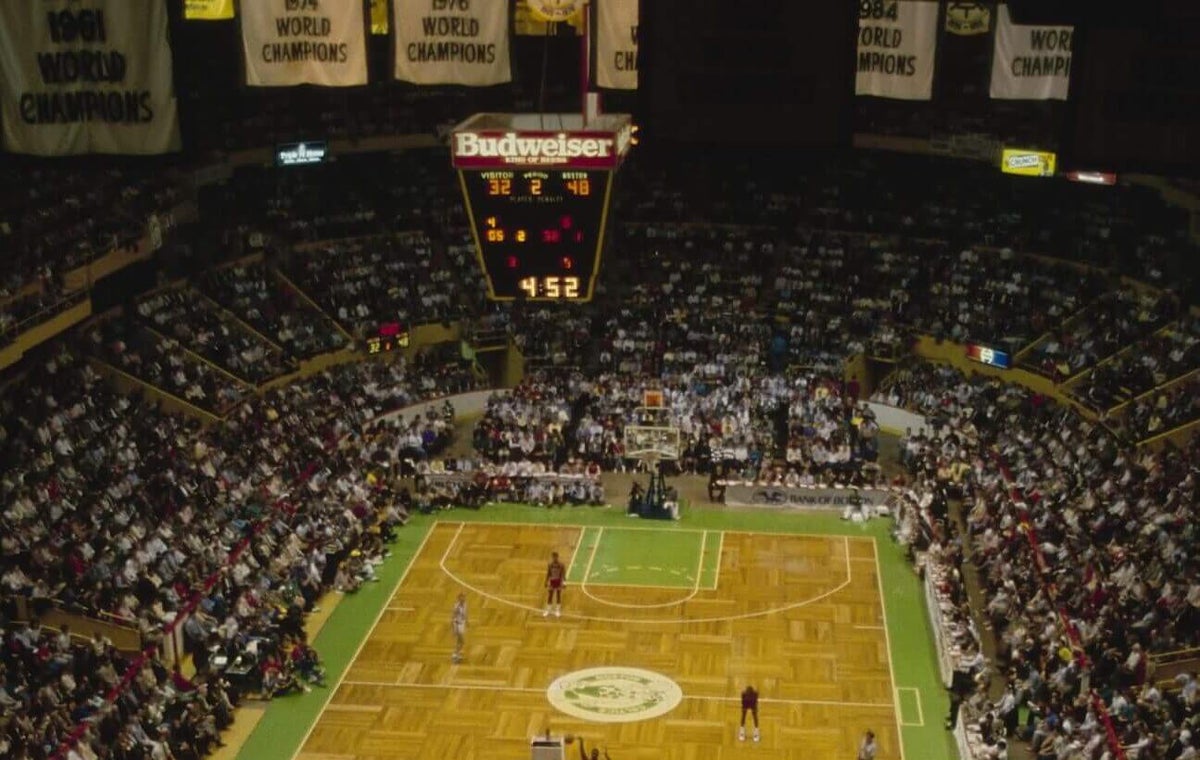
BOSTON — Perhaps you were at Boston Garden on the muggy Mother’s Day afternoon of May 10, 1970. That was the day Bobby Orr flew through the air after scoring the overtime goal that completed the Boston Bruins’ four-game sweep of the St. Louis Blues in the Stanley Cup Final.
Maybe you were there on May 3, 1969, when the Boston Celtics emerged with a 99-90 victory over the Los Angeles Lakers in Game 6 of the NBA Finals. In addition to it being the send-off to the Celtics’ championship-clinching victory over the Lakers in Game 7 two days later in Los Angeles, Game 6 was also the last time the great Bill Russell played at the Garden.
How about the night Raymond Bourque pulled off his No. 7 Bruins sweater during a pregame ceremony and presented it to Phil Esposito?
I wasn’t there for any of those events. And whether or not you were there, what matters for this discussion is that the old Boston Garden scoreboard — a sort of inverted triangle, all black save for the gold trim — was there for all of it, and so much more.
Circuses. Rock concerts. Beanpots. Suspended high over center court or center ice, the old Garden scoreboard was a product of its time, a four-sided, no-frills box of bulbs that displayed the score, time remaining, player scoring, and, for hockey games, which miscreants were sitting out penalties.
“That scoreboard was all we needed in those days,” said Richard Johnson, the longtime curator of The Sports Museum. “We didn’t need no Jumbotron back then. People just watched the game, and the scoreboard told us the score.”
Built by the Toronto-based Day Industries and installed sometime in 1967 — more about that later — it remained at its post until the old Garden closed in 1995.
When the new Garden opened next door, originally called the Fleet Center and now doing business as TD Garden (also home to The Sports Museum), it brought a new scoreboard.
You’d think the scoreboard from the old Garden would be on permanent display at the new Garden. It’s not. Or in a museum, perhaps. How about the Isabella Stewart Gardner Museum? Nobody’s suggesting it would have been a suitable replacement for those Rembrandts, Vermeers and Manets that were brazenly stolen in 1990, but we can agree on this: The old Boston Garden scoreboard was one fine piece of art.
Alas, most of what’s left of the old Garden scoreboard sits upside-down on a platform outside a warehouse south of Boston, closer to Gillette Stadium than TD Garden. Thankfully, one of its sides has been removed and rehabbed, and it will live happily ever after on a wall inside the Ink Block complex in Boston’s South End, the site of the old Boston Herald building. Passersby can see it from outside. The address is 217 Albany Street, but for marketing purposes, it goes by 7 Ink, because, I’m guessing, street addresses are so 20th century.
What remains at the warehouse is literally a shell of its former self. With its various bulbs, circuits and wiring having been removed, it only looks like the scoreboard from the old Boston Garden if you show up there looking for the scoreboard from the old Boston Garden.
When I got a look at it a while back, I immediately found myself thinking about the Tin Man from “The Wizard of Oz,” and how the Wizard mocked him as a “clinking, clanking, clattering collection of caliginous junk!”
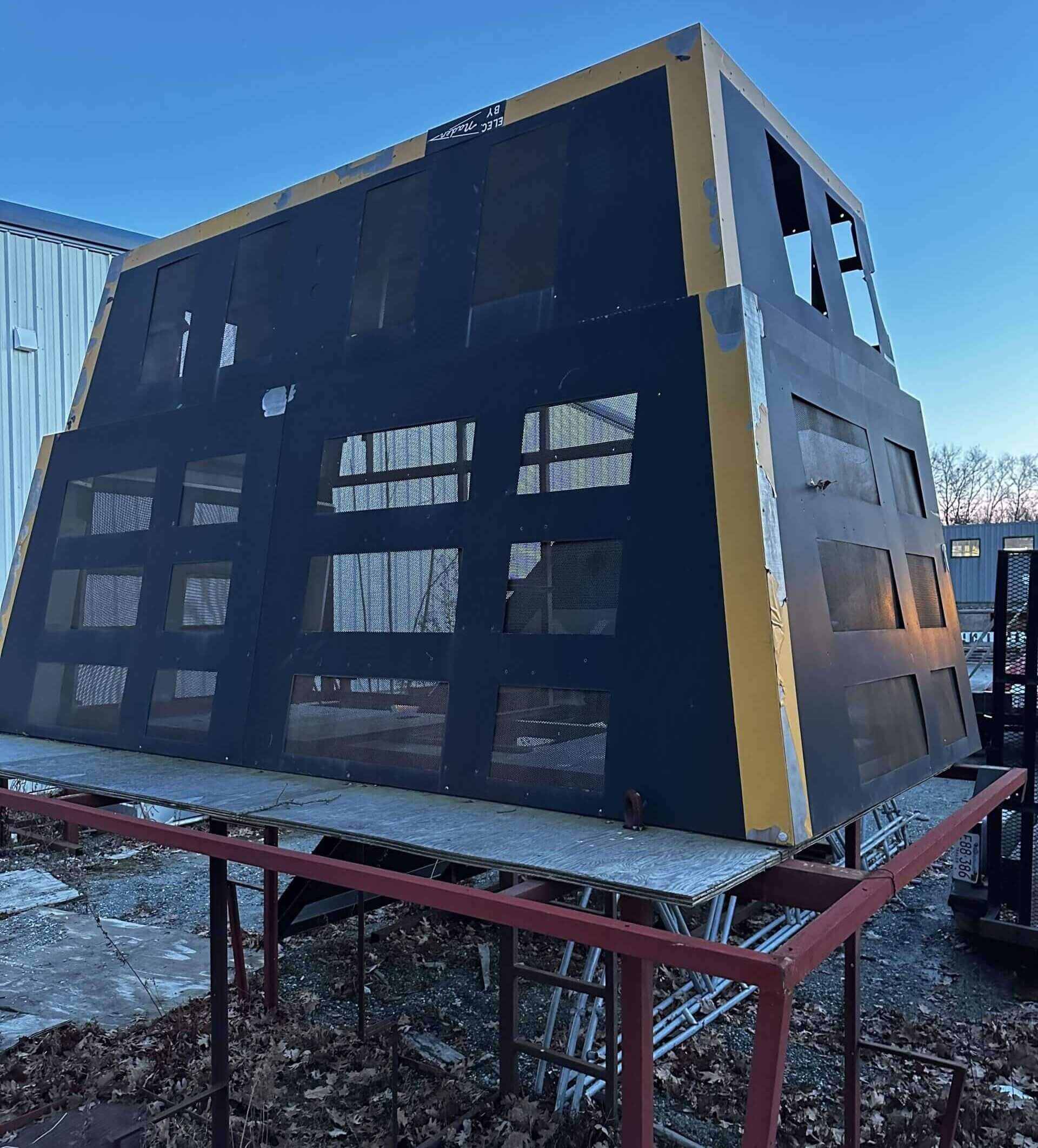
The original scoreboard sits upside down on a platform outside a warehouse south of Boston, with its bulbs, circuits and wiring removed. (Courtesy of Ted Tye)
Can the old scoreboard be saved in some fashion? Here’s the good news: Boston developer Ted Tye, who a decade ago rescued it from the wrecking ball and later preserved the piece on display at 217 Albany Street (er, 7 Ink), is open to suggestions.
Tye, 69, was a huge Celtics fan growing up in Haverhill, Mass., and is a former co-owner of the Maine Red Claws, the Celtics’ NBA G League affiliate. He’s also a fan of the basketball teams at Tufts University, his alma mater. A great, big fan: The Tufts men’s and women’s basketball teams play their home games at what is now known as Tye Court.
However, beyond making the remnants available to any responsible person or group willing to restore it to its former glory, Tye figures he did his part by saving the piece at 7 Ink.
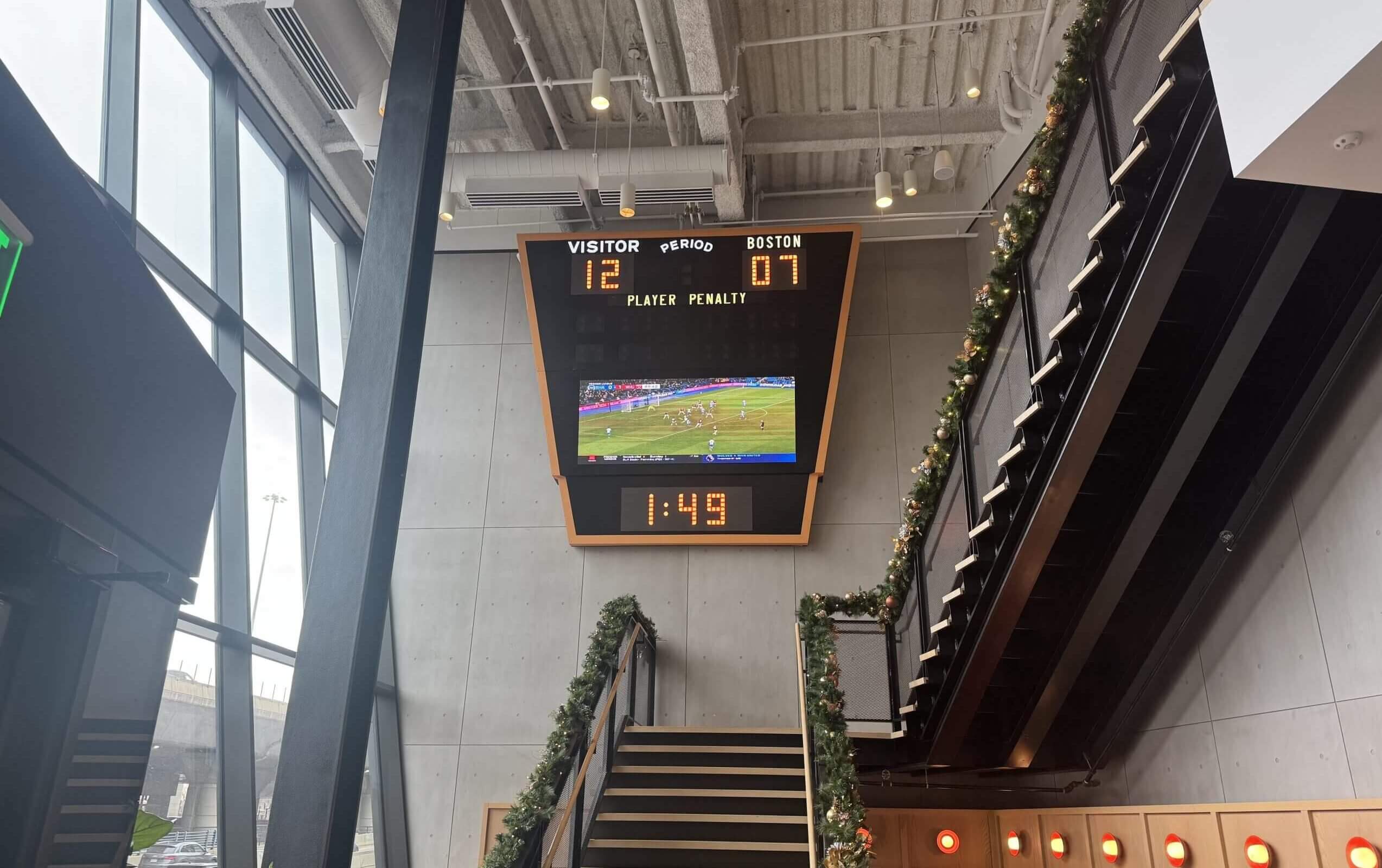
One of the old scoreboard’s sides has been removed and rehabbed and hangs on a wall inside the Ink Block complex in Boston’s South End, where passersby can see it from outside. (Steve Buckley / The Athletic)
Tye has listened to all kinds of well-intentioned ideas, such as installing it at the Tye Court inside the ancient Cousens Gym at Tufts University.
Opened in 1932, Cousens is a handsome, rustic place that drips with history: The Boston Red Sox held spring training in the field house during World War II, and the Cincinnati Reds used it for batting practice when the 1975 World Series was delayed several days by rain. But the old scoreboard, at some 12 to 15 feet tall, depending on whether advertising panels are included, would be too big for the smallish, old-timey college basketball arena at Cousens.
Enter Ben Bouma, 53, a Weston, Mass., native and longtime television producer and statistician for NHL, NFL and MLB games. He’s a sports nut who works in sports, and he says he’s about to embark on a quest to raise money to rebuild the scoreboard.
“As a longtime Bruins fan, and being around the NHL, I’ve basically spent my entire life keeping score in almost every single role I’ve had,” Bouma said. “Spending some time last year at the Hockey Hall of Fame, a lightbulb went on: Where did this thing go? That scoreboard probably took care of more points and more goals than any scoreboard ever in the history of the world when you look back at the Celtics and Bruins.”
But even if it was restored, where would it go?
“It’s the chicken and the egg,” Bouma said. “Let’s get it fixed and done and see if we can find a good spot rather than chase after the place and then get it done. Sometimes people want to see a finished product first.”
Some free advice for Bouma or anyone considering such a project: It will be no easy task. That’s the opinion of Chuck Hurley, 78, who, as a 34-year-old in 1981, was hired by the Garden to transform the scoreboard from mechanical to solid state. What’s needed now, he said, is “a total rebuild.” And Hurley’s retired now, both from his scoreboard business and his longtime day job, teaching math at Oliver Ames High School.
“My heyday was working on it when it was at the Garden, and that’s how I want to remember it,” Hurley said. “I spent six days inside the scoreboard, which had been lowered to the Garden floor. I’d drive my car right out to the floor and then go into the scoreboard through a trap door at the bottom.
“It was a big experience for a kid my age who didn’t have a lot of experience working with that kind of stuff. When I got done, it was a personal achievement for me.”
The scoreboard debuted sometime in late 1967, though the exact date is unclear. Columnist Ray Fitzgerald of The Boston Globe mentioned its arrival in an Oct. 28, 1967, notes column: “Visiting athletes to the Garden will no longer commit mathematical hari-kari trying to figure out the time on the center court clock … a new clock and scoreboard will be installed Monday, and down will come the old sweep-hand edition … the new job will click off time electronically by seconds.”
The last event held at the old Boston Garden was a preseason game between the Bruins and Montreal Canadiens on Sept. 26, 1995. It wasn’t until early 1998 that the arena was torn down, but thousands of items from the old building had already been auctioned off. The big prize was the scoreboard, which in December 1996 was scooped up for $40,000 by billionaire developer Stephen Karp, chairman of New England Development.
The scoreboard’s new home was in nearby Watertown at the Arsenal Mall, owned by New England Development. Where once the scoreboard resided “high above courtside,” to borrow a familiar phrase from the late, legendary Boston Celtics broadcaster Johnny Most, now it was high above a food court.
It was noted at the time that sentimentality played a role in the purchase, given that Karp rooted for Boston’s sports teams growing up in nearby Medford. But Karp says that commercial appeal played a big role.
“I was in the shopping center business, and I was redoing the Arsenal in Watertown,” Karp told me during a telephone interview. “Obviously, being a fan and everything was one reason. But I had a business reason where it made sense to do it.”
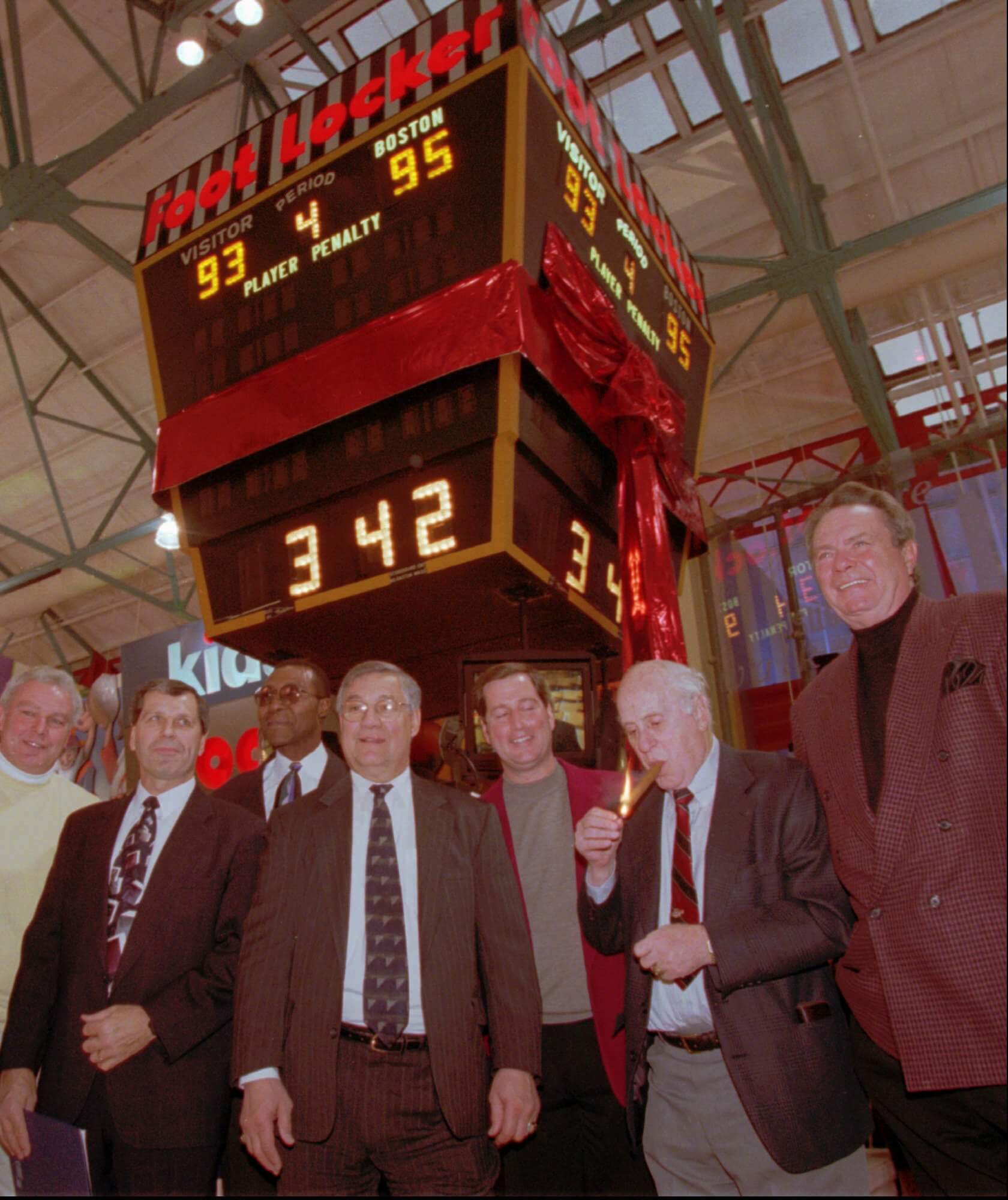
Legendary Celtics owner Red Auerbach (second from right) lights his signature cigar in 1997 during the dedication ceremony of the restoration of the original Boston Garden scoreboard at Arsenal Mall in Watertown, Mass. Auerbach is posing with Celtics and Bruins dignitaries (from left) Ken Hodge, Don Marcotte, JoJo White, Jonny Hodge, sportscaster John Dennis and Tommy Heinsohn. (Kuni / Associated Press)
However, just as many back-in-the-day sports stadiums and arenas have been replaced, a similar fate has befallen old-fashioned shopping malls that are either being torn down or retooled for other purposes. The Arsenal Mall is one such example. Most of it was demolished by new owners in 2018 to make way for Arsenal Yards, one of those mixed-use, indoor/outdoor developments that are all the rage these days.
This is where Tye, in his role as co-founder and director of National Development, entered the story. Cranshaw Construction, which is part of National Development, was doing demolition work at Arsenal Mall until the work halted when the on-site foreman got a look at the old Garden scoreboard. The foreman contacted Tye, who often blends bits and pieces of regional history into his projects.
When Tye built the mixed-use MarketStreet complex on the site of an old golf course in Lynnfield, a little north of Boston, he decorated some green space with life-sized fiberglass cows that had been familiar fixtures at the old Hilltop Steak House on Route 1 in Saugus, not far from the MarketStreet project.
He was developing the mixed-use Ink Block complex in the South End, and the design already included the metal “Boston Herald” lettering that faced the Southeast Expressway from the roof of the old building. It was given new life when it was affixed to a long brick wall inside a Whole Foods supermarket that was built on the site.
With work being done on the seventh (and last) building, there was talk of placing the scoreboard inside a two-story, glass-walled entryway, where it would presumably be visible to commuters driving in and out of Boston on the Southeast Expressway. However, reality set in once it became clear how much space would be needed to accommodate the scoreboard.
A compromise plan emerged. One face of the scoreboard was surgically removed and restored, and then affixed to a wall. Where once the game’s score was listed under “Visitor” and “Boston,” those two spots now show the month and day. Where once the scoreboard showed how much time remained, it now shows the time of day.
“I’m a little surprised there hasn’t been more of a ‘Come to Mecca’ of people to see the piece of the old scoreboard,” Tye said. “But neither do we advertise it or let people know it’s there. It’s kind of a little Easter egg that you might be walking down the street and look up and see, which a lot of people have told me they have.”
Tye is fond of likening the scoreboard at 7 Ink to the children’s novel “Mike Mulligan and His Steam Shovel.”
“The steam shovel’s days were over, but it found a useful afterlife as a furnace in the basement,” Tye said. “And the scoreboard has hopefully found a useful afterlife as well at 7 Ink, telling people the time and the date.”
In a perfect world, the rest of the scoreboard would be restored and put on display somewhere. Which takes us back to TD Garden, seemingly the obvious solution.
A message was sent to Tricia McCorkle, a vice president of marketing and communications for TD Garden.
“We take great pride in preserving the legacy of the original Boston Garden, as can be seen in the halls of The Sports Museum and our Heritage Halls exhibits,” McCorkle responded in a statement. “We are still considering whether there is an appropriate place for this piece, though finding a home for something of this scale will be no easy task.”
If that has a “don’t call us, we’ll call you” twang, it’s because that’s more or less what it is. But I don’t entirely disagree with the Garden people.
It’s been suggested that a resurrected version of the scoreboard from the old Garden would look swell suspended from the top of The Hub on Causeway, the crown jewel of a $100 million renovation that was built on the footprint of the original Garden and provides an exciting and inviting entrance to TD Garden, something that was sadly lacking when the new building opened.
And it’s not lost on me that the Bobby Orr statue, which shows the sainted No. 4 in permanent midair repose after putting the puck past Glenn Hall to win the Stanley Cup, sits in front of The Hub on Causeway.
Putting a rebuilt scoreboard there wouldn’t work aesthetically. I’m no decorator or architect, but you don’t bring in experts, spend millions on a design and then toss in Grandma’s Davenport because it has sentimental value.
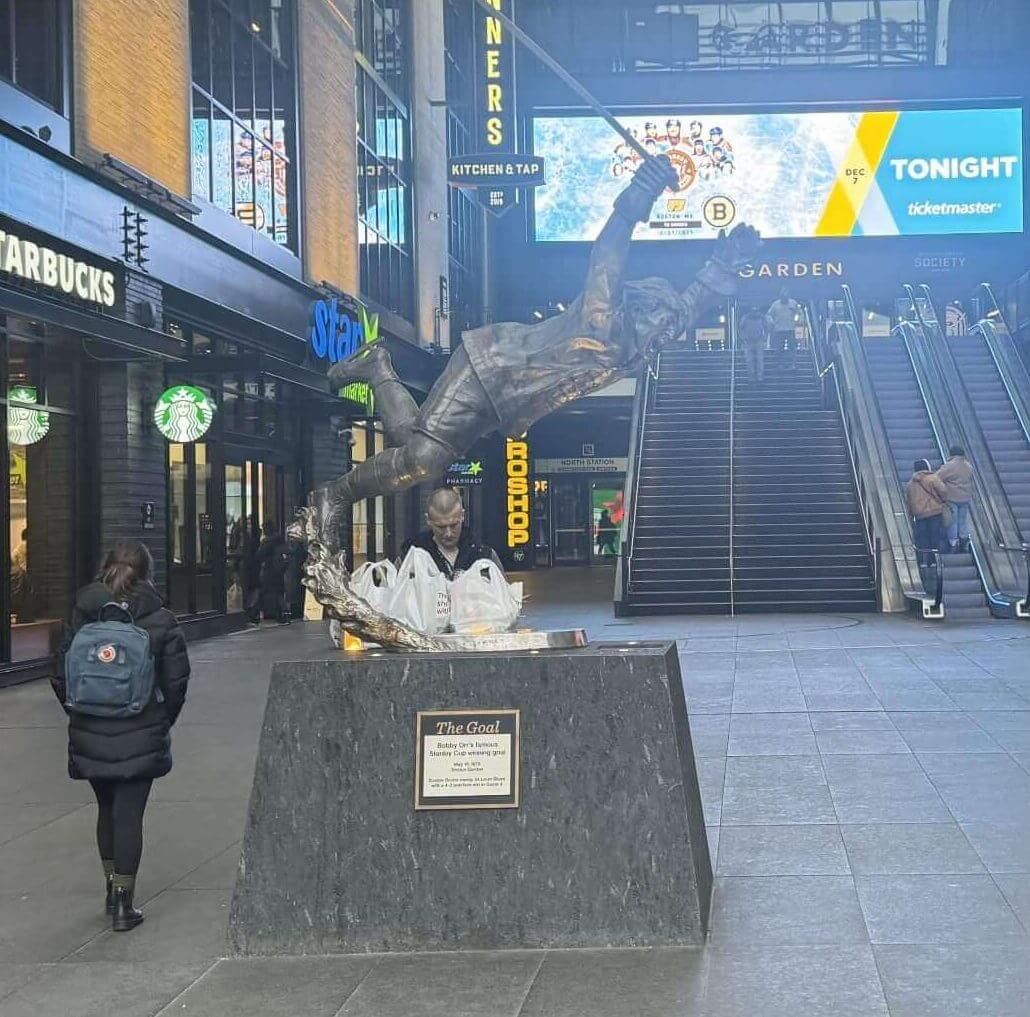
A statue of Bobby Orr that shows him in midair after putting the puck past Glenn Hall to win the 1970 Stanley Cup Final sits in front of The Hub on Causeway. (Steve Buckley / The Athletic)
I made two pilgrimages to TD Garden for the sole purpose of standing outside and gazing at The Hub on Causeway, trying to convince myself that the old Garden scoreboard would look nice suspended from the top. I couldn’t get there. I think the scoreboard would look comical and out of place.
Inside the Garden, it occurred to me there might be room for it on the back wall of the Bud Light Top Shelf Bar, another product of the renovation. I twice wandered around the bar, considering the possibilities. The first time, it struck me that it could work. I wasn’t so sure after the second visit. However, the Garden is a big place, and some bright people run it. Having made their statement, they should now make an effort to see what can be done here.
Outside the Garden, I checked out West End Johnnie’s on Portland Street. The owner, John Caron, is Ted Tye-like in his passion for old-time Boston artifacts and has collected such items as neon signs from “The Naked I,” once a bawdy strip club in the old Combat Zone, and Castignetti Brothers, a North End clothing store where it’s said Joe DiMaggio and Rocky Marciano shopped.
“It’d be great having the scoreboard, because who wouldn’t want a piece of the Garden?” Caron said. “But something that big, the sheer size of it, I just don’t have the space.”
Maybe I’m wrong about the Hub on Causeway. If you disagree with me, reach out to TD Garden. And maybe there are some very obvious solutions elsewhere I haven’t considered. In that case, reach out to Ted Tye.
However, act quickly, before time runs out on the scoreboard from the old Boston Garden.