
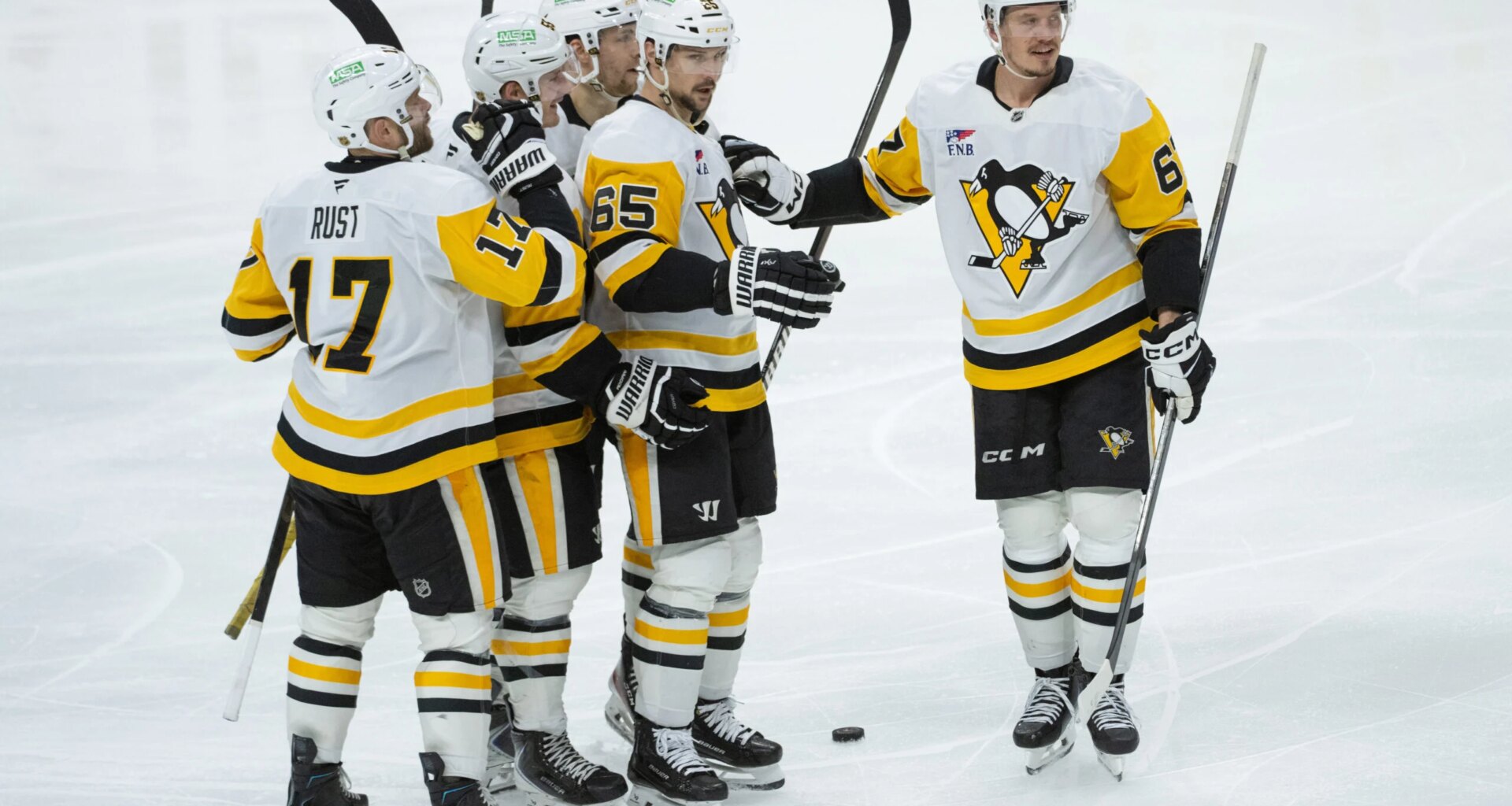
KANATA, Ontario — The Pittsburgh Penguins are never boring, and they rarely follow the script. If the Penguins end their three-year playoff drought, circle this game.
The Penguins played most of the game without captain Sidney Crosby, who suffered a first period injury. They were already without Evgeni Malkin, who is out day-to-day due to injury, and playing the Ottawa Senators at the Canadian Tire Centre, where the last four games went to overtime and the Penguins lost each.
Thursday, the Penguins flipped the script. Behind a pair of extraordinary performances from Erik Karlsson and Rickard Rakell as they beat Ottawa 4-3 in a shootout; circumstance in which they have been abjectly terrible, vaulting themselves back into the second place in the Metro Division and dropping Ottawa out of a playoff spot.
“I think when Sidney leaves the game, obviously we have two options: We can hang our heads and admit defeat, or everybody can just say to themselves that I’m going to do my absolute best every time I get out there,” said Erik Karlsson. “And I think we did that today, not only myself, but everybody really chipped in and played in a way that we’ve been successful throughout most of the year.”
It was another improbable win from a group that seems to specialize in improbable moments.
Rakell had a pair of goals and an assist. Karlsson had a pair of assists and a goal. And rookie Ben Kindel sniped the shootout winner after goalie Stuart Skinner stopped two of three attempts.
The game felt like a playoff battle, and for all intents and purposes, it was. Each team now has 10 games remaining, and only four points separate the gaggle of Eastern Conference playoff contenders.
After suffering through an uneven first period, the Penguins asserted themselves in the second period, outshooting Ottawa 16-6 and out-chancing them 19-7, according to Natural Stat Trick.
“But I think that second period, once we got into the second period, we just kind of played our game and took over,” Ryan Shea said. “We got away from it a little bit in the third, but it kind of happened. And I think the second took off and gave us all the momentum.”
The Penguins also had a staggering nine high-danger chances in the second period alone. There have been games this season in which the team didn’t reach nine or struggled to do so.
The Penguins also challenged for goaltender interference in the second period. While the overhead video replays showed little to no body contact with the skater in the crease, Skinner explained there was a lot more there, which caused the juicy rebound.
“I don’t know. I don’t even know if it’s gray area, really. I think from a goalie’s perspective, I think a lot of goalies would say that it probably was goalie interference, just because it sneaks through my right arm and the guy kind of has a stick on me,” Skinner said. “If I’m able to close my arm pockets, it’s not going to go anywhere, and it’s just no rebound. So that’s the thing. But for somebody to watch that, it’s hard for them to tell if they’re not a goalie.”
Toronto has better camera angles than the public. The Penguins are 0-for-9 on challenges.
Penguins Analysis
For large portions of the game, the Penguins were impressive. After the team settled down following a sketchy first 10 minutes, they did not necessarily dominate, but they maintained momentum and played clean, crisp hockey while under duress.
The Penguins’ breakouts were largely on point, allowing them to attack Ottawa’s 1-2-2 neutral zone forecheck. A few hit posts kept the score within a goal, and a couple of sparkling saves by Ottawa goalie Linus Ullmark added to the Penguins’ inability to break open the game.
Connectivity was the Penguins’ hallmark against the aggressive Ottawa defensive thrust. The Penguins did not try stretch passes into the teeth of Ottawa’s setup, but brought the center across the middle, providing that short-up option with speed and forcing Ottawa to react and chase.
The Penguins also skated the puck from danger, especially Karlsson, who was brilliant for the entire game. Karlsson’s offensive zone orchestration was a step ahead of everyone.
When the Penguins are playing well, their puck support is tight, and it was Thursday. Their rushes were born of short taps and easily connected passes, station to station with speed. They did so often under pressure from Ottawa’s physical forecheck, but short, easy passes don’t take time and the connections kept them moving forward and Ottawa chasing.
Especially in the second period, it was a clinic.
In the offensive zone, the Penguins took advantage of Ottawa’s inexperienced blue line. Ottawa is currently without their top three defensemen, including Jake Sanderson, so the Penguins could be high pressure on Ottawa’s puck possession, especially when they tried to get out of the defensive zone. The immediate puck pressure and backcheck created more Penguins pressure.
Fair? Who ever said this game was fair. It was to the Penguins’ great advantage, and they should have buried Ottawa, if not for their own lack of finish.
But. There’s always a “but,” isn’t there?
The Penguins’ mistakes were again ghastly. Loud. And a few of them were poor choices by defenseman Kris Letang, who twice allowed an Ottawa forward to get behind him in the neutral zone. Each resulted in an odd-man rush, the first of which resulted in Ottawa’s second goal by Nick Cousins.
Hockey is indeed a game of mistakes, but they cannot be so disastrous and so fundamental.
Penguins Report Card
Team: B+
A high-pressure win on the road in which they trailed twice, had to shrug off another goaltender interference denial, and weather an early Ottawa storm. The Penguins’ speed and rush game in the second period was as good as it has been in weeks, and they did it without Crosby or Malkin.
The Penguins were good in all three zones and in all aspects of the game. They were a few mistakes away from being dominant.
Stuart Skinner: A
The Penguins’ goalie made a few sparkling saves in the first period when the Penguins were struggling, including stopping a point-blank shot by Nick Cousins seconds after Ottawa’s second goal. Skinner stopped a couple of breakaways in overtime, too. And he stopped two of three shootouts. That was a leadership type performance.
“I mean, when we have Stu back there, it’s gives us a lot of confidence, gives the shooters confidence, for sure,” Kindel said as Stuart Skinner joined the media scrum to yell, ‘Good answer!’
“But yeah, either goalie, I think we’re confident. I think just it’s nice to see the puck go in a couple more times now on the shootout, and get a few more bounces for sure.”
Karlsson, Rakell: A++
They were spectacular and played like superstars. The puck was always on their sticks; they were always dangerous with the puck, and they controlled the play.
Karlsson had eight shots on goal and 13 attempts. Rakell had six shots on goal and four more attempts.
Good Performances
Ben Kindel: After disappearing for a brief spell this month, Kindel has been notable in the last two games. He again picked up his game, especially in the second period. Oh, and the shootout winner.
Shea-Clifton: The Penguins’ third pairing was gritty and responsible. They stabilized a sometimes rollercoaster blue line with a solid performance.
Bad Performances
Tommy Novak: The Penguins need more from their second line center. He won only two of his 10 faceoffs and was swallowed up by the tight-checking game.
Ville Koivunen: The scrappy kid is running out of time. He played only 10 minutes Thursday and was rarely involved.
Justin Brazeau: The big man’s struggles continue, too. Despite juggling lines to accommodate Crosby’s injury, Brazeau also played only 10 minutes with little effect. He lost too many net-front battles; he has to win a few more to create the chaos for some ugly goals.
Tags: erik karlsson Penguins Analysis Pittsburgh Penguins Rickard Rakell
Categorized:Penguins Analysis