
Welcome to Scott Wheeler’s 2026 rankings of every NHL organization’s prospects. You can find the complete ranking and more information on the project and its criteria here, as we count down daily from No. 32 to No. 1. The series, which includes evaluations on nearly 500 prospects, runs from March 9 to April 8.
A healthy Roger McQueen gives the Ducks one of the top forward prospects in the sport, even after graduating Beckett Sennecke. They have a couple of strong D prospects coming behind their already-young NHL group on the back end, too.
2025 prospect pool rank: No. 12 (change: -2)
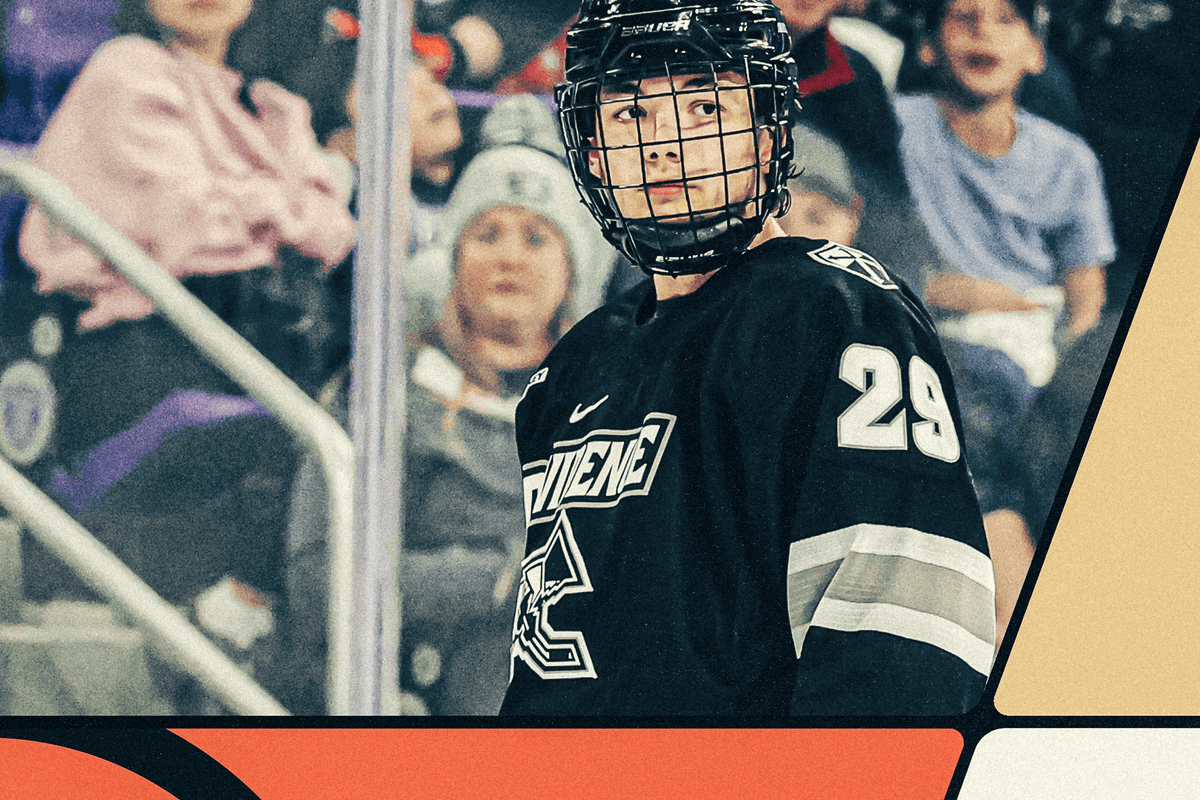
Tier 11. Roger McQueen, C, 19, Providence College (No. 10, 2025)
A standout October 2006 with size and some real skill, McQueen is a big, right-shot center with talent on the puck and skating that has come a long way over the years to fall into place nicely for a player his size (6-foot-6 and 203 pounds). The big question with McQueen in his draft year was about his health. He impressed for Canada at U17s, Hlinka and U18s — where, after a standout first game, he got injured in the second game of the tournament — and had stretches of dominant play for Brandon in the WHL, including early on in his draft year after a four-goal game kick-started it. He missed 15 games with a back injury midway through his draft-minus-one season, though, and after returning for the playoffs and U18s and getting off to that hot start last season while still trying to manage it, the injury flared up enough that he and his team felt it was important for him to step away and get it right. He has said the injury was a pars fracture, or a spondylolysis — a stress fracture of the spine.
After missing almost his entire draft season, he returned to play in early March and looked like he was getting back into the swing of things early before getting closer to form down the stretch and finishing with 20 points in 17 games on the year. But he wasn’t himself in Brandon’s first-round playoff series against Lethbridge and missed the final two games of it. If not for the injury, he was viewed as a top-five-caliber prospect. This year, after making the move to the NCAA for his post-draft season, he has played to just under a point per game as a freshman and leads the Friars in assists, sitting second in points.
I like his tenaciousness/willingness to go get pucks and then stick with them when he has them. He’s competitive. When he was younger he lacked strength, and his skating dragged behind/never properly developed because he was trying to cheat his mechanics to keep up, but it has come, and there’s a belief it will continue to develop as he adds strength and stays healthy. He uses his linemates well and plays with an offensive intellect. But it’s his ability to control and manipulate pucks in tight to his body, with his length, that I think distinguishes him. He can carry pucks into traffic and problem-solve in ways that players his size typically struggle to do. He can also go to the net and make tuck plays/rebounds with good dexterity, which has helped him play the net front successfully on the power play, a translatable role for him. His shot is pinpoint accurate around the home-plate area and even from tough angles.
There are the makings of a really unique player there, and the payoff could be significant. He often looks like a potential top-six center with some distinct attributes.
Tier 22. Tristan Luneau, RHD, 22, San Diego/Anaheim (No. 53, 2022)
Luneau is a player I’ve long had a lot of time for and have felt is underrated. He was the first pick in the 2020 QMJHL draft and looked like a surefire first-rounder through the Youth Olympics and into his strong rookie season in the QMJHL, where he won the league’s defensive rookie of the year award. And while it took him some time to get back to that status after a knee procedure cost him the summer, preseason and first three games of the regular season in his draft year, he hit his stride in the second half of his post-draft season. He was the QMJHL’s defenseman of the year and was clearly the league’s most complete defenseman by a long shot, logging huge all-situations minutes and driving offense in a big way while playing a matchup role against the opposition’s best.
Two years ago, in his rookie pro campaign, I thought he looked like a stud in the AHL and NHL early on, and he was clearly a cut above all of Canada’s other defensemen in practices and the Red-White scrimmage in Oakville for World Junior Selection Camp before a serious infection to that knee hospitalized him and derailed his season. He would have been Canada’s No. 1 D and changed the look of that World Juniors team in Gothenburg. Last year, though he didn’t make the full-time jump to the NHL that I think he was on track to make pre-infection, Luneau was one of the best D in the AHL, driving offense and play in significant minutes. Though his numbers have taken a hit in his third year (as have his team’s) and he still hasn’t made the full-time jump to the NHL, he has led the Gulls in ice time this year, and I remain a firm believer that he belongs in the NHL.
Luneau’s game isn’t dynamic in the obvious sense, but he’s a balanced and smooth-skating right-shot defenseman without being explosive, something some scouts worried about but I’ve often argued is closer to a real strength than anything else. He can run a power play, is a plus-level passer, has developed his shot and reads the play at a high level with and without the puck at both ends. His skating has looked comfortable, flexible and smoothed out when healthy. He plays a poised and polished two-way game that lends itself to driving play. And while he’s a high-floor type — he should be a good third-pairing guy at minimum — I think he has second-pair upside in the right situation, though it’s starting to feel like he’s not being prioritized by the Ducks as much as some of his peers.
His size (6-1, about 200 pounds), maturity, roundedness and discreet offensive game and skating have put him, when healthy, on a path toward becoming a contributor. He has proven he can control play and log significant minutes in the AHL.
3. Stian Solberg, LHD, 20, San Diego (No. 23, 2024)
Before last year, Solberg was a tricky projection as a player who had played exclusively in Norway at the junior and pro level before the draft, which seldom produces NHL talent. But he has also played the better part of the last six (!) seasons against men. And after an excellent playoffs for Vålerenga and an even better showing playing first-pairing minutes against NHLers for Norway’s national team at men’s worlds, his stock was at its highest as the draft arrived. (He was the biggest riser on my board in the second half of the season.)
Last season, after signing with Färjestad, he registered 15 points and a plus-10 rating across 60 games in the SHL and the Champions Hockey League as a teenage defenseman. He also registered another five points in his first 10 AHL games (where I thought he was immediately solid) and another eight points in 10 games split between a second men’s worlds and Olympic qualifying, playing a huge role for Norway’s national team. This season, in his first full year in the AHL, he has played 17-18 minutes per game (fifth among regular Gulls D), and his primary contributions have come through his physicality and big shot at five-on-five, though he hasn’t been relied upon on either special team yet.
His game has some real identity and form to it at an early age. One of the most competitive prospects in the sport, Solberg plays really hard and firm on both sides of the puck, with a mean, strong, physical presence that has seen him make life hard on opposing players whenever he has played against his peers internationally and even against men in Norway and Sweden. He’s really physical in man-to-man coverage, sometimes too much. It’s tough to take him one-on-one, and then he can skate the other way, though he can also be a little too eager on that front. His reads and decision-making need some tightening at times, as he can be sloppy/turnover-prone, but his game has grown more mature as time has gone on, leaving me less concerned about his brain than I once was.
He’s also a strong skater and advanced athlete with an athletic 6-2 build that is already over 200 pounds and is really strong/sturdy. Players with his makeup — a hard-nosed, highly engaged defenseman with good size/athletic tools who’s shown enough offense — are always going to be valuable. They tend to fit in on North American ice, too. I see a potential second-pair ceiling, third-pair floor as a hard-to-play-against D with some secondary offense that gives the Ducks’ future blue line something different from guys like Olen Zellweger and Pavel Mintyukov.
Tier 34. Lucas Pettersson, C, 19, Brynas (No. 35, 2024)
Pettersson is a well-liked player in the 2006 Swedish age group who has played well and worn a letter for the national team. He was the first draft-eligible player to play in an SHL game in 2023-24 and really saw his counting stats increase in the second half of that year at the J20 level to get picked No. 35 (he ranked almost exactly there at No. 36 on my board as well). He had a bit of a slow start at his U18 worlds, but I thought he got better as the tournament progressed and re-emerged as one of Sweden’s top forwards (he played significant minutes, was among their leading scorers and was robbed several times and hit multiple posts, preventing better production but still finishing with eight in seven on a team-high 26 shots). Last year, he played predominantly at the pro level at 18, splitting time between the SHL (where he played limited minutes) and HockeyAllsvenskan on loan to Östersunds (where he played important minutes and was quite productive for an 18-year-old, registering 19 points in 26 games). This year, after signing with Brynas, he has been one of the most productive teenagers in the SHL as well. He also registered six points in six games at the World Juniors despite missing the semifinal with an illness. I also liked him a lot at the World Junior Summer Showcase at the end of July and into August.
Pettersson is a smart and well-rounded two-way center who has some talent and understands how to get the most out of his game. He’s a very good skater. He’s a patient player who protects and shields pucks well, waiting for his linemates to play off him so that he can put them in good spots and win his shifts. He makes decisions quickly on the ice, and he’s fast and plays fast. He shoots it quickly when he gets it in good spots, with an accurate snap shot and a confident one-touch shot. He has good hands and an ability to delay and hesitate on defenders, freezing them off the rush so that he can cut past and gain an advantage. He also uses his skating to apply pressure and force turnovers, intercept passes and create breaks for himself. Plus, he’s a capable penalty killer. He’s just a good player.
I believe he has the tools to become a third-line contributor.
5. Eric Nilson, C, 18, Michigan State (No. 45, 2025)
Nilson is a lean but naturally athletic and intelligent center who was one of the smarter forwards in last year’s draft on both sides of the puck. He takes smart routes with and without the puck, finds space in possession, always has his head and eyes up and processes the game at an advanced level. He has a slick first touch and catch-and-release shot. The puck comes off his stick quickly and accurately. He’s proficient on both special teams and will block shots. He’s also a light, breezy, plus-skater who can make plays at pace and sees the ice so well that he makes his linemates better. He’ll need to get stronger to improve his faceoff proficiency and to get the most out of his heady defensive play and tracking, but once that comes, he has NHL prospects. He knows how to win back pucks with his skating and body positioning, protect them and then escape or find inside ice with his sharp edges. He’s a winning player. He gets open but will also get on pucks. He has some one-on-one skill and finesse. I want to see him score more, but he’s an interesting prospect who still has a lot of development opportunities in front of him, and I thought he was a standout at U18 worlds and the World Junior Summer Showcase (where he started as the 13th forward).
He hasn’t lit it up on a deep Spartans team as a freshman in college and lost the 1C job he started this year’s World Juniors with, but he has a lot of positive shifts and does a lot of positive things. I think time spent in the gym under strength and conditioning expert Will Morlock at MSU will be good for him, and that he’ll emerge as a sophomore or junior in the NCAA. He’s a very good, slick hockey player. This might be a little high for some, but I’m a fan.
6. Herman Traff, RW, 20, Oskarshamn (No. 91, 2024)
Traff is a big, strong, heavy winger who can rip a puck. After playing games at both of Sweden’s top two pro rungs in consecutive years as a teenager, with strong stretches of play in each, he has taken a big step this year to become a top scorer in the second-tier HockeyAllsvenskan, not just for his age but in the league. He has a quick release (both leaning into one and on curl-and-drags and adjustments, pucks come off his blade hard). He plays hard and physical hockey. He has a motor and a willingness to get after it. He plays a reliable game off the puck and could potentially be a penalty killer with the right development. For a big man (6-foot-3 and 200-or-so pounds), he has a decent transition game. There are times I’ve questioned his decision-making, reads and play selection, because he isn’t the most cerebral player. There are other times I want to see him bully his way to the net even more instead of relying so much on his shot. But there’s a shell of a good bottom-sixer with some scoring elements and a physical dimension. He was born just one day early for eligibility to return to play for Sweden in a second World Juniors this year, and would have been a top winger for them had he been eligible. He’s going to get signed, and his game should work in North America. I thought about ranking him No. 5 here.
7. Tarin Smith, LHD, 20, Everett (No. 79, 2024)
Smith, like Solberg, was another tricky one pre-draft who has begun to crystallize over time. Before the Ducks drafted him in the third round, Smith had a very productive rookie season on a decent Everett team after starting the year in a very limited role as he worked his way back to game action following a lost season the year before due to shoulder surgery. He eventually led Everett’s D in points with 49 points in 75 combined regular-season and playoff games and featured prominently on the power play. Throughout the year, he showed legitimate skill, making some high-end plays. But even though his role grew as the season went on, he never actually played a particularly big one for the Silvertips, averaging 15-16 minutes in the playoffs. Over the last two seasons, though, he has really taken important steps in his responsibility to become a top player on one of the top teams in the WHL in back-to-back years, averaging 23 minutes per game in all situations and playing to a point per game over more than 120 games. Smith is a 6-foot-2 defenseman with plenty of tools to continue to build up. He’s creative and confident. Defensively, he plays an upstanding, physical game that has slowly become more polished and still has some developmental potential. He has a pro frame, and he’s a strong athlete who moves well. There’s talent and a pro makeup. His floor is probably as a middle-pairing/PP2 AHL defenseman, but I could see him playing into an NHL mix in time.
8. Yegor Sidorov, RW/LW, 21, San Diego (No. 85, 2023)
Sidorov has really grown on me over time and has been a bit of a riser since the draft (or at least has played in line with a solid third-round pick). He scored 65 goals and 111 points in 82 combined regular-season and playoff games in his final year in the WHL, finishing tied for fourth in goals in the regular season with 50 and leading the playoffs with 15 in 16 games with Saskatoon to play his way onto the Eastern Conference’s First All-Star Team. I wanted to see how it translated at the pro level, as he was a dangerous shooter and chance-creator in junior, but he had some imperfections and gave a lot back defensively. Last year, though, after making the jump to the AHL, Sidorov was both pretty productive as a 20-year-old rookie and played very respectable minutes, averaging 17-18 per game and often breaking 20 late in the year. And while that hasn’t continued this year and his minutes have regressed to the 14-15 minute range, he’s still a young player in the league. He hasn’t been a liability off the puck either, and his effort level and tenaciousness have both shown in his game over stretches of the last two years. He has a lightning-quick release, extremely quick hands, he’s dangerous on the flank on the power play going downhill into his snapper/curl-and-drag and he’s a good enough skater to create with them. The best-case scenario is he follows the path that NHLers such as Eeli Tolvanen, Daniel Sprong, Pavel Dorofeyev and Morgan Frost did to slowly become a secondary skill guy/PP2 guy. The worst-case scenario is he’s just an AHL second-liner type long-term.
9. Maxim Massé, RW, 19, Chicoutimi (No. 66, 2024)
Massé was the first forward taken in the QMJHL’s 2022 draft (No. 3) and lived up to the selection (which wasn’t the consensus choice at the time), playing to nearly a point per game and nearly 30 goals as a 16-year-old and the leading goal scorer (second in points) on a young Chicoutimi team to win the CHL’s rookie of the year award. He also had five goals and six points in five games at the Hlinka Gretzky Cup the summer between his 16-year-old year and his draft year. He didn’t take a pronounced step forward in the two seasons that followed, though, putting pressure on him to step up this year in his final year of junior and forcing him to go the college route (he’s committed to UMass for next season) in order to earn an NHL contract.
He has earned high praise from around the QMJHL, however. Though his production only took a modest step post-draft, he scored 36 goals and led Chicoutimi in scoring by 15 points with 75 points in 67 games. At U18 worlds, he played more limited minutes but played well in them (I think it had more to do with the way a couple of other lines really clicked than him) and still managed to be productive. I thought he had one of the better performances on a thinner Team Red up front at the CHL/NHL Top Prospects Game, too. Last season, though he missed a chunk of time in October and November due to an ankle injury, Massé was again one of Chicoutimi’s most productive players when he was in the lineup, especially in the goal column, scoring 30 again. He needed to show that he could be one of the league’s top scorers and not just one of his team’s, though, and he has done that this season as the league’s second-leading goal scorer behind Blues first-rounder Justin Carbonneau.
Massé possesses a natural and versatile shot and above-average skill across the board. But it’s the completeness of his game that stands out for a player his age. He can penalty kill, he’ll go to the dirty areas and make plays around the net, he battles and he’s just a well-rounded player who stays around it and goes to the right spots, whether that’s swinging to the wall to pick up cycled pucks before defenders do or popping out into the slot at the right time. With continued work on his below-average skating (his pace will determine whether he’s just a good mid-level pro or actually has a path to the NHL), he’ll have a chance to get signed. He reminds me a little of recent, well-rounded QMJHL draft picks such as Dawson Mercer and Zach Dean, though I think he has more skill than the latter did at the same age and doesn’t have the pace that the former did.
10. Lasse Boelius, LHD, 19, Assat (No. 60, 2025)
Boelius is a player that two different connections in Finland put on my radar early ahead of his draft year last year, predicting that he’d play Liiga games early in it, and that’s exactly what he did. He’s a great skater whose calling card is his mobility. He has shown he can move pucks, skate pucks and run a power play with the national team (including in a point-per-game showing at this year’s World Juniors) and at the junior level domestically. He has also made the full-time jump to Liiga this year as a teenager post-draft. He plays with confidence against his peers and doesn’t look out of place against men because of his feet. He has some shiftiness and escapability on the puck. I wouldn’t call him a highly skilled offensive type, though, and I would like to see him play harder defensively in terms of just battling and upping his physicality (his defending isn’t always buttoned up in zone). He relies on his feet and stick to play D, and it works for him (and plenty of NHLers). He can involve himself on both sides and play a tight gap. He also walks the line well and falls back onto his heels/switchies from his heels to his toes really smoothly to absorb the first layer and get the puck from A to B. He’ll be good organizational depth at minimum, and some think he might play some games long-term.
Tier 411. Austin Burnevik, RW, 21, St. Cloud State (No. 182, 2024)
Burnevik has had a positive progression in the three seasons since he went undrafted out of the NTDP. He was always a useful bottom-six player at the program, but he has taken a couple of important steps since then. Post-draft, he made the smart decision to go to the USHL and scored 40 goals (second in the league) and 71 points (tied for seventh) as Madison’s leading scorer by 18 points. Last season, he then made an immediate impact at St. Cloud State, playing his way onto the first line and top power-play unit and producing just under a point per game as a freshman. That earned him a spot on USA’s gold medal-winning World Juniors team, though he wasn’t much of a factor for them. He has taken another step as a sophomore this year, though, again, producing above a point per game and breaking the 20-goal mark (a typical indicator of a pro-bound college player).
Burnevik is a 6-foot-4, 200-pound winger who stays around it, finds ways to get his stick onto chances inside the offensive zone, has some decent puck protection skill out wide to his body and has a good feel around the net and off both of his forehand and his backhand on the cycle/in the slot. His skating is a limiter, though, and while he’s competitive enough, it’s not a defining quality of his game. He will have to learn to play with more pace in order to give himself an opportunity to be more than just a middle-of-the-road pro, but he should get signed.
12. Sasha Pastujov, LW, 22, San Diego (No. 66, 2021)
Pastujov is a player with offensive talent and smarts, but also one who has been followed by questions of NHL projectability. He’s a dual-threat O-zone player who is equally as capable of making the play that leads to a goal as he is at finishing the play himself. Scouts have often pointed to a skating kink and mediocre acceleration and top speed for their worry about his ability to make good on his talent. Two years ago, his rookie pro season was a tough one to evaluate because he missed rookie camp and main camp due to injury and then suffered a lower-body injury, which kept him sidelined for two months from late November to late January. In my viewings, he actually had some nice moments when healthy (including an assist in his season debut and a hat trick coming out of the injury). Last year, the Ducks started him in the ECHL. But after tearing it up in Tulsa, he landed back with the Gulls and was their leading scorer after returning, registering 45 points in 43 games. His production, as with everyone else’s on that team, has taken a bit of a hit this year.
His skating does continue to need work, but I don’t think it’s ever been as big an issue as it has often been made out to be, and he has made progress. He’s an inventive playmaker who can do a lot with the puck. He has excellent touch through feet and sticks and into space (which reduces the need to be fast). He also mixes in fakes and stutter steps to create transition separation or go inside-out on defenders. He can run a power play and hold pucks; he’s dangerous around the net because of his ability in tight spaces and he’s a superb passer through bodies who can slow the play down and dictate with his poise or speed it up with his ability to quickly react to openings in coverage. Mix in a statistical profile that has suggested legit prospect (first as one of the top scorers in his age group at the national program and then with a junior-finishing 117 points in 76 combined regular-season and playoff games), no issues with work ethic (his competitiveness isn’t a strength but he engages himself enough for me), a defensive game that has come a long way, and there’s reason to be optimistic that he’s at least talented enough to become a AAAA guy. There’s a risk he becomes just a tweener, though, and the clock is now ticking. His ranking reflects the lack of a natural NHL role for him. I could eventually see him playing some games when the NHL club has a skill guy go down and wants a little more offense from a call-up, but those calls don’t always come for his player type.
13. Damian Clara, G, 21, Brynäs (No. 60, 2023)
The towering Clara was the first player born and raised in Italy to be selected in the NHL Draft and was one of a handful of goalies that I nearly ranked in my final top 100 back in 2023. Clara is also fascinating as a 6-foot-6 Italian goalie who was a real riser in his draft year after making the move from the Red Bull Hockey Academy in Austria to Sweden’s J20 level, eventually going in the second round. His post-draft career has been a real topsy-turvy one though and while he has established himself as Brynäs’ starter this year, played well as Italy’s starter at the Olympics, was a good goalie right away in a top junior league with Farjestad’s J20 team, performed well at the U18, U20 and even senior men’s level for Italy internationally at an early age, made 36 and 37 saves in his first two starts at the HockeyAllsvenskan level for Karlskoga as a 17-year-old, and outplayed his tandem mate in the second-tier at 18 and 19, he has also had some real lows where he has had to find his game again.
I viewed him as more of a mid-round target than a second-round pick because his profile and projection still came with some risk due to his limited sample and size (6-foot-6). He moves just fine, though, he has a good sense for his net for a young goalie (often a challenge for goalies as big as him) which allows him to cut off angles and take away the options of shooters, he doesn’t tend to get beat a ton in the places tall goalies do (under the arm and five-hole) and seems to have a good foundation of tools to work with. He still has some technical and movement work to continue to refine, but that’s not unusual for a goalie his size. He’s a great story and a must-follow. But he’s not a sure thing and remains a bit of a work-in-progress.
14. Noah Warren, RHD, 21, San Diego (No. 42, 2022)
Warren’s size (6-foot-5, 220-or-so pounds), strength, power, desired handedness as a righty, and skating made him a second-round pick after a rapid progression in his draft year. That progression didn’t follow as steep an incline in the two junior seasons that followed. His first pro season last year was very much a learning one, but he has had a positive defensive impact in his second AHL campaign this year across 16-or-so minutes per game.
He has defensive tools and has shown at times (though not consistently enough) that he’s capable of coming out of his shell with the puck, even if that’s never going to be a hallmark of his game (he can skate transport it when there’s open space, even if he simplifies after that). I like his stick and the job he does retreating with opposing carriers. He can step up and play the body, but he can also match and keep opposing players to the outside. If he can develop NHL adequate puck skills, he has the other tools to become a No. 6-8 option. He projects as a complementary defense partner and penalty killer if all goes well. There’s work to do still (they’ll want to see him have positive results in 20 minutes per game in the AHL instead of 16), but he was always going to be a bit of a project.
15. Nathan Gaucher, C, 22, San Diego (No. 22, 2022)
Gaucher is big and strong, and can really build a head of steam (his feet can look heavy early in his acceleration patterns, but when they even out and he gets going, he’s quite fast) and push through the middle of the ice in transition or attack off the wall inside the offensive zone. At the junior level, there were games where he really imposed himself and just looked bigger and stronger than everyone else, combining his ability to drive with and without the puck to wreak havoc. Gaucher was an important part of good teams, winning two World Junior golds with Canada and a QMJHL title and Memorial Cup with the Quebec Remparts. As one of the youngest full-time players in the AHL two seasons ago, he also played to solid results. But there were always questions about his statistical profile, offense and whether he’d maxed out at an early age, and his lack of progression beyond AHL bottom-sixer over the last two seasons has reinforced that.
Gaucher has some secondary finishing ability, but he has found it harder to create his own looks against men. He’ll play to the middle lane and jump defenders to the inside, but he can also rip a puck in from midrange. Now it’s just about getting the puck on his stick more. I see all of the pro tools that scouts loved in him pre-draft. He’s also good in the circle, on the forecheck, on the cycle, in front of the net and on the penalty kill because of his heaviness and skating. He has always lacked touch, though (he bobbles pucks and his hands can look rigid) and that has become a limiter offensively. You’d hope he can become a big-bodied fourth-line option (he can play center and wing), but he needs to develop his soft skills and find a way to play a bigger offensive role at the AHL level first.
Honorable mentionsNico Myatovic, LW, 21, San Diego (No. 33, 2023)
Myatovic turned a lot of scouts into fans in his draft year while playing up and down the lineup with a stacked Thunderbirds team that won the WHL title (and mostly down it once they loaded up) by still managing to score 30 goals. The following year, on a low-scoring and rebuilding team, he then played huge minutes (averaging over 20 per game as a forward) to just under a point per game in a season where he missed three months with a lower-body injury and got banged up a couple of times. Now he’s two years into his AHL career, and while he’s a fine depth player at the level, his progression hasn’t reflected that of a player who was picked one slot shy of the first round (though, I should note that other teams did have him in that range, too).
His statistical profile has never been glossy, either, so you’re counting on his rangy tools and pro style/habits pushing him up the lineup and into the call-up conversation eventually. He has plus-level size (6-foot-3 with a frame that he has added lean muscle mass to, raising his playing weight to around 200 pounds), skating (he’s a very smooth straight-line skater) and work ethic and there is a belief that despite being on the “older” side (he was a late ’04 in a predominantly ’05 draft), he’s still early in his development. He’s the kind of player who can play with a variety of linemate types and in a variety of roles and still be successful because of his toolsy, smart game.
Drew Schock, LHD, 19, Michigan (No. 101, 2025)
The ’07 NTDP blue line never had anyone emerge as a top prospect. Carter Amico and Charlie Trethewey briefly got that attention, but it was fleeting. Garrett Lindberg was a competitor but didn’t have the size or defining quality. Asher Barnett was a good player in his age group, but is vanilla. Mace’o Phillips’ rigid puck play and sloppy defense were too much to look past his imposing physical tools. Donny Bracco was a smart, heady player who didn’t have the body. But Schock was the one player who I felt deserved a little love, and the more time I spent with his game, the more I felt his NHL Central Scouting ranking (182nd in North America) didn’t give him enough credit. He also played some of his best hockey of the year at U18 worlds in Texas after NHLCS put out their final list, and I understand that he lacks size without a dynamic quality to carry him as well, but I liked him as a mid-to-late round pick at year’s end. While his freshman stats don’t pop and he’s only playing 13-14 minutes per game, he has fit in nicely as a depth D on one of the top teams in the country and should get more of an opportunity as an upperclassman there.
Schock also became Team USA’s go-to D over Blake Fiddler by the time U18 worlds were into the medal round in the spring, was on my tournament all-star ballot and was one of the only D on that team that drove play consistently all year. He has a good first pass on outlets and can really snap it around, moving it crisply. He’s also comfortable skating pucks. He played both special teams for them, and I liked him on the PK. He defends well and is a smart three-zone player. He has shown that he can activate and pick good spots to jump up into the play and make himself an option to make something happen in transition. I see him becoming a pretty effective two-way type with some secondary offense in college. He doesn’t have the high-end skill or high-end defensive attributes to become more than organizational depth at the next level, and he’s probably more likely a good four-year college player who becomes an AHLer, but that would be a fine outcome as a fourth-rounder.
Emile Guité, LW/RW, 18, Chicoutimi (No. 159, 2025)
Guité won QMJHL Rookie of the Year as a 16-year-old and was a No. 2 pick in the league, but hit a huge wall in his draft year, and his production actually dipped. He’s a low-pace shooter who can finish plays. He needs the right kind of usage and linemates to be successful, though, because he’s not a great skater, with knees that can knock and splay, though I think he’s a little more competitive than he has gotten credit for in conversations I’ve had with folks (he still certainly also has a lot of work to do to round out his game) and he does have some big-game pedigree at a young age. He was a Quebec U18 AAA champion and Telus Cup MVP, the leading scorer on Canada White’s gold medal-winning team at world under-17s and a top producer at the Hlinka and for Chicoutimi early on. He has been more threatening this year as well, breaking the 30-goal mark.
If you leave him open in the offensive zone, he can burn you. He has a multifaceted shot (one-timer, catch-and-release, in-motion, standing still, you name it). He has power-play skills and is a threat on his off-wing on the flank. He’s 6-foot-2. But he’s too one-dimensional and should be a more impactful player than he is. He reminds me a little of Predators prospect Matthew Wood at the same age, but Wood managed to produce enough to remain a top prospect despite some obvious flaws, and Guité hasn’t produced at that level. If you’re going to be an offensive guy, you have to light it up. They do say scoring is the hardest thing to do in hockey, though, and he can do it, which makes him at least worth a peripheral eye.
Tomas Suchanek, G, 22, San Diego/Tulsa (undrafted)
Suchanek is a 6-foot-2, 181-pound goalie who was repeatedly passed up in the draft but eventually earned a pro deal with the Ducks organization after grabbing people’s attention with his excellent play at the 2023 World Juniors in Halifax and Moncton (where he led the Czechs to a silver medal, led the tournament with a .939 save percentage and was named to the tournament all-star team — he was also on my ballot) and strong back-to-back seasons with WHL Tri-City. After performing well both in the ECHL and AHL, he then turned that pro deal into an entry-level contract. I think he was going to be the guy in San Diego last year before he underwent surgery for a ruptured ACL in September and missed the entire year. In returning this season, he has again bounced between the AHL and ECHL. I still wanted to give him a mention here, though.
Suchanek’s game is all about staying with pucks. He’s mobile, but he’s also ultra-competitive and fights to get to second and third chances or hold firm on scrambles. He plays a challenging, aggressive style to play sharp angles and relies on his feet and his battle level to recover. I think he has what it takes to become solid organizational depth, but the lost time has made it an uphill battle all over again.