
Before the Letter 2.0, there was the general manager message. When Chris Drury sent league-wide word to other teams in November 2024 saying he was willing to trade roster players — and mentioning then-captain Jacob Trouba and then-longest-tenured player Chris Kreider by name — he signaled that he didn’t feel the Rangers were good enough to truly contend. Since that moment, the Rangers’ roster has shifted. It has become more and more Drury’s own and less the one built by his predecessors, Jeff Gorton and John Davidson.
The transition has not been smooth. The Rangers entered a tailspin in 2024-25 after the message to other GMs and missed the playoffs. This year, the team has dropped even farther. It sits at the bottom of the Eastern Conference standings and was officially eliminated from playoff contention Wednesday. Drury declared the team as retooling in a January letter to fans: a development that would’ve seemed stunning during the Rangers’ 2023-24 run that included a Presidents’ Trophy and Eastern Conference final appearance.
With the 2026 trade deadline behind us and more moves looming in the summer, it’s a good time to look back. Let’s examine each individual Rangers trade since Drury’s 2024 message to other general managers. We’ll evaluate the rationale behind the moves, how they’ve panned out, and what it says about the state of the Rangers going into the offseason.
A few notes:
• Minor league trades were excluded in this exercise. Only deals involving players who appeared in five-plus Rangers games are included
• All stats are from before play began Thursday evening
Dec. 6, 2024
Anaheim Ducks receive: Jacob Trouba
Rangers receive: Urho Vaakanainen, 2025 fourth-round pick (pick eventually traded back to Anaheim, which selected Elijah Neuenschwander)
Between Drury’s failed attempt to move Trouba in the summer of 2024 and the message to the league general managers, the bridge between the Rangers and their captain had already burned by the time of this trade. The defenseman’s production was way down when Drury moved him — zero goals and six points in 24 games to start the season — and he said the team told him he either had to accept a trade or would be put on waivers. It was a messy ending, but perhaps a necessary one, given how quickly the situation had turned sour.
Trouba, now in the last year of his deal, has settled in nicely with the Ducks, who currently sit atop the Pacific Division. He’s averaging 22:53 of ice time per game — his highest average since 2016-17 with Winnipeg — and has 10 goals and 32 points in 70 games. He has a 0.2 Net Rating, according to colleague Dom Luszczyszyn’s model. That would rank second on the Rangers. Offense carries Trouba’s rating; his defensive rating (-2.5) would rank ahead of only Scott Morrow, Vincent Iorio and Braden Schneider on the Rangers.
In Vaakanainen, the Rangers got an NHL depth defenseman. Drury extended him before the 2024-25 season ended to a two-year, $1.55 million average annual value deal: a price that indicates the team expected him to play. But Sullivan has trusted Vaakanainen with only 33 games this season, and now the defenseman is out week-to-week with an upper-body injury.
Drury’s motivation was much more about clearing Trouba’s $8 million AAV cap hit than it was about acquiring Vaakanainen and the pick, which ultimately went back to the Ducks in the Kreider trade. The added space contributed to Drury’s ability to make a big swing later in the season when he acquired J.T. Miller, Trouba’s successor as captain. More on that soon.
Dec. 18, 2024
Seattle Kraken receive: Kaapo Kakko
Rangers receive: Will Borgen, 2025 third-round pick (Sean Barnhill), 2025 sixth-round pick (Samuel Jung)
Borgen, acquired as a pending unrestricted free agent, gave the Rangers a big, right-shot defenseman to replace Trouba. Drury quickly extended him on a five-year, $4.1 million AAV deal. He’s had strong stretches defensively, but the Rangers’ thin roster has led to him playing a career-high 18:11 per game. That’s more responsibility than is ideal, especially considering he’s at times had to play the left side, a position at which he’s not comfortable. He has a -0.4 defensive rating and -2.6 Net Rating, per Luszczyszyn’s model.
Kakko, who expressed frustration at a healthy scratch shortly before his trade, is never going to be what teams hope for with a No. 2 overall pick, but he’s been a good player for Seattle. The 25-year-old has 11 goals and 30 points in 53 games this season and had a strong Olympics with Finland, winning a bronze medal. His 1.91 points-per-60 minutes would rank first on the Rangers among players who have played at least 15 games, though he averages only 14:12 of ice time per game with Seattle. His 1.7 Net Rating would be fifth among Rangers forwards, behind only Mika Zibanejad, Alexis Lafrenière, J.T. Miller and Vincent Trocheck.
It’s worth noting that the Borgen trade — like the Miller acquisition that followed the next month — made the Rangers older. Kakko is four years younger than the defenseman.
Jan. 31, 2025
Vancouver Canucks receive: Filip Chytil, Victor Mancini, 2025 first-round pick
Rangers receive: J.T. Miller, Erik Brännström, Jackson Dorrington
The Trouba and Kakko trades mattered, but they don’t carry the same importance as the Miller acquisition. It will likely go down as the defining transaction of Drury’s tenure.
In Miller, the Rangers saw a chance to add someone who embodied their hard-to-play-against ideal, and the acquisition cost didn’t seem too prohibitive. A first-round pick, an oft-injured roster player in Chytil and a potential NHL depth defenseman in Mancini felt reasonable for a two-way center capable of a 100-point season. Drury doubled down on the decision, naming Miller captain going into the 2025-26 season even after the tumultuous end to the forward’s Vancouver tenure, which included a rift with teammate Elias Pettersson that leaked into the public eye.
Now 33, Miller is in the midst of an injury-riddled season with his lowest production rate (0.72 points per game) since signing with Vancouver in 2019. The first-round pick the Rangers surrendered ended up being No. 12 overall. Vancouver flipped it to the Penguins, who parlayed it into two later first-round picks. One of the fruits of the trade — Will Horcoff, drafted No. 24 overall — is now Pittsburgh’s No. 1 prospect, per colleague Scott Wheeler’s rankings.
Drury had already decided the Rangers didn’t have a Stanley Cup-contending roster when he traded for Miller, as evidenced by his willingness to move core pieces such as Trouba and Kreider. Instead of kickstarting the retool, which he ended up announcing less than a year after acquiring Miller, he added the type of player teams acquire in win-now windows. So far, none of it has worked out.
If the Rangers are going to make this retool quick — which is becoming harder to envision the more they lose — Miller will need to have a bounce back in 2026-27. It’s hard to see him becoming a 100-point scorer again, but can he be a second-line center that provides offense more consistently than he has this season? That would go a long way.
If the Rangers aren’t able to become a playoff team again while Miller is a contributor, the trade will go down as a missed opportunity. Drury was at a crossroads — able to either add a veteran to an aging core or prioritize getting younger — and might have chosen incorrectly.
March 1, 2025
Colorado Avalanche receives: Ryan Lindgren, Jimmy Vesey, Hank Kempf
Rangers receive: 2025 second-round pick (Malcolm Spence), 2025 fourth-round pick (Mikkel Eriksen), Juuso Pärssinen, Calvin de Haan
This was a seller’s trade. The Rangers weren’t going to make the playoffs, so they moved on from pending unrestricted free agents they didn’t plan to re-sign. The second-round pick was the main part of the return, and the Rangers used it on Malcolm Spence, now one of their top prospects. The pick actually originally belonged to the Rangers: They traded it to Arizona (now Utah) in 2022 to get off Patrik Nemeth’s contract, and Utah later moved it to Colorado.
March 6, 2025
Vegas Golden Knights receive: Reilly Smith
Rangers receive: Brendan Brisson, 2025 third-round pick
The Rangers gave up a second-round pick to acquire Smith from Pittsburgh in 2024, so this was a slight loss in draft capital. That’s not worth getting too worked up over; the Rangers had to get what they could for Smith, a pending unrestricted free agent, at the 2025 deadline. The third-round pick originally belonged to San Jose, which was toward the bottom of the 2024-25 league standings, so it had decent value. Brisson, a 2020 first-round pick, was also a worthwhile player to take a flier on.
March 6, 2025
Vancouver Canucks receive: 2025 third-round pick
Rangers receive: Carson Soucy
Drury didn’t keep the pick he acquired for Smith, instead flipping it to acquire Soucy, who was under contract through 2025-26. It was a bet that the defenseman could rebound from a difficult season with Vancouver and help a 2025-26 club that management hoped could contend. The team has plummeted, but Drury was eventually able to move Soucy for around what he cost to acquire.
June 12, 2025
Anaheim Ducks receive: Chris Kreider, 2025 fourth-round pick (Neuenschwander)
Rangers receive: Carey Terrance, 2025 third-round pick (Artyom Gonchar)
Much like the Trouba trade, Drury made this deal more to clear Kreider’s $6.5 million AAV cap hit than for the package he received. New York moved up only 15 spots in the draft, and Terrance is No. 15 in Scott Wheeler’s Rangers’ prospect rankings: a marginal addition to the system.
Kreider has had a solid season in Anaheim. He has 22 goals, matching his total from last season, but has three times as many assists (24, up from last year’s eight). The Rangers are bottom-10 in the league in goals, and Kreider likely would’ve added some production to the roster.
It would be a bit reductive to say the Rangers replaced Kreider with free agent signing Vladislav Gavrikov, but the money was close to a match. Drury signed the defenseman to a seven-year, $7 million AAV deal. According to Luszczyszyn’s model, Kreider (4.1 Net Rating) has been a more valuable player than Gavrikov (-0.8), but some of that is likely because Gavrikov was forced into too big a role when Adam Fox was hurt. When the two have played together, they’ve been elite. Among pairings that have played in 300-plus minutes together, Gavrikov and Fox are fourth in the league with a 59.01 expected goals rate at five-on-five, per Natural Stat Trick.
Gavrikov has also had a career-best season in terms of offensive counting stats. His 14 goals are more than double his previous career high, and he should surpass his previous career high of 33 points. He’s currently at 31.
July 1, 2025
Carolina Hurricanes receive: K’Andre Miller
Rangers receive: 2026 first-round pick, 2026 second-round pick, Scott Morrow
The Rangers faced a cap crunch in the 2025 summer, especially with eyes on signing Gavrikov, one of the top defensemen on the market. Igor Shesterkin, Lafrenière and Borgen’s extensions set in, and a series of depth transactions — extensions for Vaakanainen (two years, $1.55 million AAV), Pärssinen (two years, $1.25 million AAV), Jonathan Quick (one year, $1.55 million AAV) — further ate into the cap space. Will Cuylle needed an extension after a promising sophomore season, and the team also wanted to sign a depth forward (ultimately Taylor Raddysh).
K’Andre Miller was the odd man out. The 2018 first-round pick averaged 21:37 of ice time per game over five seasons with the Rangers, but he was never able to replicate his 2022-23 production. He had nine goals and 43 points that year. So Drury moved him to a team willing to give Miller the extension he was looking for: the Hurricanes, who signed Miller to an eight-year, $7.5 million AAV deal.
So far, that looks good for Carolina. Miller’s 6.3 Net Rating would rank second on the Rangers, and he’s scoring at a similar rate to 2022-23 (32 points in 63 games). As much as New York perhaps wanted more out of Miller, its group of defensemen misses his dynamic abilities.
Morrow hasn’t stood out with the Rangers, but it’s too early to fully judge this trade. Drury will have a chance to use the primary pieces of the return — the draft picks — this summer. The Rangers will get the better of Carolina or Dallas’ first-round selections, then Carolina’s own second-round pick.
Jan. 26, 2026
New York Islanders receive: Carson Soucy
Rangers receive: 2026 third-round pick
Soucy was a pending unrestricted free agent, and the Rangers recouped close to what they gave up to acquire him. Looking back to the original Reilly Smith acquisition, the team essentially flipped a 2027 second-round pick and a 2025 fifth-round pick for a 2026 third-round pick, Brisson, 46 games of Soucy and 58 games of Smith.
Feb. 4, 2026
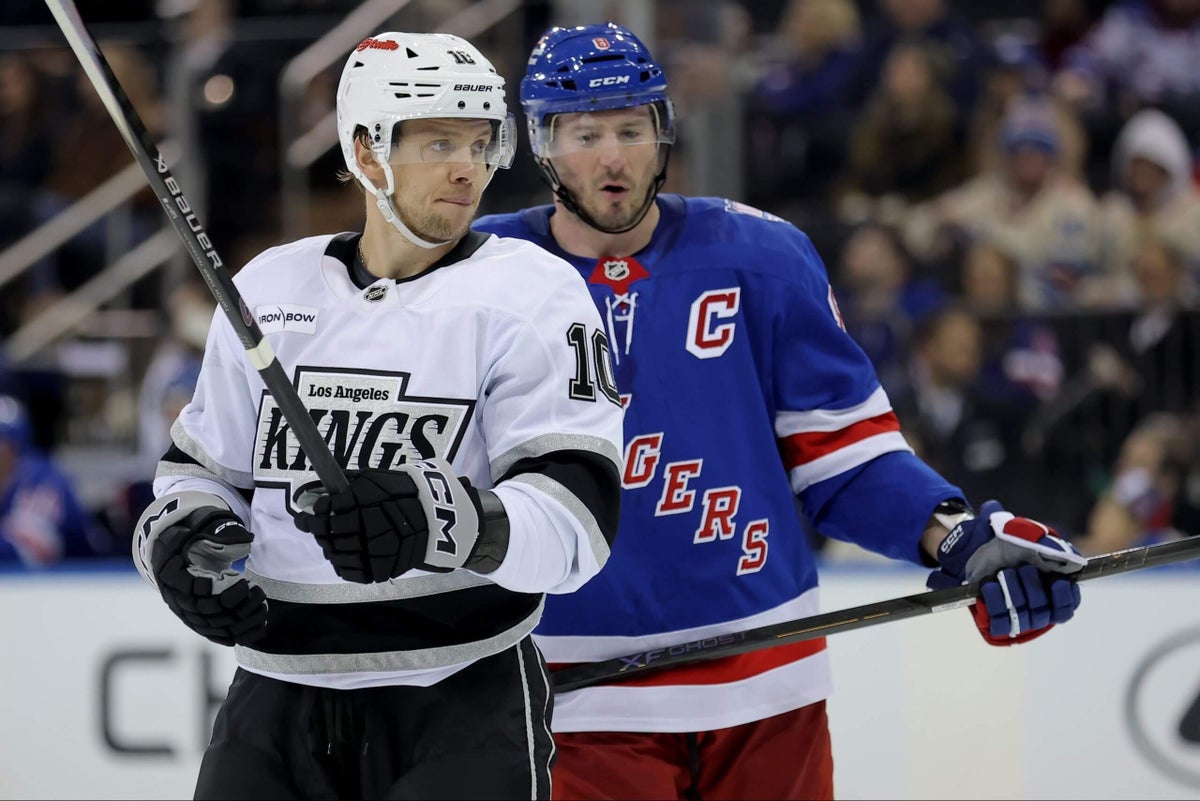
Los Angeles Kings receive: Artemi Panarin
Rangers receive: Liam Greentree, conditional 2026 third-round pick (becomes a second-round pick if Los Angeles wins a playoff series), conditional 2028 fourth-round pick (only conveys if Los Angeles wins two playoff rounds)
Rangers fans certainly wanted more in a Panarin trade, but as soon as Drury informed Panarin he wouldn’t re-sign him, the star winger had all the leverage with a full no-movement clause. After talking to teams and hearing extension offers, Panarin and his camp chose the Kings as his landing spot. Could Drury have gotten a bit more had he waited until after the Olympic break to finalize the trade? Perhaps. But that strategy would have risked the Kings backing out of the deal. The worst-case scenario would have been Drury failing to trade Panarin and receiving nothing for one of his most valuable chips at the 2026 deadline.
Greentree ranks No. 2 on Wheeler’s Rangers’ prospect rankings, so he’s a legitimate prospect. The Rangers could get better draft capital if the Kings go on a run, though that looks doubtful. They’re currently out of a playoff spot.
The more existential question is less about the return and more about the post-trade plan. The Rangers roster does not have the skill necessary to truly contend. Does Drury have any way to acquire it?
March 5, 2026
Buffalo Sabres receive: Sam Carrick
Rangers receive: 2026 third-round pick, 2026 sixth-round pick
Carrick gave the Rangers what they envisioned when they signed him to a three-year, $1 million AAV deal in July 2024. But given the state of the team and the value of centers on the market, trading him made sense and the return felt fair.
March 6, 2026
Calgary Flames receive: Brennan Othmann
Rangers receive: Jacob Battaglia
By the end of Othmann’s time in New York, it became clear the 2021 first-round pick was not going to pan out. The Rangers probably could’ve traded him sooner for better value, but it’s hard to envision them getting much more for him at this deadline.

The Offensive, Defensive and Net Ratings of the Rangers’ NHL players, as well as players they traded away on new teams. (Courtesy of Dom Luszczyszyn)
Broad observations
• When young, skilled players — ones who presumably fit a retool timeline — go elsewhere and succeed, it mandates some self-evaluation. Kakko and Miller both didn’t seem likely to reach their ceilings with the Rangers, but they have had good seasons with the Kraken and Hurricanes, respectively. As the Rangers try to infuse their roster with youth, they must examine what went wrong with recent players they couldn’t get the best out of.
• In the case of both Kakko and Othmann, the Rangers traded once-highly regarded prospects while their value was arguably at its lowest. Chytil probably falls into that category, too, but it’s hard to fault anyone for that, given his bad injury luck.
• Is retooling realistic? Or are the Rangers headed for a full rebuild? If so, the J.T. Miller trade looks like an ill-advised move, one that both made the team older in the present and cost the team a high draft pick for the future.
• Drury’s path to expediting this retool isn’t clear, especially after he moved on from Panarin, his most skilled forward. The free agent class is weak, and the Rangers don’t have as many trade chips as other teams that are already closer to contention. Cap space matters only if there are players to use it on.