
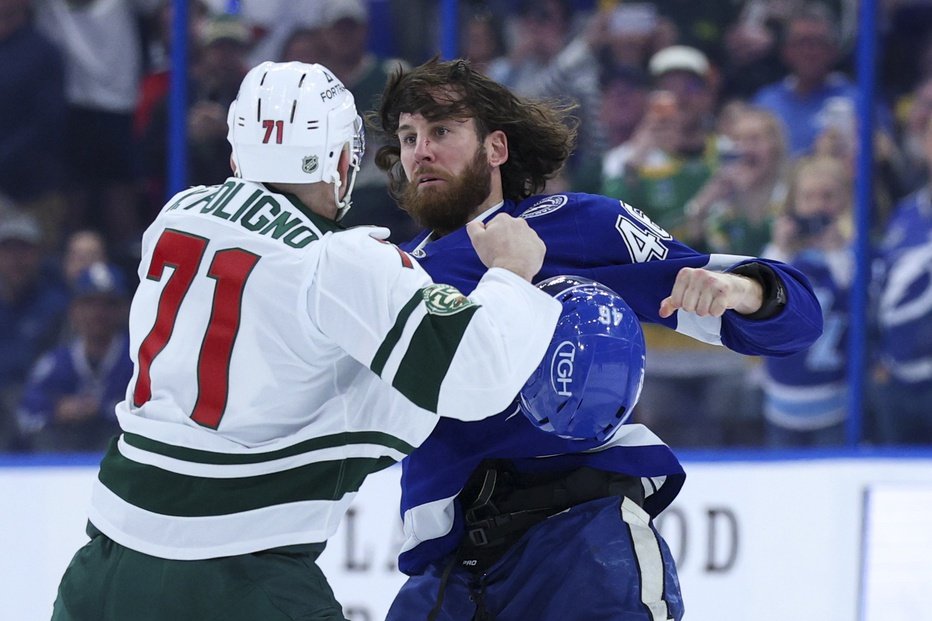
The Minnesota Wild’s newest bruisers did more than just drop the gloves in Tampa; they spilled blood and sent a message that nobody will push this Wild team around.
Early against the Tampa Bay Lightning, Michael McCarron answered a simmering, playoff-style tone by squaring up with Corey Perry, a veteran agitator who has made a career out of crossing lines. In the middle of the scrum, McCarron landed a vicious uppercut that opened Perry up, leaving a bloody gash on his face and forcing immediate attention from the trainers.
It was the kind of moment that flips a switch on both benches. The Lightning knew they had a problem in the 6-foot-6 center, and the Wild saw, in real time, what it means to have that kind of size and snarl on their side. The physicality of the fight alone didn’t resonate with the Lightning. Instead, it’s who McCarron chose and when he chose him.
Perry is a serial crease-crasher and after-whistle menace, and McCarron answered that with a statement that he can’t take liberties with Minnesota’s stars without consequence. For a Wild group that has lived on the wrong end of heavy games in recent years, seeing a new teammate address that situation and literally draw blood is a jolt of identity in one violent sequence.
Not long after McCarron sat down for his five-minute major, Nick Foligno delivered his own response to Tampa’s physical edge. A hard hit on Quinn Hughes, the Wild’s new cornerstone on the back end, lit the fuse; Foligno immediately hunted down Scott Sabourin and dragged him into a center-ice scrap that had nothing to do with the scoreboard and everything to do with sending a message.
McCarron had already spilled blood in his fight, but this was about paying that debt back on behalf of a new teammate who hadn’t even had time to fully unpack in St. Paul.
After the game, Foligno talked about an ethos that goes beyond a single night: If you run one Wild player, you answer to all of them. For a veteran walking into a new room, there’s no faster way to earn credibility than to throw hands with a star defenseman he barely knows yet. That kind of immediate sacrifice doesn’t just resonate with Hughes; it tells every skilled player in that lineup that they can take a hit to make a play knowing there’s a safety net wearing green and white.
The fights in Tampa won’t show up on any skills highlight reel, and the Wild still walked out with a 6-3 loss. However, they carry a lot of value in the room. McCarron arrived in Minnesota with a reputation as a punishing, low-risk forward who has never hesitated to fight for his teammates. He just exported that identity straight into a rivalry-style game with playoff temperature.
Meanwhile, Foligno is introducing himself in blood and bruises, establishing that he’ll happily take on a designated tough guy like Sabourin if it means reinforcing that the Wild won’t accept free hits on their core. Coaches love to say that “team toughness” matters more than one enforcer. This is what it looks like in practice: different players answering the bell at different times, building the expectation that everyone is protected.
Over an 82-game grind and into the spring, that changes how opponents forecheck, how they finish hits on Kaprizov or Hughes, and how confidently Minnesota can play through contact. In one bloody night, McCarron and Foligno didn’t just stand up for their new teammates; they helped redraw the Wild’s identity as a group that hits back, and keeps hitting, long after the first punch lands.
Think you could write a story like this? Hockey Wilderness wants you to develop your voice, find an audience, and we’ll pay you to do it. Just fill out this form.