
The coming of yet another rookie class is a reminder that you are indeed getting older.
So are the Philadelphia Eagles. The decaying elements of finality revealed their features this offseason. Lane Johnson batted away retirement speculation for another season. Landon Dickerson considered his career before pursuing stem cell treatment in Colombia (following Cam Jurgens). A.J. Brown, who turns 29 in June, remains a trade-candidate question mark as the All-Pro wideout mulls his efficacy while the clock ticks on his prime.
Those are three of the seven Eagles scheduled to make at least $20 million this season. Only two other teams pay as many so much. It is a sign of the talent general manager Howie Roseman has cultivated. It is a prompt for Roseman to reload as those players (and their contracts) mature. To prolong a golden era that includes three NFC East titles, two Super Bowl appearances and one ring, the Eagles must prevent the upper class of their roster from sliding into disorder, and secure an influx of contributors on rookie contracts who will mature within the cycle.
Roseman and his scouting department own a solid reputation on draft day. Quinyon Mitchell and Cooper DeJean, their first two picks of 2024, both earned All-Pro selections in their second seasons. Jihaad Campbell and Drew Mukuba, the first two picks of 2025, had promising rookie years and are projected starters in 2026. The Eagles acquired 14 of their 22 starters in their NFC wild-card loss through the draft. After a slightly more flexible free-agency budget than last year — headlined by signing cornerback Riq Woolen to a one-year deal worth up to $15 million — the Eagles are setting their focus on Pittsburgh, the site of this year’s NFL Draft.
The Eagles own nine total selections. Roseman’s history of frequent draft-day trades effectively makes the positioning of those picks starting points. Below is a look at some players who could interest the Eagles on each day.
Day 1
(The Eagles have one pick in the first round at No. 23)
Kadyn Proctor, OT, Alabama: Proctor is the sort of prospect who has long fit the Eagles’ plan along the offensive line. He’s 6-feet-7, 360 pounds. He was once No. 2 on Bruce Feldman’s “Freaks list.” He was a three-year starter for a Crimson Tide program that twice played in the College Football Playoff and won a Southeastern Conference title. In short, he’s a big dude who’s played in big games. Longtime offensive line coach Jeff Stoutland may have left the organization, but that doesn’t mean the Eagles are redefining what they are looking for. The Eagles need to identify a successor for Johnson, and Proctor can play guard or support as a swing tackle in the meantime. Dane Brugler and Zach Berman both had Proctor going to the Eagles in previous mock drafts. Will Proctor fall to them?
Max Iheanachor, OT, Arizona State: Here is a sensible target if Philadelphia’s system change under new offensive coordinator Sean Mannion significantly influences how the Eagles draft. The new hires, including offensive line coach Chris Kuper, signal the Eagles’ shift to more zone-blocking schemes. Will the Eagles place more emphasis on movement and athleticism with offensive line prospects? Roseman told reporters before the NFL scouting combine, “Maybe a click.” Iheanachor has a soccer and basketball background, which explains why his footwork skills helped him thrive in zone-blocking techniques. As Brugler’s No. 44-ranked prospect, is Iheanachor more of an option if the Eagles were to trade back?
Keldric Faulk, Edge, Auburn: Faulk fell to the Eagles in The Athletic’s most recent beat writer mock draft. He is Brugler’s No. 15-ranked prospect. If Faulk were available, he would be the very sort of value pick Roseman hasn’t resisted. Edge rusher also emerged as a primary need for the Eagles after the Panthers lured Jaelan Phillips away in free agency with a four-year, $120 million contract. Faulk’s 6-6, 270-pound frame would afford the Eagles an edge-setting giant they don’t have under contract. Faulk fits the Phillips/Josh Sweat mold.
Kenyon Sadiq, TE, Oregon: While we’re talking about trades, would Roseman be willing to move up a few spots to snag his next franchise tight end? Or could Sadiq fall to the Eagles? They re-signed Dallas Goedert to a one-year deal after twice pushing back a void date during the negotiation process. But it wouldn’t hurt the Eagles financially to move on from Goedert during the summer if they somehow landed Sadiq. A 6-3, 245-pound “Freaks List” alum, Sadiq is an all-around tight end whose credentials suggest he’d fit in a lineage that went from Brent Celek to Zach Ertz to Goedert.
Akheem Mesidor, Edge, Miami: Mesidor’s late-season surge in sacks is compelling. He totaled 5 1/2 of his 12 1/2 sacks in 2025 during Miami’s four playoff games — two in the CFP title against Indiana. But the 6-3, 265-pound Mesidor will turn 25 on April 5, the same age as Nolan Smith and Jalyx Hunt. Mesidor also has a history of foot and arm injuries. Is Mesidor’s pass-rush production compelling enough to make the concerns associated with his age and health worth it?
Vega Ioane, G, Penn State: I don’t anticipate Ioane being available to the Eagles, but he’s the top guard in this class and is worth mentioning due to Dickerson’s considerations of his injuries and pain management. Dickerson, who has had more than a dozen surgeries in his career, will play a sixth season in Philadelphia. But the Eagles revised Dickerson’s contract extension into a two-year deal that now ends after the 2027 season — a year earlier than the original contract. A first-round guard is probably too proactive a move at this point, but the Eagles also lack depth at this position and ought to be seriously thinking about a locker room without their three-time Pro Bowler. Ioane paved pathways for Penn State through the 2024 CFP semifinals.
Emmanuel McNeil-Warren, S, Toledo: The Eagles don’t yet know who will start at safety opposite Mukuba. Michael Carter II, a career nickel, is the front-runner after returning on a restructured contract. The Eagles also signed Marcus Epps and J.T. Gray to one-year deals after trading Sydney Brown to the Atlanta Falcons in a pick swap. It seems a reach to suggest Roseman would select a safety at No. 23. If the Eagles were to trade back, McNeil-Warren could fit in that value. Eagles coach Nick Sirianni has strong ties to Toledo’s coaching staff, and Mitchell was teammates with McNeil-Warren in 2022 and 2023. At 6-3, 209 pounds, McNeil-Warren had a pick-six last season and has shown promise against the run.
Denzel Boston, WR, Washington: We have reached the “if” stage of this big board. If the Eagles trade Brown, they’d be in the market for another outside receiver. If the Eagles trade Brown, it would not be a stretch for them to spend a first-round pick on the position. At 6-4, 210 pounds, Boston has proven he can make contested catches. It would be unfair to suggest he can beat man coverage like Brown. Few can. Still, his 3.1 percent drop rate in college shows why play callers and quarterbacks go to him. Boston was a high-volume target in his final two seasons at Washington. He totaled 125 catches, 1,715 receiving yards and 20 touchdowns in those years.
Omar Cooper Jr., WR, Indiana: Cooper played primarily in the slot last season — his most productive year (69 catches, 937 yards, 13 touchdowns). He had more experience as an outside receiver in 2024, when he led the Big Ten in yards per catch (21.2) with 28 receptions for 594 yards and seven touchdowns. Sirianni has long preached the importance of explosive plays. Cooper, who is 6-foot, 204 pounds, is arguably the best yards-after-catch receiver in this draft class. If the Eagles move on from Brown, pairing Cooper with DeVonta Smith as the No. 1 receiver (and Hollywood Brown on the field) could be an intriguing combination.
Caleb Lomu, OT, Utah: Draft pundits are bearish on Lomu’s abilities as a run blocker against powerful NFL defenders. That’s a red flag for an Eagles offense whose ruinous regression in the run game last season led to former OC Kevin Patullo’s ouster. But if the Eagles were to lean into the principles of the zone-blocking system, Lomu’s athleticism speaks louder. Utah’s offensive system frequently featured Lomu as a pulling blocker. At 6-6, 313 pounds, his frame should allow him to put on more mass to assist him as a run blocker.
Cashius Howell, Edge, Texas A&M: An All-American in 2025, Howell totaled 11 1/2 sacks and 14 tackles for loss for an Aggies team that reached the CFP for the first time. He projects as a pass-rush specialist early in his career. That could serve the Eagles well with Nolan Smith and Hunt already in the rotation. But the Eagles need a reliable run-stopper and edge-setter after Phillips’ departure. The 6-3, 253-pound Howell will need to develop into an every-down defender.
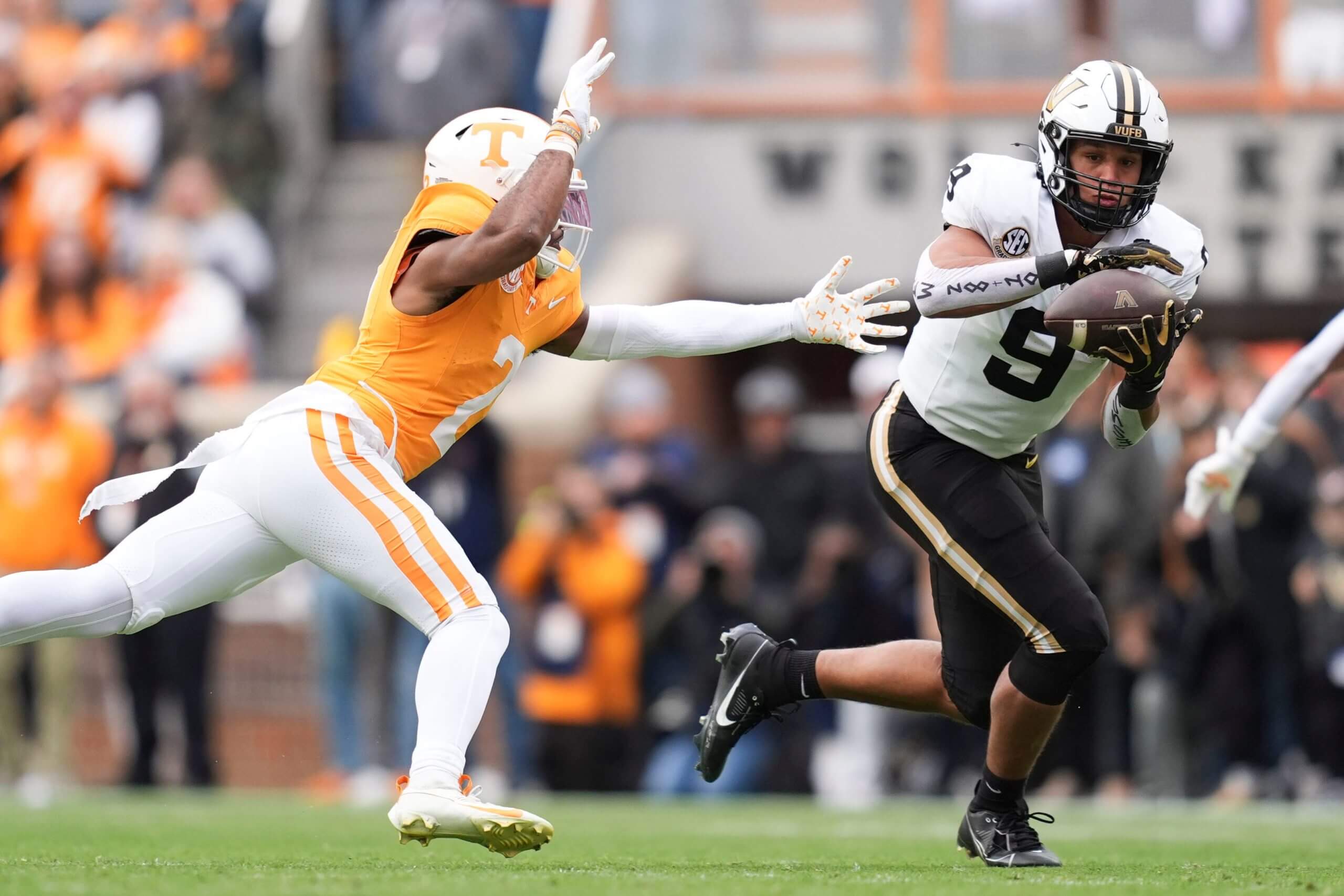
Eli Stowers could be the Eagles’ tight end of the future. (Angelina Alcantar / Imagn Images)
Day 2
(The Eagles have one pick in the second round at No. 54 and two picks in the third round at Nos. 68 and 98)
Eli Stowers, TE, Vanderbilt: After beginning his college career with Texas A&M and transferring to New Mexico State, Stowers at Vanderbilt blossomed into one of this cycle’s top pass catchers at tight end. He totaled 111 catches for 1,407 yards and nine touchdowns in two seasons at Vanderbilt. His size (6-4, 235 pounds) and quickness made him a consistent mismatch in coverage. If Sadiq doesn’t fall to the Eagles in the first round, they could scoop up Stowers as their tight end of the future in the second round — although it may take trading up to do it.
Malachi Fields, WR, Notre Dame: Another big target who projects as an outside receiver, the 6-4, 222-pound Fields has the leap-and-grab abilities that have suited Brown and DeVonta Smith in Philadelphia’s offense for the last four years. Back to the “if” game. If wide receiver becomes a major need for the Eagles, and if they can’t pass on another player of value at another position in the first round, they may be able to plan for a trade package to pursue Fields if he nears the middle of the second round. A top target for two seasons at Virginia, Fields spent his final season at Notre Dame, where he led the Fighting Irish with 17.5 yards per catch while totaling 36 passes for 630 yards and five touchdowns.
Derrick Moore, Edge, Michigan: A member of Michigan’s 2023 national championship team, Moore showed he can be disruptive in his final season. He totaled 10 sacks and 10 1/2 tackles for loss in 2025. His best production did not come against Michigan’s best competition. Still, he has enviable size for the position (6-4, 255 pounds).
Max Klare, TE, Ohio State: Perhaps the most available tight end early in the draft for the Eagles. Klare is a proven pass catcher. Before transferring to Ohio State in 2025, Klare was Purdue’s leading receiver in 2024 with 51 catches, 685 yards and four touchdowns. The Buckeyes poached him, and he totaled 43 catches, 448 yards and two touchdowns on a talent-laden team that lost in the second round of the CFP. The 6-5, 243-pound Klare was a serviceable blocker and possesses the athleticism that would suit Mannion’s system.
Zakee Wheatley, S, Penn State: A second-round defensive back for the third straight season? A second-round safety for the second straight season? Perhaps! As previously stated, the Eagles ought to still bring in competition for the starting job that opened when Reed Blankenship signed with the Houston Texans. Wheatley’s strength is in coverage. So is Mukuba’s. It’s worth wondering if the Eagles ought to balance the back end with a plus tackler instead. But Roseman said after drafting Mukuba that it’s hard to find cover safeties — indicating a higher value on that skill. A strong 2024 season showed Wheatley can be disruptive: three interceptions, two fumble recoveries and a forced fumble.
A.J. Haulcy, S, LSU: Haulcy was a turnover machine in college. The Eagles are looking to boost their takeaways after a down year in 2025, in which Hunt led the team with three interceptions. Haulcy’s nickname in high school was “Mr. Give Me That.” He started his college career at New Mexico, where he totaled two interceptions in 2022, transferred to Houston, where he led the Cougars with five interceptions in 2024, then finished his career at LSU, where he had three interceptions in 2025. Haulcy also totaled four forced fumbles across his four seasons.
Caleb Tiernan, OT, Northwestern: Tiernan, Brugler’s No. 63-ranked prospect, is another massive tackle at 6-7, 320 pounds. Brugler still describes him as a prospect who has “controlled, efficient movements as a pass blocker that help him stay square against various pass-rush angles.” Brugler is less complimentary of Tiernan’s recover skills in the run game.
Josiah Trotter, LB, Missouri: Roseman could make sure no other NFL team ever gets to draft a Trotter. The Eagles drafted Jeremiah Trotter in 1998, then drafted his son, Jeremiah Trotter Jr., in the fifth round in 2024. His younger brother, Josiah, also calls to mind images of their father. The 6-2, 237-pound linebacker perpetually hammered ball carriers at Missouri. He totaled 13 tackles for loss and two sacks in 2025. He suffered a knee injury in the regular-season finale against Arkansas that required knee surgery. The Eagles do not need starting linebackers with Zack Baun and Campbell under contract. But after Nakobe Dean’s departure in free agency, they could stand to add depth and prepare for the future.
Dani Dennis-Sutton, Edge, Penn State: Dennis-Sutton is a fine pass rusher (he had 8 1/2 sacks in each of his last two seasons), but his size (6-6, 256) and toughness against the run make him an attractive prospect for the Eagles. He fits well into the mold of Phillips and former Eagles edge rusher Sweat.
Malachi Lawrence, Edge, UCF: Lawrence had consistent sack production at UCF, never totaling fewer than five sacks in his final three seasons. He totaled 19 1/2 in that span. He has a high motor with a prototypical 6-4, 260-pound frame. As written above about Howell, Lawrence would need to improve against the run to embody the all-around edge rusher the Eagles lost in Phillips. But there is plenty of upside in Lawrence’s size and speed.
Bryce Lance, WR, North Dakota State: Bryce (the younger brother of Los Angeles Chargers backup quarterback Trey) is a 6-3, 210-pound prospect who ranked No. 34 on Feldman’s “Freaks List.” The Eagles own the No. 68 pick from the Haason Reddick trade. If they are still pursuing an outside receiver at this stage of the draft, Lance, who just had back-to-back 1,000-yard seasons, deserves a look.
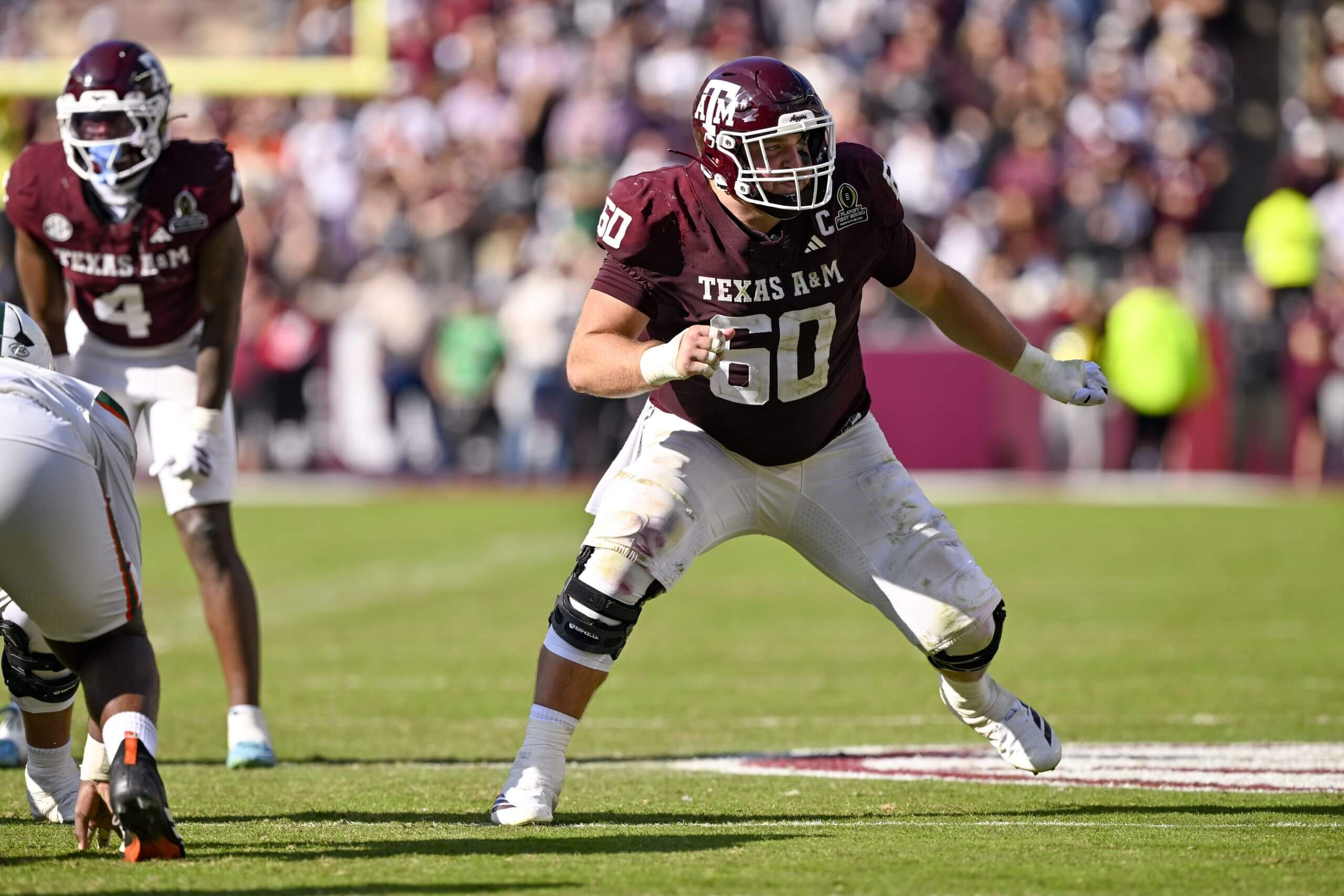
Trey Zuhn III could be an option for the Eagles in their search for offensive line depth. (Jerome Miron / Imagn Images)
Day 3
(The Eagles have two picks in the fourth round at Nos. 114 and 137, two picks in the fifth round at Nos. 153 and 178, and one pick in the sixth round at No. 197)
Trey Zuhn III, OL, Texas A&M: Roseman said the Eagles are “looking at the depth” behind their starting five offensive linemen. Doubling up in the draft on linemen will make sense for the Eagles — at the very least on Day 3. Zuhn was a four-year starter at left tackle for the Aggies and was a team captain in 2025. His lack of arm length projects him inside; the Eagles have liked linemen with inside-outside versatility. Zuhn’s lateral quickness suits him well for the zone-blocking schemes the Eagles are embracing in Mannion’s system.
Austin Barber, OL, Florida: The Eagles re-signed swing tackle Fred Johnson to a one-year deal Tuesday. But Barber, a 6-6, 318-pound left tackle, could also be a candidate for that role. That’s the sort of expectation that should be placed on linemen drafted on Day 3 — although the Eagles have hit the jackpot here on more than one occasion (Jason Kelce, Jordan Mailata).
Eric McAlister, WR, TCU: If the Eagles hang on to A.J. Brown, drafting wide receivers on Day 3 may seem like a useless exercise. They just signed Hollywood Brown and still have uncharted talent in Johnny Wilson and Darius Cooper. But if a wide receiver is the highest prospect on the Eagles’ draft board on Day 3, I’d still expect them to take a shot at the lottery. McAlister is projected to go on Day 3 because of reported limitations as a route runner and difficulties against man coverage. The 6-3, 193-pound wideout led TCU with 1,190 receiving yards and 10 touchdowns in 2025.
Taylen Green, QB, Arkansas: Roseman has long valued quarterback depth to a higher degree than most teams. The Eagles now have two capable backups behind Jalen Hurts: Tanner McKee and Andy Dalton, whom they acquired from the Carolina Panthers for a seventh-round pick. Drafting a fourth quarterback would prepare the Eagles in the event they find a good trade package for McKee. Would they invest as high as a fourth-round pick in a QB with McKee still on the team? Green has favorable size at 6-6, 229 pounds and rushed for more than 2,400 yards across four seasons as a starter at Boise State and Arkansas.
Ar’maj Reed-Adams, OG, Texas A&M: Reed-Adams spent his first four seasons at Kansas before transferring to Texas A&M in 2024. His 6-6, 314-pound frame catches the eye. Draft analysts tend to scrutinize his ability to run block on the move. Stoutland earned a reputation for developing linemen into reliable contributors and All-Pros. Kuper’s ability to develop Day 3 offensive linemen will be measured against Stoutland’s stellar record — fairly or unfairly.
VJ Payne, S, Kansas State: Payne could be a good Day 3 find if the Eagles eschew the safety position during the first two days. The three-year starter and team captain’s career interception total may be low (four), but Payne thrived as a cover safety against the Big 12’s top pass catchers. At 6-3, 206 pounds, he has tempting physical traits. Questions of his play against the run remain.
Ja’Kobi Lane, WR, USC: Lane was a premier red-zone target for the Trojans during a 2024 season in which he had 12 touchdown receptions. At 6-4, 200 pounds, he has proven himself capable with contested catches. Questions persist about his ability to separate.
Jalon Kilgore, S, South Carolina: Another option for depth at safety for the Eagles. Kilgore’s time playing nickel for South Carolina makes him a distinct prospect in Day 3. The Eagles seem intent on keeping DeJean at nickel. But it doesn’t hurt to prepare contingency plans in the event they must move their most versatile defensive back to cornerback or safety for whatever reason. Kilgore can play safety and nickel and totaled eight interceptions in his final three seasons.
Aaron Graves, DT, Iowa: Creating an Eagles big board without a defensive tackle just feels wrong. They have them in ample supply. Jalen Carter, Jordan Davis and Moro Ojomo are projected starters again in 2026. They spent a fourth-round pick on Ty Robinson last year, and Robinson is expected to have an increased role in 2026. Gabe Hall and Byron Young remain under contract. But Roseman can never draft too many linemen. Graves is a 6-5, 295-pound tackle who totaled 16 1/2 sacks and 25 tackles for loss in four seasons with Iowa. A William V. Campbell Trophy finalist, Graves could be a tempting pick on Day 3.
Cade Klubnik, QB, Clemson: Once an elite recruit, Klubnik entered the 2025 season as a Heisman Trophy contender before a down year diminished his draft stock. Klubnik, who is from Austin, Texas, could stand to benefit from being in a quarterback room with Hurts, a Houston native. Promising tape on Klubnik remains. In 2024, he threw for 3,639 yards, 36 touchdowns and six interceptions. He threw for 2,943 yards, 16 touchdowns and six interceptions in 2025.
Mikail Kamara, Edge, Indiana: Kamara was the defensive MVP of the College Football Playoff National Championship Game. His blocked punt against Miami turned into a decisive touchdown in Indiana’s first national title game victory. He totaled 23 1/2 sacks and 45 tackles for loss across his four seasons playing for James Madison and Indiana. He’s considered undersized at 6-1, 265 pounds. But he could be a versatile platoon player and an impact player on special teams.