
Welcome to Scott Wheeler’s 2026 rankings of every NHL organization’s prospects. You can find the complete ranking and more information on the project and its criteria here, as we count down daily from No. 32 to No. 1. The series, which includes evaluations on nearly 500 prospects, runs from March 9 to April 8.
The Sabres don’t have any legit wing prospects after moving Isak Rosén and graduating Zach Benson, but they have pieces at premium positions, with future NHLers at center and on defense.
2025 prospect pool rank: No. 11 (change: -2)
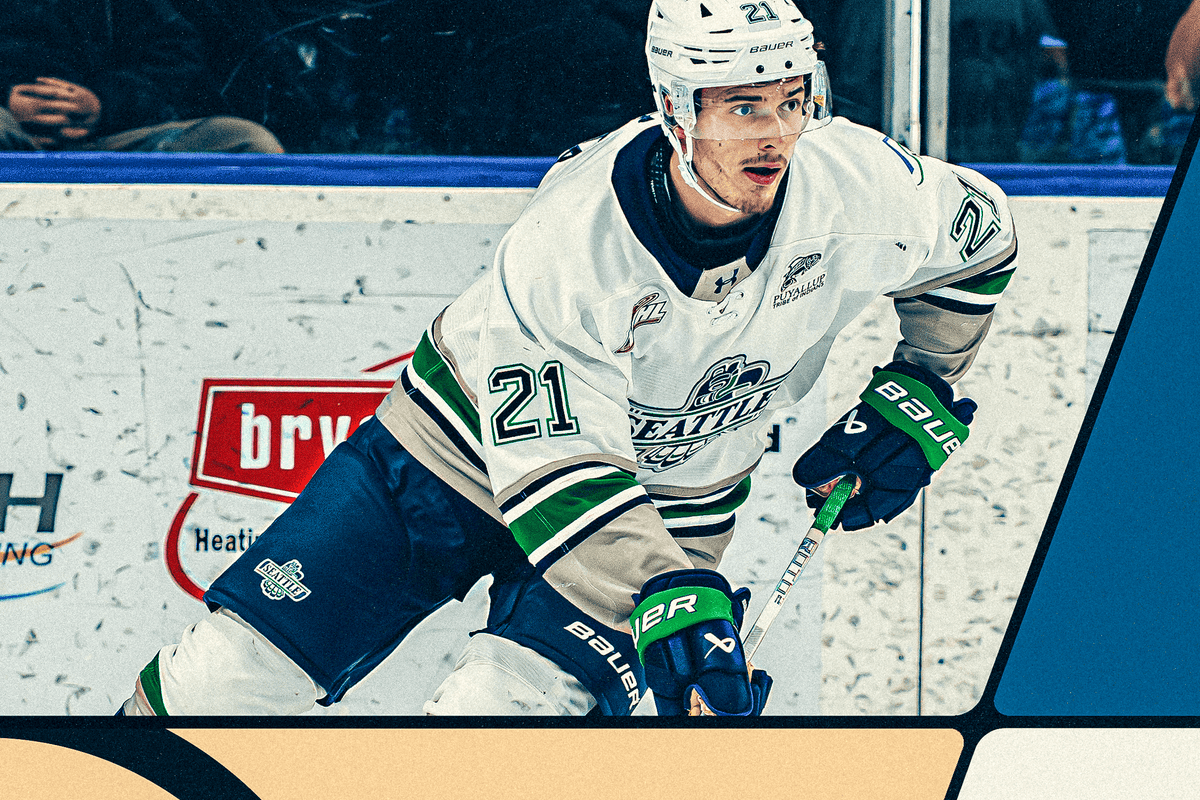
Tier 11. Radim Mrtka, RHD, 18, Seattle (No. 9, 2025)
Mrtka is a towering right-shot defenseman who skates extremely well and played huge all-situations minutes last season for Czechia at the Hlinka, Seattle in the WHL and the national team again at U18 worlds in Texas, where he was outstanding in the tournament opener against Team USA but didn’t stand out in the same way in Czechia’s other games. After joining the Thunderbirds in his draft year, he was phenomenal, playing to nearly a point per game on a low-scoring team, logging an average of 27 minutes and often 30, and going over the boards first on both the power play and penalty kill. This season, after starting in Rochester, he has had a good year back with the Thunderbirds and played at the World Juniors for Czechia, where he missed the start of the tournament due to injury, but I wouldn’t say he has taken a step. He has a very compelling combination of tools, though.
Mrtka can transport pucks down ice, activate and join the rush, walk the line and even side-step pressure in control at 6-foot-6. He shows poise and comfort on the puck with a willingness to hold onto it and make a play in small areas, though I think he can be indecisive at times. He has a good shot that he keeps low and on target and can occasionally really attack into, which I’d like to see him do more of! He’s super smooth moving around the ice. He defends well with his long reach and standout skating ability. He has a good stick, and with his length and mobility, his defensive upside is high. I’ve seen him play physical and impose himself that way as well, though there are scouts who want to see him play a little harder at times and coaches may try to push him that way at the NHL level.
It’s also important to remember that Mrtka is a June birthday and already doesn’t have some of the kinks you expect a D his size and age to have. I would like to see him take charge a little more on both sides of the puck at times, given the tools — he reminds me a little of Owen Power in some ways — but the upside is real, and he’s going to have a long career.
2. Konsta Helenius, C, 19, Rochester/Buffalo (No. 14, 2024)
Helenius put together one of the most productive under-18 seasons in Liiga history in his draft year, in similar territory as names like Patrik Laine, Kaapo Kakko and Mikael Granlund without quite chasing down record-holder Aleksander Barkov. He wasn’t just one of the better young players in Liiga, or one of the better players on Jukurit, either. He became one of the top players in the league, cemented by an excellent Liiga playoffs, and did it while sticking at center as a 5-11 17-year-old, too. At year’s end, he was also excellent in his debut with the Finnish men’s team, earning a spot on the senior world championships roster though his men’s worlds was a little up and down. He was also Finland’s top player at U18s, though he didn’t completely take over in the way many expected he would. All this, after impressing at world under-17s and a prior U18 worlds; after playing 33 Liiga games as the league’s youngest player at 16 and still registering 11 points; after impressing at the World Junior Summer Showcase months after his 17th birthday and still as the youngest player invited; and after centering a top-six line as an underager at his first World Juniors, where he wasn’t a star but I thought played better than his two points in seven games indicated.
Last season, while he was a good player in the AHL and a top point producer for the silver medal-winning Finns at his second World Juniors, I don’t think he was a standout for either, and the quiet showing marked a second consecutive international event like that. This season, he seems to have moved past the rookie learning curve in the AHL and has really settled in as a top player in the league as a teenager, scoring his first NHL goal along the way.
Helenius is going to have a long NHL career, and you have to remind yourself of his age when contextualizing what he’s accomplished, but some things in his profile do give me pause about a true top-six projection. He may end up as more of a middle-six type. Some wondered for a time if he’d be a center or winger at the NHL level, but he’s solid enough in the faceoff circle and aware enough defensively — it was a real strength of his game pre-draft because of his reads, positioning, tracking and puck-winning on the forecheck, but there have also been times post-draft where I’ve found he’s not engaged as much as he was last year — that I project him as a center.
Helenius is enjoyable to watch navigate, manipulate and pass the puck with his smarts and intuition. He’s crafty in traffic and does a great job finding ways through the neutral zone and across the line on entries. He can find his teammates in space and then get pucks to them with the perfect weight and timing, even while he’s well covered. He can also stir the drink through his effort level, though again I’ve found it to be inconsistent in stretches of his young career as well, and can come up with pucks when you don’t expect him to (he’s good on steals and lifts) while quietly and efficiently affecting play.
He needs to play with more pace at times, but he does such a good job identifying lanes and taking what the defense gives him. He’ll look for his own look when it’s there or play in a quick give-and-go when spacing tightens up. He seems to create constantly for his linemates with his poise and passing play. He’s a decent, though not above-average, skater who anticipates the play at a very high level off the puck — the puck just seems to find him again and again inside the offensive zone. He shields pucks extremely well for a player his size and can play keep-away to wait for his options to open up. He has a sixth sense for timing and spacing. He’s usually in good support positions and makes smart decisions with the puck. He has vision and finesse as a problem-solver.
He’ll be an interesting case study in how far smarts can take a player without a defining/dynamic trait to complement the IQ.
3. Noah Östlund, C, 22, Rochester/Buffalo (No. 16, 2022)
Östlund’s calling card is his airy, agile skating stride, excellent hands, cleverness and committed two-way game. The skating and defensive aptitude (including on faceoffs) make him an able penalty killer, and the rest give him clear tools of play creation at five-on-five and on the flank on the power play. He wins a ton of short races, creates quickly as soon as he’s in possession and darts around the ice in control to get into scoring areas or facilitate from the perimeter.
His lack of size and strength — he has always been lean at 5-11, though he is now up to a playable 180 pounds — has been a talking point at times, but I thought it’d make his jump to the SHL and then AHL and NHL a little more challenging than it was. He wasn’t helped by a fall hand injury in his rookie season in the AHL, but he really came on strong in the second half of his first season in Rochester last year, and the on-ice results have been consistently strong, earning him a full-time NHL job that will soon graduate him from this list. His well-rounded game, consistent play and skating have always made him a coach’s favorite.
Östlund is silky smooth in possession and a superb puck transporter through neutral ice. He has a slippery quality that few players have; the puck just sticks to him in tight coverage, and he is a catalyst on his line in a variety of ways. He’s a nifty little player. Some scouts worried about whether he’d be able to get to the inside/hold his own physically along the wall in the NHL (he has never scored a ton), but his approach and skating have predictably helped mitigate against that. The flow, the work ethic, the ability to hang onto it or play in quick give-and-goes, his stick on steals, the changes of directions and cutbacks: there’s a lot to like. He has and holds the puck a lot, he’s so shifty in possession side-stepping defenders or turning them on angles, and even though he doesn’t always produce something out of his natural playmaking game because he’s still missing that finishing strength, he’s noticeable and making plays nonetheless. The stops and starts, and how quickly and tightly he turns, really make him hard to get a handle on and have helped him escape the cycle well against bigger competition.
He has skill and pace, and he can be a driver.
Tier 24. Devon Levi, G, 24, Rochester (No. 212, 2020)
Levi’s pro career hasn’t lived up to the pedigree he built in his college years, but his career AHL save percentage is still between .915 and .920. And while I’ve been in the minority and the Sabres don’t seem to be prioritizing him as they did early on anymore, I’ve always favored him to Ukko-Pekka Luukkonen. He had two seasons for the ages at Northeastern, winning the Mike Richter Award as college hockey’s top goalie in back-to-back years as a freshman and sophomore, and finished his college career with a .942 save percentage while mixing in three appearances at three different levels for Hockey Canada. His journey from the CCHL to the World Juniors and then the Olympics, all during the pandemic, was one of the best stories in hockey for a little while there. And he’s still young by goalie standards, even if it feels like he has been around forever and hasn’t broken through at the NHL level.
He still has pretty much exactly the skills smaller goalies need to be successful. Impressive control on his inside and outside edges, and the patience to hold them. Quick feet on his shuffles so that he can stick with dekes and go post-to-post or low-to-high to get to tough pucks. Good hands. Excellent reads on shooters. Excellent tracking through and under traffic. And a battler’s mentality in the net, which keeps him in plays even when he looks like he’s down and out. There aren’t a ton of 6-0 goalies in today’s NHL, at least not starting ones, but guys like Jet Greaves and Dustin Wolf have broken through and I’m still not ready to count Levi out — though I do wonder if a change of scenery could help at this point.
5. Adam Kleber, RHD, 20, Minnesota-Duluth (No. 42, 2024)
Kleber is a 6-6 right-shot well over 200 pounds who had a good season in the USHL in his draft and even showed a little bit of offense, but struggled under pressure at the NCAA and World Juniors levels last year as a freshman. He played just under 19 minutes per game for the Bulldogs as an 18-year-old freshman but treaded water in my viewings. This year has come with much stronger results and an even greater role with just under 22 minutes per game. He also played 22 minutes to solid results (including after partner Cole Hutson got injured) on a Team USA blue line that really struggled at the World Juniors.
Kleber makes a good first pass when there’s a direct play to be made. He’ll hold and skate pucks occasionally. His offense isn’t natural, but he puts pucks through and on net. He has a good stick and snuffs out his fair share of plays.
I wonder about his boots and his control and poise against pressure at times, but both have come even as he has added weight, which is good. He can look a little sloppy at times out there at times but he moves well within a pattern — it’s more when he’s in a rush. With proper patience and more checkpoints in his development along the way, he has a real chance to become a depth NHL D. He’s also a strong athlete, which bodes well for his mobility continuing to improve from a standstill.
Tier 36. Brodie Ziemer, RW, 20, Minnesota (No. 71, 2024)
Ziemer is, to use a tired cliche, a hockey player. He’s just good. Wherever he goes, whoever he plays with, he plays well.
He was the ’06 captain at the NTDP and head coach Nick Fohr’s everyman, an effective 18-year-old freshman at Minnesota and good for Team USA as an 18-year-old middle-sixer at the World Juniors. He was Team USA’s captain again at the World Juniors as a returnee this year and has now broken the 20-goal mark as a sophomore, which is typically an early indicator of pro progression. Ziemer is a competitor who seems to make his linemates better regardless of who he has played with. He’s committed to the details. He’ll block shots and sticks with the play. He’s opportunistic, and makes the right decision more often than the wrong one. He’s capable of opening up his hips to go heel-to-heel around the offensive zone to widen his plane of sight. He’s a good athlete who skates well and plays a strong 200-foot, three-zone game for a 5-11 winger. He just does a lot of positive things.
And he has some offense. I’ve seen him make plays from the wall and below the goal line, as well as off the rush. Those tools aren’t going to define him, but nobody will be surprised if he finds a way to become an NHL role player with some secondary offense. He’s by all accounts committed to getting better and will take his career as far as it will go. He’s not promised to be an NHLer, but if he makes it, it’ll be as a likable third-liner who plays honestly and the right way, and all of those other cliches. He finds ways to contribute at five-on-five, is better on the cycle and in the dirty areas than you expect for a player his size, and gets the most out of his game.
7. Nikita Novikov, LHD, 22, Rochester (No. 188, 2021)
Novikov impressed me in the brief World Juniors in Edmonton prior to cancellation and then really grabbed my attention at two rookie tournaments in Buffalo, racking up assists and driving two-way results. After playing 109 games in the KHL at 18 and 19 (not a common thing for defensemen), he looked the part of a good two-way defenseman as the youngest D in Rochester in his rookie year in the AHL as well, contributing at both ends and playing to the best goal differential results on the team while averaging just over 15 minutes per game. He hasn’t really taken that next step since, though. He has continued to play to strong results in a slightly increased role over the last two seasons (18 minutes per game), but he’s still not being used as a true top D at the AHL level, which means he’s not in the call-up conversation.
He has a pro build (6-4, about 200 pounds) and keeps his head up, has good feet and mobility for his size and plays a heady and efficient game. Offensively, he advances and supports play, and he defends well against the cycle and the rush with a good stick, a willingness to engage and to get in the way of shots. I think he sees the ice well, even if his game offensively doesn’t have a ton of dimension. I believe he has what it takes to be a third-pairing defenseman in the NHL and, without a doubt, a No. 7/8. But the clock will start to tick.
8. Maxim Strbák, RHD, 20, Michigan State (No. 45, 2023)
A steadying defender, Strbák’s game is all about killing plays, blocking shots, winning battles, efficiency and effectiveness. He has been relied upon across age groups with Slovakia’s national team and made the move to North American ice by working his way into big all-situations minutes in the USHL with Sioux Falls before joining the Spartans. He averaged about 18 minutes per game on a good team to positive defensive results as a freshman and has played closer to 20 as a sophomore and junior while those results have held pretty firm. He’s a go-to PK guy for them too.
Strbak is a pro-built, stocky and physically strong defender who can play hard minutes. His game doesn’t have a ton of soft skill and his skating can look a little heavy (though powerful as well) at times, but he compensates with hard work, staunch and sturdy posture, timely pinches and effective closeouts to rub players off the puck. And while he’s really strong in physical engagements, he’s also good with his stick on the puck, so he doesn’t have to always rely on his physical advantage to defend. He has also shown some offense internationally in his ability to push down ice and join in transition, and a willingness to activate off the line and get hard shots on target.
I’ve seen him really impose his defensive will and competitiveness in all four corners of the rink in games. His style occasionally comes with some mistakes trying to step up and make a stop, but he’s a rock-solid defender on the whole. The Sabres are likely hoping he can be the kind of player who balances out a more natural offensive defenseman on a pairing as a no-fuss No. 6/7/8 D.
9. Anton Wahlberg, C, 20, Rochester (No. 39, 2023)
Wahlberg is big with good hands and average skating; though he can lack coordination and look a little clunky when he’s in a hurry, he actually moves well once he settles into his stride. He has some presence on the puck and a hard shot/comfortable one-timer. He can beat defenders and make plays in and out of traffic with uncharacteristic comfort for a bigger player. He also possesses a quick, hard release, protects the puck well and uses his size effectively in control. I like him at the net-front on the power play, and he’ll block shots and commit to defense at the other end. For a 6-4 forward, he shows comfort carrying pucks into and through coverage and making soft-area plays to his linemates.
The sum of those things makes him interesting by default. Add in that he has a summer birthday, that he can play center or wing, and that he hasn’t looked out of place in the SHL at 18 (where he played 18-19 minutes for much of the second half of last season with Malmö) or in the AHL at 19 and 20 playing 15-17 minutes per game, and there’s reason for optimism that he has NHL upside if he continues to develop. I viewed him as more of a late second/early third rather than an early second in his draft year, but he’s a fine prospect who likely becomes organizational depth at minimum and may have a decent NHL career as a bottom-sixer if developed properly.
10. Vsevolod Komarov, RHD, 22, Rochester (No. 134, 2022)
Three years ago, Komarov averaged 23 minutes per game on the best team in junior hockey, playing to strong on-ice results for the Quebec Remparts as they won the QMJHL title and the Memorial Cup. After a trade from the Remparts to the contending Voltigeurs, he then played an even bigger role, logging 25 minutes per game in the regular season and 30 in the playoffs and into a second QMJHL title and Memorial Cup appearance. He led all QMJHL D in points and won both the league’s defenseman of the year award and playoff MVP while playing huge minutes in all situations and stepping up big in the absence of teammate Maveric Lamoureux, who missed the second half due to injury. He has played 16-17 minutes per game over two years in the AHL since turning pro and, like Novikov, has impressed in some rookie tournaments, but (also like Novikov) hasn’t taken a major step to put himself into the call-up conversation.
Komarov is a two-way defender who makes life hard on opposing forwards. He plays physically, makes a lot of stops and has shown improved offense and comfort on the puck beyond his big point shot (he has a mean clapper) over the last couple of years. He can look a little stilted in his posture and heavy over his feet at times, but he’s a good enough skater and he handles his gaps and coverage/assignments very well. He puts a lot of pucks through to the net, will jump off the line when he can and then knows how to position himself to win engagements on pucks. He has size (6-4, well over 200 pounds), competitiveness, smarts, hard skills, some soft skills, some vision, some poise, a good stick and a willingness to block shots.
I think he becomes a call-up option eventually, and progress in his skating will determine whether or not he becomes a full-time NHLer. There are also only so many D jobs to win, and there’s a crowd in Buffalo, which complicates things.
11. Luke Osburn, LHD, 19, Wisconsin (No. 108, 2024)
Osburn is a 6-1, 189-pound left shot whose game revolves around his four-way mobility. He’s a waterbug who uses sharp edges and footwork to change directions, close gaps, walk the line, defend tightly and move pucks. He impressed me at the World Junior Summer Showcase at the end of July and then played 22 minutes per game for Team USA at the World Juniors. He has averaged 21 per game on a good Wisconsin team this year as well.
His challenge is that while he can influence play all over the ice, he isn’t a pure stopper or a pure offensive type. He’ll have a long pro career and skates like an NHLer, but he’ll have to work his way through the AHL after college, and there’s no guarantee he plays NHL games.
Tier 412. Yevgeni Prokhorov, G, 19, Dinamo Minsk (No. 199, 2025)
Prokhorov, a seventh-round pick last year, is a 6-3 Belarusian goalie who has been the backbone of a surprisingly strong MHL team in Bobruysk this year, playing to a save percentage around .930 and a winning record, albeit in a weaker side of the massive MHL. He’s a very difficult player to handicap at this stage, as last year was his first in the MHL and his sample is still small, but he has the athletic makeup. He moves well, has good hands, controls his rebounds well, and can play the puck comfortably. He’s a long-term dice roll but worth keeping tabs on.
13. Ryerson Leenders, G, 19, Brantford (No. 219, 2024)
Leenders’ .909 save percentage led the OHL in his draft year with Mississauga, and he has followed it up with two more seasons at .910 in Brantford. He has played well on the bigger stages as well: He stopped 19/20 in the CHL/NHL Top Prospects Game (.950), 26/27 in his lone start at U18 worlds against Switzerland (.963) and has played well in his last two postseasons in the OHL. He’s not the biggest goalie, but he anticipates the play well, he’s good going post to post and athletic in stretches, he competes in the net and he has good composure. He’s also a strong positional goalie who gets in and out of his butterfly quickly, seals his posts, tracks pucks well, recovers quickly and has good feet and hands. He most likely just becomes organizational depth, but I think he gets signed after a deep playoff run with the Bulldogs this year.
14. Gavin McCarthy, RHD, 20, Boston U./Rochester (No. 86, 2023)
McCarthy, BU’s captain this year, is a what-you-see-is-what-you-get defenseman who plays the game firm and hard and has pro physical tools but relies heavily on playing off instinct instead of processing, which can come with some warts. He missed part of his draft year with a fractured knee suffered at the World Jr. A Challenge, but was an assertive defenseman at the USHL level when healthy. He played a pretty limited role as BU’s No. 7 as a freshman (about 13 minutes per game) but has played a big role in some of their challenging minutes as a sophomore and junior (23-25 minutes per game), including on both special teams.
His size (6-2, about 190 pounds), handedness and decisive game have pro appeal. I do find myself wishing he would play with a little more care and poise on and off the puck at times. He just wants to take and take and take, whether that’s attacking off the line into his shot, stepping up physically in neutral ice or taking his space in front of the net, though he has polished his game over time. He has always struck me as a version of Columbus Blue Jackets first-rounder Corson Ceulemans and actually has some parallels to Strbák as well. He should be a depth AHL D at minimum, and I could see him playing NHL games someday.
15. David Bedkowski, RHD, 19, Owen Sound/Ottawa (No. 71, 2025)
Bedkowski is a tricky one for me because his statistical profile as a now four-year OHL player and December 2006 suggests he has no chance. But he also impressed me with his skating and simple execution in multiple viewings last year (including at the OHL Top Prospects Game), was named captain in Owen Sound this year and is now playing 20 minutes per game for one of the top teams in the OHL in Ottawa.
He’s a mobile skater for 6-5, with impressive balance falling back onto his heels. He makes his decisions quickly and smartly and executes basic plays with high frequency, making a good first pass. His puck game is bland and vanilla but often in a good way. His defining quality is his physicality, though. He’s one of the meanest, toughest players to play against in the OHL and is eager to use his feet, size and timing to take away space and close out and eliminate opposing players. I could see him playing his way into an NHL contract and becoming a No. 8/9 D who plays some games. Think Simon Benoit. There’s a very real chance he becomes nothing more than a third-pairing AHLer, though, too.
Honorable mentionsMelvin Novotny, LW, 18, Muskegon (No. 195, 2025)
Novotny has been a regular — though as a depth guy — with Sweden’s ’07s internationally over the last couple of years. He played to just under a point per game at the J20 level to get drafted and has been one of the more productive forwards in the USHL this season as a rookie with Muskegon this year, despite suffering an upper-body injury in December that cost him nearly two months of games. He’s a smart, heady, 6-1 winger who gets open, goes to good spots and reads the play well with and without the puck. He’s a UMass commit who should become a solid NCAA player and has an outside chance at making next year’s World Junior team if he plays well as a freshman with the Minutemen. He has also shown some lateral elements this year, attacking off the flanks to the interior:
Novotny is a comparable prospect to those in Tier 4, and I nearly ranked him there.
Noah Laberge, LHD, 19, Newfoundland (No. 135, 2025)
Few players have logged the kind of minutes Laberge has this year in the QMJHL, averaging 26 per game for the Regiment. A Northeastern commit, Laberge is a 6-1 lefty who skates well, makes good reads on and off the puck, defends the rush well and competes. He doesn’t have the traits of a hard-to-play-against shutdown type or an offensive type in the NHL, but he should be a good two-way NCAA D who gives himself a chance to get signed and climb through the AHL.
Ryan Rucinski, C, 19, Youngstown (No. 219, 2025)
Rucinski, the Phantoms’ captain this year and an OSU commit, is a heart-and-soul competitor who plays hard and with energy, engages physically, can stir the pot, stands up for his teammates and is consistent in effort and drive. He’s also an effective penalty killer. His challenge is going to be that while he has junior offense and is well-liked by his teammates and coaches, he’s a 5-11 center and it gets harder and harder to play the way he does at that size up levels without significant offense at lower levels.
Topias Leinonen, G, 22, Rochester/Jacksonville (No. 41, 2022)
Leinonen is a 6-5, 230ish-pound goalie who would be among the biggest goalies in the NHL today. He was the first goalie picked in the 2022 draft and then dealt with injury troubles (including to his ankle) in each of the two seasons that followed, missing his training camps twice and limiting his games played. He bounced back nicely last year, though, in a tandem with Jani Lampinen for Mora in Sweden’s second-tier HockeyAllsvenskan, which helped him earn a contract. Now in his first year in North America, he has again dealt with injury troubles splitting time between the AHL and ECHL, and his numbers have been poor when he has played.
I believed he needed a stronger track record of success to warrant the second-round selection as a blocking-style goalie at the time of the draft and had red flags about his fitness, but he has apparently put in the effort to get into better shape. He may still work out under the right guidance, but his movement and quickness are an issue, and his game can break down against good shooters and at higher paces. He does have good hands, he reads the play well enough and he covers a lot of the net, so there’s a foundation there to continue to build upon. I’ve always been skeptical, though.