
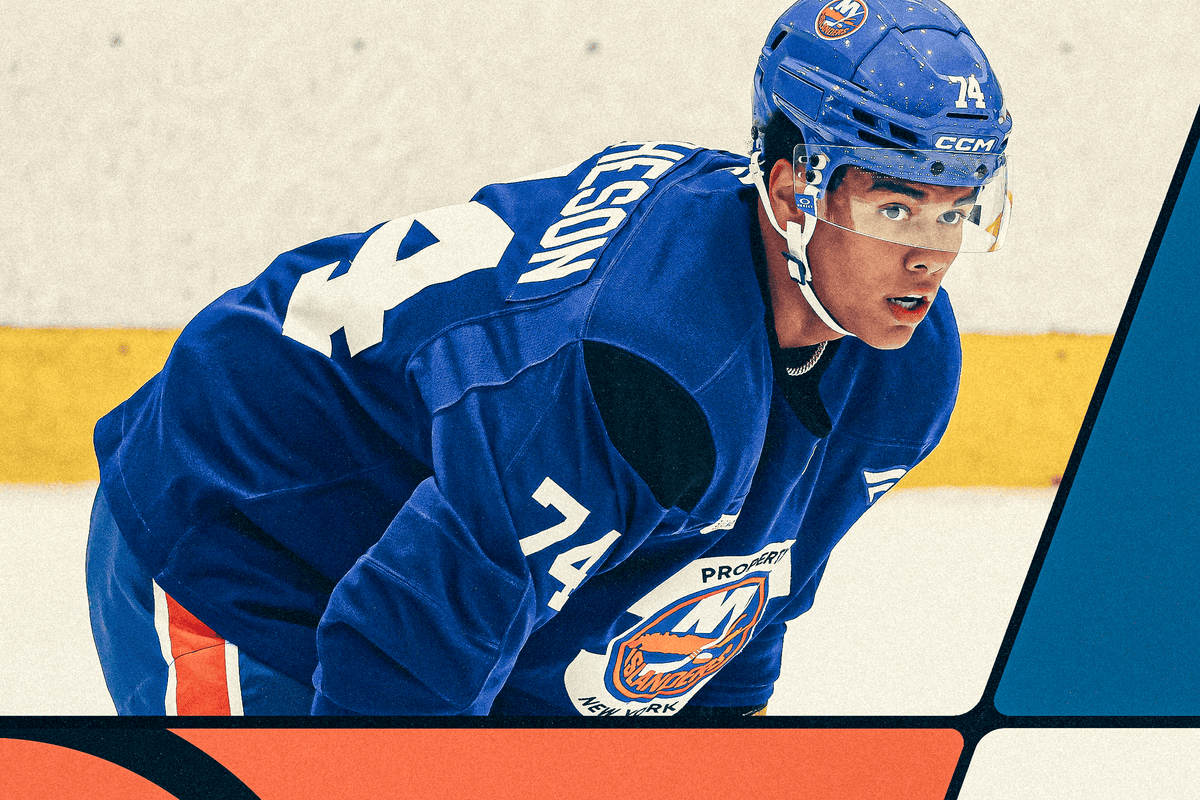
Welcome to Scott Wheeler’s 2026 rankings of every NHL organization’s prospects. You can find the complete ranking and more information on the project and its criteria here, as we count down daily from No. 32 to No. 1. The series, which includes evaluations on nearly 500 prospects, runs from March 9 to April 8.
The Islanders transformed their prospect pool last year with the acquisition of Calum Ritchie and a nine-pick 2025 draft class that included three top-20 selections and four in the top 50. Even with the immediate graduation of Matthew Schaefer, their pool is in the healthiest position it has been in years.
2025 prospect pool rank: No. 25 (change: +13)
Tier 11. Calum Ritchie, C, 21, Bridgeport/New York (No. 27, 2023)
This will be the first and last time Ritchie appears in the Islanders’ pool ranking (his three AHL games this season narrowly resulted in his inclusion on this year’s list), as he has looked like a legitimate NHL player and has already carved out a niche at the side of the net on the power play.
Ritchie is the complete package and was one of the top players in the OHL in his last two seasons of junior. From my first live viewing of him five Octobers ago in St. Catharines when he looked like the Generals’ most talented forward in just the second game of his OHL career; to his four-goal, seven-point series in Oshawa’s six-game first-round defeat against the Kingston Frontenacs four years ago; to his Hlinka performance three summers ago; to Langley at the CHL Top Prospects Game, Switzerland for U18 worlds and continued live viewings in Oshawa right into the OHL Final last year (he didn’t elevate at the World Juniors for Canada but I thought he was fine there), Ritchie consistently impressed me before he turned pro this year and the continuation of that strong play comes as no surprise.
On the puck, he’s a multifaceted playmaker who often looks like the player who was the No. 2 pick in the 2021 OHL Priority Selection and an OHL First All-Rookie Team member. Off the puck, he’s a reliable two-way center who defends and supports play but can also play off his linemates offensively without taking up too much oxygen on his line.
He has quick hands (he’s prolific on breakaways/in the shootout/around the crease), a dangerous curl-and-drag wrister, decent cleverness to his game as a passer (whether through seams or often blind), slick skill in traffic and out wide sliding pucks under sticks and rotating through coverage or past checks for a player his size, and a knack for finessing pucks into spots for himself or his linemates to skate onto. He has also begun to fill out his frame (though his shoulder surgery did hurt a key summer for him post-draft), which has helped turn him into a diligent, relied-upon two-way player off the puck. He’s also strong in the faceoff circle, makes those around him better and has picked up a bit more of an acceleration gear from a standstill (and his skating was completely fine before that).
He takes smart routes with and without the puck, he has become a reliable three-zone player and the skill is there (he has superb puck control). He does a good job finding inside ice in possession (or off it). He’s also a very selfless player for his age who is quick to change in the offensive zone and will sooner make the right play than try to overdo it. I’ve noticed an uptick in his physicality as well, and he’ll forecheck and finish his checks. I’ve liked the progress I’ve seen in how strong he is over pucks and getting up and under sticks to take them back in pursuit or go to the net for tips (which he’s actually quite dexterous on) instead of always trying to free himself for his shot. When he keeps his feet moving, he’s an impressive player. I’ve always seen second-line potential and his ability to play center and the wing helps.
2. Kashawn Aitcheson, LHD, 19, Barrie (No. 17, 2025)
Aitcheson was a big-minutes player for Team Canada at the 2024 U18 worlds — where his ice time rose when the games and the shifts mattered most, especially in defensive situations — and has been a big-minutes player for Barrie the last three seasons, featuring as a go-to guy on both the power play and penalty kill. After wearing a letter last year in his draft year, he was also named the Colts’ captain this year. He has chased 30 goals in back-to-back years and led all OHL defensemen in scoring this season. He was also a part of Canada’s 2026 World Junior team, where he blocked shots, won a lot of battles, played his physical brand and flashed his big shot a few times, but also looked scrambled at times and struggled setting gaps in neutral ice, revealing some of the work he has to do.
Aitcheson is a powerful, bullish defender who is hard to play against, defends firmly and commands his ice. He knows who he is and plays with confidence and aggression, often directing his teammates and always talking (to his teammates and opponents). He’s strong on the PK. He’s chippy and extremely physical, looking for every opportunity he can to lay a hit, get in someone’s face or give someone a shot. He’s eager to drop the gloves. He’s a willing shot-blocker. He has step-up physicality and likes to knock guys around (I’ve seen him lay some huge hits in visits to Barrie). He has a hard shot and makes a good first pass. He’s a strong enough skater (though his feet can splay and kick a little when he’s in a hurry, and he still has work to do on his stride mechanics, which I know have already been a focus) and a physically mature athlete with some real power and presence about him. He has a good stick, so his defending isn’t completely reliant on his physical play. His discipline and decision-making can get him into trouble, and he takes a lot of stick penalties and will make the odd mistake, but he can play in all situations and has a lot of the tools you look for in a hard-nosed two-way type. Aitcheson was named to the OHL’s Second All-Star Team in 2024-25 and has a real chance to be the OHL Defenseman of the Year this season. He’s going to have a long career in the NHL as a two-way competitor with some real bite.
3. Victor Eklund, RW, 19, Djurgarden (No. 16, 2025)
I have a lot of time for Eklund, but most do. He’s a 2006 who played 30 pro games in the second-tier HockeyAllsvenskan two seasons ago, registering 10 points and looking like he belonged. He then took another step last season, producing regularly at the pro level on a Djurgarden team that earned promotion into the SHL and impressing as one of Sweden’s better forwards at the World Juniors. He also stood out on a team that needed him to be an impactful top-six player as a 2025 draft-eligible at U18 worlds two years ago and had a strong World Junior Summer Showcase leading into last season. This year, he was a top-nine regular in Djurgarden’s first year back in the SHL and finished fourth among U20 skaters in league scoring with 24 points in 43 games. He also had a good, relied-upon second World Juniors without being dominant, saved his best game for the gold medal game, and got off to a strong start in the SHL playoffs.
The younger brother of Sharks first-rounder William Eklund, Victor gets above-average grades for his smarts, skill and skating, but he’s really a standout competitor who works and plays extremely hard for a 5-foot-11 winger. He wins races. He keeps his feet moving. He’ll make effort plays in key moments. He gets inside body positioning. He finishes his checks and battles. He can play the bumper or the flank on the power play. He has great edges and handles, and a quick and accurate wrister. He has feel on the puck and is a slick saucer passer. And he plays an intuitive, heady game on and off the puck, but can also be a go-getter who relies on timing and instincts. I think he has the tools to develop into a nice top-six player in the NHL. He’s a smallish winger, but he has proven through his motor, skill, good feel for the game and determination that he can still be a driver. He uses Travis Konecny as his comp, and it’s a fitting one — though he’d be an absolute best-case outcome. He’s a very good, likable player who is going to have a long career.
I thought about ranking him second here, but I just want to see him score a little more (he had six goals in the SHL this year).
4. Cole Eiserman, LW/RW, 19, Boston University/Bridgeport (No. 20, 2024)
A dynamic goal scorer in the truest sense, Eiserman possesses a rare ability to pick his spots in the net and cleanly beat goalies from distance and sharp angles. He can score in every way: long-range, midrange, jam plays, rush plays, quick hands in tight, the one-timer, a lethal catch and release (there isn’t a pass he can’t take and get off). In his U17 year at the NTDP, he showed one of the better shots I’ve seen in a player that age. In his U18 year, he chased down Cole Caufield’s all-time NTDP goal-scoring record. He’s also a late August birthday, which I think sometimes got lost in evaluations of him during his draft year, in how scrutinized he was as a player and person/teammate. Last season he led the Terriers in goals as a freshman with 25 in 39 games, including one in each of BU’s games at the Frozen Four, and was productive in very limited usage as the 13th forward for Team USA at the World Juniors, scoring some big goals in a role he seemed to really embrace (which was positive as the actual seven points in seven games). His 25 goals also led all U19 skaters in college hockey, and his 36 points were one shy of Hagens’ 37. This season, on a BU team where everyone had a tougher time, he led the Terriers in goals (18) for a second time and finished second in points with 28 in 32 games before turning pro. He also disappointed at his second World Juniors, where he had difficulty finding ways to contribute when his shot wasn’t falling (though he does have a track record of scoring internationally).
Eiserman is a shot creator and finisher with the ability to score off the rush and in-zone. There have been some big games over the years where he has found it tougher to beat top defensemen one-on-one, causing some to question him, but I thought he helped his case in some big games last year. Eiserman is always a threat to score, even when he’s occasionally forcing things or fighting it in a game, because all he needs is one look. He’s also more competitive than he gets credit for, and is willing to forecheck and battle for pucks even if he’ll sometimes also cheat for offense.
I actually think he’s a better skater than he has been given credit for in conversations I’ve had with folks about him too, but it’s his puck skill, quick release, shot variety — he can rip it in motion or standing still, and he’ll make goalies guess wrong in alone because of how fast his hands are — and sneaky strength (when he uses it) that have allowed him to score with relative ease against his peers. But how easy that part of the game has always been for him has also created some bad habits. He can frustrate, and scouts have wanted to see him round out his game and improve his play selection (which I also thought he made progress on at BU). Though he’s still very much an imperfect player, I saw some progress in his playmaking and off-puck detail with the Terriers (though they’re still inconsistent). He can be a little careless and selfish with the puck, but he actually has good vision when he looks for it as well. He can get carried away trying to do too much: stickhandling into trouble, shooting into shin pads, forcing shots from bad spots on the ice or trying to be too cute.
He does the hardest thing in the sport to do better than just anyone his age, though: He doesn’t miss when he has an opportunity. And it’s so hard to find goal scorers like him outside of the very top of the draft. I have seen him play pretty complete, competitive games. I’ve also seen him zip passes around and show a playmaking tilt, and think he’s an underrated passer who actually identifies second and third options quite well, even if he doesn’t always give the puck to them.
Eiserman produces that “he’s about to score here” feeling when the puck comes to him in a good spot. He has work to do still in other areas, and there’s some risk that it doesn’t work long-term at the NHL level (a la Patrik Laine and others). But he also often looks to me, with continued coaching, like he’s capable of becoming a 30-goal-scoring winger and PP1 focal point — if a flawed one. I understand the reservations many have about him and his game. He’s a complicated player and person, though I think he has been overanalyzed as well. His next couple of years are going to be fascinating to track.
Tier 25. Dmitri Gamzin, G, 22, CSKA (No. 115, 2024)
Gamzin was one of the best KHL goalies, building on the promise he showed in No. 2/3 roles over the last couple of years to continue to perform under a heavier workload as CSKA’s starter this year, outperforming a former NHL goalie in Spencer Martin. He’s a lean 6-foot-3 goalie with good mobility, reflexes, dexterity, and hands, moving to pucks early and playing quickly. He still has two more years on his contract in the KHL, so Islanders fans won’t likely see him in North America until mid-2028, but he has positioned himself as one of the better young goalies outside the NHL this year.
6. Daniil Prokhorov, LW/RW, 18, Dynamo Moscow (No. 42, 2025)
Prokhorov is a big, strong, driven, hardworking player who scored a bunch of goals and registered a bunch of shots in the MHL last season, becoming one of the risers in its Russian class. This season, he showed some real promise in Russia’s second-tier VHL, too.
He plants himself at the net, knows who he is and will score goals on rebounds and wraparounds and tips, but also has some skill for his size (6-foot-6 and 220 or so pounds) and can handle pucks one-on-one and in open ice. He doesn’t see the ice particularly well, but he has a clear identity at an early age and a profile that could translate into an impactful bottom-six scorer with size if developed properly. He also likes to be in the thick of things, moves well enough for his size and has a nose for the net and a willingness to win back pucks for his linemates, even if he isn’t a feared competitor type. I have some concerns about his hockey sense, but he has a pro profile.
7. Danny Nelson, C, 20, Notre Dame (No. 49, 2023)
Nelson is a big, pro-built player who, for a short period of time before he joined the national program in his draft year, had some believe he might end up in the conversation as the top 2005-born American prospect for the 2023 draft. That didn’t last after an up-and-down season between the NTDP’s second and fourth lines turned him into more of a consensus second-round guy, but I thought he played his best hockey of that year in Switzerland at the U18s and played well again at the World Junior Summer Showcase to really begin to build. He was good at last year’s World Juniors (where Team USA chose him as one of their top three players of the tournament) as a returnee. I’ve also liked what I’ve seen out of him across his three years at Notre Dame, where he created more looks than I expected as a freshman and has been a go-to player as a sophomore and junior (it was less of an adjustment to the college tempo than I anticipated). While his production (just below a point per game) doesn’t leap out at you, he looks like a player who is going to play in a bottom-six NHL or be a call-up option at minimum.
His motor and skating were questions for some, but he has made important progress toward keeping his pace higher. When he keeps his feet moving, he’s a lot to handle; he can stick with pucks and take possession off the wall to the interior, where he has an NHL shot.
Nelson has a good first touch for his size (6-foot-3 and over 200 pounds). He can set the tone physically and on the penalty kill. He’s reliable defensively. He flashes a quick release with limited drawback and a good catch-and-release action. He excels at getting open and protecting pucks and takes his space in control. He has started using his size to attack the middle third and the net more and can impose himself on games when he does. He’s begun to up his activity without the puck as well, turning his dependable off-puck play into a strength. He can also play both center and wing, and the defensive awareness from playing defense years ago is still noticeable.
Tier 38. Quinn Finley, LW, 21, Wisconsin (No. 78, 2022)
I didn’t love Finley when the Islanders took him in the third round in 2022, but he was also an August birthday with a slight frame who was well-liked by most scouts, and he has progressed in line with where he was selected. There were clear attributes to like and clear room for growth there all along. He had a strong post-draft season in the USHL, playing to well above a point per game with Madison (where he was a top player on one of the worst teams in the league) and then Chicago (where he didn’t miss a beat), while also impressing on USA’s gold medal-winning team at the World Jr. A Challenge. He had a decent freshman campaign at Wisconsin, again continuing to play well and playing to good results in a secondary role. And over the last two years, as a sophomore and junior, he has now established himself as an excellent college player and been one of the Badgers’ leading scorers, hovering around a point per game.
Finley is a left-shot winger with above-average skill who processes the game at an advanced level and makes his plays without overstepping his boundaries. I like his work ethic, the consistency of his approach and his habits. He has a quick release and the instincts to get open for it as well. I’m not sure what his upside is as a pro, but he’s become an excellent college player and is on track to get signed. He plays a well-liked, well-rounded, versatile three-zone game that has shown more secondary skill over the last couple of years than I thought was there. I expect him to get signed.
9. Isaiah George, LHD, 22, Bridgeport/New York (No. 98, 2022)
George was one of the development stories of the year in hockey last season. It came as a real surprise to those who followed him closely in the OHL that he made the jump to the NHL as quickly as he did. And while he hasn’t stuck there, the fact that he has made himself a call-up option is still viewed as a strong turn in his development versus where he was for a while as a player in London.
For a long time, George felt like a player who had the tools he needed to develop quickly and really take off and run with it. But a combination of a deep blue line in London, some failure to take the steps you’d expect and others who got preference ultimately held him back, resulting in usage that sometimes didn’t align with his age or pedigree as a signed NHL prospect with the Knights. Though he still played a big role on a Knights team that won the OHL title and lost in the Memorial Cup final, he ranked fourth on their blue line in ice time (about 22 minutes per game) before he made the jump to pro and quickly climbed into the NHL lineup for a stint.
He has always had ability and a pro makeup. When he plays with confidence and ambition, George can really take charge of shifts on both sides of the puck. Defensively, he’s a strong, sturdy, mobile presence. Offensively, he can carry the puck off the line and transition it. There are times when he can look a little out of sorts or late on reads inside the defensive zone, but there’s a lot to like about the tools and the way he’s capable of using them. For a while, it was more about how he used those tools and needing to improve the consistency of his reads. His skill also isn’t super natural on the puck, so while he can transport it and move it, he’s never going to have much pro offense.
I wrote two years ago that “I won’t be surprised if he someday becomes a useful depth defenseman.” I didn’t think that would happen as quickly as it did, though — although his career has regressed to the mean a little and where he’s at now (more of a No. 8-9 option) feels like where he belongs.
10. Xavier Veilleux, LHD, 20, Cornell (No. 179, 2024)
Veilleux has been on a good path for a sixth-round pick over the last couple of years. He led all under-18 defensemen in USHL scoring in his draft year, registering 32 points in 62 games as a 17-year-old, built on it with 41 points in 61 games post-draft (tied for second among U19 D) and a strong playoffs en route to a Clark Cup title while playing to strong two-way results. As a freshman at Cornell (he was originally committed to Harvard), he has really impressed, playing nearly 24 minutes per game and driving results at both ends.
He’s a 6-foot left-shot whose game is built on efficiency, sound decision-making, reads and overall on-ice intuition and intellect. He understands spacing and gaps, coverage on and off the puck and the subtleties of puck movement. His skating and skill level aren’t super high-end, but both are assets, and he’s comfortable carrying pucks and attacking at defenders. He also sets a good gap and plays quickly when possession switches hands (on either side of the puck). He’s already a heady NCAA defenseman who can contribute at both ends and looks like he’s on a path to getting signed.
11. Jacob Kvasnicka, RW, 18, Penticton (No. 202, 2025)
Scouts were down on the ’07 NTDP class last year, and Kvasnicka is a 5-foot-11 winger who wasn’t even one of the names with more than a little prominence. But I really enjoyed watching him play at the program, and he became a big part of that team, stirring the drink with his work ethic, competitiveness, determination and drive. And he has now carried that into a very successful season with a new WHL team in Penticton, leading them in scoring by double digits and finishing in the top 10 in the league.
He gets to pucks first, keeps plays alive and has enough skill to be opportunistic. He’s a good to very good skater (he was flying at the World Junior Summer Showcase in a group of top prospects). He takes pucks to the middle third whenever he can. He stays around the action. He knows exactly what he is. I ranked him 99th on my draft board last year and was really happy to see him get picked. He’ll be a good college player for Minnesota, and I expect him to climb the Golden Gophers’ lineup and become an important player for them as an upperclassman. He’s also an August birthday, and I think he has a path to keep getting better within his already-established hardworking identity as a player. Whether it’ll work at his size at the pro level is to be determined, but he’s worth following.
12. Jesse Pulkkinen, LHD, 21, Bridgeport/Worcester (No. 54, 2024)
One of the top overagers in the 2024 draft, Pulkkinen really impressed scouts with the huge step forward he took in his re-entry year. He went from four points at Finland’s junior level and a non-consideration for the draft to an absolute force against his peers who quickly progressed through the second-tier Mestis and into Liiga. He also made the national team for the first time at the 2024 World Juniors. The last two years haven’t seen another jump, though. Last season, he became a full-timer in Liiga with JYP and played third-pairing minutes to positive results, but didn’t pop quite the same. And this season, after making the jump to North America, he has bounced between the AHL (where he has struggled a little) and ECHL (where you’ve seen the tools and puck play more). Pulkkinen is interesting for what he could be because of his skill set and makeup.
He’s a towering 6-foot-6, 220-pound defenseman who handles the puck very well, often taking and beating opposing players one-on-one. He moves well and plays in an active posture. He’s a good athlete. He plays the game with confidence, looking to make things happen on both sides of the puck with his length and surprising skill. His game could use a little more control at times, but he’s physical in man-to-man coverage, looking to take a piece of opposing players and snuff out plays early. It still feels fairly raw, but he has a lot to work with, and once he gets the reads/decision-making pieces down, he could be an interesting AHL D who gets a look at some point.
13. Luca Romano, C, 18, Kitchener (No. 74, 2025)
Romano is a great skater and natural center who plays the game with jump and speed. His numbers haven’t taken that next step over the last two years, but he’s also a late June birthday and was always going to take some time. Last year, he impressed at the OHL Top Prospects Game. When he’s at his best, he passes the eye test from a skating/skill standpoint. Romano thrives in transition, skating pucks out of the defensive zone, through neutral ice and into the offensive zone to create a ton of zone exits and entries. He has skill off the rush and can make plays at pace. He has a quick release. And he has some two-way habits and work ethic, even if he’s not the biggest or most physical player. He’s also a natural athlete who should get stronger (which should help his two-way game and his need for improvement in the faceoff circle). Consistency has been his big issue. There are games where you can really see the potential and others where you’re left wanting a lot more. Importantly, when he plays with speed, he doesn’t drop his head and tunnel vision when he’s flying around out there (a common issue for faster players), keeping his eyes up and on a swivel. He has some fans around the OHL, but is eventually going to have to translate his tools onto the score sheet to get signed. The talent, skating and tools are there, but there does seem to be something else missing.
14. Sam Laurila, LHD, 19, North Dakota (No. 138, 2025)
Laurila was passed over coming out of a depth role at the NTDP, but generated a lot of attention from scouts last season as one of the top defensemen in the USHL, leading the Force in scoring with 41 points in 57 games and playing well at the Chipotle All-American Game. This year, he has played mostly limited minutes on a deep North Dakota blue line as a freshman, but has had decent results in them.
He has a comfortable and strong point shot. He has active feet and is a good skater. He has played different roles over the years and has a strong defensive game beneath an expanding game with the puck. He’s capable of involving himself in all three zones and played a very influential style last year. And he’s a strong athlete who plays hard defensively and should become a successful two-way D in college. His challenge may be that he’s a 6-foot-1 D without a defining trait for the pro level.
15. Calle Odelius, LHD, 21, Bridgeport/Worcester (No. 65, 2022)
At lower levels, Odelius was a steady, calculating two-way defenseman who played a head-on-a-swivel game built on snuffing plays out defensively and advancing play back the other direction. Early on in North America, he has struggled to be that as a 6-foot D.
He’s not a dynamic on-puck carrier or creator in the offensive zone, but he walks the line well and he’s prolific at moving the puck from A to B, either with precise first passes or comfort in carrying. He also has a balanced skating posture — he’s a very impressive backward skater on his heels and both his inside and outside edges — that allows him to manage the rush, quickly move from accepting a pass into sending one while retreating, and leverage his strong frame to its fullest in engagements. His game offensively hasn’t progressed much for his size over the years after making the jump to the pro ranks at an early age, though, and he hasn’t been able to build on the decent start he had in the AHL as a 20-year-old (when he played 20 minutes for Bridgeport a few times early on after coming over). I’d like to see him attack off the line a little more because he’s actually comfortable doing so, but it’s his control and efficiency that he’ll have to rely on if he wants to become a call-up option someday.
I was sad to see him break his foot/ankle and miss out on the 2024 World Juniors, because he would have featured prominently on a strong Swedish blue line there, and it seemed to affect his development.
Honorable mentionsBurke Hood, G, 18, Vancouver (No. 170, 2025)
Hood was a great story for the Giants last year, going from a sixth-round bantam draft selection who wasn’t in the league as a 16-year-old to starting and playing to a winning record and .910 save percentage across 42 games as a 17-year-old. That play earned him his first invite from Hockey Canada as well (he served as their third-stringer at U18 worlds). He gave up a couple of six packs in the first round of the WHL playoffs, but Spokane did that to more than one team, and he was the reason the Giants won Game 3 of that series. He was also excellent in the second half. This season, though he hasn’t maintained those numbers on a below-average Giants team, he has played a lot and been pretty reliable for them. He also grew from his 6-foot-2.75 listing on draft day to almost 6-foot-4 now.
Hood is a smart goalie with good size and decent athleticism/movement. He reads, tracks and anticipates the play well, seems to have a studious approach to the position, gets to his spots early, has patience on his outside edges and has good dexterity. I don’t think he’s the most purely gifted goalie, and he still has some things to work on, but he stays square, is reliable and has tools to develop. He’s the kind of goalie I said I would have targeted in the draft’s later rounds once the true top goalie prospects were gone last year, and that’s what the Isles did.
Tomas Poletin, LW, 18, Kelowna (No. 106, 2025)
Poletin is a good-sized winger who finished last year playing fourth-line minutes in Liiga and then captaining the Czechs at U18 worlds in Texas. I’ve had time for him since first seeing him at U17s, and thought he played well at the Hlinka the previous August as well. This year, he made the move to the Memorial Cup hosts in Kelowna and was an important cog of Czechia’s second line at the world juniors at five-on-five, registering six points in seven games and doing a lot of little things at five-on-five in the offensive zone (going to the net, winning battles, etc.). With the Rockets, he has played to just under a point per game and just above a 30-goal pace across 68 games.
Poletin is a big, heavy player who wins battles, can skate for a 6-foot-1, 200-pound winger, has good hands pulling pucks and takes them to the inside. Despite his heaviness for his age, I find he actually isn’t the strongest player, but he’ll go to the net and drive and he has good instincts on and off the puck. He has a good stick, has impressed me on the PK and seems to break up a lot of plays, but also has a nose for scoring areas and finishing plays. He has a chance to become a bottom-sixer with the right development, but may also end up as an AHL bottom-sixer.
Kamil Bednarik, C, 19, Boston University (No. 61, 2024)
Bednarik is an easy player to like for his consistency and his know-how, but he really disappointed at U18 worlds, where he was a bit of a non-factor, causing some to question his merits as a second-rounder in his draft year, and he has never been able to elevate in best-on-best despite some opportunities (including at this year’s World Juniors). And while he has been a dependable player for Jay Pandolfo and his staff and has played legitimate minutes across his first two years at BU, the production isn’t where it needs to be to get signed there yet, either.
He’s a heady, methodical player who makes little plays all over the ice and does everything well without having a dynamic quality. He doesn’t have the individual skill of some of his peers, but he does stay around it and will make a play in moments of opportunity. He has well-rounded skill, some layers and has shown he can stir the drink and make a play, depending on what’s called for. He’s a strong athlete. He reads it well. He also plays to his linemates’ strengths, which made him a natural fit with different players at the program. His skating isn’t a strength, and it can be a little stilted at times, but I’d say his speed is average. I’m just not sure what that next level looks like for him. I think we’re going to see more offense out of him as an upperclassman in college. But while he generally finds ways to impact shifts and games, I’ve just never really seen him take over or dominate. I could see him having a long pro career, but I would guess it’s in the AHL.