
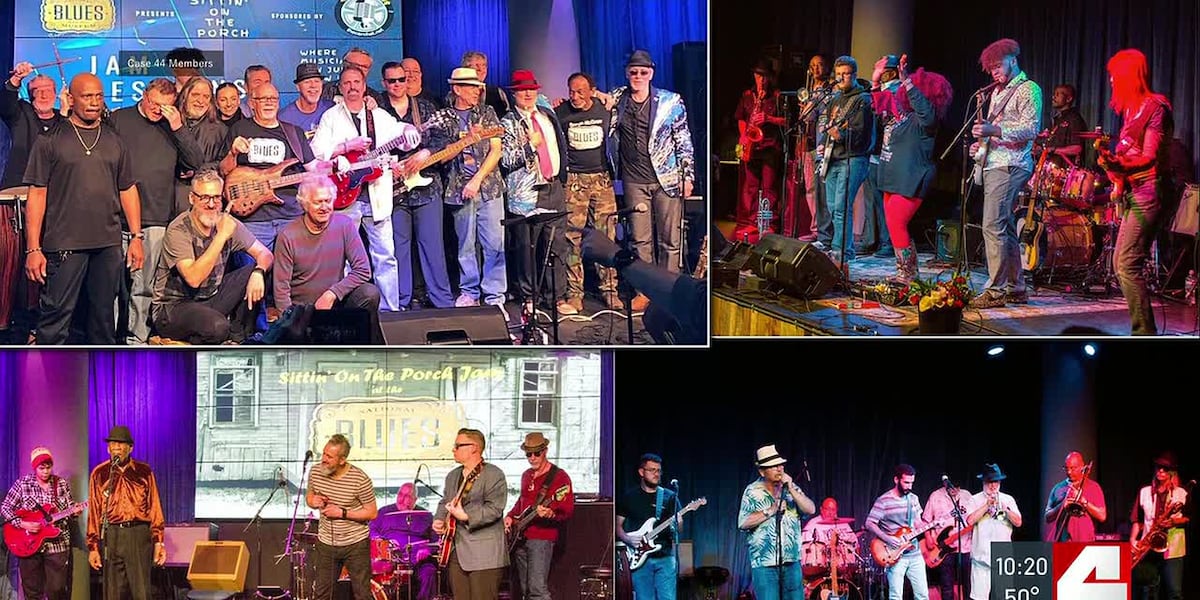
ST. LOUIS, Mo. (First Alert 4) – The National Blues Museum will close its doors after nearly a decade of preserving the history of the music genre and providing a stage for musicians. It opened in April 2016 on Washington Avenue in Downtown St. Louis.
The museum announced the closure Friday, citing cuts in federal funding and a tough economic situation downtown as reasons for the decision. The final performance is scheduled for Sunday in memory of St. Louis blues and jazz singer Marsha Evans.
“The blues is the integral part of American music. I consider it the roots of all American music,” said Lady J Huston, a vocalist, trumpeter, songwriter and recording artist.
Lady J Huston
Lady J Huston said the play at the National Blues Museum was finding a home. She first took the stage at NBM in 2018, debuting her Lady J Houston show in tribute to Albert King.
It was after she returned to St. Louis from Las Vegas following an illness. She said the relationship she built during that show continued.
“It was extra special because touring with blues legend Albert King, I met people like Muddy Waters, John Lee Hooker, Bobby “Blue” Bland, who I worked for also. They are laid up around in the museum in the display. So, when I come in, I feel a place of home. Being on that legends showroom stage was phenomenal because the lighting was great. I got a feel of being in Las Vegas. It was a close venue where you can see the people eye to eye and just see the love in the room, feel it, feed off of it, and just enjoy the whole experience. It was always a great experience,” said Lady J Huston.
With the rich history of blues in St. Louis, she joined with the museum to help share that with kids through Blues in the Schools and the community. She even spent time working in the box office.
“I got to meet and greet and just saw how much people enjoyed learning about the blues, not knowing all of the artists that even St. Louis have contributed to.” She said, “The memories are going to stay. I just hope that its legacy continues on in some form because it’s well-deserved. It was a great venue, and I’m hoping that we establish something new.”
Like so many who performed at the National Blues Museum, she is reflecting on the announcement of its closure and the loss of a venue she said elevated and worked to make people aware of the genre.
“I was sad. I was sad. I was reflecting on so many great memories I had there. The audiences, I started going through videos and reminiscing. I talked to some of the founders, and it’s just been devastating news,” said Lady J Huston.
She said, knowing about some of the difficulties the museum was facing with the loss of federal funding, she was nervous that something like this could happen.
At the same time, she’s hoping that a new home can be found for the exhibits spotlighting blues music, including the St. Louis role, pointing to the Missouri History Museum and Griot Museum as potential homes.
“I’m hoping that the Missouri History Museum will be the new home for all those wonderful artifacts. I have a collection there as well from my musical career as well as my mother’s, who was a wonderful singer here in St. Louis, Loyce Huston. So I know that they are interested in the music history that came from St. Louis,” said Lady J Huston.
She added that there are other opportunities in St. Louis to keep blues music alive and well, but it needs people’s support.
She said, “We need to support live music. That is the bottom line of what’s going on in general. I feel is that too much of the technology and the sitting at home and things, is not keeping the live music fulfilled enough that it can sustain organizations.”
Marty D. Spikener’s On Call Band
“Just the word National Blues Museum is one of the main reasons you want to play there because it’s representing the blues,” said Marty D. Spikener, who performs with Marty D. Spikener’s On Call Band.
Marty D. Spikener is among the many performers and musicians who have taken to the stage at the National Blues Museum and spent a lot of time there. He also highlighted memories of playing the outside gigs, when 6th Street by the museum would be closed and the music would take over the street.
“It was really nice stage, and the atmosphere was great, too. I love playing there,” said Spikener. “I think that was real special, because St. Louis has a real strong Blues history. Matter of fact, a lot of musicians that came from the South came to St. Louis first to learn, hone their craft, and then moved on, but St. Louis has a great Blues history.”
He and his band also played for school kids who came to the museum and served as a host of the regular jam sessions, which brought in people, not just from St. Louis, but other states and countries.
“I think that’s one of the major things about blues. You want to pass it on and keep that history going,” he said.
Spikener is also taking in the news that this space is closed. He lamented the loss, saying that too many other places around St. Louis that cater to blues music have also closed.
“I was shocked. I was shocked, surprised, and I hate to see it happen. To me, when they started defunding it and everything like that, it was kind of like you could see the writing on the wall. I hated to see that, you know,” said Spikener.
He added, “I was hoping that throughout the years, you know, through this time, that the Blues Museum could hang on. But a lot of things have been closed up due to, you know, what’s going on now.”
He’s also hoping something can happen to find another place or way for the museum and what it represented to continue.
Case 44
The museum became a special place for blues musicians in St. Louis, serving as both a performance venue and a meeting ground. Three members of the band Case 44 — Michael Johnson, Steve Eschbacker and Robert Elmore — each showed up to the museum to jam but ended up forming friendships and a band.
“I was fresh out of high school, maybe like two weeks when I first went to that jam session,” Johnson said. “Not really knowing the blues and everything. So I started going with these guys and started playing with them every week and started getting to meet all these great musicians through there and really learning.”
“There was a lot of musicians came through the Blues Museum, and that was the most valuable part of the whole experience there. Because it’s an endless scroll of musicians that came in. Dave Beardsley was instrumental and started in the museum. And a gentleman named Jesse Lopez had the idea to start a jam session, because he’s a long-time blues devotee,” said Eschbacker.
All three spoke to a family being found at the museum through these jam sessions and performances, with each other, the staff and the audience. For them, that was part of the National Blues Museum’s mission.
“You walked into the Blues Museum, it was like all your burdens was a coat, and you shed that coat off, and you walked in, and it just was freedom,” Elmore said.
Eschbacker said, “If I had to put one word to it, I’d say supportive was the general theme. Audience, musicians, young and old, everyone just dropped all the baggage at the door and came in and you just started from that position of, let’s have some fun. Yeah. And it worked.”
With it being where the three became Case 44, it is difficult to say goodbye to the National Blues Museum. Eschbacker said as they hear of other venues closing, this is one they didn’t want to hear.
“This is what gave us this opportunity, what we’re doing, and to hear that that closed down, I mean, that was, that, that was pretty heartbreaking for me because it was just a big part of my musical journey. I don’t know where I would have been had I not gone to that jam session, met these guys, met a bunch of these other musicians. I probably wouldn’t be doing music like I am now without that jam session and the National Blues Museum support,” said Johnson.
“It’s hard, it’s hard to take because I can’t even put a number on the, the amount of enduring friendships that were created down there. Just across the whole musician base in this town got so many quality people that I was fortunate to meet and got to share the stage with week after week.” Eschbacker said, “That’s an experience that I really hope every musician gets a chance at.”
Elmore said, “We just keep coming back to us where we began. So sad, I was, I was really sad to hear it.”
The members of Case 44 said there are many memories created at the National Blues Museum, and that’s part of the legacy it will leave behind, centered on the music and history.
“I would say it’s about the music. Again, music and musicians, and that sense of community. Of coming together and something in common that crosses ages and, you know, even accents and languages. I mean, like we said, with so many foreign people coming toward St. Louis to visit and would stop in the museum,” Eschbacker said. “We got people from countries all over the place. Everyone sat down, had fun, smiled and listened to music.”
They will keep playing the blues, and the museum will carry on in the songs Case 44 performs.
Johnson said, “With the history of the band and everything, I mean, we even say at one of our songs every night, like, hey, we met at the National Blues Museum. This is what made us meet.”
St. Louis Blues Society
John May, chairperson of the St. Louis Blues Society, is also remembering the impact of the National Blues Museum.
The National Blues Museum was built to preserve the legacy and honor the history of the music that is the foundation of American music. It told the story of the blues and its progression over time.
The live performances in the Legends Room featuring world-class talent provided an immersive music experience for an appreciative audience in an intimate concert setting.
As an organization, the St. Louis Blues Society has endeavored to increase peoples awareness of how deep the roots of blues run in the City of St. Louis and proud of what we accomplished in our collaborative efforts with the museum.
We believe the story of the blues will continue to be told. It lives on through us, and we appreciate the publics support in our ongoing endeavors to preserve, promote, and perpetuate blues music in the City of St. Louis for the benefit of those under the spell of the blues.
Copyright 2026 KMOV. All rights reserved.