
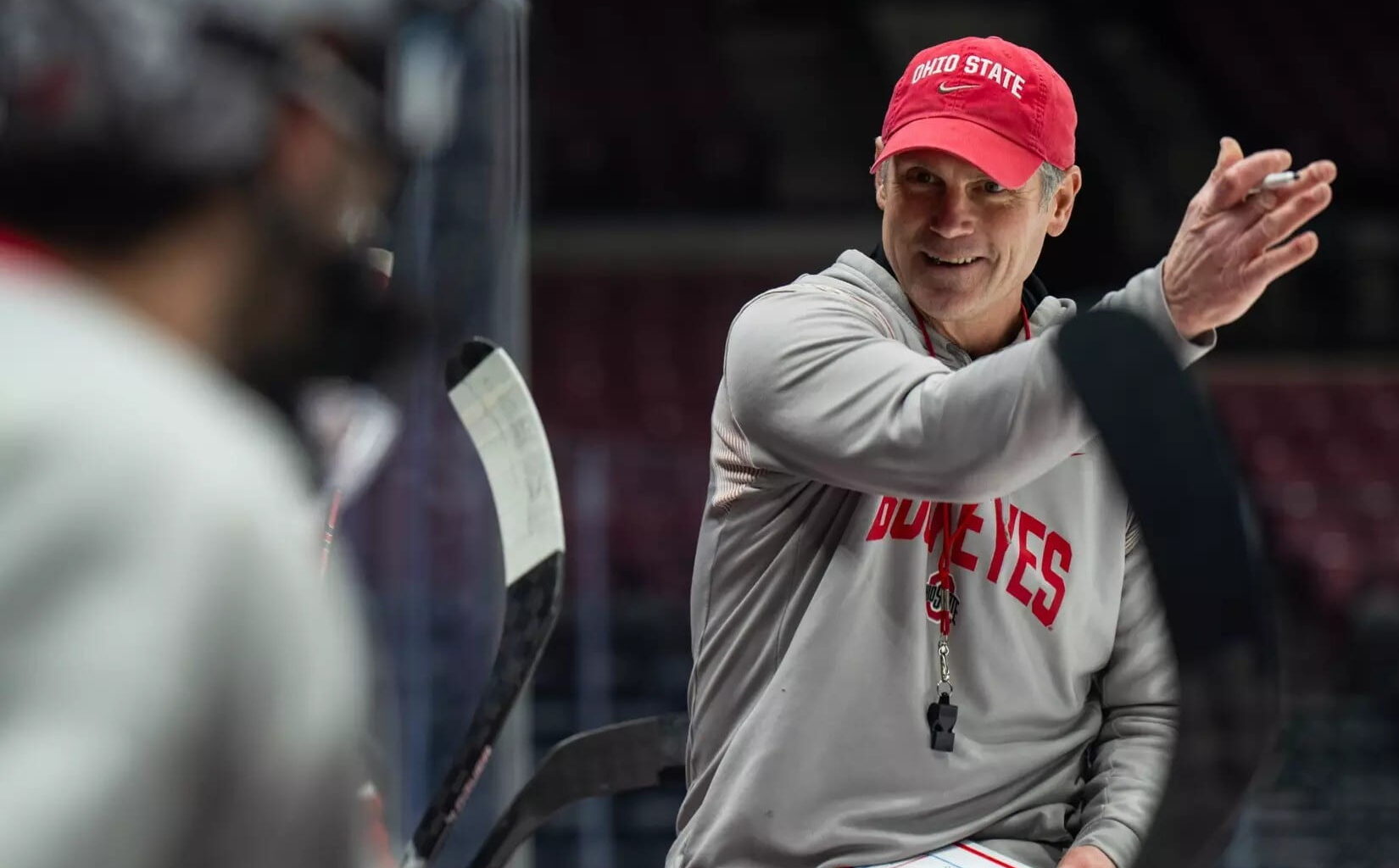
Ohio State head coach Steve Rohlik Credit: Ohio State Athletics
For a team picked to finish near the bottom of the Big Ten, Ohio State spent March looking like it belonged at the top.
The Buckeyes pushed their way to the conference championship game, coming within minutes of an NCAA tournament berth before their season ended against Michigan—another close loss in a year defined by them.
Inside the locker room, head coach Steve Rohlik didn’t see a team that fell short; he saw one that proved something.
In this conversation with Lantern men’s hockey beat writer Megan Finn, Rohlik reflects on a season built on belief and resilience, the fine margins that shaped it—eight overtime losses among them—and the foundation he believes can carry the program forward. Questions and answers were edited for length and clarity.
Megan Finn: What’s your evaluation of how this season went?
Steve Rohlik: I think just like everybody, you never win as many as you want. And there’s only one team that wins the last game of the year in any sport. No one really gave us much of an opportunity or a chance where our projections were, where we were supposed to finish. And I think we were as competitive as any team out there, and it showed down the stretch.
I was proud of our guys. I mean, we were 10 minutes away from a Big Ten Championship and getting a berth in the NCAA Tournament, so, I think my guys did a pretty good job.
MF: With the team exceeding expectations in the Big Ten tournament, what do you have to say about the success that the team found and the upsets you accomplished in the tournament?
SR: We did beat Wisconsin during the year. We did beat Michigan State during the year. I looked at it as we went into this tournament with some confidence and at the end of the day, we fell one game short.
And I think it speaks volumes for the players in our locker room of what their belief was. Unfortunately, we fell a little bit short. But, I mean, back-to-back years in the Big Ten championship game and for us as a program, I mean that’s something to be respected.
MF: For next season, how are you looking to remedy the team’s theme of late comebacks in games and have those comebacks start sooner?
Consistency has always been a huge thing. And that’s what we talked a lot about this year. And in college hockey, there’s so much parity from the start of the season to the end, and you’ve got to be at your best every night. Unfortunately, sometimes we would play 50 great minutes of hockey, and 10 minutes, all of a sudden, skews a game one way or the other.
That’s something we want to strive for. We know how important the start of the season is and hopefully, we can put a little more consistency from Oct. 1 through the end of the year next year.
MF: What do you think the biggest strengths and the biggest weaknesses were this past season?
The biggest strength for me was just our culture and our belief. I mean, our guys never wavered. Their practice habits never wavered. They knew we were a good team, and that was, to me, the strength of our team.
If there’s a weakness, it was, again, the close games and not being consistent for 60 minutes and not finding a way. Obviously, the biggest glaring thing is you lose eight 3-on-3 overtime games. I mean, eight games certainly change perspective on where you end up at the end of the year. Unfortunately, that was decided on 3-on-3 hockey.
MF: What were some of the toughest challenges that you faced this season, and how did you navigate them?
It was losing some of those tight games. It was losing eight 3-on-3 overtime games. And the challenge was continuing to hold that belief and move forward, knowing we were right there, knowing we were a good team, and knowing we just needed to persevere. That’s what our group did.
MF: Is there anything that you would have done differently looking back on this year?
It’s certainly a reflection time, and it never slows down right now. And as a coach, every day you put your head on your pillow and you wonder what more can I do? And I don’t do that just at the end of the year. I do that every day. Obviously, I want to continue to find ways to help these guys develop into one of the best hockey players, but also people they can be. I think that helps our culture.
There are things that you can continue to work on. And that’s what we’ll do in the offseason, sit back and sit down as a staff and a program and continue to find ways to work on areas that we need to.
MF: What would you say are those specific areas that the team needs to work on?
Three-on-three, if that’s part of the game, we’ve got to get better in that area. Special teams, you’ve always got to get better in those areas.
I haven’t had a chance to thoroughly go through things because there’s really no slow time or downtime right now. But this is something we’re certainly going to sit down and reflect on when we do have some more time to obviously go over those things. You know, we communicate with our guys about the things they thought were real positives during the year. What are things that they think we’ve got to continue to work on? We take all that into account.
There’s a lot there that we can build on. That’s the exciting part.
MF: What are you most proud of in terms of player development this year?
The thing I’m most proud of is just, again, these guys’ effort every day. And if they do that and they follow their habits and their details and they take care of those things and they come to work every day like they did, they’re going to get better.
And we did as a team. We did as individuals. You see it with some guys signing pro contracts. You see it with some guys excited for next year and making the jump. To me, it was a team effort.
So the most exciting part is the buy-in and the culture that we have here. When you’ve got a support staff and a staff like I do, certainly there are so many people in place here that help these guys.
MF: Are there any specific adjustments you were trying to make throughout the season?
Really, truly it is about sticking with what we were doing and just continuing to try to get better at what we’re doing, trying to get better.
And because, again, when you look at it, you go back and you kind of look at a lot of the games and all the one-goal losses, overtime losses, the tight games.
Going through those experiences, I mean, throughout the year, it was like you’re right there, how do you get through the door? How do you get over the hump? And it was a belief in our room that if we continued to work as hard as we could, be the best version of ourselves. I think you saw that coming down the stretch. There was a big belief in our room, and that’s the one thing we continue to work on, and it paid off for us.
MF: What are your hopes for the new recruits next year?
We’re really excited. Obviously, we got a fantastic nucleus here. We got a great group coming back, and you look at our list of guys that are coming in, and we couldn’t be more excited. One, they’re very good people, and they fit to what we want to do as coaches. They’re good players, and we think that they’re just going to add to our culture. We couldn’t be more excited about the group we got coming in so far.
MF: Former Ohio State President Ted Carter was a big proponent of building the new hockey arena. What are your thoughts or concerns about the progress of this idea now that Ted Carter’s gone and there’s a new administration establishing itself?
Ross Bjork has continued to communicate to me that things are still moving forward, and they want to continue to move with this idea of a new facility—not just for men’s hockey, but for men’s and women’s hockey. So, I think we got a lot of momentum. There’s a lot of support, and we’re in a great spot.
MF: Thanks so much for your time.