
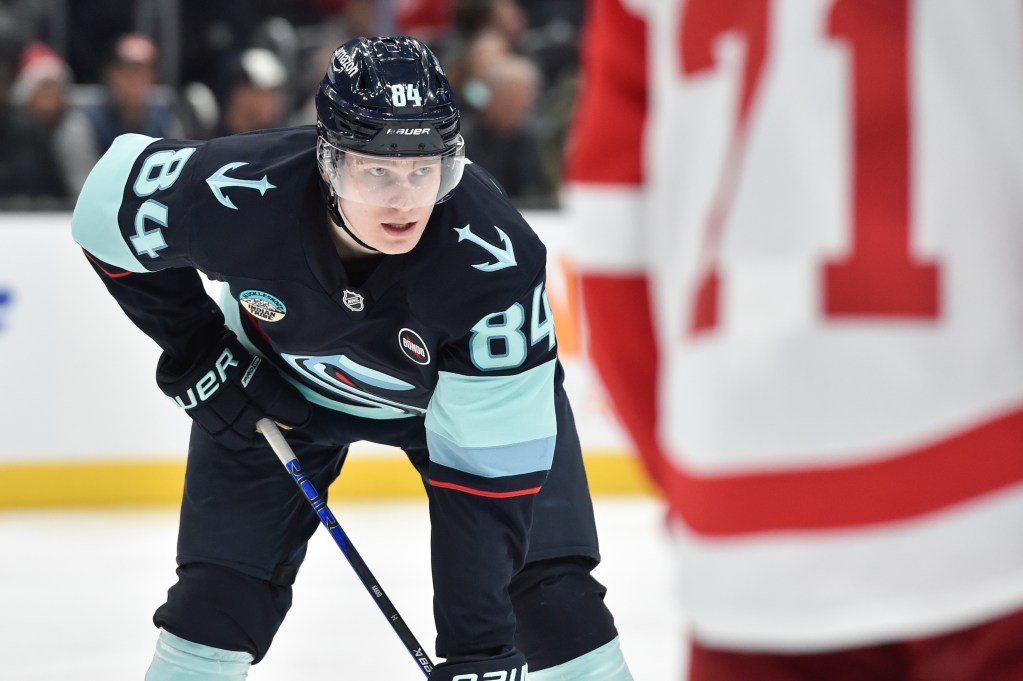
As Seattle Kraken fandom awaits white smoke rising from the Kraken Community Iceplex signaling the appointment of a new head coach, the front office has been hard at work developing an offseason plan for player acquisition as well. General manager Jason Botterill told Kraken season ticket holders last Thursday that the team had recently completed its pro personnel meetings. The team has its list of free agent and trade targets in hand.
With that work done, the Kraken have been implementing their plans. Botterill indicated that the team has already contacted restricted free agents Kaapo Kakko, Ryker Evans, and Tye Kartye expressing interest in new deals for those players. More concretely, the team re-signed unrestricted free agent forward John Hayden to a two-year, league-minimum deal on Wednesday.
Now, a significant offseason landmark is right around the corner. With the NHL Draft shifting to a “remote” format this year, the 2025 NHL Draft Scouting Combine, which begins on Sunday, June 1, will be the only offseason event that will bring most of the league’s top decision makers together. Many around the league expect that teams will use the combine to discuss potential trades and seek team “permission” to contact pending free agents.
So, the “real” work of offseason is just days away. With that in mind, there is no better time to examine what lies ahead in this critical period. In this part one, we’ll get into where Seattle stands and where its offseason priorities should be. In part two, we’ll return with a look at the options on the market that are both realistically available and intriguing fits to fill Seattle’s needs. We’ll conclude next time with a “mock offseason” to show one scenario of how these pieces could fit together. Let’s dive in.
Kraken offseason roster status
Assuming, for the moment, that all of Seattle’s young players on entry-level deals—aside from Shane Wright—will be in the AHL or another non-NHL level, the Kraken enter the offseason with $21 million of space under the projected $95.5 million salary cap for 2025-26. They have nine forwards, four defensemen, and two goalies under contract. With an assist from CapWages, here is what Seattle’s salary cap sheet looks like right now.
Forwards Kaapo Kakko, Tye Kartye, and Ben Meyers are restricted free agents, with Kakko and Meyers both being one year away from unrestricted free agency and possessing arbitration rights. On defense, Ryker Evans and Cale Fleury are restricted free agents, with Fleury being one year from unrestricted status and having arbitration rights.
There was some uncertainty publicly about whether Meyers and Fleury would be Group-Six Unrestricted Free Agents given their NHL service time. I can report that is not the case. Each remains a restricted free agent, in Fleury’s case owing to service time rules from the COVID-affected seasons.
Forward Michael Eyssimont is scheduled to be an unrestricted free agent on July 1, as is defenseman Josh Mahura. Several depth pieces are pending unrestricted free agents too, including goalie Ales Stezka and defenseman Gustav Olofsson.
It is also important to remember the pieces the team already subtracted before the trade deadline, when the team shipped out defenseman Will Borgen, and forwards Oliver Bjorkstrand, Yanni Gourde, and Brandon Tanev. Each of those players are NHL-level contributors, with the subtraction of Bjorkstrand in particular being significant for the offense.
Overall this season, Seattle posted middle-of-the-pack overall offensive production (16th of 32 NHL teams in total goals scored) and shooting percentage (14th highest) and did well staying out of the penalty box (fifth-fewest penalty minutes) and avoiding goals against on the power play (second fewest), but struggled in almost every other metric conceivable. Leveraging standard and advanced data from Evolving Hockey, here is where Seattle stacked up in various metrics:
The trade losses are somewhat mitigated going into the offseason by the acquisition of Kakko, but I think it’s fair to say that absent dramatic leaps from Seattle’s young players, the team is in a relatively weaker position now, both offensively and defensively, than it was when Seattle’s lineup was fully healthy early last season.
No surprises from warmups. Here’s how the #SeaKraken will line up against the #StlBlues for Game 1 of 82. pic.twitter.com/0epaxfFQsr
— Sound Of Hockey (@sound_hockey) October 8, 2024
Looking back, it is easy to recall the preseason narratives. The Kraken would continue to be staunch defensively, buoyed by the addition of Brandon Montour, and would get back to their identity of a relentless, depth-based attack, with few “fourth lines” capable of matching Gourde, Tanev, and Kartye. As we all know, it didn’t work out that way. For example, that intimidating “fourth line” combined for just 47 points all season with Seattle.
So, the Kraken need to add pieces just to get back to this past year’s baseline—a standard that was, itself, disappointing to all involved. Additions on top of that will be necessary to push this team toward contention. No wonder, then, that the team has vowed to be “aggressive” in making roster changes for the second consecutive offseason.
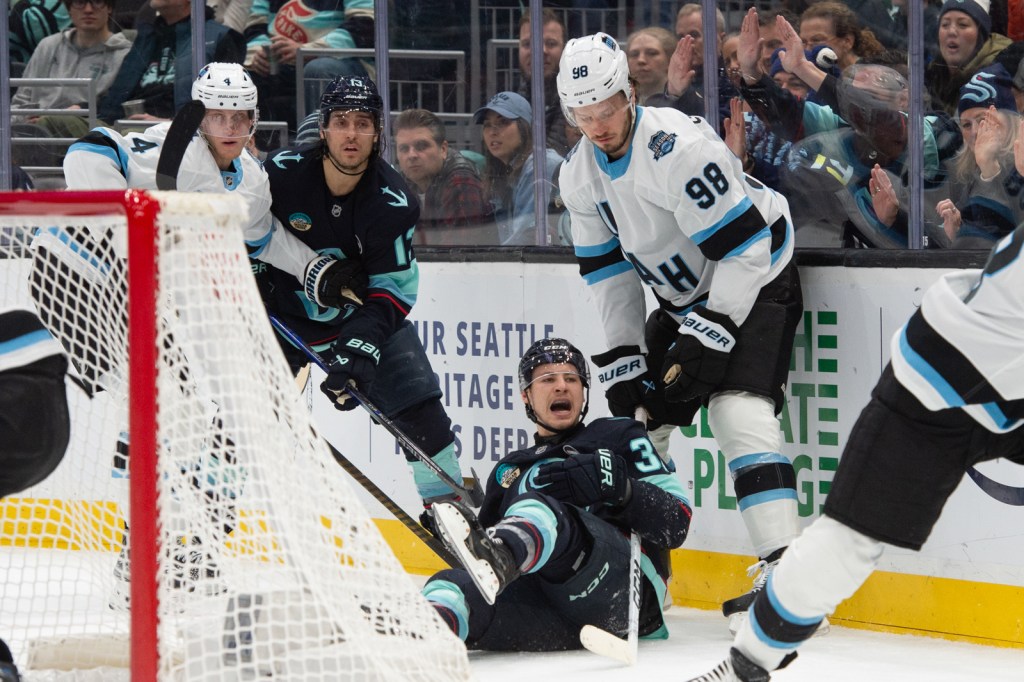 Yanni Gourde and Brandon Tanev (Photo/Brian Liesse)Kraken offseason priorities
If we were penciling out a Kraken depth chart today, it might look something like the following. (As a disclaimer, these aren’t projected lines, and I wouldn’t put much stock in the actual order. The goal is just to display the team’s depth.)
Extrapolating from this depth chart, in the context of existing roster performance laid out above, I’ve identified the following seven personnel-related offseason priorities. (For the moment I’ll set aside the two most pressing agenda items, neither of which are personnel-related: Finding a head coach and fixing the defensive approach.)
Priority No. 1: Make a splash move
Under then-general manager Ron Francis, Seattle built a solid base of talent, organizational depth, and upcoming draft capital. Now comes Botterill and the 2025 offseason, and the goals are different. “It’s my job to go out there, whether it’s free agency or making trades, to drop in elite talent,” Botterill said.
This is the top priority. Whatever the position, whatever the means, Seattle’s focus should be on adding a “game-plan player”: A player the opposition needs to account for in their pre-scout; a player that can drag the team back into the game with a single skilled play, even on a night when everything else is going wrong. (No, unfortunately, it is not going to be Daniel Sprong.)
With a solid prospect pool and ten picks in the first two rounds of the next three drafts, Botterill and the Kraken have the assets to make it happen. That is not the challange. “[Y]ou never know what trade is going to come, but we’re going to at least be in the discussion with those [extra first-round picks] moving forward,” Botterill explained.
The challenge is in finding a player that matches the Kraken’s short- and medium-term need. The Kraken are not one player away from a Stanley Cup. The Kraken are not one year away from the Stanley Cup. They need a player who can contribute to a playoff push now and potentially be part of a winning core years down the road. Hypothetically, this could mean targeting a true star player in his late prime years, since even the post-prime years are likely to be useful. More realistically, it means targeting players earlier in their prime window. Botterill told the season ticker holders last week “we want to continue to add younger players to [the roster] mix in and around Matty [Beniers]’s age”—i.e. 22 years old.
Those assets are rare and difficult to acquire. It is the challenge before them, and it might require an “overpay” to achieve.
Priority No. 2: Retain your restricted free agents
The 2025 offseason depth chart above pencils out as a playable lineup only if the team’s restricted free agents are retained. And I believe there is a solid argument to retain each of them at their market prices. Using Evolving Hockey‘s contract model, here is what it could cost to retain Kakko, Evans, Kartye, Meyers, and Fleury:
There’s a good argument the team should put pen to paper on each of these contracts now if it can. Kakko is 24-years-old and only one year from unrestricted free agency. I suspect Kakko’s camp would prefer a shorter deal (getting him to unrestricted free agency sooner) or a much longer one (providing more security), so three years would be something of a compromise. Five years may be the ideal term for Seattle. If the contract were to span five seasons, Evolving Hockey projects a $5,598,000 cap hit. Failing that, the three-year term would be a reasonable outcome, locking in peak years without back-end risk.
Evans may still be an ascending player, but he didn’t show enough in our opinion to commit on a long-term deal at this juncture. A shorter bridge deal that leaves him short of unrestricted free agency at contract’s end—like Evolving Hockey‘s predicted two-year deal would—seems ideal to me. In reality, I suspect it may take $3 million-plus to sign Evans, though.
Each of the other deals are solid for the depth they would provide and could be fully (or almost fully) buried in the AHL if the player is out of the NHL mix. The Kartye contract prediction may be a bit more player-friendly, but the compromise could be a two-year deal in the $1 million average annual value range where the first year has a two-way contract split and the second year is a one-way amount.
Priority No. 3: Find a backup goalie
Seattle’s goalie depth chart looks locked in, but Philipp Grubauer’s struggles may dictate a change. Grubauer’s poor play since signing with Seattle is well chronicled, but it bears emphasis in retrospect. His .890 save percentage over the last four years ranks second-worst of the 53 goalies with at least 100 starts in that span. His -43.13 goals saved above expected and -0.30 goals saved above expected per 60 minutes are both the worst in the league among those 53 goaltenders in the last four years. His tenure with Seattle likely reached a breaking point last season when he was waived and sent to Coachella Valley for a few weeks.
A buyout of the last two years of Grubauer’s contract would save the team $3,916,667 against the cap in 2025-26. That said, the move would be less about saving money—since a quality backup would use much of that space—and more about turning the page in the pursuit of a steady backup for starter Joey Daccord. The intent would be to obtain a player who could provide closer to league average production in the short term while Nikke Kokko and Seattle’s other goaltending prospects continue to develop at other levels.
The window for a buyout opens 48 hours after the Stanley Cup Finals end, but no earlier than June 15th, and closes on June 30th at 5 p.m. ET. So, we will have an answer whether Seattle will be the goalie market before free agency begins.
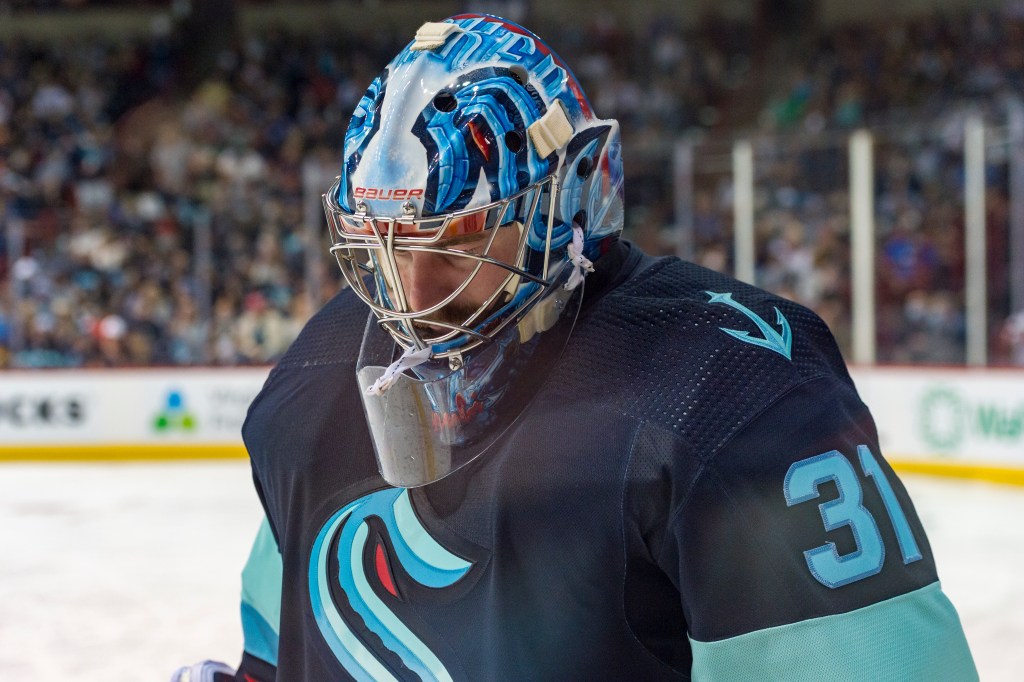 Philipp Grubauer (Photo/Brian Liesse)Priority No. 4: Acquire a top-nine winger
Looking at the team’s depth chart, there is both the need and the room to add another scoring winger, even if a splash move delivers a second new winger. Both Andre Burakovsky and Eeli Tolvanen sit in top-nine roles on the current depth chart. Neither are guaranteed to stay there.
Burakovsky has struggled to provide any offensive or defensive value since an injury de-railed him midway through the 2022-23 season. He’s a second buyout candidate if cap space becomes necessary for a splash addition. A buyout would create $3,541,667 in cap space for the 2025-26 season.
For his part, Tolvanen could be a piece the team uses in a trade to acquire a frontline player. His production (23 goals last season), contract ($3.475 million cap hit for one season), and age (26) are likely attractive to other clubs. Even if he stays, his skillset (shooting, hitting, and defense) works up and down the lineup. He’d create competitive, upward pressure on those higher in the lineup and valuable injury insurance if he started the season in a “fourth line” role.
Recently, Botterill spoke about the need to add more physicality at the net front: “[B]ringing in players with a little bit more size like a Kakko or a Jani Nyman, I think will certainly help out. [There just needs to be an] emphasis of getting to the net, being stronger in front of the net there from that standpoint.” Ideally, one of the team’s top additions fits that mold. A top-nine winger signing may be the most realistic way to add that presence.
Priority No. 5: Acquire a third-pair defenseman
The Kraken could retain restricted free agent defenseman Fleury and I believe the organization remains high on Ville Ottavainen, but neither player (nor Ty Nelson) should be penciled into an NHL lineup without veteran competition. Ideally, the Kraken add a player with NHL experience at a low cost who could be serviceable as a No. 6 defenseman alongside Evans if Fleury or Ottavainen can’t seize the role. Pending unrestricted free agent Mahura fits the mold.
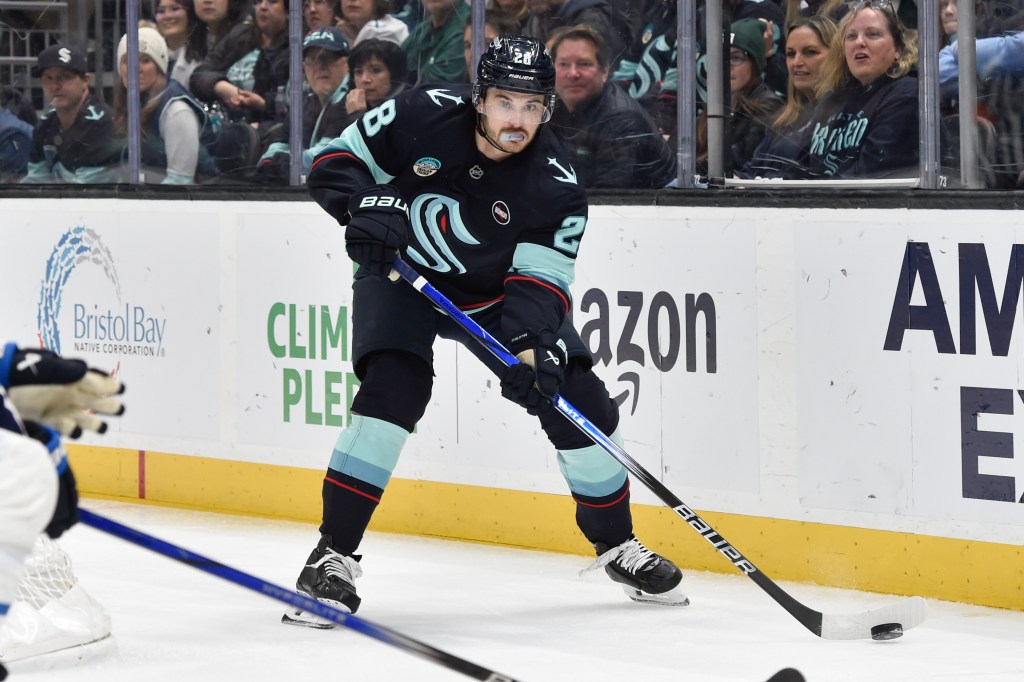 Josh Mahura (Photo/Brian Liesse)Priority No. 6: Sign a fourth-line center
Similarly, the Kraken could retain restricted free agent center Meyers, and the team has already re-signed Hayden. Those players, along with Mitchell Stephens, provide solid depth down the middle. Similar to the depth defenseman need discussed above, a free agent veteran who could win face-offs and play on the penalty kill would improve the mix and ideally win the job.
Priority No.7: Sign a fourth-line winger
The Kraken want to leave open the possibility that a prospect like Jani Nyman (or Berkly Catton, or Ryan Winterton, or Jacob Melanson) seizes a role in the fall. If a prospect forces his way into the lineup, the depth chart could get crowded, but Seattle still may be a forechecking depth winger short. Pending unrestricted free agent Eyssimont is an example of a player who would fit the need.
Bonus: Continue to be opportunistic
Finally, and this likely goes without saying, the Kraken are not talented enough to look past an opportunity for value even if it doesn’t fit the framework above. For example, suppose a finesse winger like Bjorkstrand is available on the cheap or another team wants to overpay to acquire Tolvanen. The Kraken should be in those conversations too.
* * *
What do you think are the team’s offseason areas of need and priorities? Let us know on X @deepseahockey or @sound_hockey or on BlueSky @deepseahockey or @soundofhockey.com.

Curtis Isacke
Curtis is a Sound Of Hockey contributor and member of the Kraken press corps. Curtis is an attorney by day, and he has read the NHL collective bargaining agreement and bylaws so you don’t have to. He can be found analyzing the Kraken, NHL Draft, and other hockey topics on Twitter and Bluesky @deepseahockey.