
The 2025-26 NHL season has reached the point where narratives give way to numbers— and the numbers tell a story of parity.
With fewer than a dozen games remaining for most teams, the race for the Stanley Cup is tightening into a data-driven sprint. Goal differentials, special teams, and situational execution are no longer supporting details— they are defining indicators.
Advertisement
No team has separated. Several have built cases.
At the top, the Colorado Avalanche (48–14–10, 106 points) and Carolina Hurricanes (46–21–6, 98 points), each with a goal historically a strong predictor of postseason success. Close behind, the Tampa Bay Lightning and Edmonton Oilers rank among the league leaders in goals.
Further down the bracket, momentum belongs to teams like the Pittsburgh Penguins and Vegas Golden Knights, while younger rosters in the Buffalo Sabres and Anaheim Ducks are beginning to translate development into results.
All these teams have a real shot at making it to the Stanley Cup Final, which begs the question: What would some of the most likely Finals matchups look like?
Advertisement
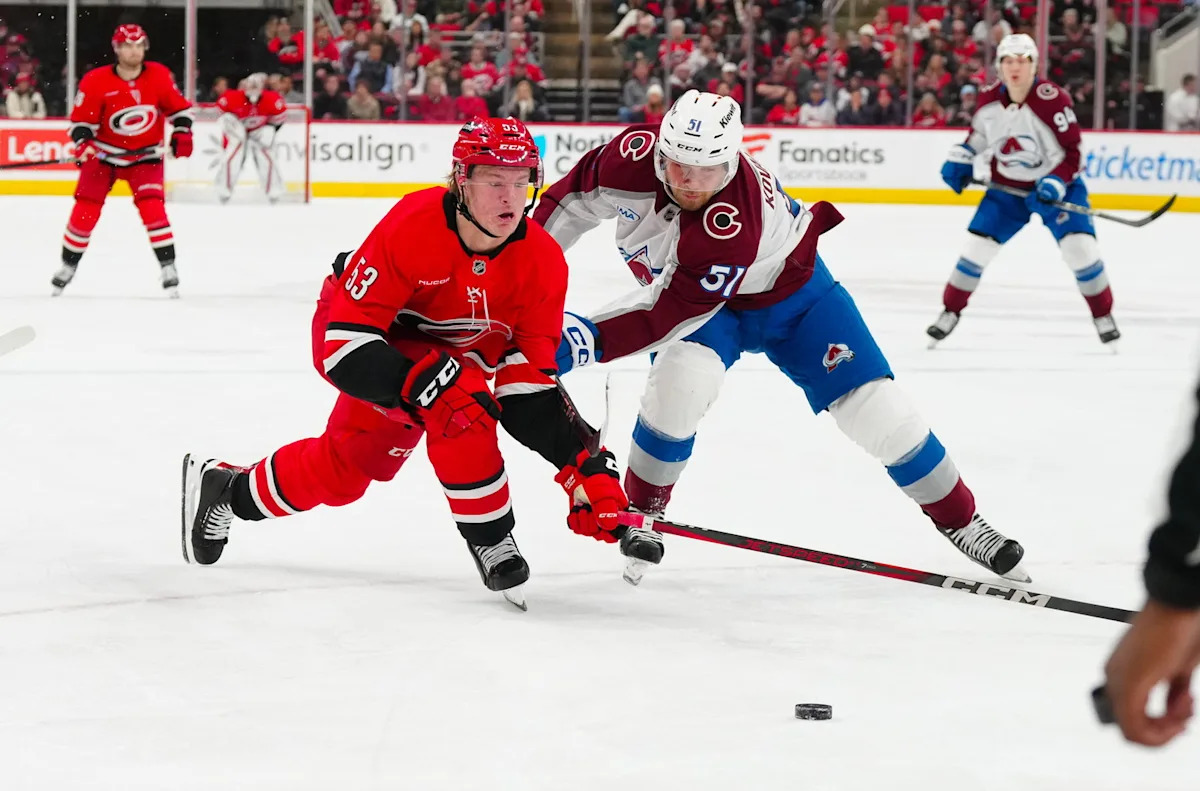
Hurricanes vs. Avalanche: Elite by Every Measure
A Carolina–Colorado series wouldn’t just feature two contenders—it would feature two of the league’s most complete statistical profiles.
Colorado’s 48 wins are backed by top-tier puck possession metrics and a goals-against average hovering near 2.5 due to the amazing performance of Scott Wedgwood.
The Aves power play operates at 17.2%, which is not the percentage the Aves want. The offense of the Aves speaks volumes. A +85 goal differential has driven the Aves’ ability to outshoot opponents. This means the Aves are near perfect at outscoring their opponents.
Advertisement
Carolina matches that efficiency differently. Their penalty kill ranks at the top of the NHL at 166 penalties, and they allow 10.6 shots per game—one of the lowest marks in the league. The Canes have 46 wins and aren’t built on explosive scoring, but on control: structure, forechecking pressure, and depth scoring across all four lines.
Head-to-head, Colorado’s 5–3 win in January reflected the contrast—high-end scoring versus layered defense.
In a seven-game series, the edge may come down to special teams. Both teams are top-tier at even strength. The difference will be who capitalizes when the game tilts.
Penguins vs. Golden Knights: The Analytics of a Turnaround
Pittsburgh’s resurgence is backed by underlying improvement, not luck.
Advertisement
Since the Olympic break, the Penguins have posted a points percentage above .600 while reducing goals against to about 3.0 per game. That, in part, is because of Arturs Silovs’ stellar save percentage at .891.
Captain Sidney Crosby has fueled mainly the puck control in key moments at 709 face off wins.
Vegas, by contrast, has remained steady rather than surging. Their 32–26–16 record reflects inconsistency, but their advanced metrics suggest a team more dangerous than its record indicates. The franchise must think there’s more untapped potential on the roster, as they just fired Head Coach Bruce Cassidy with eight games left in the season.
Both the Golden Knights and Penguins win in similar ways: structured breakouts, disciplined neutral-zone play, and limiting high-danger chances.
Advertisement
This would not be a high-scoring series. It would be a territorial one—decided by inches, not chances.
Lightning vs. Oilers: Numbers vs. Identity
Few matchups present a clearer stylistic—and statistical—contrast.
Tampa Bay ranks among the league’s best in goals allowed per game at 2.75 while maintaining a power play efficiency near 22%. Their experience shows in situational metrics: the Bolts have one of the lowest turnover rates in defensive zones.
Edmonton, meanwhile, leads the league in offensive production, averaging close to 3.5 goals per game. Their power play hovers around 30% which is not just effective, it’s game-changing.
Advertisement
This series would hinge on pace. If Edmonton pushes games into track meets, the numbers favor them. If Tampa Bay slows it down, history—and efficiency—favor the Lightning.
Sabres vs. Ducks: Growth, Quantified
The numbers behind Buffalo and Anaheim point to something larger than promise—they point to arrival.
Buffalo has increased its scoring output to 3.43 goals per game, a significant jump from recent seasons. More importantly, their goal differential has turned positive, signaling a shift from rebuilding to competing.
Anaheim’s improvement shows in shot generation and transition speed. They’ve on pace to reduce their shots against by nearly 300 this season, while increasing high-danger scoring chances.
Advertisement
Neither team is statistically dominant—but both are trending upward.
And in a league defined by timing, trajectory matters. Ducks-Sabres would be a heartwarming Stanley Cup Finals if the two teams were to make Cinderella-esque runs.
The Takeaway
The numbers reinforce what the standings suggest: there is no runaway favorite Stanley Cup Finals matchup.
Multiple teams rank in the top five across key categories—goal differential, special teams, and scoring efficiency. Historically, that kind of distribution leads to unpredictable postseason outcomes.
The difference this year may not be who is best, but who is best at the right time.
Advertisement
The post What Are Some of the Most Likely Stanley Cup Finals Matchups? appeared first on The Lead.