
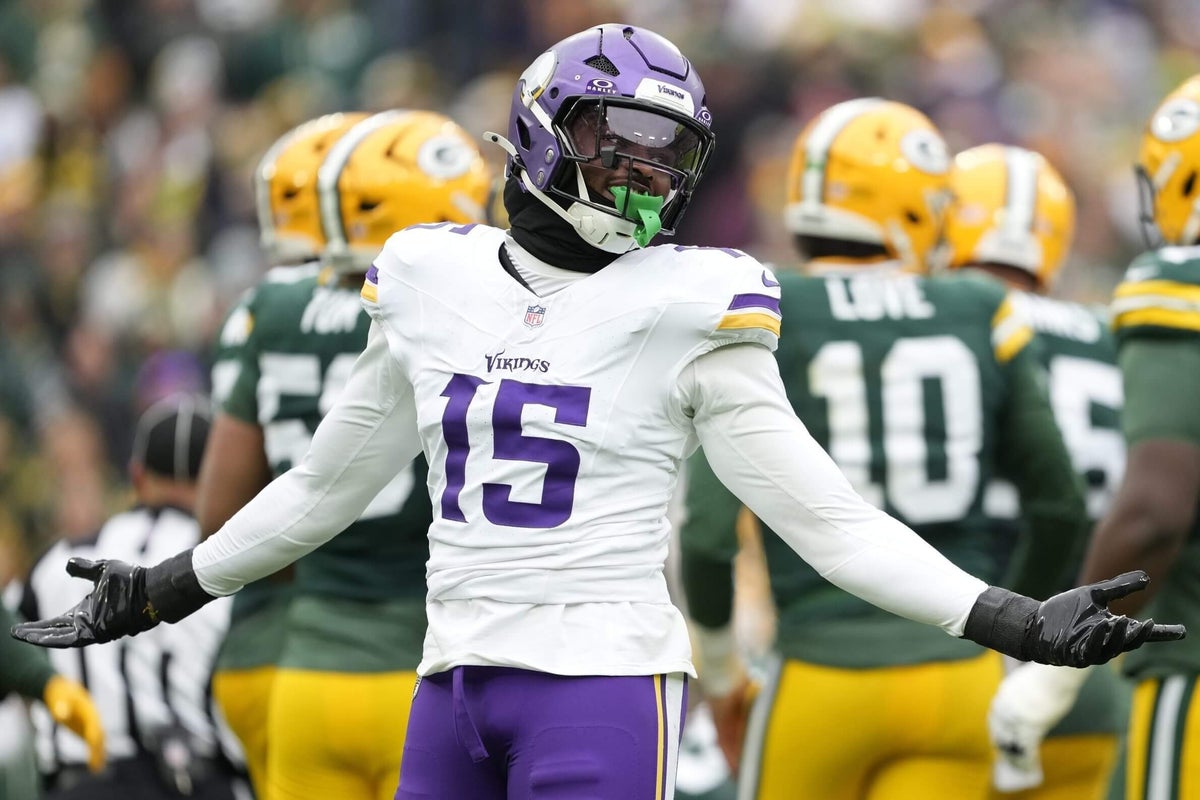
The Minnesota Vikings took a patient approach in free agency. Their thinking? Why spend top-of-the-market money, in many cases, on players whose production doesn’t match?
This has helped the team smooth over its salary-cap situation, but plenty of holes remain. Interim general manager Rob Brzezinski has stated that he wants the team to build depth through the draft, beginning next month. So, what is needed?
As a primer for workouts later this spring and summer, here is a very early roster projection to assess where each position group stands.
Quarterback (3)
Starter: Kyler Murray
Backup: J.J. McCarthy
Depth: Carson Wentz
This shouldn’t come as much of a surprise. The Vikings want competition at quarterback. They’ve secured the players. Now, the fun begins. Two things to watch for during the early part of this offseason: how quickly Murray adapts to coach Kevin O’Connell’s offense and how McCarthy looks after a productive offseason. The real evaluation will begin in late April, following the draft.
Wentz will have a role, too. He proved last year that he can perform with minimal practice reps. Another season in Minnesota’s system should open up more possibilities, but Murray and McCarthy will need the most on-field time. As for Max Brosmer, the Vikings won’t want to lose him. They could try to slide him to the practice squad.
Running back (3)
Starter: Aaron Jones
Backup: Jordan Mason
Depth: Zavier Scott or draft pick
Jones may start because he possesses more of a three-down skill set than Mason, but Mason is the more productive runner. The Vikings will have to thread this needle. How do you ensure you have solid pass protection out of the backfield (Jones) but also force defenses to commit resources to stopping the run (Mason)?
Scott showed flashes in 2025, especially as a receiver. You cannot rule out a draftee at running back, though the Vikings haven’t selected one on Day 1 or 2 since Alexander Mattison in 2019.
Fullback (1)
Starter: Draft pick or FA signing
Some NFL teams don’t carry a fullback. Other offensive play callers (like the Bears’ Ben Johnson) use rugged tight ends at the spot. Regardless, it feels like the Vikings should roster one. Recent retiree C.J. Ham not only inserted effectively in the run-blocking phase, but he was also huge as a pass protector on third down. Vikings assistant head coach Frank Smith thrived with Alec Ingold in Miami; finding someone to play a similar role seems wise.
Wide receiver (6)
Starters: Justin Jefferson, Jordan Addison, FA signing and a draft pick
Depth: Tai Felton, Myles Price
In the best-case scenario, Felton, whom the Vikings drafted last year late in the third round, develops into a trusted No. 3 option like Jalen Nailor (who signed with the Raiders in free agency). The Vikings love his athleticism, smarts and run-after-catch ability. Can he become a consistent route runner? Can he limit drops?
Regardless, the Vikings could use another player or two at the position. A veteran free agent would eliminate the need for a premature promotion for Felton. A draftee would add insurance for the future, depending on what Addison’s status and next contract look like.
Meanwhile, Price stays as the returner. He was a revelation in 2025, and it’s fair to think he could eventually become an offensive weapon on jet sweeps or screens.
Tight end (3)
Starters: T.J. Hockenson and Josh Oliver
Depth: Ben Yurosek or draft pick
Hockenson’s production has dipped from his 2023 breakout, but he’ll be another season removed from the torn ACL and in a contract year. His pairing with Oliver can be potent. The fewer times Hockenson has to remain in the backfield to pass protect or chip, the more likely he is to serve as a safety valve for Murray.
The depth is more interesting. Gavin Bartholomew, a sixth-round pick in 2025, missed last season with a serious back injury. Yurosek showed some flashes. The Vikings could seek a tight end with more starter-level traits in late April, which would only further the competition for the No. 3 spot, especially given Hockenson’s and Oliver’s injuries in recent seasons.
Offensive line (9)
Starters: LT Christian Darrisaw, LG Donovan Jackson, C Blake Brandel, RG Will Fries and RT Brian O’Neill
Depth: T Ryan Van Demark, G Joe Huber, C Michael Jurgens and a draft pick
Four of the Vikings’ five starters return. Two questions may dominate the summer: How prepared is Darrisaw to play a full workload in 2026? And will the Vikings extend O’Neill? It’s easy to be optimistic about both. If the Vikings don’t ink O’Neill for the future, pursuing a tackle in the draft would make sense.
Regardless, the Vikings will explore the draftable center crop. That type of acquisition would round out the room, given the Van Demark signing and internal faith in Huber’s development.
Defensive line/edge rusher (11)
Starters: Jonathan Greenard, Jalen Redmond, draft pick at DT and Andrew Van Ginkel
Depth: Dallas Turner, Tyrion Ingram-Dawkins, Levi Drake Rodriguez, Bo Richter, Elijah Williams, Chaz Chambliss, draft pick at edge rusher
Perhaps the most important roster question in the short term is Greenard’s future. He has been one of the key cogs in coordinator Brian Flores’ defense. Trade him, and the Vikings would be relying heavily on Turner, a third-year player. While Turner has shown flashes, those would be massive shoes to fill.
Beyond that, drafting defensive tackles and edge rushers is never a bad strategy. This draft has plenty of intriguing nose tackles. The Vikings could also find a developmental edge rusher in the middle rounds. These young players would fit in nicely with Ingram-Dawkins, Rodriguez, Richter, Williams and Chambliss. Undrafted defensive lineman Tyler Batty will also be vying for a spot. This should be one of the most competitive position groups in training camp.
Linebacker (3)
Starters: Blake Cashman and Eric Wilson
Depth: Ivan Pace Jr.
Why mess with success? When Cashman was healthy in 2025, he and Wilson were central to the Vikings’ defensive success. Cashman can blitz, he sniffs out runs and he doesn’t get lost in coverage. Wilson is much less comfortable in space, but his fit with Flores is undeniable.
Could the Vikings benefit from drafting a linebacker who’s comfortable in coverage in the event of Cashman suffering another injury? Yes. But those types of players are hard to find in the draft.
Cornerback (5)
Starters: Byron Murphy Jr. and Isaiah Rodgers
Depth: James Pierre, Zemaiah Vaughn and a draft pick
The Vikings rarely play with three cornerbacks. They are also creative enough with their safeties that they don’t value this position as highly as other teams. Murphy and Rodgers may not have been difference-makers in 2025, but they were reliable.
Pierre arrives with upside and familiarity. Vaughn impressed last fall, and, with another offseason of physical development, is worth watching this summer. Drafting another cornerback who is instinctive and a willing tackler seems logical, too.
Safety (6)
Starters: Harrison Smith, Jay Ward and Josh Metellus
Depth: Theo Jackson, Tavierre Thomas and a draft pick
Smith has not ruled out a return. It doesn’t feel like a decision is imminent, either. The Vikings don’t plan to push him for a decision, knowing they need to plan for the future regardless. Smith is 37 years old. If he plays, he’ll want the chance to bring a Super Bowl to the organization he’s given his career to. Ward’s snap count should increase, too, and Metellus remains a trusted slot defender.
Adding youth is essential. If the Vikings emerge from the 2026 draft without a young safety, it’d be somewhat puzzling. However, given Flores’ appetite for versatility, it’s possible that the Vikings could keep a budding player like Kahlef Hailassie and draft a corner who is more of a slot defender.
Special teams (3)
Starters: K Will Reichard, P Johnny Hekker, LS Andrew DePaola
This might be the most stable position group entering the 2026 season. Reichard is coming off one of the NFL’s best kicking seasons, and DePaola is an annual All-Pro candidate. Hekker’s numbers aren’t as exceptional as his six-time All-Pro run from 2013 to 2018, but he is a reliable holder. Expectations should be high for special teams coordinator Matt Daniels’ group.