
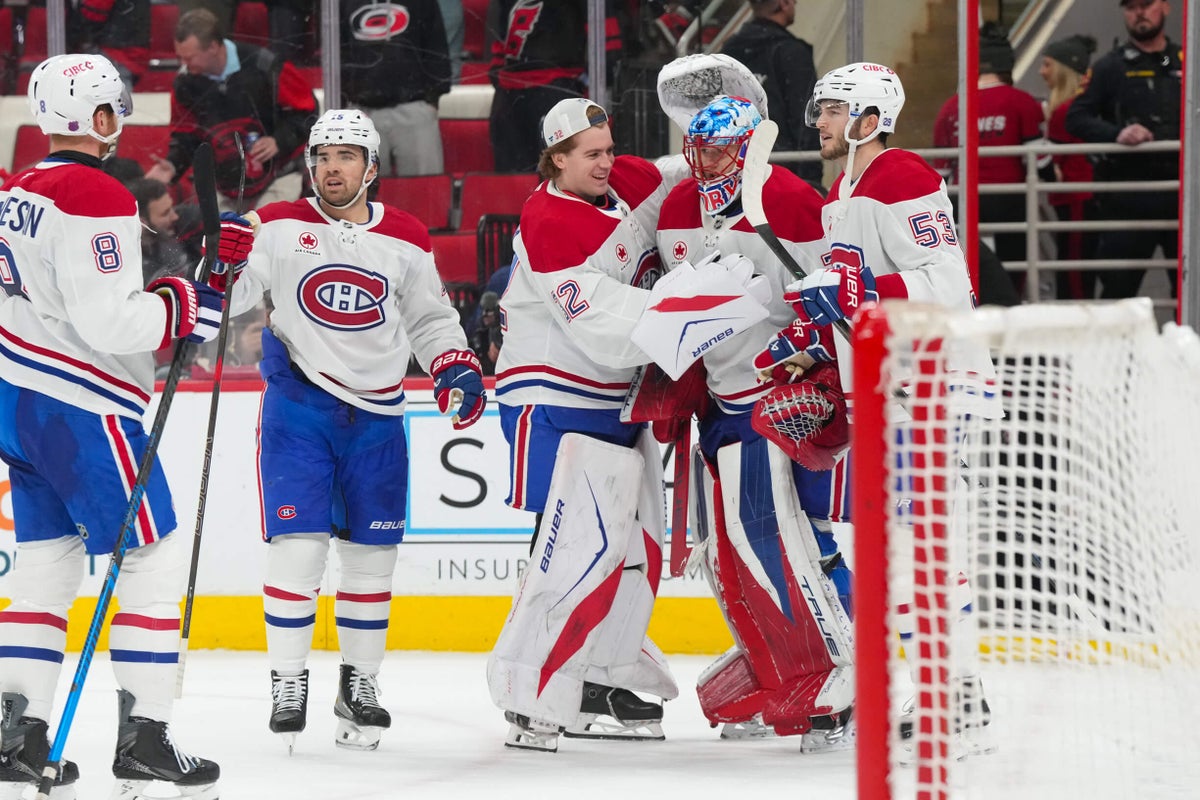
TAMPA, Fla. – It is really starting to feel like the home back-to-back losses against the San Jose Sharks and Anaheim Ducks March 14 and 15 was a transformational weekend for the Montreal Canadiens.
They have gone 6-1-0 since, with a 3-1 loss at the Detroit Red Wings on March 19 the lone blemish on their record in their last seven games.
Goaltender Jakub Dobeš was named the NHL’s first star of the week Monday, and there should be no mistaking that his play is the driving force behind this late-season surge. The Canadiens have a .937 team save percentage since facing the Boston Bruins on March 17, second in the NHL entering play Monday.
Just as Bruce Cassidy was fired by the Vegas Golden Knights in large part due to porous goaltending, excellent goaltending will make any coach look good. But it’s not that simple. While Martin St. Louis readily admits he doesn’t know the first thing about goaltending, and the firing of Éric Raymond and promotion of Marco Marciano at goaltending coach on Jan. 28 appears to be the real turning point of the season, the way the Canadiens have played in front of Dobeš and Jacob Fowler has contributed to their ability to stop pucks.
In their last seven games at five-on-five, they have been cumulatively outshot by a wide margin, but the Canadiens are breaking even in expected goals percentage (49.8 percent) and high-danger scoring chances (50 percent), according to Natural Stat Trick. The Canadiens have still outscored their opponents 18-7 at five-on-five over this span, which means their goalies have saved roughly nine more goals than expected in seven games, an enormous impact.
But while the goaltending has allowed the team to build leads, the Canadiens have done a much better job protecting them than they did earlier in the season. Goaltending has something to do with that as well, but puck and game management have seen massive improvement, the penalty kill has been better and defending at five-on-six has improved, too. All of these season-long issues only recently began turning around. And all of them are directly related to goaltending.
Sometimes a team’s defensive difficulties can ultimately be tied to its inability to maintain offensive pressure, or its offensive struggles can be linked to an inability to exit its own zone with possession. While strong goaltending can often mask team-wide deficiencies, sometimes it serves to accentuate certain aspects of a team’s game, and as those aspects improve the goaltending also improves in kind.
It’s too soon to say whether that applies to the Canadiens, but the last seven games suggest that may be what is taking place.
The emergence of the Bolduc-Evans pairing
Last Wednesday, after the team picture and a brief Canadiens practice, Zack Bolduc came out to chat. He was riding a 31-game goalless drought that included an apparent goal disallowed because of an offside review, and was asked if simply watching that puck enter the net was good for his confidence.
Bolduc shrugged.
“I don’t have any issues with my confidence,” he said. “I know I can score goals. I think, for myself, you build confidence in practices, and I still score goals in practices. So I can score goals, and I’ll never doubt that. But I feel as a line we’re playing really well and we’re doing everything but scoring.”
Bolduc was paired with Jake Evans on a line on March 6 in Anaheim, the day of the trade deadline. The two of them have played with a few different linemates, but aside from one game in which Bolduc was scratched, the two have been joined at the hip over a span of 12 games.
Just look at how the Canadiens have performed collectively at five-on-five with Bolduc and Evans on the ice and without them. It is a stark difference.
Evans and Bolduc’s 5v5 impact
CF%SF%HDCF%GF%XGF%
With Bolduc and Evans
51.9
56.5
64
83.3
63.2
Without Bolduc and Evans
47.1
47.1
45
60.4
47
That “without” column includes the minutes played by Nick Suzuki’s line, which have been overwhelmingly positive, so that really is an indictment of how the Oliver Kapanen and Phillip Danault lines have been unable to tilt the ice in their favour.
Right now — and it’s been the case for some time — the Canadiens’ second-best forward line is the one anchored by Evans and Bolduc. The lesson is that it is easier to feel confident in your game when the process is going this well, even if the results and rewards aren’t there.
And wouldn’t you know it, Bolduc had a goal and an assist in his very next game.
That wasn’t the only foreshadowing…
Alex Newhook also spoke after that Wednesday practice and was asked if he can get in trouble if he tries to read linemate Ivan Demidov’s eyes.
“You’ve got to be ready to get the puck all the time,” Newhook said in agreement. “He wants to make plays, and he sees you all the time. So just get into a shooting area, and don’t be surprised if it gets to you.”
Being Demidov’s linemate forces you to be in a state of high alert at all times. And then, as if to prove Newhook’s point, Demidov did this two games later in Nashville on Saturday night.
… he sees you all the time.
Indeed he does.
Demidov interview outtakes
Speaking of Demidov, our feature on him that ran Monday came after a 45-minute conversation a week earlier.
A lot of that conversation did not make the piece. One part focused on how he and Lane Hutson talk hockey, particularly on the road as roommates. When asked if he and Hutson see the game similarly, the answer was instantaneous: “Yeah, I think so.”
And he would know, because when he and Hutson go back to their hotel room on the road, there is always a game breakdown happening between the two.
“After games?” he asked. “Every time.”
Before just about every game, Demidov will find some time to look at all his shifts from the previous one, trying to find little areas he can improve. The only exception is on back-to-back games with travel if he can’t find the time, but normally he will do this either the night before a game or just before going down for his game-day nap.
“Just re-watch them and figure out what I have to do,” he said.
And finally, Demidov was asked to compare how well he speaks English now to a year ago, when he first arrived in Montreal.
“The difference is so, so big difference,” Demidov said. “When I just came back then, I was like, I don’t want to be shy, but I don’t want to look goofy. So I would be like, ‘OK, I’m going to try to say something.’ And in the mind, it sounds like I’m so good, you know. But then, for example, I watched my draft interview and my first interview here after my first game…”
At that point, Demidov did a literal face palm, laughing.
“What am I saying?” he continued. “I look at my face, and in my mind I’m probably saying, ‘Yeah, it’s pretty good.’ But yeah, it’s a big difference. Obviously the summer helped me that I stayed here because I was just around the boys and we just talked about everything. Right now I feel a big difference if I compare it to myself last year.
“I feel confident right now in everything.”