
Lakers’ Demise a Loss For Everyone
by Ken Taylor/Guest Commentator

Last week’s announcement that Mercyhurst University is eliminating its men’s hockey program was a gut punch—one that’s hard to stomach and one that deserves serious reconsideration.
The vast majority of the college hockey world was introduced to Mercyhurst on March 24, 2001 when the Lakers pushed Michigan to the brink in the first round of the NCAA Tournament. Mercyhurst fell 4-3 after surrendering a 3-2 lead in the third period to a powerhouse loaded with NHL talent.
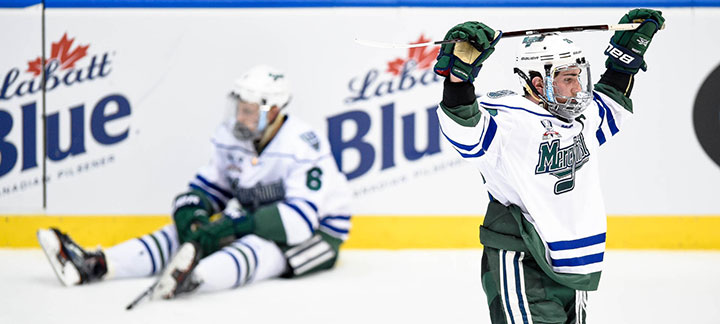
The 6,792 fans in attendance knew they had witnessed something different. When the final horn sounded, the Lakers lingered on the ice — as teams often do when a loss marks the end of a season, and for some, a career. When they finally made their way off, the entire arena — Mercyhurst, Michigan, and other fans alike — rose to salute a team most had never heard of just a few hours earlier. It was a well-earned ovation for a group that proved a true Cinderella story could exist in college hockey.
That game became a defining moment for emerging programs in leagues like the MAAC (later Atlantic Hockey America) and College Hockey America. At the time, the college hockey establishment wasn’t fully on board with granting automatic bids to conferences outside the traditional power structure (then the WCHA, CCHA, Hockey East and ECAC). Many expected a rout. The shot total reflected that — Michigan, 51-24 — but Mercyhurst had the pieces to compete. Goaltender Peter Aubry was outstanding, as expected, and players like Louis Goulet, Eric Ellis, Adam Tackaberry, Jeff Gould, Brad Olsen, Jody Robinson and Mike Muldoon capitalized on their chances to make it a tight game.
Mercyhurst wasn’t a one-hit wonder. Long before 2001, the program built a track record of success — reaching the Division II championship final round in 1993 and 1995, and qualifying for the Division III tournament in just its fourth year as a program in 1991. At the Division I level, they returned to the NCAA Tournament in 2003 and 2005.
The constant through it all was head coach Rick Gotkin. He led the program for all 37 years of its existence, and it’s hard to imagine anyone doing more with the resources provided. Mercyhurst was one of the first programs from the MAAC and later Atlantic Hockey to prove it could compete with the sport’s elite. That credibility helped drive growth across the sport and contributed to NCAA Tournament expansion from 12 to 16 teams in 2003.
But the impact went far beyond wins and losses. At a small Catholic institution, hockey became a centerpiece of campus life. For 25 years, the men’s and women’s programs competed at the Division I level and served as flagship programs for the athletic department.
Rick Gotkin’s presence defined the culture. Within minutes of meeting him, you understood what his program stood for — effort, integrity, and doing things the right way, on and off the ice. That kind of leadership doesn’t just shape a team; it elevates an entire campus.
That’s what makes the news of the program’s elimination so jarring — and so disappointing.
A closer look suggests a rushed decision that failed to consider the bigger picture. Yes, these are difficult economic times in college athletics, and enrollment challenges force tough choices. But this one appears to have lacked transparency, proper vetting, and strong leadership in execution.
You can’t promote a fundraising campaign for a program on social media and then eliminate it 24 hours later. You can’t pull the rug out from a coach like Rick Gotkin — especially when he’s away from campus fulfilling his NCAA Hockey Committee duties in South Dakota surrounded by media — without giving him the chance to be there for the student-athletes he’s spent decades supporting.
This wasn’t handled the right way. Not even close.
The financial savings from cutting men’s hockey will likely pale in comparison to the opportunities lost — opportunities for growth, engagement, and institutional identity. Given the chance, the Mercyhurst hockey community could rally and raise the necessary support to sustain the program.
Set a goal. Make it clear. Challenge the Mercyhurst community to meet it — and if they do, reinstate the program. While you’re at it, promise that if the goal is met, you’ll name the ice center after Rick Gotkin. (He won’t like that element, but he’s earned it.) Build a committee of former players spanning every era and let them reconnect with teammates and classmates. That model works. It’s been proven.
I wasn’t surprised by what I saw in 2001. At the time, I worked with the MAAC, though I’m a Michigan graduate. You might think my loyalties were divided — but they weren’t. It’s the only time I ever rooted for a team in green and white against Michigan.
Why? Because I believed in what Rick Gotkin’s program represented. I had seen Mercyhurst up close. In the MAAC’s five years of existence, the Lakers won three regular-season titles and two conference championships, earning two NCAA bids and enjoying a great rivalry with a program many know well — Quinnipiac.
After that 2001 game, I stood with Coach Gotkin and a few players outside the press room. Michigan’s Hall of Fame coach, Red Berenson, stopped to commend them on their effort. Then at the press conference, Gotkin did what he always did — he focused on what had been achieved, the experience, and what it meant for his players. No complaints. No regrets.
When he finished and stood to leave, the press room gave him a standing ovation.
That doesn’t happen at press conferences. But Mercyhurst hockey had a way of earning respect — instantly.
College hockey people may be inclined to gloss over the Mercyhurst news. The team finished 63rd and last in the NPI this past season. But that attitude doesn’t account for what is lost when a program like that drops from its ranks.
To the Mercyhurst administration: this program gave your University far more than you seem to recognize. It created opportunity, identity, and pride. It deserved more than a sudden, poorly executed decision.
You have a rare asset — every player who ever wore that jersey shares a connection to the same head coach. That kind of continuity is powerful. Use it. Engage it. Give them a chance to help.
Save the program.
Your university will be better for it.
Ken Taylor is a former college athletics administrator (1999-2025) and oversaw day to day operations for the MAAC Hockey League from 1999-2003. He was also Associate Director of Athletics for Development (Fundraising) at Monmouth University 2015-2025.