
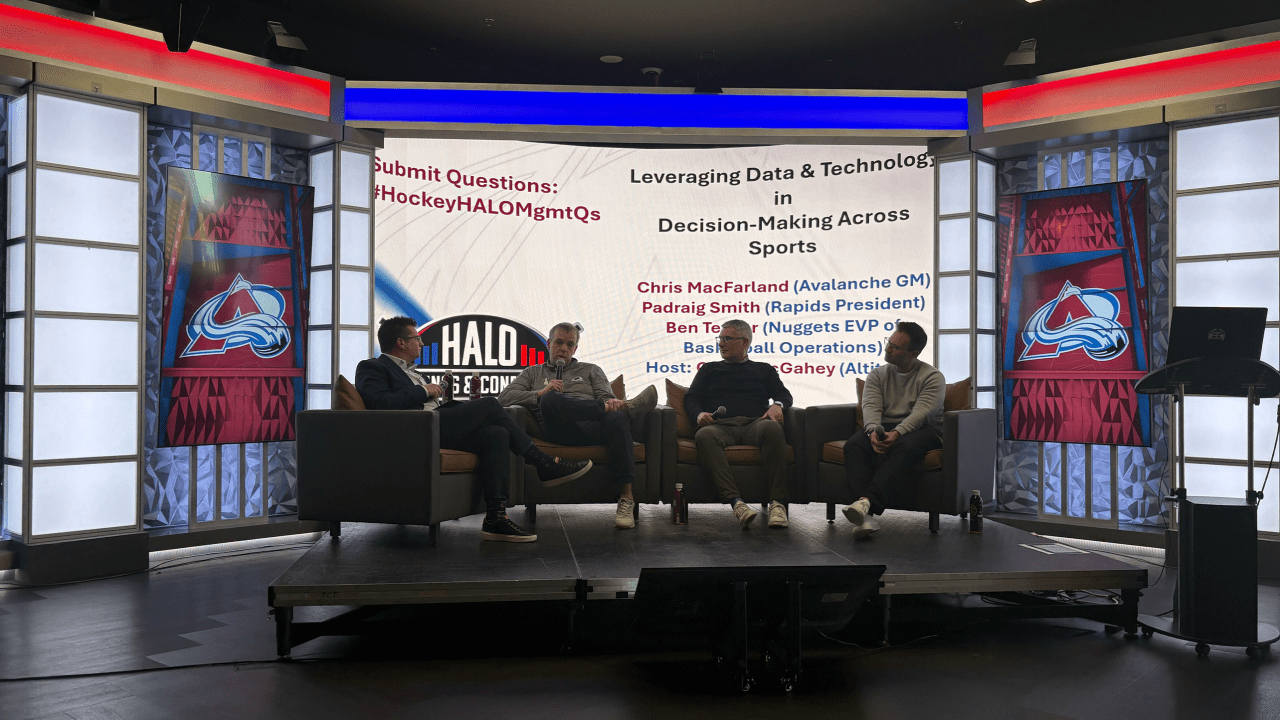
One of the panels featured some of the top executives for the Colorado professional sports teams, including MacFarland, Denver Nuggets (NBA) executive vice president of basketball operations Ben Tenzer and Colorado Rapids (MLS) president Padraig Smith. MacFarland, Avalanche president of hockey operations Joe Sakic and Bednar use advanced metrics as a tool for both coaching and management, helping the team become a perennial Stanley Cup contender.
The Avalanche have factored in analytics heavily in retooling their roster with a barrage of trades in recent seasons, acquiring key players like goalies Scott Wedgewood and Mackenzie Blackwood, forwards Martin Necas and Brock Nelson, last season and bringing back forward Nazem Kadri, a member of their 2022 championship team, prior to the NHL Trade Deadline this season.
“We like to use (analytics) as a look under the hood, whether it’s after a game or player acquisitions,” MacFarland said. “When our analytics team and scouts agree, that’s pretty good. But I like it when they don’t agree. It allows us to peel the layers of the onion back and go deeper, all in an effort to help us make better decisions.”
Bednar said he’s in close touch with the Avalanche’s analytics department prior to, during and after games. Bednar said he and his coaching staff closely monitor analytical trends and League rankings for the team in various metrics and constantly tweak their playing style to continue to feature elite talents like forward Nathan MacKinnon and defenseman Cale Makar, but also to fine-tune other areas of their play.
“It’s ever-changing … and it’s a copycat League too,” Bednar said during the live episode of “The Hockey PDOcast” with Dimitri Filipovic and Thomas Drance recorded at the HALO conference. “It comes from our (coaching) staff, our analytics department and also the players. It’s an all-in atmosphere there. Everyone is able to come in and share ideas, and we take them all seriously.”
Bednar, in his 10th season as Avalanche coach, said he always has been really impressed by Colorado’s management team, which has built strong relationships with its players and is comfortable sharing data and information with them, and vice versa.
Bednar added that “emotions tend to be high” following a game, whether his team wins or loses, so he usually does not go into the Avalanche’s locker room afterward.
“If I want to send a message right then and there, I do it,” he said. “But to me, that time is for the players. I like to take my time, go through my stuff. I have our analytics, our game tape, so when I do my reviews, it’s the next day.”