
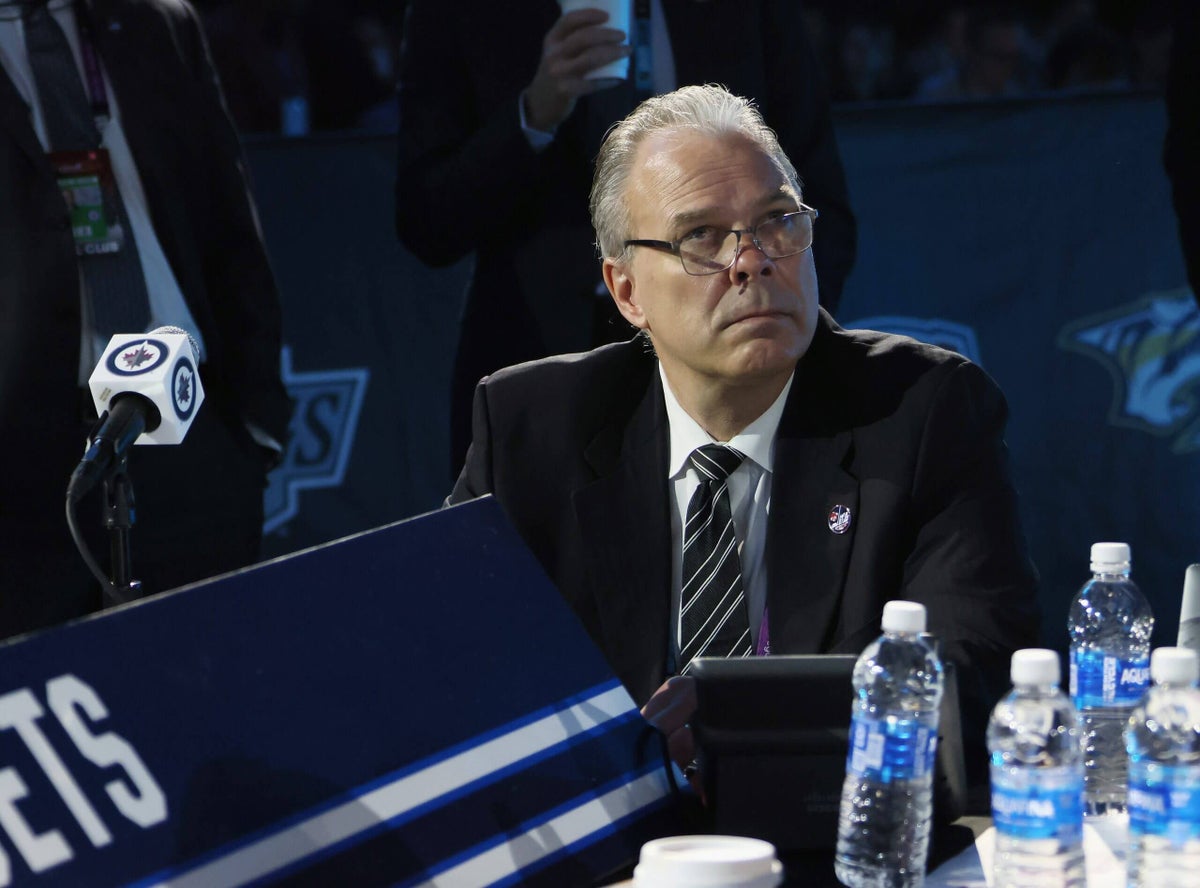
There is a concerning element to the Winnipeg Jets’ playoff push and it has nothing to do with the draft lottery.
No, this isn’t about Gavin McKenna or Keaton Verhoeff or your prospect of choice. It’s not about the Colorado Avalanche, who dominated Winnipeg two years ago and will start Round 1 as overwhelming favourites against any opponent. GM Kevin Cheveldayoff and the rest of the Jets front office need to face hard questions this offseason.
The problem with the Jets players’ well-earned push up the NHL standings is that it gives Jets management the opportunity to fool itself. A review of past end-of-season interviews with Cheveldayoff — and the Jets’ subsequent signings, trades, and deployment — indicates a team that’s not always as self-critical as the circumstances have called for. Whether or not the Jets continue their late-season surge, the most important outcome from this season will be the lessons they learn from it.
When the Jets get it right, they hire Rick Bowness and turn a divided group into a defensive juggernaut. When they fail, they sign veterans who are too slow to play Bowness’ brand of hockey or carry out Scott Arniel’s “forecheck, backcheck, defend the guts of the ice” philosophy.
Last summer, Jonathan Toews, Tanner Pearson and Luke Schenn were lauded for their Stanley Cup-winning acumen as Arniel joked there was no way Toews would play on the team’s fourth line. The Jets proceeded to play Toews like a second-line centre as his minuses piled up, then found that team performance magically improved once Pearson, Schenn, and Logan Stanley were moved at the deadline.
The team’s belief seemed to be that it was a Cup contender that only needed playoff experience and a bit of toughness to take the next step. But Cheveldayoff’s acquisitions and Arniel’s deployment didn’t have the quality or pace to play “Winnipeg Jets” hockey.
The team Cheveldayoff has built is a wild-card team based on roster quality with no clear route out of the mushy middle. Any swings taken towards a true second-line centre, an upgrade on defence or revamping Winnipeg’s bottom-six forward group must be more effective than Cheveldayoff has been since a torrid streak of transactions that began with the Andrew Copp trade in 2022.
More recently, Winnipeg has sent a first-round pick, two second-round picks, a third-round pick and two fourth-round picks away for Sean Monahan, Tyler Toffoli, Brandon Tanev, Schenn and Colin Miller. Only Miller remains (albeit in a depth role). Winnipeg’s .615 points percentage since Cheveldayoff shipped Schenn (and Stanley) to the Buffalo Sabres can’t solely be attributed to that one transaction, but the dynamism and pace on its third pair since Schenn’s departure has been a revelation by comparison. Isak Rosen is a good prospect but Jacob Bryson has been outscored 12-5. A lot of factors go into goal rates, but the small sample result is a downgrade on Schenn’s 29-16 disadvantage in 46 games prior to being traded.
This is a long way of saying that the Jets’ poor run of transactions in recent years may be responsible for part of their misery. Their most recent trade may be a step in the right direction, but it is not enough to ease concerns regarding its capacity for self-criticism.
“Everyone seems to forget the role that Logan Stanley played in winning four straight against Edmonton (in 2021),” Cheveldayoff told me in January 2025. “He was a regular shift player, he played all the (playoff) games. We go into Montreal, he’s the one that scores the two goals in Montreal. So he’s on a pretty good trajectory as a developing player at that point in time.”
There is some missing context with respect to this quote. The discussion was rooted in Cheveldayoff’s decision to protect Stanley at the 2021 expansion draft. I’d asked about that and followed it with a reference to two Jets defencemen lost to Stanley’s development: Johnathan Kovacevic and Declan Chisholm.
The part he missed was that the Jets’ evaluation of their own players had omitted the impact of variance, while ignoring the lengths their own coaches went to in order to hide Stanley from top-end talent that season. Stanley averaged the sixth-most minutes among Jets defencemen during the 2021 playoffs, playing nearly five fewer minutes per game than Winnipeg’s No. 5 defenceman. The coaching staff kept Stanley as far from opponents’ star players as possible, mirroring his extremely sheltered deployment from the regular season, and the Jets were still outshot (slightly) and outchanced (heavily) during Stanley’s minutes.
The team was fooled by percentages — Connor Hellebuyck’s incredible performance, combined with an unsustainably high shooting percentage — and decided it had a budding top-four defenceman on its hands. Why should the management team whose assessment missed PDO (and who traded two draft picks for Schenn after the quoted conversation) be trusted to re-route this year’s Jets?
It’s a good time to remember Winnipeg has made excellent offseason moves, too. Cheveldayoff’s acquisition of Gabriel Vilardi, Alex Iafallo, Rasmus Kupari and the draft pick which became Alfons Freij was first-class work, turning an untenable situation into a clear win. Extending Vilardi, along with franchise cornerstones Hellebuyck, Mark Scheifele and Kyle Connor, was critical towards building a playoff-contending team. Cheveldayoff has also retained Dylan DeMelo, Nino Niederreiter and Vladislav Namestnikov after acquiring each for discount prices, back when they were younger and more effective than the versions Winnipeg got this season. In all three cases, those players delivered positive value because they filled roles the Jets legitimately needed to fill.
This isn’t a Logan Stanley hit piece. He’s a beloved ex-teammate who eventually found his way to third-pairing quality. It’s not an indictment of Toews, whose performance is often of solid bottom-six quality, and whose lack of cheat was evident during some of Winnipeg’s worst games of the season.
It’s an indictment of Winnipeg’s ability to be fooled by its own success. It’s difficult to head towards the 2026 offseason believing in the group that sold Toews as a second-line centre and the GM who said, “There is some offensive help there to replace (Nikolaj Ehlers)” with respect to Pearson and Gustav Nyquist.
The Jets roster needs help whether it makes the playoffs or not. The problem with the Jets’ process is that they deemed Stanley’s 13 minutes of five-on-five hockey per game and two goals against Carey Price in 2021 as indicative of a blossoming top-four defenceman. It predetermined Elias Salomonsson’s AHL status this season, despite performance which has been markedly better than Schenn’s.
It’s clear Winnipeg has an imperfect sense of when a prospect is or isn’t ready to make an NHL impact. Betting on veterans makes sense for a win-now, all-in team with no room in its decision-making matrix for a young player whose total impact may be superior to a veteran but whose shift-by-shift performance may fluctuate. Cheveldayoff has perhaps the most difficult GM job in hockey, given no-trade clauses and the unrestricted free agent market’s lack of fondness for Winnipeg. But the idea that you can prescribe a player to a league prior to the season, like Salomonsson — as Arniel indicated last week — is costing Winnipeg the opportunity for long-term wins.
There are good examples of prospects “over-ripening” in other leagues. The Detroit Red Wings were famous for this, slow-playing the rise of Henrik Zetterberg and Pavel Datsyuk as two of the best players in the NHL. Still, Winnipeg’s focus on the immediate moment has cost the team enough opportunities at NHL players for a long enough time period to be detrimental. (Remember the time Ville Heinola went over a month without playing a competitive hockey game in the NHL or AHL despite good health — twice?)
Let’s end by taking a breath. Winnipeg won the 2025 Presidents’ Trophy as the NHL’s top regular-season team. It gave up the fewest goals in the league for two straight seasons prior to this one. Even when you include this season’s middling (and potentially still miserable) outcome, the Jets have won the fourth-most games over the past three seasons. It is a truly impressive run of accomplishments following Winnipeg’s last playoff miss in 2021-22, when Paul Maurice stepped down, Dave Lowry replaced him, and Bowness was hired in the offseason.
Recall that the Jets spent a large portion of the 2022 offseason recruiting outside opinions on their strengths and weaknesses. When Bowness first took Winnipeg’s phone call, he didn’t realize it could be to offer him a job. Cheveldayoff had recruited opinions from luminaries around the league, including sitting down at great length with coaches like John Tortorella to get honest outside opinions. It’s clear that Winnipeg’s management team is capable of finding the right answers to difficult questions — especially when their hands are forced, whether on the hiring front via Maurice’s resignation or by trade in the form of Dubois.
That’s why this late-season push carries foreboding undertones. There is a troubling ease with which a playoff-bound Jets team could blame Hellebuyck and Adam Lowry’s surgeries, Dylan Samberg and Cole Perfetti’s injuries, or sheer bad luck for their middling quality. A playoff spot would suck the urgency out of any offseason reflections, whether or not the Jets gave Colorado a fight.
Cheveldayoff is fond of saying that the NHL is a tough league to win in.
“Half the teams now don’t make the playoffs,” he said in 2022. “Half the teams are standing here the day after the season ends and answering the tough questions.”
Whether or not he finds himself among that half of the league seven games from now, Winnipeg needs its management to ask the hard questions this offseason.