
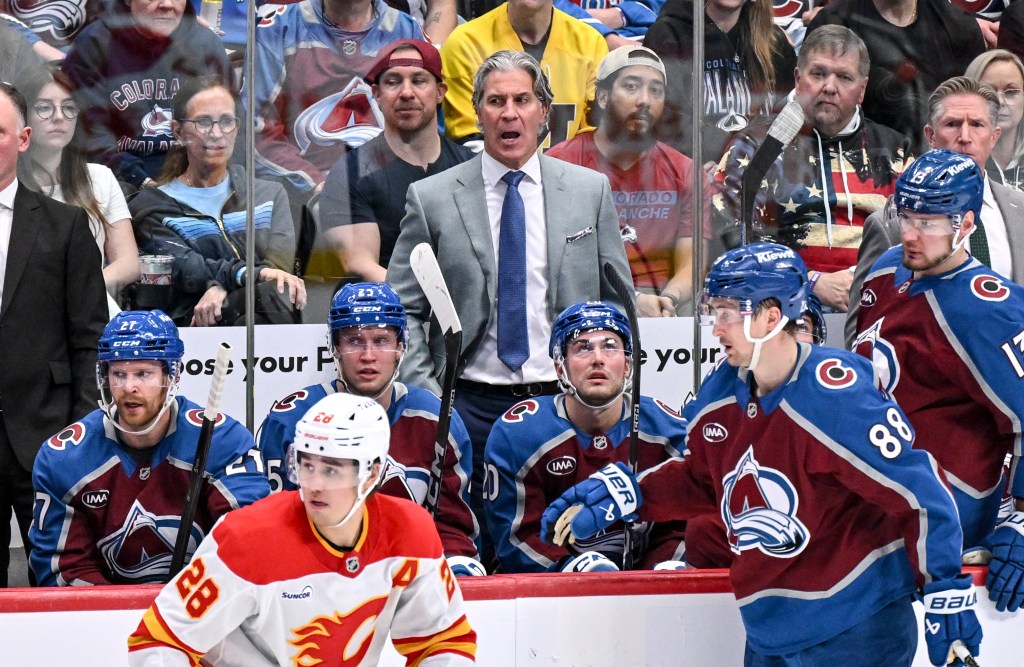
The Avalanche had a random quirk in the schedule Monday night, and a game that carried a little more consequence than a typical late-season contest against a rebuilding club.
It was Game No. 73 of 82, but it was also the first of the season against the Calgary Flames. It was also two days after the league-leading Avs dropped their fourth consecutive game at Ball Arena, including three in regulation. This is the same group that lost twice in regulation in the first 40 games of the campaign.
So, the preparation for what would otherwise be a pretty random Monday night tilt for a Stanley Cup contender waiting for the important games to come took on a little more significance. And the pregame prep worked, because the Avs started fast and crushed the Flames in one of the most impressive performances of the season.
The next day, Jared Bednar was at the Hockey Analytics League Operations (HALO) meetings and conference at Ball Arena. Hosted by Arik Parnass, head of the Avs’ analytics department, it was the largest gathering of NHL analytics staffers the league has ever seen — nearly 90 employees from 31 clubs. One of the panels during the conference was a live taping of the PDOCast, a popular, analytics-friendly hockey podcast hosted by Dimitri Filipovic, and Bednar was a guest on the show.
Bednar gave the 300 people in attendance an in-depth look at how the Avs operate and how he coaches. One of the most fascinating topics was how he uses the data Colorado’s analytics department provides him, and what he passes on to his players.
“(The analytics team) digs in on our opposition, so like we hadn’t seen Calgary yet this year,” Bednar said. “So I dig in, and I have an idea that they’re a quick breakout team — sixth-fastest in the league, and they’re fourth-fastest through the neutral zone — like everything’s up and out quick. So we have to manage our depth on our forecheck right away. We want to hunt their ‘D.’ They’re prone to some turnovers, but we need to manage our depth because we can’t let guys get in behind us.
“That was an important point for us (Monday) night. I felt like if we got on top of them quickly on the forecheck, that we could create some turnovers. We did. Their (defensive) coverage is a similar coverage to what we’d seen before, that our team tends to have significant amount of success against. So you’re just hitting points again from some of the teams that you just played that had the same coverage. We wanted to make sure we’re shooting the puck and challenge them inside. We did that. And then on the defensive side of it, like what do you need to be aware of?”
That was far more information than a typical NHL coach might want to reveal about an opponent, especially one the Avs still have to play two more times this season. But it was a peak behind the curtain of how Bednar uses the information at his disposal to get his team ready to play.
Bednar has been one of the most information-friendly coaches in the league for a long time. The Avs are seen around the league as a model franchise for how the front office and coaching staff embrace the use of analytics and work them into every aspect of running a successful franchise.
Brett Kulak is on his third team just during the 2025-26 season, and the fifth of his career. He joined the Avalanche just before the trade deadline, and now has nearly a month of Bednar’s pre-scout meetings under his belt.
“He just makes sure there is no detail missing,” Kulak said. “It’s not just a vague, broad message he’s sending to the team. It’s very specific in each area of the ice.”
Bednar is far from a numbers wonk. He’s a traditional hockey guy, but he’s also recognized that advanced statistics and the work an analytics staff does can be very valuable.
He’s found a way to marry numbers, video, and traditional scouting for a blend of information that helps his players see trends, be aware of danger areas with opponents, and also solve problems over the course of a long season.
“I don’t know if he loves analytics,” Avs general manager Chris MacFarland said later in the day during another panel during the HALO conference. “He certainly uses it and embraces it. It’s definitely a tool in the toolbox.”
One of the bedrocks of Bednar’s coaching philosophy is breaking the season into 10-game segments. That helps him and his coaching staff self-scout and identify any short- and long-term issues the team needs to address.
And as Kulak said, the information given to the players is never vague. It’s put together in an easy-to-digest package, often accompanied by video clips that show what the numbers are saying.
“I give them numbers, but they’re not getting decimal points,” Bednar said. “They’re getting ranked in the league. Like (Calgary) is fourth-fastest through the neutral zone. I don’t get too worried about 1-2 games a week or whatever, but when you’ve got through 10 games, we want to try and be top five in everything.
“If there’s something like we haven’t scored enough goals in a segment, and I’m noticing that it doesn’t seem like we’re shooting the puck enough, we’re not getting inside enough — generally, when the numbers come back, all of a sudden we’ve slipped from fourth or fifth in the league in low-slot chances to 27th. Guaranteed, I’ve got a lot of video that can match that. … That’s not a recipe for success. So I sell it to our guys and where I’ll give our guys a lot of credit is, over the years, when I address something, it’s generally (fixed) the next night. … They fix things and implement them very quickly, which is why I think we’ve had so much success this season.”
Want more Avalanche news? Sign up for the Avalanche Insider to get all our NHL analysis.