
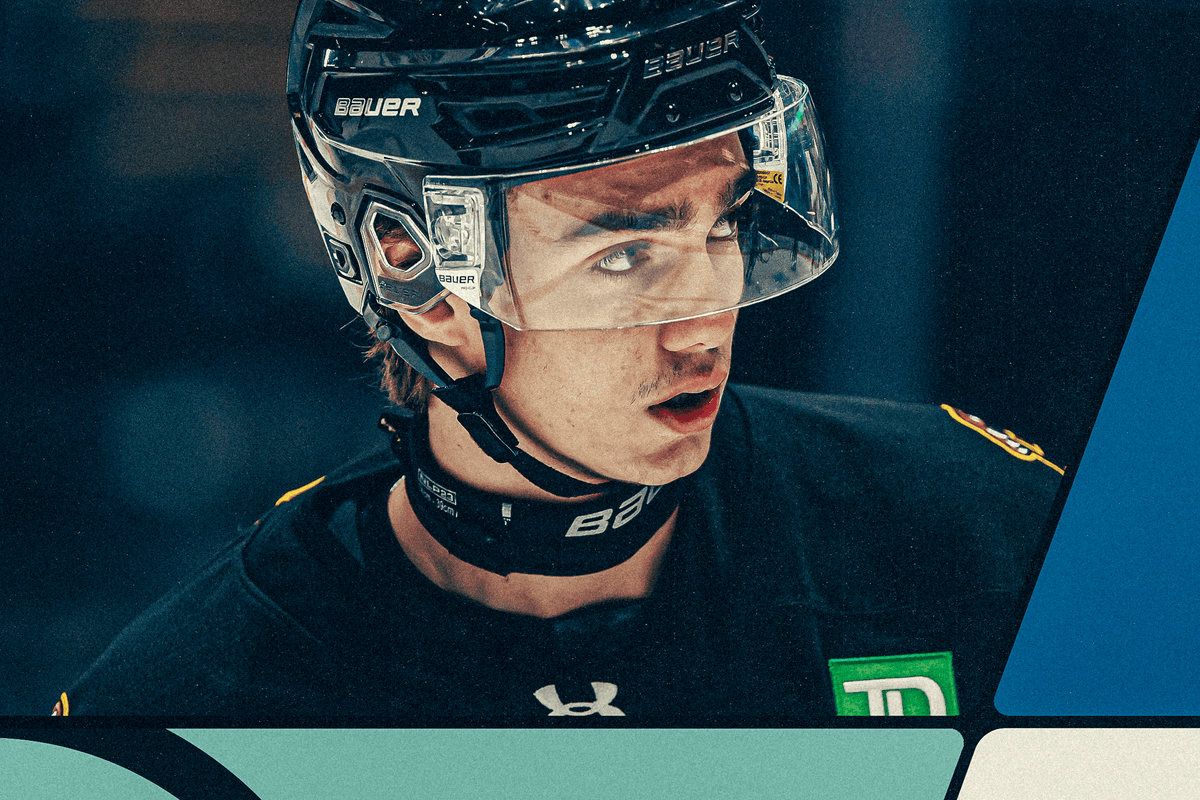
Welcome to Scott Wheeler’s 2026 rankings of every NHL organization’s prospects. You can find the complete ranking and more information on the project and its criteria here, as we count down daily from No. 32 to No. 1. The series, which includes evaluations on nearly 500 prospects, runs from March 9 to April 8.
The Kraken have the most players featured in this year’s pool rankings, with 25 prospects I felt were worth mentioning here. That group is led by two of the NHL’s better forward prospects and rounded out by a ton of interesting (though imperfect) wingers, a center who is already playing in the league, some potential depth D and two solid goalie prospects. The big thing their pool is missing is the one thing it has lacked since the organization’s inception: a true top D prospect.
2025 prospect pool rank: No. 10 (change: +3)
Tier 1 1. Berkly Catton, C, 20, Seattle (No. 8, 2024)
Even though he has played exclusively in the NHL this year, including at times on Seattle’s first line, I’ve elected to include Catton because of a combination of his age and the fact that he’s ineligible for the AHL. He would have been a prime candidate for the rule change that’s being implemented next season, which will allow first-round CHL 19-year-olds to play in the AHL.
The WHL’s fourth-leading scorer in his draft year, Catton registered 54 goals and 120 points in a combined 72 regular-season and playoff games on a Spokane team that lost more games than it won. He had real pedigree even before his draft season as a No. 1 pick into the WHL who was an offensive catalyst on a bad Chiefs team in his rookie season who also led Canada Red to silver as captain at the World Under-17 Hockey Challenge with 12 points in seven games, and then again captained Canada at the Hlinka Gretzky Cup with a tournament-leading eight goals and 10 points in five games. He continued to build on his strong statistical profile last season as well, producing near the top of the WHL (151 points in 77 combined regular-season and playoff games) and looking like he was playing with his food after the arrival of Capitals top prospect Andrew Cristall. They were the best duo in the CHL and made plays with ease inside the offensive zone.
Catton is dangerous whenever he’s on the puck and shines with his knifing, slippery game. Inside the offensive zone, the way he baits and shades, drawing players to him and then playmaking past them with a pass or a cut, is pretty impressive to watch. Catton is a heady playmaker who uses spacing to his advantage and sees the ice at an advanced level, regularly executing quick plays through coverage or delaying into a pre-planned play. He has multi-dimensional skill, with an ability to play both with speed on the rush as a smooth, fast and nimble high-end skater and more slowly inside the offensive zone when the pace ramps down and he has to spin away from pressure, which he does so well. He has great instincts offensively. He tracks back consistently and will get up and under sticks to win his fair share of battles, with more room to round out his game defensively (mostly inside his own zone) and steady progress made on that front. He supports play well off the puck defensively, which was a focus of his this year.
He gets to the guts of the ice and also makes plays out wide. He thrives in tight spaces and on cutbacks; he can play on the perimeter or take it to the net, and he has a dangerous and quick release while moving. He does such a good job of losing defenders with his back to them to avoid getting pinned down because of how adjustable his skating is through stops and starts and tight turns. He draws a lot of penalties with his skating and has also been a top penalty killer in the WHL the last two years because of his ability to pounce and create offense short-handed.
He has some very translatable top-six elements with his skating and skill set. I believe he has the chops to stick as a center despite being on the smaller side, though he has played both this year and may end up on the wing, because you want him getting touches lower in the zone so that his skating can lead in transition. He has a bit of an injury history, which has affected a couple of offseasons and led to him sitting out of U18 worlds, but he’s an exciting talent with higher-end offensive chops.
2. Jake O’Brien, C, 18, Brantford (No. 8, 2025)
O’Brien was the OHL’s Rookie of the Year after playing to above a point per game and leading all rookies in points and assists. He didn’t grab me in repeat live viewings in the OHL that year and early on last season to start his draft year, but he really took off as the year went on and sold me in the second two-thirds of it. He created a lot for the Bulldogs and drove his line (while not playing with OHL leading goal scorer Nick Lardis at five-on-five, and without his usual running mate of Marek Vanacker until the end of November). He was a little quiet at two separate tournaments for Hockey Canada, but he was definitely a little snakebitten in his scoreless Hlinka and didn’t play the typical top-of-the-lineup role he has in the OHL. He nearly broke 100 points by the end of his draft year, too, finishing with 98. He then had 11 points in 11 playoff games and played a lot for the Bulldogs in their final four games after Lardis went down with an injury. This season, he was named captain of the Bulldogs, and while he didn’t make Canada’s World Junior team, he led the OHL in points per game (1.75, or a 119-point 68-game pace).
He’s a finesse player with tons of feel, skill, poise (this one with emphasis, with just an unshakeable ability to wait and wait in possession, including around the crease/under pressure) and craftsmanship on the puck and as a passer (he seems to know where guys are even when they’re in his blind spot). The IQ and passing ability are high-end tools. He has a high-end ability to put pucks into spaces for both his linemates and himself. He’s a decently fast skater who uses fluid crossovers to build speed and weave up the ice in control (though he could use a little more power). I’ve wanted to see him up his tempo and put the puck in the net more at times, but he has shown he can do all of that. He’s extremely smart on and off the puck. He’s also viewed as a competitive enough center (though he supports play well off the puck, I’d like to see him involve himself more in the fight and he lacks a physical element) who should fill out his frame (which should also help him in the faceoff circle, where he needs to improve). It’s also worth noting that he’s a June birthday and the son of two high-level hockey players, so the athleticism is there, and the muscle should come. The skill, sense, IQ, patience and ability to make plays at different paces are all very appealing when you consider he’s still a lean almost-6-foot-2. He has top-six forward written all over him.
Tier 23. Jagger Firkus, RW, 21, Coachella (No. 35, 2022)
Firkus had a phenomenal final season in the WHL two seasons ago, winning CHL Player of the Year and the WHL title with Moose Jaw. He registered an incredible 77 goals and 162 points in 87 games split between the regular season, playoffs and Memorial Cup, both tops in the CHL by a wide margin. Last year, he produced respectably for a 20-year-old AHL rookie playing 14-15 minutes per game, registering 39 points in 75 combined regular-season and playoff games (15th among U21 AHLers). I bet on him to take a big step in the AHL this year, and he has, stepping up as one of Coachella’s leading scorers and one of the most productive U22 AHLers at just below a point per game.
Firkus is one of those little guys who just always seems to be around it and shows talent when he is; he’s going to finish top 10 in the AHL in shots this year and doesn’t play on the perimeter. He plays the game with pace, energy and skill so that you can’t help but notice him as he dashes around the ice making plays offensively. With the puck, defenders struggle to stick with him off cuts, and when they do, he has the craftiness to beat them in other ways. Without the puck, he races in and out of pockets to get open. The result is an at-times magnetic game that pulls you (and opposing players) in and then beats them with aggression and intention.
He’s not an explosive skater, but he’s both quick and nimble, plus he has added a bit of a straight-line burst/acceleration. His smaller frame (5-11, now 170 pounds) made him a second-round pick instead of a first-rounder, but he has endeared himself to just about everyone with the way he plays, and it’s clear watching him that he feels he can go out and create offense when he’s on the ice. He’s a slippery, always-threatening player who defenders — even, and maybe especially, those who are much bigger and stronger — either can’t stop because he pounces on opportunities and beats them before they get a chance to, or struggle to stop even when they get a crack at it.
There are times I’ve wanted to see him play a little quicker against better competition, not in movement but in decision-making. I know some folks believe he’ll become the classic AAAA guy who lights it up in the AHL but never really becomes a full-time NHL guy, but I won’t be surprised if he becomes a top-nine winger with some skill and quick-strike ability with the right patience and coach, either. Sometimes you need an opportunistic little water bug like Firkus. There is a bit of a crowd of young forwards in Seattle, though, and he risks not being prioritized.
4. Oscar Fisker Mølgaard, C, 21, Coachella/Seattle (No. 52, 2023)
I’ve written for years that Fisker Mølgaard might be one of the most under-the-radar B/B+ prospects in the sport, and it has been nice this year to see him get talked about at the Olympics and in Seattle.
The Dane played 41 games in the SHL three full seasons ago with HV71 and led the Division 1A U18 worlds in goals, assists, points and plus-minus as the tournament’s top forward award winner to help Denmark to a silver medal and nearly promotion into the top flight. Two years ago, he continued to build on his advanced pro experience playing 15 and a half minutes per game as the SHL’s highest-scoring under-19 player ahead of players like David Edstrom, Felix Unger Sorum, Axel Sandin Pellikka, Anton Wahlberg and Otto Stenberg, who were drafted ahead of him. And last year, his third as a full-time SHLer and still a teenager, he took another step after returning from an injury he suffered in HV71’s first game of the season, producing at half a point per game and doing it to positive two-way results before finishing the year in the AHL. In his first full season in North America this year, he has split time between the AHL and NHL, earning trust in both. He also played well and registered three points in four games in Milan.
Mølgaard plays a driven, hardworking game that blends above-average skill with strong skating to push tempo, get after it and make quick plays and decisions with the puck. His skill isn’t flashy, but he plays to positive results, reads the ice at an advanced level on and off the puck and projects as a center, though the one area of his game that needs work is in the faceoff circle. I could see him becoming an up-and-down-the-lineup type.
5. Ty Nelson, RHD, 22, Coachella (No. 68, 2022)
Nelson has had a strong start to his pro career in the AHL over the last two seasons. Last year, he produced at a good clip for a 20-year-old defenseman with solid defensive results while playing 19 minutes. This year, he has been Coachella’s No. 1 D playing a team-high 23 minutes per game, including a team-high three minutes per game on the penalty kill on top of his PP duties.
There were actually times four seasons ago when I wanted him to play a looser, attacking style because I thought he was capable of even more offensively than his 61 points in 79 games already revealed, but some of that was the system played in North Bay in his draft year. Three seasons ago, he just completely took charge of games with a strong Battalion team, leading all OHL defensemen in shots on goal (296, more than four per game). Two seasons ago, after an injury scare when he fell and hit his head on the ice during a fight (missing a few weeks with a concussion), I saw more of the same in the OHL. He finished with another 66 points in 70 games, and I liked him at both Canada’s selection camp for the World Juniors and then in the tournament when he was called up late to fill in for injuries. I thought he looked confident in a limited role as the team’s No. 7 D and outplayed a couple of the D who were getting more reps and really struggled.
A No. 1 pick into the OHL, Nelson has always been a draw for his offensive skill and advanced physical build. He’s one of the most physically built prospects I’ve come across at 5-10 and about 209 pounds of bulky muscle. There’s some risk-taking that comes with his game, but he has also learned to simplify; he has the makings of both a modern and throwback D, and doesn’t shy away physically because of how strong he is. His head is always up, his shot pops and he’s not afraid to use it, a trend that has continued with high shot totals in the AHL. He’s eager to activate up ice and join the rush or lead a transition sequence, he side-steps pressure with ease, and while I wouldn’t say he’s fast, his stride is compact and balanced through forward and backward pushes and aggressive and almost choppy through his crossovers (in part because of how darn big he is for his height).
He has a presence and swagger about him out there, too, always looking confident, decisive and very communicative. He pounds his one-timer. He makes plays on exits and entries under pressure to shake past opposing players. He has active feet in and out of give-and-gos and off the line to involve himself in plays and present an option. He more than holds his own defensively for a 5-10 D. He’s never lackadaisical defensively — I think there are times when he’s actually gripping the stick a little too hard and a little too dialed in, with the result of some chasing at the expense of positioning. He steps up physically and closes gaps. He has a good stick and breaks up plays defensively with diving slide plays.
I think he’s going to surprise some people and make it as an everyday NHL defenseman.
6. Jani Nyman, RW, 21, Coachella/Seattle (No. 49, 2022)
Nyman is a big, heavy player (6-2 and change, 212 pounds) who’s strong as an ox with an uncharacteristic playmaking feel. The more I’ve watched him these last few years as he transitioned from point-per-game second-tier Mestis player to one of the better scorers (regardless of age!) in Liiga and then one of Coachella’s leading goal scorers as a sophomore who has already scored seven NHL goals, the more I’ve grown confident about his chances to stick as a third-line secondary scorer. Then you contextualize it against his July 30 birthday, and there’s a lot to like.
He stands out on the ice for more than just how big and strong he is (and how hard he shoots the puck out of his curl and drag), too. He also has good playmaking feel, the right instincts off the puck and great hands in tight. And while he carries a lot of weight around — and he’ll have to be careful not to get too heavy — he moves well for his size, can really get going, regularly puts defenders on their heels in transition and off the wall and sometimes even gets to the middle inside the offensive zone. He’s a lot to handle when he drops his lead shoulder because of how strong he is. Add in a comfortable one-timer and those surprising handles on the puck, and you have a player who can finish and also make things happen off the cycle. I’ve seen him power to goals, pound goals and also show small-area skill as a soft passer.
He’s not quick in short bursts/races, but he’s strong pushing into space and has a clear pro frame and skill to build upon and develop into a complementary NHL winger.
7. Eduard Šalé, LW, 21, Coachella (No. 20, 2023)
It has been tricky evaluating and contextualizing Šalé at times over the course of his young career. First, he was above two points per game (99 in 44 games) in Czechia’s top junior league four years ago and smashing (and even doubling in some cases) the production of top Czech players at the same age, including first-rounders like Jakub Voracek and Tomas Hertl, then he struggled with the transition to the pro game in Czechia. He has played to some real highs and lows internationally: looking like one of the most talented players at four international events in Germany for U18 worlds, Red Deer for the Hlinka Gretzky Cup, Switzerland for a second U18 worlds, and Ottawa at his last World Juniors, but also coming and going at the World Juniors in Halifax and Gothenburg. He’s also struggled to live up to his talent in the OHL in both Barrie and Kitchener.
The Kraken bet on the individual skill level, hoping the consistency, competitiveness, habits and style could be worked upon. I saw the talent and the risk, too, and I would have taken the same chance at about the same point in the draft as well. Throughout, there were times when various coaches didn’t trust him. I thought last season was a positive, not just on the back of captaining the Czechs to a bronze medal in Ottawa, but also in the AHL where his skill semi-regularly flashed and his rookie year in Coachella was a step in the right direction for me. He hasn’t taken another step this year, but it hasn’t been a step back either.
He’s a smooth skater who’s noticeable in transition for both his ability to weave up ice and facilitate and also his ability to create breakaways for himself and beat goalies one-on-one. He has superb vision and grades highly at dissecting coverage as a passer. I love him on the half-wall/point on the PP with his ability to hit east-west seams; he just seems to see every lane and opening. He can slow it down and pick things apart or hurry up his passes through holes. He has shown a knack for making big plays at big moments and can really shoot it, whether with a quick-release wrister or his dangerous one-timer. He’s also a dexterous player who has good size (which will fill out). He can beat you on the perimeter with his skill, highlighted by excellent one-on-one hands on defenders.
But he lacks competitiveness, though it does seem to be coming around a little, and everyone would like to see him play with a little more effort both on (going to the guts of the ice more) and off the puck (cutting down on his gliding and puck-watching) at times. When he does go to the inside, I’ve seen him get sticks on tips and redirects. He’s prone to drifting at five-on-five, but his eyes light up and his head swivels when the puck lands on his stick, and he can make skill plays against the grain. He has poise and patience on the puck, sometimes too much so. He has a multi-dimensional shot. He just needs to continue to work to involve himself in the play more. He has cut down a little on the moments of carelessness/turning pucks over, allowing his finesse on the puck and that game-breaking quality to be the thing that catches you instead of all of the mistakes.
The talent level is clear, but it doesn’t always work in practical hockey terms as it shows in flashes, and the result is a player who has faded in games at times over the course of his career and comes with a boom-or-bust profile. I’m a firm believer that not all 12 forwards on an NHL team need to be worker types, and he still has a lot of work to do if he wants to get there as a skill guy, but the talent level is there.
8. Carson Rehkopf, C/LW, 21, Coachella (No. 50, 2023)
A toolsy, rangy forward with good straight-line speed and an NHL shot and skill, Rehkopf can impress with his one-on-one ability for his size, his puck control and his ability to make plays in direct attacking sequences. He has played a lot at both center and wing, but was primarily a center in the OHL over his last couple of years. He impressed scouts in a depth role with Canada at the Hlinka Gretzky Cup and was cast as a bit of a potential two-way checker type at the next level in some early conversations I had with scouts. But that’s not how he was known around the OHL, where he was perceived to be a one-dimensional offensive player in his minor hockey days. That became more and more how he’s viewed now, which was evident in the way Team Canada staff spoke about him as basically only a scorer ahead of and during his two World Juniors, and has been evident in the 11-12 minutes of usage he has gotten as a rookie in Coachella this season.
I wrote ahead of the draft that while he scored 30 goals in his draft year (which isn’t easy to do), “I think he might just be scratching the surface (and) the team that drafts him in the second round should look to mold him into an attacking winger with a dangerous and accurate shot, rather than a checker.” Post-draft, he scored 58 goals and 106 points in 70 combined regular-season and playoff games, leading the OHL in power-play goals. Last season, he followed that up with 49 goals and 94 points in 63 combined regular-season and playoff games. This year, he has scored a dozen goals as a rookie in the AHL but is still figuring out how to make his game work and earn trust.
He’s so dangerous as a shooter straight-up with goalies. He has this little feint he does pre-release before he lets it go. It looks like as he settles into that feint, he’s comfortable getting rid of it at any time, too. There are times when he will force it, and his decision-making isn’t always buttoned up, but he has also shown some creativity. He has great, quick-twitch hands and footwork into his shooting patterns. And while his play off the puck isn’t his calling card, I think it’s better than it gets credit for, and the pendulum of perception about him may have actually swung too far back. I’ve seen him finish all of his checks in a game (including delivering some hard ones), win back pucks, stay above pucks defensively, go to the front of the net on screens instead of just looking for his shot out wide, etc. He’s a capable forechecker. He does need to tighten up with the pucks at times — he can be a little too careless — but he creates a ton of looks for himself and his skating, skill and especially shooting are projectable. He also takes good routes, finds ways to get loose without necessarily cheating for it and has clear power-play value.
He has some natural tools, and now it’s just about building use-cases for them. I’d bet he’s more of a middle-six scoring winger at the next level than a center if all goes well, but there’s some risk he becomes an AHL scorer without an NHL identity. I thought about ranking him a couple of spots lower here, but I’ll sit tight for now.
9. Blake Fiddler, RHD, 18, Edmonton (No. 36, 2025)
One of the standouts at the 2024 Hlinka Gretzky Cup, Fiddler captained Team USA and had a couple of the better games of the tournament. That strong play then spilled into a step forward with the Oil Kings, where he played 22-23 minutes per game in all situations to strong two-way results in his draft year. It also resulted in an invite to USA Hockey’s selection camp for the World Juniors. I do think his Hlinka buoyed him a little, though, and I think he’s a little vanilla as a prospect. He was fine-to-good at U18 worlds as USA’s No. 1/2 D, but rarely grabs you and can leave you wanting more skill and hardness. And though he played to excellent post-draft results defensively with the Oil Kings this season, his offense didn’t take the step I wanted to see.
The son of Vernon Fiddler, Blake is a big right-shot D who defends at a good level at an early age with a developing game on the puck. He’s smart in the defensive zone. He defends the rush well with good gaps and a good stick. I don’t think his offense is as natural as it looked in some moments at the Hlinka (his hands aren’t super comfortable) but he moves well for a 200-plus-pound teenager, and he has shown some poise in possession. He’ll try to break past pressure or carry pucks up, even if the execution isn’t always there. He can skate pucks out. He’ll close gaps early in the neutral zone. I want him to lean on guys and impose himself more at times, though.
His decision-making and reads still need some refinement, but have also come along step-by-step, and there’s clearly a strong foundation and a projectable role for him in the NHL as a two-way five-on-five D with length. Fiddler’s game is primarily about his ability to take up ice, defend the rush and break up plays in-zone, but progress in other areas and his confidence in involving himself in the play offensively was just enough to keep him in this range and could give No. 4-6 upside. He’s also a summer birthday. He’s not a sexy prospect, but he’s an effective player.
10. Tyson Jugnauth, LHD, 21, Coachella (No. 100, 2022)
After a winding road, Jugnauth has become a really positive development story for the Kraken. He’s gone from a fourth-round pick out of the BCHL to two years at Wisconsin in the NCAA, leaving for the WHL, finishing his junior career as the WHL’s Top Defenseman award winner and a CHL second team All-Star, and now a rookie season in the AHL, where he logged 21 minutes per game as a go-to five-on-five play-driver and power-play quarterback who was named to the AHL All-Star Game.
Jugnauth is a highly mobile offensive defenseman who uses his feet to escape and beat pressure, effortlessly walk the line and be involved in a lot of the action on offense — sometimes to a fault, though his feet also help him be an adequate defender at 6-0, 183 pounds. He’s confident in himself and plays that way, jumping and activating quickly and decisively to try to apply pressure whenever he can. He’s going to be a call-up option who can provide more offensive juice than the D that typically get those calls at minimum. The question is whether he can be the busy and active player he wants to be as a full-time NHLer.
Tier 311. Julius Miettinen, C, 20, Everett (No. 40, 2024)
Miettinen is a well-built, strong 6-3 center who works, wins battles, plays hard and can skate. He has some soft skill and some strength to his game. He protects the puck well and can play along the wall or go to the front of the net and make plays around the crease. I like him going to get pucks and he’s good in the faceoff circle. He has a quick release and some skill. He’s strong, wins battles and is competitive.
He has been an important part of a top team in the WHL for the last three seasons. He also played well early on at the World Juniors in Ottawa, though I thought he was less noticeable late in the tournament for a Finnish team that won silver, and then wore the “C” briefly as a returnee in Minnesota this year when Aron Kiviharju got sick, playing a big role in his second go-around after he was late to play due to an injury of his own. He plays off his linemates well but can also make some plays with good hands, confidence on the puck and a willingness to try things against his peers, though I’ve wanted to see him fill the scoresheet a little more given his age/pedigree/team in the WHL.
I had him ranked No. 69 when the Kraken used their second pick of the 2024 draft on him at No. 40, and I still think he was more of a third-rounder than a second-rounder, but he has a chance to become a bottom-sixer who brings secondary offense.
12. Nathan Villeneuve, LW, 19, Windsor (No. 63, 2024)
Villeneuve is a unique prospect in the Kraken pool. He’s an ultra-competitive pest who plays (and talks) on the edge, involving himself in everything that happens between whistles and after them. He works. He’s effective. But he was also a top prospect in minor hockey and some real secondary skill, with an ability to bother opponents and get under their skin, but also back it up with his play. I remember when he was added late to the CHL Top Prospects Game in his draft year and then grabbed my attention in it, and he has held my attention in a lot of viewings since. Even if the production has always been more good than great, his gumption and aggressiveness give him a chance at becoming a fourth-line NHLer someday.
He received a 15-game suspension following an OHL investigation into bounty allegations in a team group chat in 2024. The Kraken went on to draft him at the end of the second round, and he has since signed. He’ll play in the AHL next year.
13. Kim Saarinen, G, 19, HPK (No. 88, 2024)
Saarinen, who was signed by the Kraken all the way back in the summer of 2024 after they drafted him, has had two impressive seasons in Liiga since, with a career .914 save percentage across 70 games played as a teenager. He was also a part of two Finnish World Junior teams, though he didn’t play in either behind starter Petteri Rimpinen and his results with the U20 team have been more mixed.
Saarinen is a summer birthday who has size (6-4) and a lean but athletic build. He moves well, holds his lines effectively, can make reactionary saves while maintaining control of his body, and has poise in the net for a goalie his age. I don’t think he has star/starter quality, but he looks like he’s on a path to becoming a No. 2/3.
14. Jacob Melanson, RW, 22, Coachella/Seattle (No. 131, 2021)
In his draft year, I felt Melanson was just average to above-average at everything and would project as a good pro but more than likely top out as an AHLer. Since then, he has progressed nicely, hit some important checkpoints, and turned me into a bit more of a believer that he might have what it takes to become a full-time bottom-six NHL forward who can provide some secondary scoring. But the outcome where he’s just a call-up option still feels more likely.
Melanson is a sturdy (6-1, 200-plus pounds) and powerful, “come at you in waves” kind of player who boasts a hard shot that really pops off his blade, a determined and scrappy disposition, and the kind of strength and athleticism that sets a player apart at the junior level. He was a force to start with Acadie-Bathurst and a force after a trade to Sherbrooke, playing at a goal per game on the year and nearly two points per game after the trade in 2022-23. He has now played more than 30 NHL games and parts of three seasons in the AHL, too, and while his production in Coachella hasn’t screamed NHLer, his pro style, habits, strength and consistency have helped him continue to get NHL time.
If he makes it as a full-timer, it’ll be as an energizing role player with a finishing quality and a workman’s approach. He has progressed exactly how you’d hope a fifth-round pick would. There were games in the Q where he looked unstoppable, and I wasn’t surprised when he showed up repeatedly in the CHL/NHL Top Prospects Game’s player survey as someone top prospects in the 2024 draft listed as their hardest opponent to play against. He has a ceiling, but his floor (which is where he’s at right now) is as useful organizational depth.
15. Niklas Kokko, G, 22, Coachella (No. 58, 2022)
Kokko was a .913 goalie across almost 100 games in Liiga at an early age and has now been a .907 goalie in the AHL across more than 60 games. But I’ve never been able to get there in viewing him as more than a No. 3 and find that he can look small in the net for a 6-4 goalie, allowing a few too many goals through his body and moving well through his tracking, but at times also getting beaten a little too easily one-on-one. He has size, he’s smart, and his results are good. I just don’t know if the ability is NHL-level.
Honorable mentionsJakub Fibigr, LHD, 19, Windsor (No. 202, 2024)
Fibigr is a summer birthday who played reasonably well at U18s and Hlinka and played an important role for a young Steelheads team in his draft year, often as their top LHD and a staple on one of their two power plays despite lingering until the end of the draft. I couldn’t get a real read on him across multiple live viewings that year, though, and he was ultimately an honorable mention on my list ahead of the 2024 draft because there were games in which I thought he took pressure well and showed real poise on the puck to navigate past it and make the next play, then others in which I felt he needed to make better decisions with the puck and was playing above himself. He’s also average-sized (6-0, 170-180 pounds), and I’m not sure what his role is up levels.
Since his draft year, though, he has taken steps to become a really impactful and consistently good two-way D both in the OHL and at two World Juniors for Czechia. He was steady in Czechia’s toughest matchups at this year’s event and quietly very effective at last year’s, chipping in offensively in both with his heady, efficient, smart puck-moving without sacrificing his reliability for that coaching staff defensively. He’s now committed to Ohio State, and while he lacks a defining quality, I expect him to be a very good college D who gives himself a chance to get signed. He was one of my final cuts here.
Caden Price, LHD, 20, Coachella (No. 84, 2023)
One of the younger players in the 2023 draft due to his late August birthday, Price impressed scouts with his creativity and vision at the Hlinka Gretzky Cup four summers ago. He was Kelowna’s most productive defenseman as a 17-year-old three seasons ago, played to 66 points in 73 combined regular-season and playoff games two seasons ago, and he was one of the only Canadian players who exceeded expectations at last year’s World Juniors in advance of a trade from Kelowna to Lethbridge. Now he’s a rookie in the AHL, and he has played to respectable results for his age in 17-18 minutes per game of usage: sixth among the nine D who’ve played for Coachella this year and three more than peer Lukas Dragicevic.
He has enough size (about 6-1 and 190 pounds) and sees the ice well, consistently executing east-to-west passes through coverage. He transports the puck smoothly and can use his feet to influence play. He can make some plays under pressure and side-step past the first layer. He can attack inside the offensive zone with control. I would like to see him scan and shoulder-check a little more defensively, as he can be prone to mistakes going back to pucks or under pressure in his own zone. His defensive game has come along, though, and he has put the pieces together nicely over the last couple of years, adding more of a shot-blocking element. He’ll still occasionally get beaten playing too tight or setting a bad gap, but he has good mobility and a decent stick. Price will be good AHL depth, whether or not he plays NHL games.
Lukas Dragicevic, RHD, 20, Coachella (No. 57, 2023)
Dragicevic was one of the more difficult evaluations in the 2023 draft and has remained one since. In his draft year, he led a poor Tri-City Americans team in scoring by 11 points, registering 15 goals and 75 points in 68 games. Typically, a player with that kind of statistical profile would rank in the first round, especially when he’s a 6-2 righty. But Dragicevic’s game has some real warts, highlighted most notably by, as one scout aptly described to me, “clunky feet.” He was highly productive in Tri-City and last year in Prince Albert, but questions about how his tools and style can translate have followed him and have resulted in an up-and-down year in the AHL.
Alexis Bernier, RHD, 19, Chicoutimi (No. 73, 2024)
Those who watched the QMJHL closely in 2023-24 should have developed a healthy amount of respect for Bernier’s development. He played a big role on a Baie-Comeau team (including as a go-to on both special teams) that went all the way to the Q final, averaging more than 22 minutes per game and registering 40 points in 84 combined regular-season and playoff games. He’s also a summer birthday whose game has a real maturity to it. He hasn’t taken that next step in the two years since to become a force, though, and while he has remained a top player on a top team, it does feel like his development has stagnated. Though it should also be noted that he had offseason ACL surgery last summer, which cost him much of this year.
He’s in impressive shape and is a really strong natural athlete. He’s a smart, sound defenseman who manages pucks well and defends with his eyes, but is also competitive and strong, and anticipates play in all three zones. He has some secondary talent, though again, that hasn’t resulted in a growth in production even though he has learned to be more active using his feet off the line to involve himself offensively. I think he has a chance to be organizational depth, but he’s currently unsigned.
David Goyette, C/LW, 22, Coachella (No. 61, 2022)
Goyette was a top player in the OHL who was quickly signed as a second-round pick, but has struggled to translate his game at the AHL level and was suspended in February of this year for 20 games for violating the league’s performance-enhancing substance program.
He first caught my eye with a standout performance in Calgary at Hockey Canada’s summer showcase four summers ago. He then became one of the OHL’s leading scorers in each of his last two seasons, and its top scorer his final season with 117 points. His transition to the AHL has been a challenging one, though, both because he has been caught in a numbers game and because he hasn’t taken that next step as a 5-11 forward.
Goyette is an impressive athlete and a very good skater with a flowing stride who catches and handles pucks at speed. He tried (and executed) difficult plays offensively with his hands by finessing pucks under sticks, through feet and into space for himself at the junior level. He can stay on pucks inside the offensive zone by keeping his feet moving or getting up and under sticks. He can challenge defenders with a cutback, or can draw them in so that he can feed pucks into soft spots in coverage for his linemates. He’s also a player who frequently came up in my conversations with coaches and general managers around the OHL as someone who certainly had their respect; he was more well-respected around his league ahead of the draft than by NHL scouts. But he has found it harder to be and do all that against men, and that has pushed him off the Kraken’s list.
Will Reynolds, LHD, 18, Newfoundland (No. 68, 2025)
Reynolds was a late riser in last year’s draft class, garnering more and more attention as the year went on before ultimately getting picked early in the third round. He’s a big, strong, competitive D who can really skate, and while his production — 16 points in 69 combined regular-season and playoff games last year — didn’t scream top-75 pick, the Kraken weren’t the only team that considered him in that range. Those numbers haven’t taken a step this year on a Regiment team where Noah Laberge was the go-to guy offensively, but he’s a 6-3, 191-pound August birthday who has played 23-24 minutes per game, and his game translates to the NHL and what teams are now looking for in D because of his range and mobility. The question is whether his puck play is too vanilla to become more than a reliable AHL D.
Karl Annborn, RHD, 19, HV71 (No. 205, 2025)
Annborn used to be considered a top prospect in the ’07 Swedish age group and was still a top-four D for the national team and a productive J20 defenseman who got his first SHL point (albeit with bottom-feeding HV71) last season. He has split time between the SHL and second-tier HockeyAllsvenskan in Sweden this year and has been productive in the latter, too, which isn’t a given for a D his age.
But whenever I’ve watched him, I’ve always come away thinking, “He’s just OK.” There’s just a lot of mediocre or average. He has average size, feet, offense and defense. He’s a fine player and solid two-way D, but I just don’t see a quality that will carry him or a clear identity/role up levels beyond becoming an average five-on-five two-way depth guy in the SHL or AHL. He kills penalties and can run a power play against his peers, but I don’t see him doing either up levels. He’s a fine young player whom I felt I should get picked (and did), but it’s just pretty bleh.
Zaccharya Wisdom, RW, 21, Western Michigan (No. 212, 2023)
Wisdom is a junior for the Broncos after he spent his underclassman seasons at Colorado College. The younger brother of Flyers prospect Zayde Wisdom, Zaccharya was a late bloomer with a nose for the net and a willingness to engage, play in the guts of the ice and go get pucks. He plays with intention, helped fill some holes after the Broncos’ first national championship last year and is a better, lighter skater than his brother. I’ve never seen NHL upside, but he’s going to make a living playing pro hockey, and I thought he warranted a mention for a seventh-round pick.
Ollie Josephson, C, 19, North Dakota (No. 105, 2024)
Josephson is a heady, competitive, well-rounded center who played an important all-situations role for the Rebels in his draft year, was named their captain in his post-draft season and quickly endeared himself to North Dakota’s coaching staff as a freshman this season because of his work ethic, habits and consistent approach. His statistical profile doesn’t scream NHL prospect, but Red Deer didn’t score much as a team in his time there, and he has contributed right away while immediately becoming a reliable checker and penalty killer in college, leading the Fighting Hawks in PK minutes. He plays an intelligent three-zone game. He also reads the play effectively on the defensive side of the puck and has shown himself to be a strong penalty killer because of his defensive details and reads, strong skating and willingness to track and then battle for pucks. I’d like to see him score more, and his two-way game and average-sized makeup may not translate as well up levels, but I wouldn’t count against him, either.
Clarke Caswell, LW, 20, Denver (No. 141, 2024)
Caswell was one of the best passers in the 2024 draft for me and the leading scorer on a good Broncos team that season. He then went from 77 points in his draft year to 84 points last year before making the jump to college, where he immediately became a productive pass-first playmaker for Denver.
Caswell is an elusive and slippery 5-11 playmaker who facilitates into open space beautifully. He has a knack for drawing coverage and then using the gaps to play pucks back in for his linemates. He has quick hands and impressive processing/problem-solving. Caswell received mixed reviews from scouts in his draft year, though, with some praising his sixth sense in the offensive zone on the puck and others questioning whether he had the roundedness in the rest of his game that he’d need to make his pass-first style work up levels. There are some skills there that complement his style well, though, including light and adjustable skating. He’ll need to get to the slot and score more to get signed and become more than an AHL passer, but he does have some unique attributes, and he’s at least worth following.