
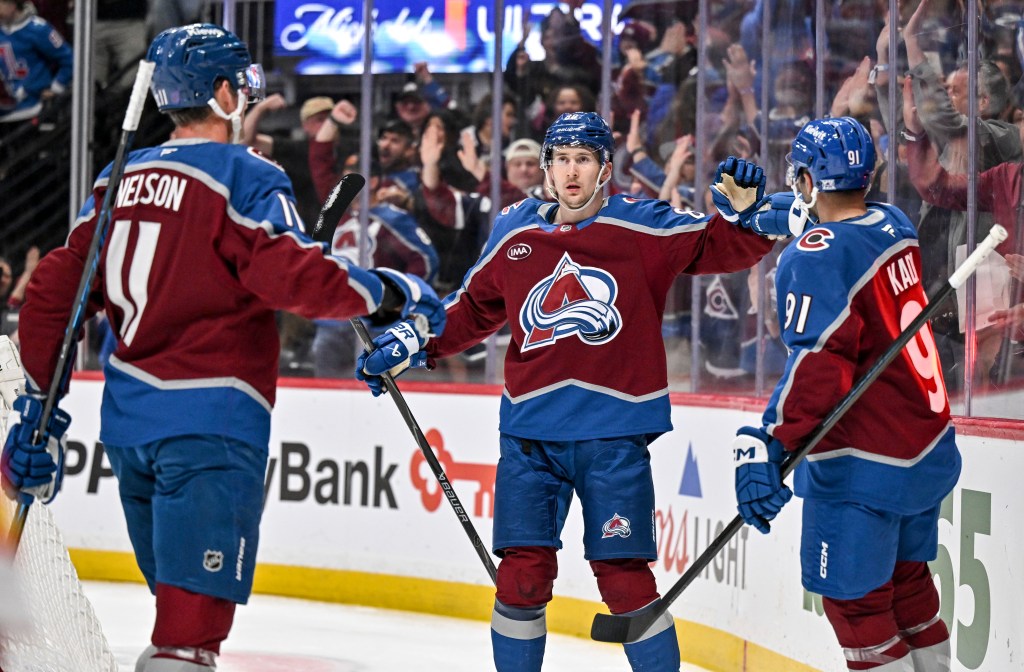
The most surprising detail from the Colorado Avalanche’s well-documented struggles on the power play is just how much the club was shooting the puck.
Think back to before the Olympic break. The Avs struggles reached a nadir when they went 0-for-17 with the extra man leading into the break, dropping Colorado to dead last in proficiency at 15.1%.
What was an obvious refrain? They need to shoot the puck more.
Well, the Avalanche had the second-most shots on goal in the NHL on the power play from the start of the season until the Olympic break. It’s true.
Part of the reason for that is Colorado earns a lot of power plays because of its style of play, so often the percentage-based stats and the accumulation numbers don’t quite line up. It was also, in part, because the Avs had so many power plays that lasted the full two minutes, which gave them more opportunities to put shots on goal.
The biggest issue wasn’t the quantity, but the quality of those shots, with a little bit of bad luck and other minor variables mixed in.
So what changed, and when? There have been several factors that led to a big improvement in March, when the Avs went 15 of 48 on the power play — the third-best rate in the NHL at at 31.3%.
“The change was long before the break,” Avs coach Jared Bednar said. “The detail within the change was consistent, kind of before the break.”
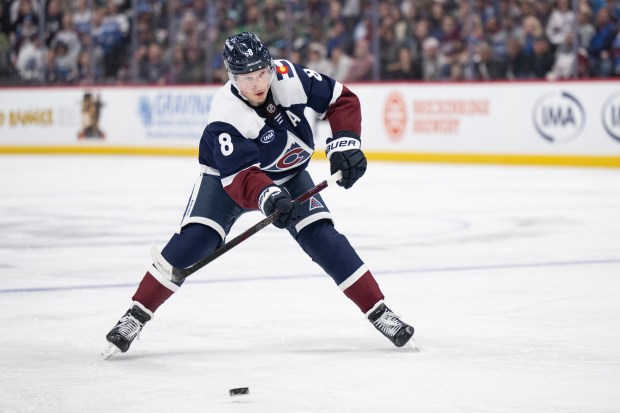 Defenseman Cale Makar (8) of the Colorado Avalanche reads the defense during the third period against the Dallas Stars on Wednesday, March 18, 2026, at Ball Arena in Denver. (Photo by Timothy Hurst/The Denver Post)
Getting more quality shots
So what’s different since the break? Nazem Kadri is here, and that’s part of it. But a much bigger part is … the guys on PP1 are just executing better. They’re completing more passes, making better decisions and finding more high-quality looks.
“I have to lean like … the details, the execution, the hunger, the mindset, attitude, buy-in – to me, that’s on the players’ side of it,” Bednar said. “So 70/30 execution side of it, and all those things I just mentioned over like a change in plan since the break.”
Aesthetically, the Avs power play clearly looked better in the few games after the Olympic break. The fresh start after some time apart clearly helped. It looked more consistently dangerous, like a power play featuring a top-3 collection of talent in the NHL naturally should.
The goals started to come shortly after. Kadri’s arrival has given the club a defined first unit when everyone is healthy — Cale Makar, Nathan MacKinnon, Martin Necas, Brock Nelson and Kadri. There’s no obvious net-front guy, like Gabe Landeskog or Valeri Nichushkin, but Kadri has become something of a poacher for the Avs on the opposite side of the ice from MacKinnon and Necas.
Mikko Rantanen brought the hammer from the right circle and scored some insane redirect goals near the side of the net. Kadri’s involvement has been more varied, but in him and Nelson, the Avs have found a balance of lefties to complement the MacKinnon-Necas duo.
Here is a look under the hood at the Avs’ power play and where it ranked in some key metrics, before and after the Olympic break (through March 31):
All stats are from Natural Stat Trick or NHL.com
Metric
Pre-OLY
Post-OLY
PP chances
6th
4th
PP conversion
32nd
4th
Shot attempts
5th
4th
Shots on goal
2nd
5th
Goals
T-26th
1st
Expected goals
14th
3rd
Scoring chances
15th
8th
High-danger chances
26th
12th
Shooting %
32nd
6th
High-danger shooting %
32nd
11th
The number of shots is about the same, but the quality is up across the board. Colorado’s expected numbers being so high is a big change — even in past seasons when the Avs’ power play was among the top 5-10 in the league, their expected numbers often lagged behind.
The reason? MacKinnon, Makar, and Rantanen, plus a net-front guy or two, can outshoot expected models with raw finishing talent.
If we look at the per-60-minute numbers, that weeds out Colorado’s ability to rack up volume solely from having so many power plays. It’s a better indicator of sustainable success.
Metric
Pre-OLY
Post-OLY
Shot attempts/60
14th
6th
Shots on goal/60
8th
10th
Goals/60
32nd
5th
Expected goals/60
27th
10th
Scoring chances/60
28th
12th
High-danger chances/60
31st
19th
The per-60 numbers are slightly lower than the volume numbers, but they still represent a dramatic improvement. That is much closer to the sweet spot the Avs are trying to find.
They have guys like MacKinnon, Makar and now Necas who can turn a so-so scoring chance into a goal with a nasty shot. But finding better looks more consistently has made everyone more dangerous.
How does that look at the individual level? The differences in both who is shooting and how much are noticeable.
Here’s before the Olympic break, both at the team level (on ice shot attempts per 60 minutes) and individual (shots on goal per 60 minutes):
Player
On-ice SA/60
SOG/60
Nathan MacKinnon
113.77
18.5
Valeri Nichushkin
112.03
8.83
Cale Makar
109.26
10.8
Brock Nelson
106.75
8.81
Victor Olofsson
106.59
12.7
Martin Necas
106.28
9.28
Artturi Lehkonen
102.92
9.02
Gabe Landeskog
97.48
10.83
As a reference, the Florida Panthers are the best team in the league over the course of the full season at 115 shot attempts per 60 minutes on the power play. The Vancouver Canucks are 10th at 106.72.
Now, here’s after the Olympic break, for the guys who have settled in on PP1:
Player
On-ice SA/60
SOG/60
Nazem Kadri
126.86
11.65
Cale Makar
122.89
9.26
Brock Nelson
121.46
8.43
Martin Necas
120.44
16.5
Nathan MacKinnon
116.85
15.47
Obviously, the shot attempt numbers are outstanding. MacKinnon’s is a little less because he stays out with PP2 a lot, and most teams’ second unit won’t put up the same numbers as the top group.
Kadri has been a big help, likely as much for his work with puck retrievals and his passing as upgrades over Victor Olofsson, who was out there because he can really shoot it (it just didn’t go in very often for him in Denver).
One of the biggest adjustments, though, is Necas. He’s putting way more shots on net. That has helped in a couple of ways. For one, he can really, really shoot it, which leads to more goals. A more spread-out approach is also helping to open up space for everyone.
It will be interesting to see whether more opposing teams try to pressure Necas and take him away, or whether the track record of MacKinnon and Makar keeps PKers from giving them more space.
“I think we have the talent there to be a top power play in the league,” Bednar said. “And it’s not a short stretch anymore, either. So they’ve been doing good things and getting rewarded for it. Every goal we get and every discussion we have, we expect it to sort of keep growing.
“And there’s a lot of good conversations between those guys on like, hey, did you see this. Let’s try that. And then it’s just kind of starting to click and come together for us.”
Want more Avalanche news? Sign up for the Avalanche Insider to get all our NHL analysis.