
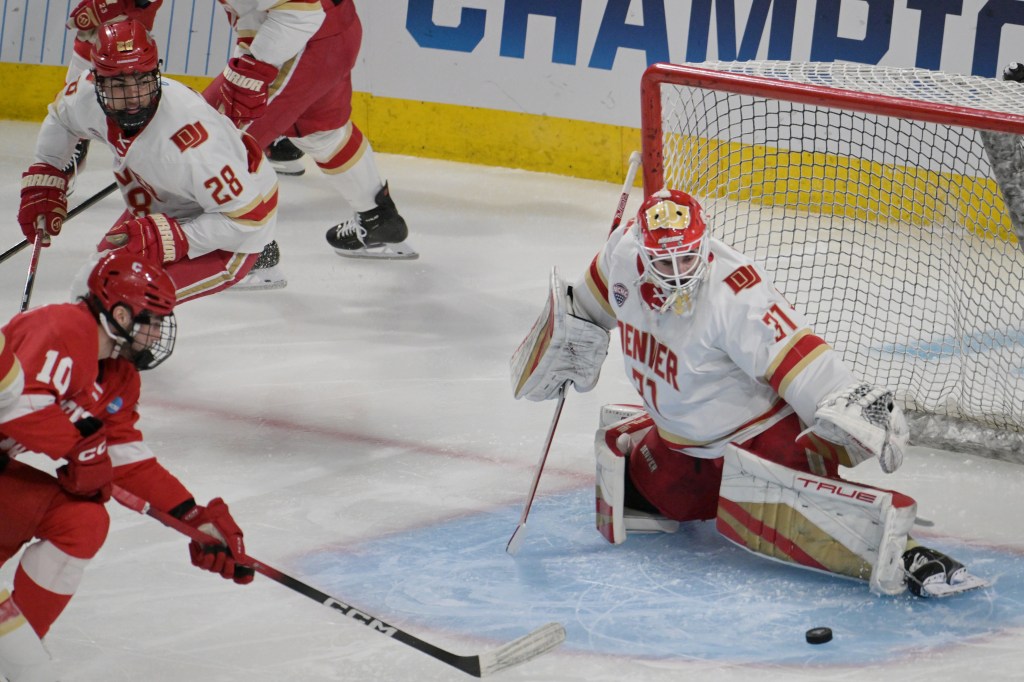
Johnny Hicks shut his mouth so he could stop the shots.
Before Hicks burst onto the scene this year as the University of Denver’s catalyst to a seventh Frozen Four in the last 10 NCAA tournaments, Hicks was the goalie for the Brooks Bandits of the British Columbia Hockey League. And on game days, his focus left no room for words.
“He didn’t talk to the coaching staff, he didn’t talk to other players — he went completely mute the day of the game,” recalled Ryan Papaioannou, who coached Hicks for two seasons on the Bandits. “The first time I noticed it, we were at a morning skate and I said something to him about a drill, and he just nodded to me.
“Later, when he would walk in (the locker room), he’d have to walk by my office to get there. He would just turn and look at me and nod. It took some getting used to for (the coaching staff) but then you watch him work on his craft and you see how he plays, and it’s like, ‘Great, don’t talk to anybody. We don’t care.’”
With DU, the freshman has strayed slightly from his muted gameday approach — he carries a quiet, man-of-few-words confidence instead — but not much else has changed as Hicks has emerged as the Pioneers’ stalwart between the pipes.
The Kamloops, British Columbia, native has been a driving force behind DU’s resurgence after the Pioneers were treading water through the first half of the season. The team’s finishing stretch saw the Pioneers claim the NCHC Frozen Faceoff title, then dominate the Loveland Regional with a pair of wins over Cornell and Western Michigan by a combined scored of 11-2.
Since Hicks took over in net for an injured Quentin Miller on Jan. 24 vs. St. Cloud State, he hasn’t been beaten, with a 14-0-1 record that is the best-ever career start for a DU goalie in the modern statistical era.
“I wasn’t too sure of (my ability to lead DU to another Frozen Four), to be honest,” a ho-hum Hicks said. “I was more focused on my process. Everything has worked out so far, and I think we’re just all very excited for what’s next.”
Red-hot Hicks
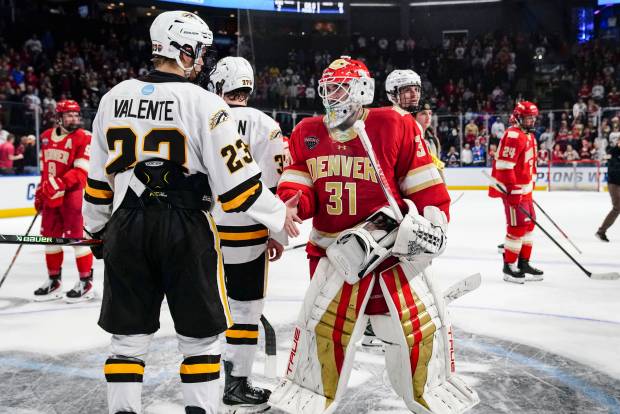 Western Michigan Broncos forward Liam Valente (23) and Denver Pioneers goaltender Johnny Hicks (31) shake hands after the game at Blue FCU Arena on Sunday, March 29, 2026, in Loveland, Colo. Denver Pioneers beat the Western Michigan Broncos 6-2 in the NCAA Regional Playoff game. (Photo by Rebecca Slezak/Special to The Denver Post)
Hicks was the Most Outstanding Player of the Frozen Faceoff tournament, capping his play there by stopping a career-high 41 shots in DU’s dramatic double-OT win over Minnesota Duluth. Then Hicks followed that up by earning Most Outstanding Player again at the Loveland Regional.
Entering next week’s Frozen Four, Hicks leads the country with a 1.125 goals-against average as well as a .958 save percentage.
This all coming from a guy who, judging by the fact that both Miller and Paxton Geisel got starts in net in 2025-26 before Hicks did, played the first part of the season as the team’s No. 3 goalie.
“He’s continued to elevate his game time and time again,” DU defenseman and senior captain Kent Anderson said. “He didn’t play a game the first half of the year, but if you came to watch practice or saw him in the gym, you’d think he was the starting goalie … he was preparing like he was going to be that guy every day.”
That preparation included visualization drills before each game, long before the song “Johnny B. Goode” became an arena anthem during the Pioneers’ run through four Frozen Faceoff home games at Magness Arena, and then again when it blared at Blue Arena in Loveland.
“The very moment he was called upon to get put in that game (on Jan. 24), it was clear he was ready,” DU goalie coach Ryan Massa said. “He had a built-in sense of calm — not nervous, not anxious, making really good, clean saves right out of the gate despite being called upon suddenly after seeing your starting goalie rolling and playing game after game.
“There was no hesitation whatsoever, and he’s never looked back from that moment.”
Small stature, big confidence
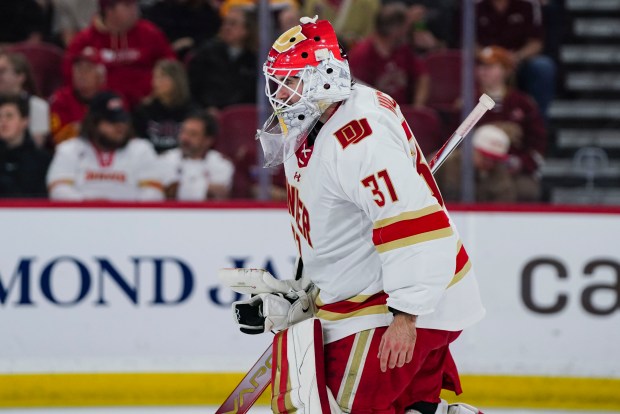 Denver Pioneers goaltender Johnny Hicks (31) skates to the bench during the second period during a break in play at Magness Arena on Saturday, March 21, 2026. Denver Pioneers played the Minnesota Duluth Bulldogs 2026 NCHC Frozen Faceoff. (Photo by Rebecca Slezak/Special to The Denver Post)
Hicks’ wild success this season is juxtaposed with the fact that he’s the opposite of what hockey’s central casting would tab as a typical dominant goalie.
At 5-foot-10, 157 pounds, if you see Hicks in street clothes, you might mistake him for the equipment manager. He has an artsy side that he leans into off the ice, including playing the guitar (he’s dreamed up a handful of acoustic songs) and painting landscapes of his native British Columbia.
But when he puts on the pads, he does it with the intention and fire of a young man raised on the game. Hicks started his hockey journey as a 3-year-old, when his dad, Derek, would shoot on him in the full-size hockey net perched in their living room. By the time he was 11, he was skating so much on the sheet of synthetic ice in the family garage that the ice, which had a lifetime warranty, developed a hole after just over a year.
“It was an all hockey, all the time atmosphere that Johnny grew up in,” Derek Hicks said. “We’d blast music and play hockey every night in the living room. He couldn’t get enough of it.
“As he got older, he would skate all day in the garage, and when he came in for breaks, he would be drenched in sweat. He would put his skate guards on, wouldn’t take his pads off, and there’d be John, sitting on the living room couch with all his gear on just taking a little break before he went back out there.”
He was a renowned youth goalie across Western Canada, but around the same time he was skating a hole in that synthetic ice, his size became an issue. Not in Hicks’ eyes, but in the evaluations of coaches.
At 14, he went to Delta Hockey Academy, a school specifically for hockey players. Because of his smaller size and the coaches’ unfamiliarity with his game, Hicks was placed on the school’s second-level 15U prep team. But one outing that season showed Hicks’ mettle, when the young goalie rose up despite his team being drastically outmatched.
Hicks faced 104 shots in a game where his opponents “stopped tallying their shots (in the stat book),” according to his father’s accounting. He allowed just six goals for a 94% save percentage, and turned all of the Delta coaches’ heads in the process.
“He was definitely the best goaltender in our program that year, even though he was on our second team,” Delta Hockey Academy president Ian Gallagher said. “(In that game) he proved he has endless compete. He’s got a no-victim mentality. And that game also demonstrated he’s never looked at his size as a disadvantage, because he took every challenge and measured himself against the best every single time he could, even when he was under constant attack that day.”
Hicks has continuously made up for his lack of size with athleticism, positioning, puck control, reads and reaction time.
With that toolbox, he proved snap judgments made about his game because of his frame to be a “stigma,” as he called it, with a grin. He did it at Delta, where he emerged as the starter on the school’s top 17U prep team his second year there. He did it for the Merritt Centennials of the BCHL, where he was a two-team MVP. And he did it for the Brooks Bandits, where he went 26-3-0 with a 1.98 goals against average and seven shutouts in 2023-24.
And in 2024-25, when he made the jump midway through the season from Brooks to the Victoria Royals of the Western Hockey League — which is part of the Canadian Hockey League, the country’s top junior circuit — he continued to excel with a 10-4-1 record and .909 save percentage. When the NCAA decided to permit CHL players to play Division I hockey beginning in 2025, it opened the door for Hicks, who was originally committed to Tennessee State, to land on Buchtel Boulevard.
“As an undersized goaltender you have to compensate in other areas, and be very good in those areas,” Massa said. “John’s athleticism and his intelligence level and his speed at which he can read and react has allowed him to compensate for that lack of size.
“He’s also a one-save goaltender, which is especially important when you play dynamic, high-powered teams. You have to be a one-and-done goaltender, and you can’t give them opportunities to feed off rebounds and chaos. John has shut teams down this year by taking away those opportunities.”
11th on deck?
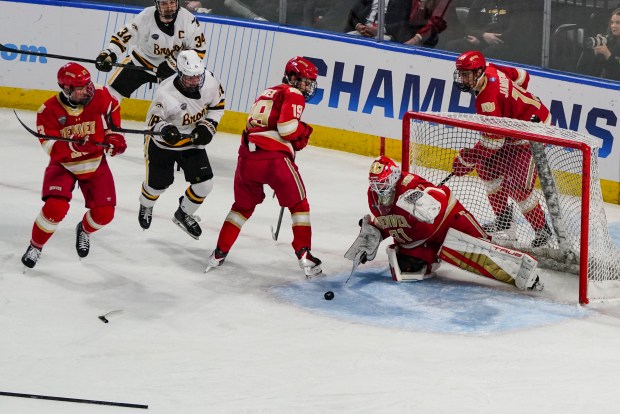 Denver Pioneers goaltender Johnny Hicks (31) finds the puck to cover it in the second period at Blue FCU Arena on Sunday, March 29, 2026, in Loveland, Colo. Denver Pioneers played the Western Michigan Broncos in the NCAA Regional Playoff game. (Photo by Rebecca Slezak/Special to The Denver Post)
Now, the Pioneers hope Hicks can ride the momentum to a record-extending 11th national title. DU takes on Michigan on April 9 in the Frozen Four semifinal at T-Mobile Arena in Las Vegas, with the winner to face either North Dakota or Wisconsin for the national championship two days later.
All four teams left feature freshmen goalies, including North Dakota’s Jan Špunar, the NCHC’s Goaltender of the Year. But DU is counting on Hicks to be the ultimate X-factor in net. In 2025, the Pioneers lost the Frozen Four semifinals 3-2 in double OT to Western Michigan, a year after winning their record 10th national title.
“We’re only halfway home, so we haven’t done anything yet,” DU head coach David Carle said. “I don’t think (this team) is satisfied with just making it to a Frozen Four.”
“… Hopefully (Hicks) will stay focused, not see what too much of what (the media) is saying about him and stay in his own head and in his own routines… Our team’s played better in front of him. So it’s all kind of bottled up into a good little recipe, and the job is to keep it going.”
Want more sports news? Sign up for the Sports Omelette to get all our analysis on Denver’s teams.