
The Minnesota Wild have depleted their vaunted prospect pool, and for the most part, the State of Hockey should be happy about that.
For years, the Wild ranked near the top of most prospect-heads’ lists of the top organizations. On one hand, that’s great. It meant the Wild were accumulating talent at a better rate than their usual draft positions would suggest. But no team should want to perpetually be atop those lists. They want to graduate those prospects into NHL players; they should want to cash them in for impact players. A player that’s crushing in the QMJHL is, by definition, not helping the NHL club.
The Wild’s fall from a top-five farm system to a bottom-ten is largely good. Minnesota graduated Danila Yurov and Jesper Wallstedt into full-time NHLers. They flipped Zeev Buium and Liam Öhgren into arguably the best defenseman in the world. Even the relatively disappointing David Jiříček trade turned into a solid middle-six winger. These are all bad for the prospect lists, but good for the NHL club.
But the Wild do need to start rebuilding their pool, and they need to do so with limited assets. With no first or second-round pick in 2026, the team might have to get creative to start amassing talent again. Fortunately, such an opportunity may be available to them this summer with Cruz Lucius.
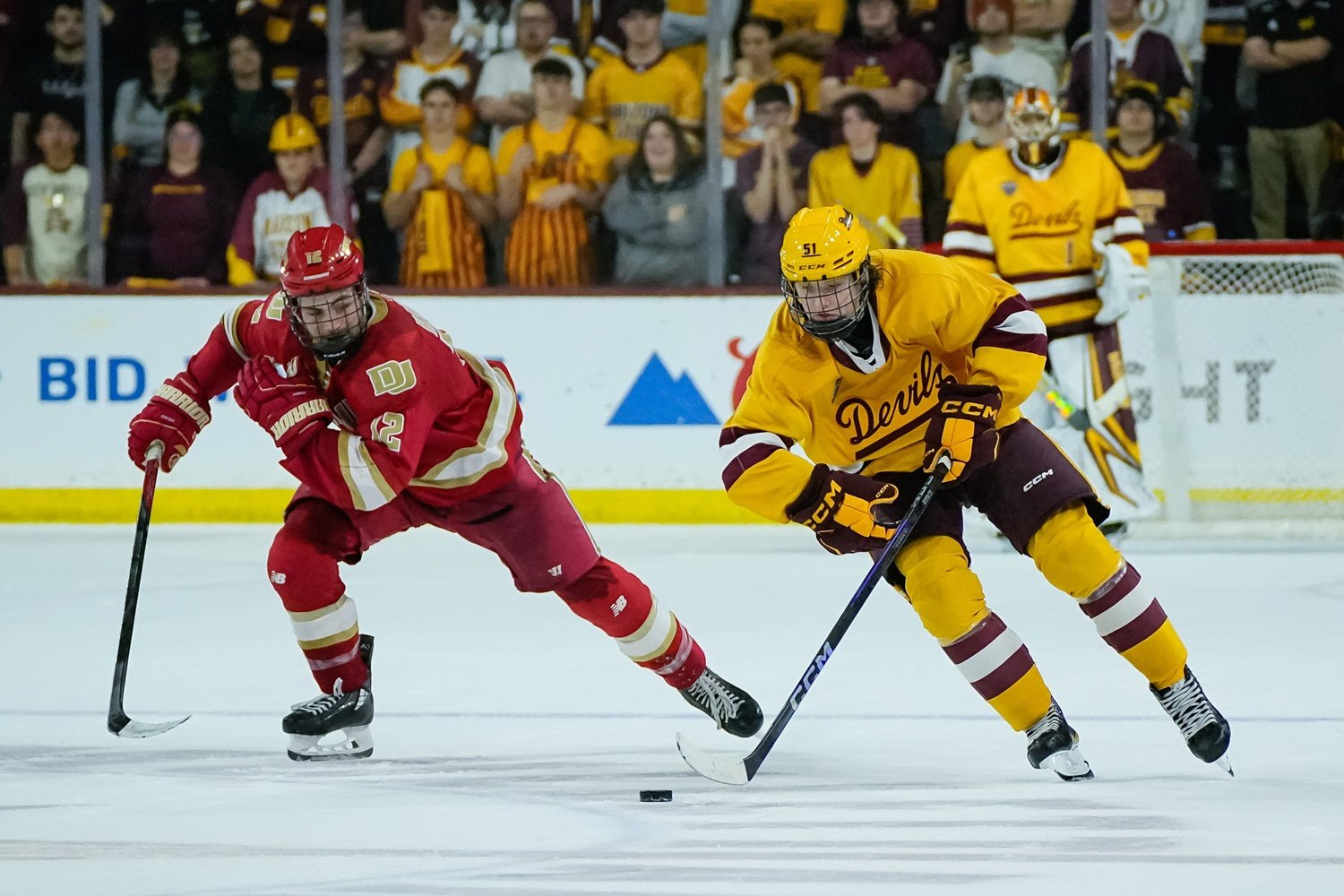
Lucius isn’t exactly a top prospect. He was just a fourth-round pick in the 2022 Draft, and after struggling in his junior season at Arizona State, Lucius fell off the prospect radar. But he made a resurgence as a senior, leading the Sun Devils with 15 goals and 43 points this year, and has announced his intention not to sign with the Pittsburgh Penguins and hit free agency.
There are no rumors of a specific team Lucius is looking to sign with, only that he wants a fast track to the NHL. That might seem incompatible with the Wild and their deep roster at forward, but there’s a path for Lucius to catch on with a contender in Minnesota, and the Wild would do well to investigate that route.
The Wild have just eight forwards under contract next year because Mats Zuccarello (38 years old), Marcus Johansson (35), and Vladimir Tarasenko (34) will become unrestricted free agents. Those are three aging wingers in scoring roles, and while it’s easy to see Zuccarello coming back on a one-year deal, it’s tough to see all three returning.
Any one of them going out the door would appear to open up a spot for Lucius, who turns 22 on Sunday, to compete for a roster spot next year. His balanced skillset of shooting and passing ability has the potential to offset one of the Wild’s aging, perhaps soon-to-move-on scoring wingers.
Austin Broad of Elite Prospects was impressed with him early this year. Commenting on Lucius’ two-assist effort in a November 15 win over North Dakota, Broad wrote, “Lucius was operating at maximum speed all game long. Everything he did was at top speed; his skating, passing, shooting, and decision-making were all lightning-quick in this game…. Lucius’ skillset will allow him to be a strong bottom-six offensive producer, and his speed and work ethic should allow him to adapt to different roles.”
Should the Wild extend Quinn Hughes this summer, they’ll have three foundational pieces in place between him, Kirill Kaprizov, and Matt Boldy. They will also be quite an expensive trio, and the Wild are looking to take another superstar swing in the near future. That creates a problem that the NHL’s perennial contenders need to solve.
Two teams stand out as perpetually successful at this: the mid-2010s Pittsburgh Penguins and the Tampa Bay Lightning. The Penguins were so great at churning out middle-six players out of nowhere that it spawned the meme of “Mark Donk.” Third-round pick Jake Guentzel is the most extreme example, but they also got big performances out of undrafted wingers like Conor Sheary and Bryan Rust.
The Lightning hit the lottery twice, finding Nikita Kucherov in the second round in 2010, then Brayden Point in the third round in 2014. But over the years, the Lightning unearthed players like Ondrej Palat (seventh round, 2011), Tyler Johnson (undrafted), Yanni Gourde (undrafted), and Anthony Cirelli (third round, 2015). Finding value forwards in the bargain bin has extended their contending window for over a decade.
In both places, the formula was simple, if difficult to execute: Find skilled players that your stars can take to another level. The Wild have inklings of this in their prospect system. Hunter Haight and Riley Heidt are AHL prospects who were scorers in junior, while 18-year-old Adam Benák is having a terrific year at the OHL. Still, a team like Minnesota needs more fliers, and Lucius represents a skilled player that the Wild can take a chance on.
If Lucius doesn’t head to St. Paul, perhaps it’s no big deal. There are other Mark Donks and Buzz Flibbits out there to find. But if the Wild are going to keep selling off draft and prospect capital, they’ll need to work extra hard to identify, sign, and develop those players if they want their shelf life to extend past the next two to three seasons.
Think you could write a story like this? Hockey Wilderness wants you to develop your voice, find an audience, and we’ll pay you to do it. Just fill out this form.