
ST. PAUL, Minn. — The Minnesota Wild are coming off back-to-back wins against teams fighting for their playoff lives in the Ottawa Senators and Detroit Red Wings.
And while the Wild have safely been in the No. 3 spot in the Central Division for what feels like an eternity, they’ve been trying to turn it up a notch lately to get their game ready for the playoffs. That’s the goal in the final five games, which include a three-game road trip to face likely first-round opponent the Dallas Stars, as well as the Nashville Predators and St. Louis Blues, bookended by home games against the Seattle Kraken and Anaheim Ducks.
Home ice is on the line, with the Wild two points back of the Stars and each team having five games left, including Thursday’s final regular-season meeting.
“They have urgency there, but it’s no different for us,” coach John Hynes said of the Senators and Red Wings. “We want to have our team playing well, and we want to make sure, part of that, is also having individuals play well and play at the top of their game.”
But there’s a balance, like weighing the desire to get home ice against resting some heavy-workload players — forwards like Kirill Kaprizov, Matt Boldy and Joel Eriksson Ek, and defensemen Quinn Hughes, Brock Faber, Jonas Brodin and Jared Spurgeon.
Minnesota will try to work some players into the lineup in the final week of the season. Defensemen Daemon Hunt and Jeff Petry should get playing time with Zach Bogosian sidelined by his latest lower-body injury. Petry played in Sunday’s 5-4 win at Detroit.
The Wild also could be on the verge of signing a college free-agent defenseman, per league sources, who could debut in one of the final three games (he won’t be playoff eligible). One big shame is that after planning to sign Charlie Stramel to his entry-level contract and debut him down the stretch, he broke his ankle in his final game with Michigan State, delaying his signing, but if Stramel still signs a contract starting in 2025-26, he would be eligible for the playoffs once healthy.
But first things first. In these final five games, the Wild are looking for answers to some key questions before the playoffs. Here they are:
The goaltending rotation
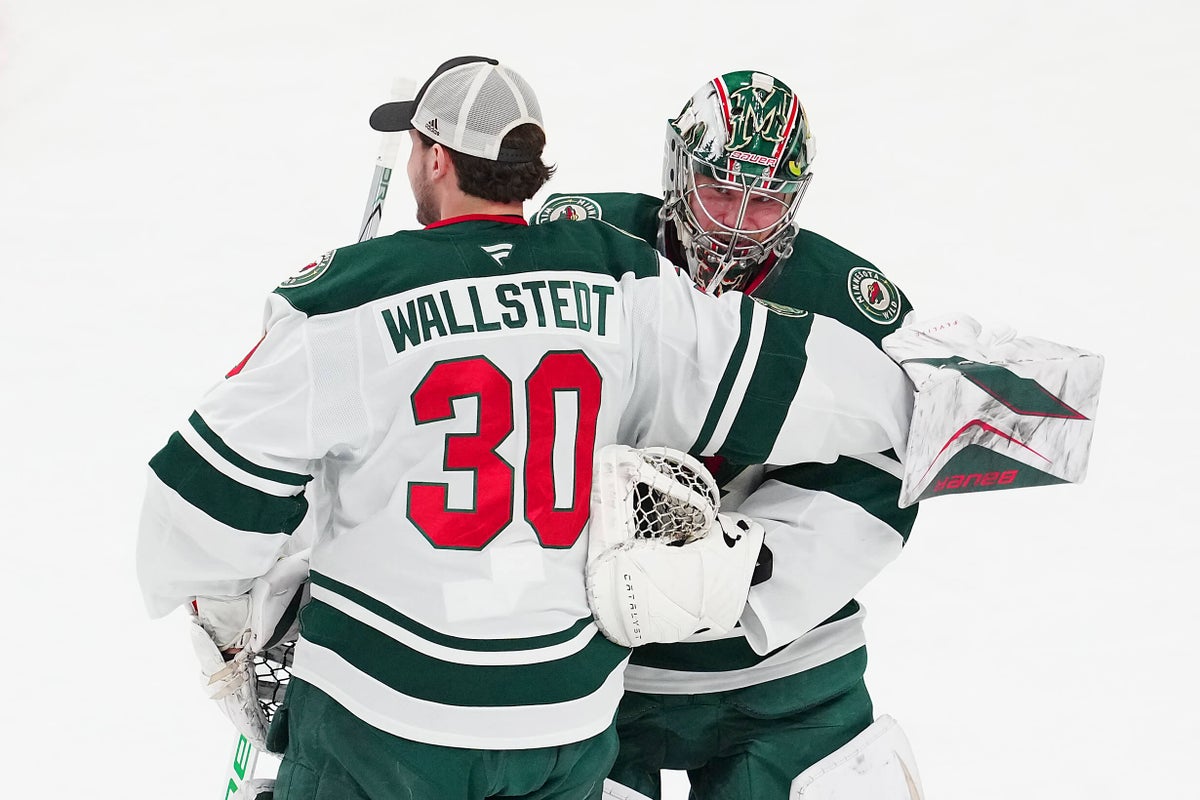
For most of the year, the Wild have employed a pretty strict goalie rotation, especially since Jesper Wallstedt’s game took off in November. It has worked out well, with Wallstedt and Filip Gustavsson backstopping Minnesota to the NHL’s fourth-best goals-against average (2.83) and best save percentage (.906) through Saturday.
The question is whether Hynes is open to using both goalies in the playoffs.
“I haven’t thought that far ahead,” Hynes said. “I think that they both give us a chance to win. So that’s a good feeling. So we’ll see how it goes down the stretch. Both guys are gonna get a good amount of work here leading into the playoffs.”
Gustavsson, signed to a long-term extension in September, will likely get the Game 1 start of the Wild’s first series. He has the experience, and the Wild’s two first-round exits with him in net can hardly be blamed on him (2.53 GAA and .917 save percentage in 11 starts).
But Gustavsson and Wallstedt’s numbers have been pretty darn close: Gustavsson at 2.56 GAA and .909 save percentage, and Wallstedt at 2.67 and .913.
Wallstedt has been better since the Olympic break, but there are still five games to decide who has the hot hand. Wallstedt isn’t sure a rotation works best in the playoffs.
“It’s hard,” he said. “You don’t want to switch up too much if one’s hot. It’s hard for me to say too. I’ve never been in the Stanley Cup playoffs. So I don’t know much either. But I guess we’ll see. I think either way we’ll be in good hands.”
Who plays with Hughes?
Hughes and Brock Faber were pretty much attached at the hip after the Wild acquired Hughes in mid-December. But Hynes and his staff started to experiment with their pairs a few weeks ago, putting Spurgeon with Hughes and Faber with Brodin.
Why? To get a better idea of what Hughes looks like with a different partner, and because Hughes and Faber were starting to bleed chances, with both being a little too aggressive offensively.
The Wild went back to Hughes and Faber on Thursday.
The Hughes-Spurgeon pair wasn’t bad, with a 47.65 Corsi-for percentage in 105:59 (46.03 expected goal percentage), per Natural Stat Trick. The Faber-Hughes pair has better numbers over a larger sample size, with a 54.15 Corsi-for percentage over 705 minutes and a 56.19 expected goals percentage.
Hughes-Spurgeon could present a size issue in the playoffs, while Brodin and Spurgeon are usually money together. In fact, Sportlogiq’s Mike Kelly noted Saturday that entering the Sens game, the Brodin-Spurgeon pair had played nearly 105 five-on-five minutes together since the Olympics and had only been on the ice for four inner-slot shots against as opposed to 16 for the Wild. In that span, they had only been on the ice for two goals against.
Having a shutdown pair like that would be good in the playoffs.
“We still haven’t decided finally what we’ll do with it,” Hynes said. “There’s a little bit of time here, but I think both pairs would be good.”
Who’s the odd man out?
The biggest lineup decision will be who fills out the bottom six.
Minnesota gave itself a lot of depth at the deadline, acquiring Michael McCarron, Bobby Brink and Nick Foligno, just after claiming Robby Fabbri on waivers. The forward group is heavier and more versatile.
It’s a good problem to have.
After a few weeks of experimenting, Hynes is close to deciding on the group for Game 1.
“We, for the most part, have a strong idea of what we’re going to do,” Hynes said. “But we’ll still look at a few different combinations. Not a wholesale (change), but I think you have pairs. You maybe see what a third guy on a line looks like, and see what that chemistry or what it looks like in live games.”
The top two lines will likely be Ryan Hartman between Kaprizov and Mats Zuccarello, and Eriksson Ek between Marcus Johansson and Boldy.
In the bottom six, they’ll likely be deciding from game to game between two of Danila Yurov, Brink and Nick Foligno.
Yurov’s faceoffs have been an issue all season (39.1 percent, including 10 of 14 lost on Saturday), so much so that he barely kills penalties anymore. But he brings speed and offense and chemistry on an all-Russian line with Vladimir Tarasenko and Yakov Trenin.
Foligno, on the other hand, is a great penalty killer, is grittier and can win draws.
The issue is playing both Nick Foligno and McCarron essentially guarantees that one has to be your third-line center if Yurov is out. If Yurov plays under those circumstances, Brink — who provides speed, skill and the willingness to go to the dirty areas despite being undersized — would have to be scratched because it’s hard to see the Wild sitting Trenin, the NHL hits leader (390) who has had a strong year and was good last postseason.
So the third-line possibilities are likely:
Tarasenko-Yurov-Brink
Tarasenko-Yurov-Trenin
Tarasenko-McCarron-Brink
And the fourth-line possibilities are likely:
Marcus Foligno-McCarron-Trenin
Marcus Foligno-McCarron-Nick Foligno
Marcus Foligno-Nick Foligno-Trenin
One way or another, it looks like Nico Sturm and Fabbri are destined to be in the press box if the Wild are healthy, along with one of the bottom-six forwards above.
There will be no set lineup, so there’s no use fretting over this. One loss, like for every team in the playoffs, will likely bring lineup changes. For the Wild to get where they want to go, they’re going to need everybody to go four rounds. Same thing on defense, where, if Bogosian recovers from his latest injury, he’ll likely be the right D on the third pair over Petry.
Split up Kaprizov and Boldy?
In last year’s first-round playoff series against the Vegas Golden Knights, Kaprizov and Boldy were dynamic together. They were on the top line with Eriksson Ek and racked up a combined 10 goals and 16 points in six games, each star scoring five goals. But once the Golden Knights slowed them down, Vegas took over the series, with Kaprizov and Boldy combining for just two goals in the final three games.
So it would make sense to split them up, and it looks like the Wild will.
For the past few weeks, the Wild have been going with Kaprizov-Hartman-Zuccarello — with Hartman on fire and looking primed for the playoffs — and Johansson-Eriksson Ek-Boldy. For those who scoff at Johansson being on the second line, the fact of the matter is that Boldy enjoys playing with the smooth-skating Swede. There’s chemistry there with Johansson, a pass-first winger, and Eriksson Ek, a do-it-all, tough-as-nails shutdown center.
“It’s just playing simple and letting it come to us,” Boldy said. “When we kind of let it happen, and we’re in the right spots and just play quick and simple, then stuff opens up.”
You could argue that this year’s team is deeper up front than last year’s, so the Wild could afford to put Boldy and Kaprizov together, if needed. Tarasenko has provided a strong, bounce-back year with 22 goals. Brink is a playmaker with speed. The Foligno brothers could chip in offense.
But Hynes will likely start the playoffs with Kaprizov and Boldy detached. And if Hartman plays with the kind of purpose and playmaking we’ve seen in the playoffs in recent years, then it should be a good match.
If Zuccarello and Kaprizov get too cute or play too much east-west, Hynes can always put them through the line blender.
Do they go for home ice?
Hynes hinted after last week’s win over the Vancouver Canucks that the Wild could rest players, but suddenly, home-ice advantage is attainable if they take care of business. How does that change things?
“We’ll talk about the plan and where we’re at and where guys are and what we’ll do,” Hynes said.
Home ice doesn’t always matter, but remember that when it comes to Wild-Stars, historically, Minnesota stinks in Dallas.
The Wild are 39-41-13 all-time against the Stars in the regular season, but 13-26-8 in Dallas and 2-4 in the playoffs. At home, however, the Wild are 26-15-5 all-time in the regular season against the Stars and 2-4 in the playoffs.
So it’ll be interesting to see how Hynes and the Wild brass proceed this week. It’d be a shame if they sustain injuries heading into the postseason, but it’d also be a shame not to at least try to snag that extra home game.
“If it happens, it happens,” Boldy said of getting home-ice advantage. “But the more you start to think about that stuff and stress about it, it just adds a little bit more into the group that I don’t think we need right now. We’re definitely pushing for it — don’t get me wrong — but I think if we just focus on playing the right way and taking care of one game at a time and it happens, then great.”