
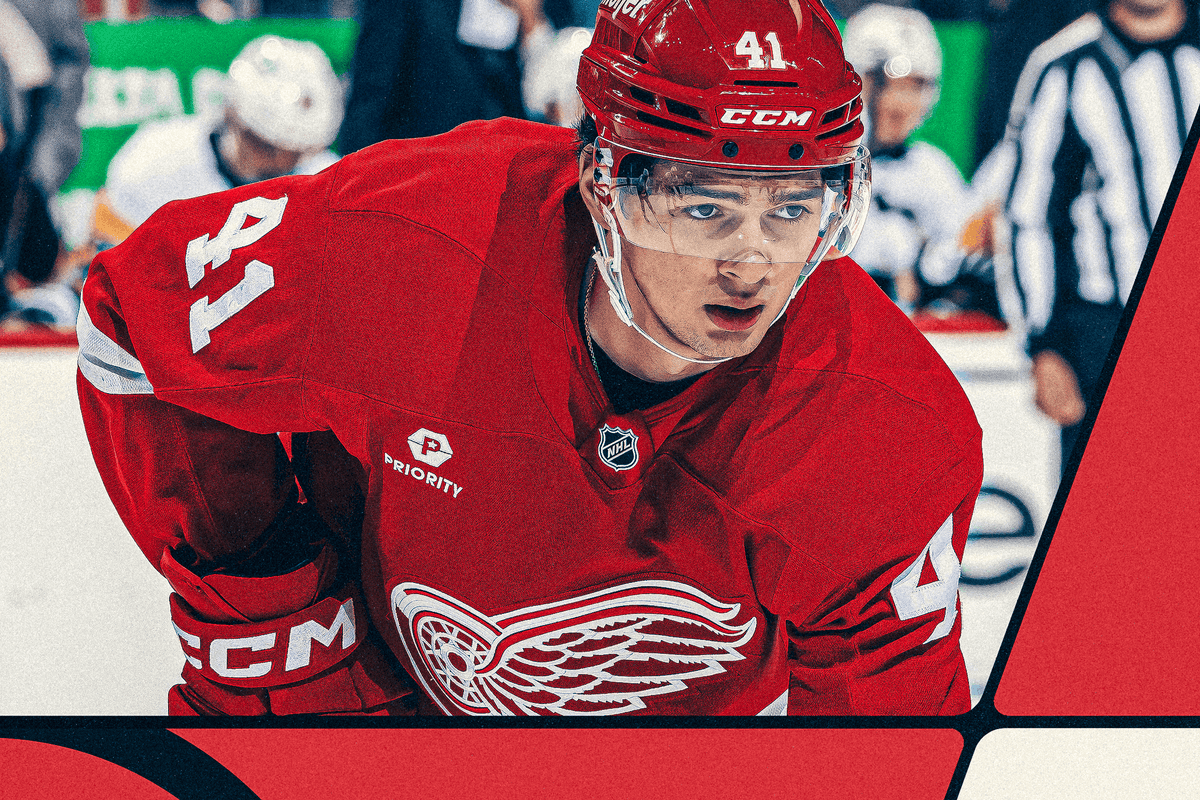
Welcome to Scott Wheeler’s 2026 rankings of every NHL organization’s prospects. You can find the complete ranking and more information on the project and its criteria here, as we count down daily from No. 32 to No. 1. The series, which includes evaluations on nearly 500 prospects, runs from March 9 to April 8.
The Red Wings have seven legit prospects, and there are a dozen or so on their list who I expect to play NHL games, plus a few others with some traits or intrigue. Their group is missing a game-breaking forward prospect, but they have several projectable top-nine forwards who will help them win games, a top young D prospect and two of the best goalie prospects outside the NHL.
2025 prospect pool rank: No. 5 (change: +1)
Tier 1 1. Sebastian Cossa, G, 23, Grand Rapids/Detroit (No. 15, 2021)
Cossa has always had the talent and upside, but he has also made important progress in some important areas over the years, limiting some of the ups and downs that he had earlier in his career and playing to a high level in the AHL, albeit behind some strong Griffins teams. He’s a huge (6-foot-6), powerful, athletic goalie, and those last two things don’t always come with the first. He’s also a fiery, confident, talkative competitor who doesn’t like to get beaten — which contrasts with the stoic demeanor we see in many goalies, including Trey Augustine — and wants to command the net and the room. Bigger goalies often struggle with their movements and their recoveries, but neither is an issue for Cossa. His positioning and reflexes help him block and grab a lot of pucks; he does a good job holding his outside edges to be patient on shots and has great hands up high. But it’s his ability to bounce back into his stance or change directions with passes that separates him for a goalie as tall as he is. His power through his pushes gives him a rare side-to-side ability for a goalie that big as well.
There have been times over the years when I’ve seen him look leaky and really struggle to close his five-hole because of his size. This remains a bit of a recurring issue, though it has improved, and he does a really good job kicking pucks aimed for the lower corners. He’ll still occasionally lose himself in his net on scramble plays, as those strong pushes to get to tough lateral saves can pull him off his lines. He can get pulled out of his net overcommitting on dekes. But he has worked to settle down in each of those areas (though his habits still need to be more consistent) and his natural gifts give him undeniable upside.
When he’s set and square to shots, he’s tough to beat. I’ve seen him look unflappable and make point-blank save after point-blank save when he’s dialed in. I’ve also seen him look rattled as shots sneak through holes they shouldn’t be finding. His combination of size, dexterity, competitiveness and explosiveness in the net is very real, though, and he now has a career .921 save percentage from the WHL supported by a .912 career AHL save percentage.
2. Trey Augustine, G, 21, Michigan State/Grand Rapids (No. 41, 2023)
The definition of calm, cool and collected, Augustine is the best goalie prospect to come through the national program since Spencer Knight. I like him more now than I liked Blackhawks goalie prospect Drew Commesso at the same age. I’ve seen him play a ton over the years, and I’ve always been impressed by his composure and the consistency of his play, whether that was in Plymouth with the program, Germany and Switzerland at two U18 worlds, Halifax, Gothenburg and Ottawa at three World Juniors (and twice in the net for gold) or on trips to East Lansing. After a strong freshman year with the Spartans, he was even better for them as a sophomore and then junior over the last two years, too; his save percentage rose from .915 to .924 and then .929. He was a big reason for their revival as a top program, finishing this season as a top 10 finalist for the Hobey Baker and twice winning the Big Ten’s goalie of the year award.
He’s dialed in, by all accounts just as much off the ice in the way he carries himself and goes about his business as on the ice, where his game has rare detail and intellect for a netminder his age. He’s good moving on his knees and in a crouch. He’s good at tracking pucks through traffic and across ice on seam plays. He plays good, sharp angles. His rebound control steering pucks into the corners is good. He’s good at getting down into his butterfly to close his five-hole quickly. He has good control generally. He’s as good in the lower third as any goalie his age, kicking pucks into the corner instead of out into the slot and sticking with dekes and five-hole plays. His athleticism is there when he needs it. He’s stoic. He’s just a good goalie.
While he’s not big for a goalie (listed at 6-1 and 194 pounds) and he can occasionally get frozen glove side or drop pucks into his glove, he’s a goalie I have a ton of confidence in projecting to have a long NHL career. He doesn’t have obvious starter talent or size, but I could see him getting there or at the very least becoming a solid, reliable tandem goalie. I’d trust him to play for my team and remain even-keeled any day. He and Cossa are such different people and goalies, which will make for an interesting yin-and-yang dynamic, I think.
I very nearly ranked Augustine No. 1 here and have had him ahead of Cossa in the past.
3. Axel Sandin-Pellikka, RHD, 21, Grand Rapids/Detroit (No. 17, 2023)
Sandin-Pellikka had a brilliant run in the SHL in the two years before this one, producing at near-historic rates as a teenager in both, winning an SHL title and emerging last season to play 20 minutes per game as one of the league’s most productive defensemen regardless of age before coming over. He also won back-to-back directorate awards as the top defenseman at the World Juniors, including as Sweden’s youngest defenseman the first time he did, too. He faced some predictable challenges in the NHL this year before his recent demotion to the AHL, but none that are out of the ordinary for a D his age.
Sandin-Pellikka is an individually talented, competitive 5-11 defenseman with natural scoring instincts and the tools to execute. He has really good edges and mobility and has shown improved speed in straight lines to pull away from chasers, with more room for growth there still. He walks the line to get shots through at a high level, wants the puck in the offensive zone and has the skill and shot to make things happen when teammates find him off the point or as the trailer off the rush, which he often activates into. He keeps his head up in the neutral and defensive zones and is a confident puck carrier on exits and entries. Though he’s not big, he’s athletic and he plays hard and physical and engages in battles in the defensive zone with some sneaky strength. He has a good stick. He does a good job maintaining gaps and matching opposing forwards step for step skating backward, and times his close-outs and pinches effectively.
He can really shoot it with a pinpoint accurate shot, a wrister that comes off hard and an eagerness to put pucks on net from the point. He has comfortable handles. He walks the line looking for his shot and chances to take space off it to attack into better spots, but he’ll find open teammates cross-ice through seams as well and is seeing the ice better and better. There are times when he can wait too long to make his decisions, and I wouldn’t call him super creative or a highlight-reel type, but he’s very talented, he makes good choices more often than he’s careless, and he has progressed really rapidly.
He projects as a high-end offensive defenseman and a defensively capable one at five-on-five. When he’s on, he can control the game in all three zones and really drive shot creation. Defensemen of his size have struggled in recent years to make the same impact in the NHL that they made at lower levels, but I think ASP gets there.
4. Carter Bear, LW, 19, Everett (No. 13, 2025)
You could rank the Red Wings’ trio of Bear, Nate Danielson and Michael Brandsegg-Nygård in any order, and I debated them all, but I’m partial to Bear, who I just think has a little more skill though he’s a weaker skater, too.
Bear is a late ’06 who scored 25 goals and 57 points for the Silvertips two years ago and last year wore a letter, broke 40 goals and was their leading scorer and a go-to forward before suffering a skate laceration on the back of his leg that partially tore his Achilles. This year, he got off to a slow start in his return from the injury but picked it up enough to play his way onto the Canadian World Junior team and, despite only playing 10 shifts in the tournament, returned to Everett in January and continued his strong play down the stretch for one of the CHL’s best teams.
He’s a play driver and play creator at the junior level, and it’s rare to be both. He possesses quick, soft hands, legit skill and a natural shot, but he also stays around it, plays with intensity, works extremely hard and goes to the net and inside ice. Though people talk about him for his motor and pro style, I’ve seen him make some impressive skill plays and dance some goalies and defensemen. But he can also beat you with his work ethic, and I like both the intentionality of his game and the way he uses his skill to play to the middle third. He works his tail off, tracks and puts himself in good spots. He can push play at five-on-five, make things happen all over the ice and contribute on both special teams.
He was a bit of a late bloomer, and his skating is just average, but he looks like a player now and should become an impactful top-nine worker with skill in the NHL who can be the best player on a third line or a go-getter for a top line. The more I’ve watched him over the years, the more I’ve appreciated his game, his approach and his identity.
5. Nate Danielson, C, 21, Grand Rapids/Detroit (No. 9, 2023)
Danielson is a good prospect who had a good rookie season in the AHL last year, took another step this year, has started to get NHL play and is going to be a good NHLer for a long time as an effective top-nine forward. But his skill has never grabbed me, and I’ve always wanted to see him score more, which has left me a little lower on him than most.
His counting stats in junior never popped when you contextualized them with his late birthday and near-2022 draft eligibility. He has some pedigree, though. Danielson was a point-per-game player and one of Brandon’s top producers four seasons ago. He was named captain of the Wheat Kings for his draft year, and after a bit of a slow start, he came back into his own and finished with 33 goals and 78 points as the best player on a bad team. Two years ago, he was an effective bottom-sixer for Canada at the World Juniors and the counting stats began to come more after a move from Brandon to Portland, but even then he didn’t light up the league. (Post-trade he had 41 points in 28 regular-season games, an impressive 100-point pace over 68 games and a noteworthy uptick, but production that still would have landed him third on the Winterhawks in scoring and outside of top 10 in the WHL.) Last season, he was consistently good for the Griffins, logging 19-20 minutes per game in the AHL as a 20-year-old rookie and contributing in all areas, and was probably owed a little more than his modest production indicated. But that can only be a talking point for so long, too, and eventually you have to score as a top-10 pick. Even this year, as his production climbed closer to a point per game in GR, the goals didn’t come with it.
Danielson is well-liked by scouts and should become a solid middle-six center in the NHL, though he needs to improve in the faceoff circle. He’s a 6-1, 190ish pounds, hardworking pivot who can skate, drive through the middle of the ice, push tempo and play with a decent talent level and good overall detail. He plays a well-rounded two-way game, is a proficient penalty killer, wants to make a difference in all areas when he’s on the ice and blends good overall skill with his effort. He plays with intention and consistency. He can simplify his game or mold his play to his line or coaching assignment. His lines tend to spend their shifts in the offensive zone. He’s a good skater who can play in transition as well as a good forechecker with some secondary skill. He’s a smart player on and off the puck, offensively and defensively. Though his game lacks dynamism for me, he’s a complete player without any glaring holes. I’ve just never been able to get excited about his offense.
6. Michael Brandsegg-Nygård, LW/RW, 20, Grand Rapids/Detroit (No. 15, 2024)
I think Brandsegg-Nygård will have some scoring punch and presence about his game at the NHL level in the prime of his career.
He’s a very well-rounded and projectable winger. He’s an October birthday with a pro frame who played to above a point per game at the junior level and scored his first pro goal in HockeyAllsvenskan three seasons ago. If not for knee surgery in March 2023, he might have played for Norway’s senior national team at men’s worlds before his draft year had even started. He then got back in time for his draft year and got off to an excellent start, registering nine points in his first three J20 games and quickly establishing himself back with the pro club, building as the season progressed toward a standout postseason that saw him register 10 points in 12 playoff games at Sweden’s second-rung pro level.
Last year, he played on loan with the reigning SHL champs in Sweden’s top flight, averaging 14-15 minutes per game and contributing at five-on-five and on the power play. He has also been really solid for the Norwegian men’s national team, which has included nine points in 12 games at men’s worlds, two goals in three Olympic qualifying games and a four-goal game in a men’s worlds tuneup against Denmark. His numbers didn’t pop in the SHL, and he only scored one goal at the Division 1A World Juniors for Norway, but he did lead the entire tournament in shots on goal with 25 in five games, so I’m not reading into it too much. After coming over to the AHL last spring, he looked solid in Grand Rapids in the playoffs last year and has had a decent first full year in North America split between the AHL (where he has played 17-18 minutes per game) and NHL, where he has averaged a little over 12 per game and has had enough looks in my viewings for this as of April 1 that I think he’s probably owed his first NHL goal.
Brandsegg-Nygård’s game is built on his work ethic and drive. He’s a multifaceted shooter who can score from the top of the circles with his wrister but also gets down to one knee and really powers through a good one-touch shot — skills that have helped him excel on both the flank and the bumper on the power play across domestic and international levels. He’s not a dynamic individual play creator, but he has pro size (6-1 and a strong 204 pounds), he works extremely hard and engages himself in the play, he plays well off his linemates and he has good all-around skill. He also plays the game with a physical tilt, even against pros, constantly engaging in battles, bowling players over and keeping his effort level ramped up. He has good straight-line skating. He has a commitment to staying on pucks and finishing his checks, and uses a long stick to protect pucks well out wide to his body.
He looks like a projectable middle-six push-and-pop driver and shooter to me as the third guy on a more talented line or a driver on a bottom-six line with continued development. Some wonder about his skill in terms of NHL points, but you won’t find anyone who doesn’t at least like his game/style, and I think it’s going to translate into a real go-getter with some jam at the NHL level.
7. Emmitt Finnie, C, 20, Detroit (No. 201, 2023)
I had members of the Blazers get in my ear about Finnie when he was playing for their very deep, Memorial Cup-hosting team, and I couldn’t quite get to where their belief was in him at the time and felt where he ended up getting picked was appropriate. Boy, has he followed the exact path they said he would, though. Last year, he was their captain, their leading scorer (by 18 points!) and finished top 20 in the WHL in scoring. And then we all know the story this year, starting on the first line and sticking in the NHL. Despite his end-to-end year in the NHL, I did make an exception to include him here because of his age: he’s a June birthday who was a young 20 to start the season.
Finnie is going to be an up-and-down-the-lineup NHLer for a long time. I don’t know whether he’s ever going to produce points in a significant way because he’s never going to be a top PP guy — though I know he has a handful of power-play goals this year, which is a definite positive — but there’s a path for him to go from the low-30s pace he has played at this year to a consistent 40-something point player. That’s huge value out of a seventh-round pick. Finnie is a 6-1, 190ish-pound forward who can play both center and the wing and who works his tail off. He can play in all situations, can be relied upon to give a consistent effort and find ways to win shifts and plays his high-energy, stick-to-it game without taking penalties, winning battles cleanly and then making quick, smart decisions with the puck. He plays with intention and pace. He’s already a success story for a No. 201 pick, earning his 15-plus minutes per game this year and everything he has gotten to date in his young career.
Tier 28. Max Plante, LW, 20, Minnesota-Duluth (No. 47, 2024)
The first time I watched Max Plante play, I was scouting his older brother Zam, then a star at Hermantown High and now a Penguins prospect. Immediately, Max stood out even next to his older brother for his dynamic puckhandling ability and hardworking disposition. Where Zam’s game was about smarts, Max’s was all about working to get the puck and then creating with it. His smarts are also a major, major asset, and funnily enough have become more of his calling card since. When I was done with the viewing, the pair had toyed with the opposition, and I texted a Minnesota-area NHL scout to say this: “That Max Plante is a demon.” A year later, he was predictably named to the national program.
But there was a hitch: He was really tiny. So even when he made plays in his U17 year, it always seemed to come with a “but.” Now he has grown a couple of inches, and while his body (and face) still look like he’s behind the curve physically, and he has dealt with injury issues, the playmaking has continued into his college career at Minnesota-Duluth. Despite a prolonged absence due to an upper-body injury he suffered in his NCAA debut last year, he finished his freshman campaign with 28 points in 23 games (1.22 points per game, making him the most productive U19 forward in college hockey). He took another step this year as well, establishing himself not just as a top player in his age cohort but as one of the top forwards in all of college hockey and a candidate for the Hobey Baker with a 52-point campaign. He was limited to slightly under three games due to injury at the World Juniors and wasn’t as impactful as many expected there, but we’ll call that a wash for him.
His game is packaged with a well-liked character, which has always made him a favorite of coaches and teammates. He has also clearly worked hard to continue to build a sellable identity as an all-around player and worker when he doesn’t have the puck. He supports well, he plays a team game and then the skill enters the equation when it should, rather than as his only thing. I’m a fan of the skill level but also the way he plays the game, which has an endearing quality to it. He can lack pace, but his smarts and feel for spacing and timing compensate. There are times in games when he just can’t beat his guy or get to his spot fast enough, but he’s not slow, and you hope that more jump comes with the physical maturity that should still be ahead of him. He has small area skill, feel and sense, and puts pucks into areas so well for his linemates.
I’ve felt since the draft that he could surprise some people to become a skilled and determined NHLer. I think there’s a good chance he just tops out as a top-six AHLer/call-up option as well, but something about his game just clicks.
9. Eddie Genborg, RW/LW, 18, Timrå/Grand Rapids (No. 44, 2025)
Genborg played a bottom-six role last season for a strong Swedish U18 team that had 2025s Anton Frondell, Viktor Klingsell, Jakob Ihs-Wozniak, Milton Gastrin, Filip Ekberg and Eric Nilson as well as top 2026s Ivar Stenberg and Viggo Björck. He only played about 13 minutes per game between the Hlinka, the WJAC, the Five Nations and U18 worlds, but he was one of the most productive 2007s in Sweden’s J20 level with Linköping, scored his first couple of SHL goals and played the net-front on Sweden’s power play at times. He has shown that he’s a better player than his national team usage last year indicated this year, too, registering 25 points in 43 SHL games with Timrå (third in U19 scoring behind Stenberg and Frondell) and playing effectively in his role as the third fiddle on his line at the World Juniors with draft-eligibles Stenberg and Björck. He’s now in the AHL at 18 and is averaging 13-14 minutes per game so far.
He’s a good-sized winger with some secondary skill who also plays hard and can really shoot the puck. He’s physical, he’s heavy, he can play the cycle and he’s going to have to be a bottom-six player in the NHL. But he also controls and handles pucks well in tight to his body, has strength and scored some nice goals going right at defenders over the last couple of years. His stride can be a little choppy and he needs to move a little quicker at times, but he has some strength and power, he makes plays to the interior off the wall and he can gain and hold body positioning. He also goes to the net and battles for his ice, he’s competitive, he forechecks hard, he keeps his feet moving, he finishes his checks and he can play in and out of give-and-gos to free himself for his shot, but also has some feel on the puck. He has a real chance to play NHL games.
10. Amadeus Lombardi, C, 22, Grand Rapids (No. 113, 2022)
Lombardi is an incredibly smart player who earned respect around the OHL before he turned pro for the advanced understanding he had of the game. After a 102-point season to finish his junior career, his transition to the pro game two years started playing some pretty significant minutes up front, but he finished it playing 9-10 minutes per game, which was fine for a rookie campaign on a deep team. Since then, he has played 18 minutes per game (though he has dealt with injuries in each of the last two seasons as well) and has been a top player for the Griffins at five-on-five and on the PP, producing just below a point per game. His NHL debut is coming.
Lombardi plays on reads, problem-solving, timing and anticipation and sense. He knows where to be, where to go and how to help connect plays. It’s a hard thing to pinpoint and describe, but he just has a real feel for the game. He has quick hands and some natural individual skill, too. His development is going to need to be the physical kind; it presents itself in things like struggles in the faceoff circle and playing through contact. He’s a good athlete, but he has below-average size for a center at 5-11 and 182 pounds. I think he’s smart enough to learn and adjust his game so that he can eventually give himself a shot to stick. He’s a call-up option and organizational depth at minimum.
Tier 311. Anton Johansson, RHD, 21, Leksands/Grand Rapids (No. 105, 2022)
After showing well in both the SHL and AHL last year at 20, Johansson returned to Sweden this year to play another year with Leksands and logged more than 20 minutes per game, playing a lot at five-on-five and chipping in on the second units of both special teams. You might also remember that after a strong showing at the World Junior Summer Showcase in Plymouth, he worked his way onto the Swedish World Junior team in Gothenburg. And while he fell from the top six into the No. 7 role, I think that had more to do with the play of Blues first-rounder Theo Lindstein than it did with his own performance: he played 20 and 17 minutes in the first two games and was solid.
Johansson is a what-you-see-is-what-you-get defenseman at 6-4, 200ish-pounds, whose steady game has allowed him to play his four post-draft seasons in the SHL in a compliment to his physical and mental maturity on the ice. He plays a strong, physical game and moves pucks effectively and simply. He knows who he is and plays within himself. He keeps his head up while carrying it and does a good job getting his shots through with a natural wrister from the point. He’s a good, flowing skater for his size who is capable of transporting pucks up ice and activating off the line.
He’s a high-floor, low-ceiling guy who probably becomes good organizational depth and a solid top-four AHL defenseman. There’s a chance he becomes a two-way No. 6-7 D as well.
12. Shai Buium, LHD, 23, Grand Rapids (No. 36, 2021)
Buium stepped into college and helped a team to a national title as an effective player at both ends as a true freshman four years ago, impressing scouts. Although I’m sure he was disappointed not to make the World Junior team three years ago — I actually think Team USA could have used his size on the back end — he also had a decent sophomore year at Denver as well. Then, as a 20-year-old junior, he continued to progress, playing a leading role at both ends and on both special teams for the Pioneers and winning his second national title. He hasn’t yet taken that next step at the AHL over his two seasons of pro hockey thus far, though, playing 16-17 minutes per game for the Griffins to fine but not standout results.
Buium plays a well-rounded, three-zone game that is built upon a strong foundation of tools, an understanding of the game and a strong 6-3, 220-pound build. He has developed his shot into something he’s more comfortable with and has developed his quickness just enough as well — two tools that needed some work. He doesn’t have a major physical element given his size, but he defends with his stick and can hold and maintain gaps, plus he reads the play well defensively. He’s also a strong outlet passer who plays a calculating game on both sides of the puck. There will be more defensive value to his game long-term than offensive value — he can swallow up the neutral zone and breaks up his share of plays inside his own zone — but there’s enough to his game to at least contribute on offense and he was quite productive for Denver (close to a point per game) despite having to share offensive minutes with two players as talented as his little brother Zeev and Avalanche prospect Sean Behrens.
He’s smart and heady, and simple but effective with the puck. He no longer looks a step slow like he used to, and while he remains a touch heavy going forward, he’s a solid backward skater and just a decent two-way player overall. He may top out as organizational depth, but he has a chance to play games. If he takes a step, he could become a No. 6-8 D.
13. Michal Pradel, G, 19, Tri-City (No. 75, 2025)
Pradel, a Colorado College commit who impressed at last spring’s U18 worlds to help himself get drafted in the third round, has been one of the top goalies in the USHL this season with the Storm. He was named one of Slovakia’s three players of the World Juniors in Minnesota, where he was better than his .877 save percentage indicated. Has some real tools, but work to do to refine them. He’s a 6-5 goalie who is smooth in the net for his size and tracks pucks well and competes in the net. His rebound control and control in general can let him down at times, and he’ll let shots squeak through his body and scramble in the crease, but the skill tools in terms of size, feet, hands and so on are there.
14. Rudy Guimond, G, 20, Moncton (No. 169, 2023)
Guimond is a tricky one in that his numbers in the QMJHL have been outstanding the last two year — as in, best-in-league with a career .927 save percentage across 66 games — but he has also done it at 19/20 behind the best team in the league after playing to mixed results in Cedar Rapids coming up (.871 in 38 games). The truth is probably somewhere in between, but when the Red Wings drafted him in the sixth round in 2023, that was based strictly on his raw upside and play at Taft School in the U.S. prep circuit.
He was previously committed to Yale and has done the Red Wings a bit of a favor by going the college route at Harvard next year, because based on his play in the Q, he has warranted a pro contract. I would imagine Augustine joining Grand Rapids also complicated things, and this now puts them on different timelines. Guimond is 6-4/5 with good habits and, by all accounts, a great off-ice demeanour, approach and consistency to his work ethic. He’s quite raw physically, and his footwork can occasionally let him down, but he stays square, he reads and anticipates play well, and a lot of pucks hit him. If he takes his time and continues to refine his game, there will be a pro opportunity for him out of school.
15. Jesse Kiiskinen, RW, 20, HPK (No. 68, 2023)
Finland’s captain at times with the U18 and U20 teams, Kiiskinen first really impressed me at the fall 2022 Five Nations in Plymouth, where he was in on eight of their 12 goals, led the team in points and shots and showed both skill and a respectable work rate. Since then, he was one of the more productive players in Finland’s top junior league (which once included a 20-shot hat-trick performance), looked like Finland’s best player at a U20 Five Nations, led the Finns in goals at the World Juniors to help the team to a silver medal in Ottawa and has taken steps in Liiga over the last two years to become one of the league’s top U21 scorers. though his point totals regressed this year, his goal totals went up, both of which I think were to be expected.
He’s dangerous on the flank and point on the power play because of his shot (both a quick wrister and the one-timer on his off-wing) and has excelled there in Liiga, forcing opposing teams to respect his shot and plan for it as a weapon. He also has a willingness to use it as a decoy in his passing game. He plays hard and gets off the flank to finish plays around the net. He has a pro frame and strong enough balance on his skates. But he’s not a quick north-south skater due in large part to short, almost stunted stride extensions, even though he evades defensemen with cuts and stop-ups to change directions and has looked a step quicker over the last year. He has a pro shot and deft handling skills, with a knack for having the puck in good spots a lot and a confidence flipping the switch to attack mode. That includes skill at catching and giving saucer passes and good dexterity around the net on tips and redirects.
He doesn’t turn 21 until the end of August either, giving him a good runway to come over to North America to try to work into the call-up conversation in the AHL eventually. My only complaint about his game is that it can lack pace. He always seems to be lurking around the net, though, and can make a play up high in the zone, too. He may top out as a top-six, PP AHL winger, but you’re looking to build him into a call-up option with some close-to-the-net and mid-range secondary scoring elements.
Honorable mentionsLarry Keenan, LHD, 21, UMass (No. 117, 2023)
One of the top prospects in the U.S. prep school circuit in his draft year at Culver, Keenan, who played his minor hockey in the Toronto area, has always had a compelling profile and has chosen steps since in places with a track record for developing defensemen: Penticton and now UMass. As a sophomore this year, he led all UMass D in ice time at 23:33 per game and finished second in D scoring with 19 points in 36 games while playing some tough minutes to solid two-way results. He’s long, he’s mobile, he has quick feet and comfortable edges for a player his size, and he plays a good transition game, moving pucks and defending the rush. Some of the rawness that existed in his decision-making has been completely cut out, too, and he can recover from the very few mistakes he now makes with his feet.
I strongly considered ranking him 14th or 15th here. He has pro tools and the habits and little things have really come.
Brent Solomon, RW/LW, 19, Sioux Falls (No. 109, 2025)
I thought Solomon was an interesting dice roll at the draft. He scored at will in Minnesota’s high school circuit and showed enough in a brief USHL stint to warrant a mid-to-late round pick. This season, he registered 51 points in 53 games in his first full year with Sioux Falls. Next year, he’ll join Wisconsin. His defining trait is an NHL release. He can rip it. He’s also a barely 6-0 winger who can lack pace, though. Building more of an NHL identity will determine whether he’s a sign-worthy player out of Wisconsin in a few years or just an NCAA scorer.
Dylan James, LW, 22, North Dakota (No. 40, 2022)
James won the USHL’s Rookie of the Year award in his draft year after making the move from the AJHL to score 33 goals and 69 points in 72 combined regular-season and playoff games as an October 2003, earning a second-round selection. Now he’s finishing his senior year at North Dakota, and he set career highs in goals (21) and points (31) in 39 games heading into this week’s Frozen Four.
He plays the kind of honest, plug-and-play-on-any-line game that Fighting Hawks staff love in their players. He’s a bit of a Swiss Army knife who can play a variety of roles on the power play and penalty kill, and he plays the same shift to shift and game to game regardless of his linemates. There isn’t a ton of flair or style to his game, but he has enough skill, he plays hard and he sees the ice well. He’s probably an AHL deal guy more than an NHL deal guy for me, but I thought he was worth a mention and topical with his college career about to come to a close in Las Vegas this week.
Ondrej Becher, C, 22, Grand Rapids (No. 80, 2024)
Becher is a play-driving forward who was drafted as an overager in the third round after he really impressed at the 2024 World Juniors and was a big part of one of the best lines in junior hockey with Zac Funk and Terik Parascak in Prince George. He’s a well-rounded, consistent forward who can go get pucks and make his linemates better. He has above-average skill as a handler, shooter, passer and skater. He can play center or the wing, can be trusted in all situations and creates looks for himself and his teammates with his smarts, know-how, skill and timing. He always seems to find a way to do something positive, and while I’m not sold on him becoming more than organizational depth, he has had two respectable years with the Griffins and has been a solid five-on-five and PP contributor for them this year. I could see him playing some games in his mid-20s.
Michal Svrcek, LW, 19, Brynäs/Västerås (No. 119, 2025)
Svrcek is a player who really caught my eye at two U18 worlds ago in Finland, where despite scoring just one goal in seven games for the Slovaks, he was one of the team’s only consistently noticeable forwards offensively. He then broke out at last year’s U18 worlds in Texas, wearing an “A” and making some big plays inside the offensive zone, including two huge goals in the bronze medal game. He was also noticeable at the Hlinka and was also one of the most dangerous players at the J20 level last year, which combined to be enough for me to rank him in my top 100 as a smaller winger.
This season has come with some predictable challenges in making that next step to the pro level at 18, but he has lit it up when with the J20 team and has played games in the SHL and the second-tier HockeyAllsvenskan. He was a little quieter than I expected at his first of what will be two World Juniors, but had a couple of moments there.
Svrcek is a good skater in straight lines and on cutbacks, twists and turns. He’s agile, plays with jump and has quick hands. He will take pucks to the net but can also score from the flank on the power play. He will finish his checks. He really loads his shot well and is dangerous as a snapshot shooter and in catch-and-release. And while there are times when he can try to do too much, he can also attack defenders one-on-one and really shoot the puck in motion. I’m not entirely sure how it will work up levels, but he’s an eye-catcher at times against his peers.
Noah Dower-Nilsson, C/LW, 20, Frölunda (No. 73, 2023)
A talented offensive player, Dower-Nilsson lit up Sweden’s top junior level in his draft year and then missed almost all of his post-draft season to two separate shoulder surgeries. He has now had two healthy years in the SHL at 19 and 20 and registered 16 points in 48 games this year (10th among U21 skaters).
He makes a lot of finesse plays, and his hands and creativity both get good grades. He loves having the puck on his stick inside the offensive zone, and while he has work to do to get stronger and build more consistency into his game off the puck, his talent level is higher than that of a typical third-round pick. Though he can reach in at times off the puck, he plays fairly hard, wants to push the puck into the middle third and will finish his checks even if he’s not considered a physical player per se. On the puck, he’s smooth out there, and it’s hard for defenders to get a hand on him one-on-one. He also does a good job freeing himself and finding pockets of space in the offensive zone to get open into, and I like him in give-and-go situations as much as I do when he’s splitting lanes with his hands. There’s just a tactile skill to his game. With continued health, development and patience, there might be a top-six AHLer there who is worth signing and bringing over.