
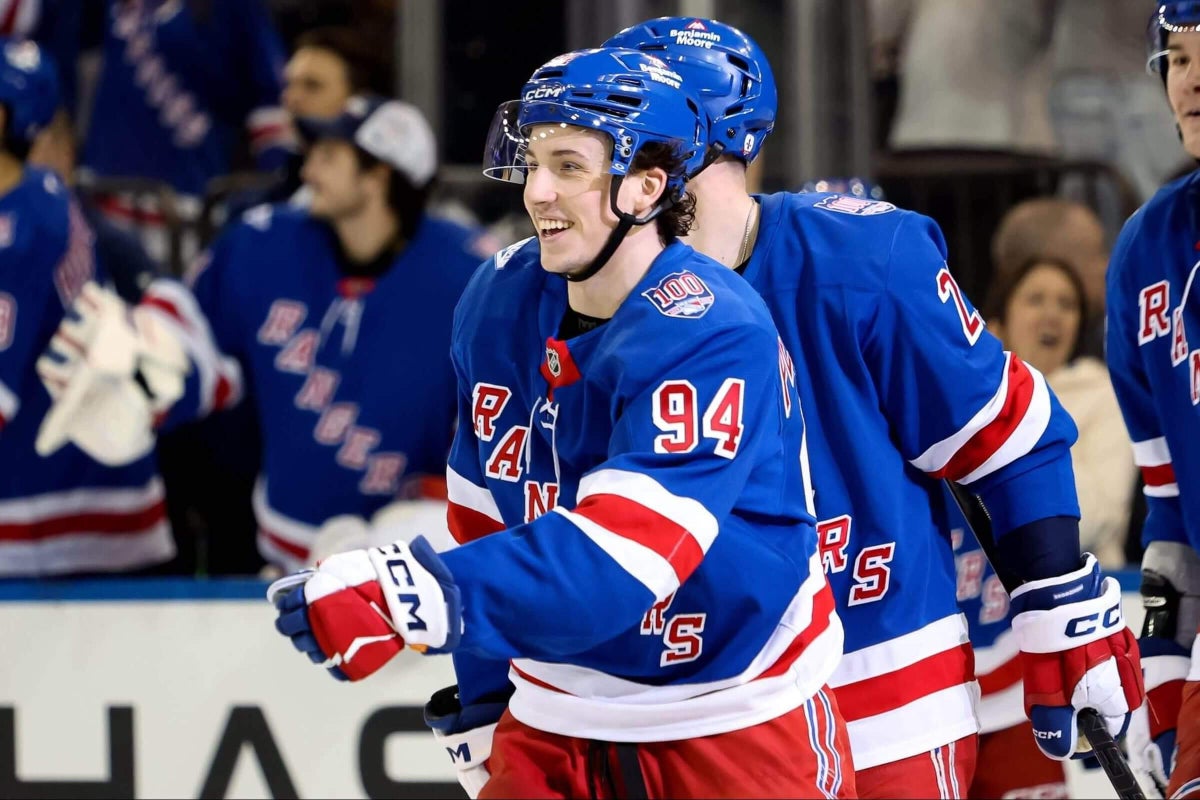
TARRYTOWN, N.Y. — There was surely some level of disappointment when Gabe Perreault found out he was beginning the season with the New York Rangers’ American Hockey League affiliate, the Hartford Wolf Pack. But he had been braced for the possibility and immediately set his mind on using that time to his advantage.
“I understood why I had to go down and work on some things, and I think I handled it well,” Perreault told The Athletic following Rangers practice Tuesday at the MSG Training Center. “I tried to look at it as a positive. I tried to not think about being here. I tried to focus with them down there, day by day.”
In retrospect, it may have been the best thing for the rookie winger. Twenty AHL games served as a constructive steppingstone on Perreault’s swift path to New York.
“The pro adjustment — you hear about it, but you don’t really necessarily know how it is till you’re in it,” he said. “I think that definitely slowed the game down for me and made it easier the next time I got called up.”
Perreault made a brief three-game appearance in mid-November, but the Rangers quickly determined more seasoning was needed. They sent him back to Hartford for another month, then recalled him again just before Christmas.
“One of the things that we look for all the time is whether a player is being challenged versus whether a player is being overwhelmed,” coach Mike Sullivan said. “We don’t want to put our players in positions where we feel like they’re being overwhelmed. We don’t think that helps their overall development. If they can’t have a certain level of success, then it affects their confidence, their self-esteem. It makes it hard for a player to continue to grow and develop at an optimal rate. … We’re always trying to find that sweet spot.”
The 20-year-old scored in his first game back, on Dec. 18, and has been an NHL regular ever since, appearing in 42 of New York’s last 43 games, including 40 straight entering Wednesday’s home finale against the Buffalo Sabres.
His trajectory hasn’t been entirely linear, with Perreault registering only three points during a 17-game stretch that spanned all of January and February. But the Rangers stuck with their No. 1 prospect and held firm to their belief that the subtle improvements they were observing would eventually lead to more points.
Perreault couldn’t pinpoint a switch-flip moment but felt his confidence grow gradually. It began to boom once he was promoted to New York’s top line with Alexis Lafrenière and Mika Zibanejad.
“It was kind of like, ‘Oh, I can play with these guys,’” Perreault said. “When I started playing with Mika quite a bit, I think I’ve made a lot of strides since that. He’s been really good. I’ve said it before, but it’s awesome having a guy like that to talk to on the daily and learn things from.”
The last 20 games, during which the Rangers have gone 11-7-2, have solidified that feeling. Perreault has collected 17 of his 25 total points (10 goals and 15 assists) in that span, including his first career hat trick in Saturday’s 4-1 win over the Detroit Red Wings.
“He’s becoming a great player right in front of us,” captain J.T. Miller said that day.
An Eastern Conference scout who’s kept a close eye on Perreault likened him to the Philadelphia Flyers’ dynamic forward, Trevor Zegras — except in Perreault’s case, he’s seeing fewer risky decisions and more of the responsible all-around play coaches crave.
“He’s more honest than Zegras, and arguably as smart and as skilled,” said the scout, who predicted Perreault will be a point-per-game player moving forward. “When he cheats (for offense), he cheats smartly.”
Perreault’s hockey IQ and vision have always been his calling cards, leading to some dazzling passes in recent weeks. He averages 4.2 scoring-chance assists per 60 minutes, ranking No. 3 on the team behind Zibanejad and traded star Artemi Panarin, according to AllThreeZones tracking.
Those traits are beginning to manifest in other areas as well.
Sullivan pointed to improved “quickness” as evidence of how well he’s reading the game, with Perreault showing a nose for disruption because he’s thinking faster than his foot speed might indicate. As a result, his defense, which was considered a potential weakness coming out of Boston College last year, “has actually been fine,” according to the scout.
But it’s the offensive side of the puck where the 2023 first-round pick has a chance to flourish. Sullivan saw the first goal of Saturday’s hat trick, in which Perreault made a deceptive adjustment after receiving a pass from Zibanejad, as a shining example of what can happen when he lets his instincts take over.
“If you guys go back and watch it, just his awareness to be able to change the (shooting) angle,” the coach said. “He pulls (the puck) 6 inches towards his body. That opens up the lane to allow him to score that goal. No. 1, he sees it, and then he has the stick skills to be able to execute on it.”
RIGHT ON TARGET 🫡 pic.twitter.com/f4RtiDJ1uY
— New York Rangers (@NYRangers) April 4, 2026
For an organization that’s traded away high-scoring veterans such as Panarin and Chris Kreider and lacks top-end prospects, Perreault stands out as a welcome anomaly. New York has a long history of draft mistakes, but snagging the U.S. National Team Development Program product at No. 23 is looking like a steal.
“The market was really dumb to let him slide that far,” the scout said bluntly.
Perreault’s emergence inspires hope that the Rangers have at least one young forward to build their top six around. He’s looked the part for well over a month now, but how high is his ceiling?
Sullivan laid out a two-part plan to help the 5-foot-11, 180-pounder maximize his potential, starting with an offseason program to add strength.
“We have the resources and the wherewithal with our strength conditioning staff and our team nutritionist, and we’re going to surround him with all the resources to try to set him up for success there, Sullivan said. “It will help with his ability to protect pucks, to create separation, to be stiffer in the puck battles, to be harder at the net front, to be better on the wall, because he’ll have a stronger center of gravity.”
Doing so could lead to a more diverse offensive profile. Much of Perreault’s damage has come off the rush, where he’s averaging 10.5 shots per 60 minutes, as opposed to only 3.15 off the cycle. In theory, bulking up could increase his in-zone production.

The scout talked about the importance of training to enhance skating and prevent injury but found the emphasis on adding pounds less significant. He pointed to multiple examples of skill players who succeed at a similar size, adding, “It’s the brain” that will separate Perreault.
Sullivan seemed to acknowledge that as well, stressing that the second part of their plan is to accentuate Perreault’s playmaking skills and sharpen the “velocity and release” on his left-handed shot.
Perreault said he intends to work on all of the above this summer, but the most valuable component to his development is the experience he’s gained at both the AHL and NHL levels this season.
“There’s still definitely a learning (curve),” he said. “You think the play is there, and it’s not. I’m still learning what does and what doesn’t work, but I think I’m making a lot of strides in that aspect.”