
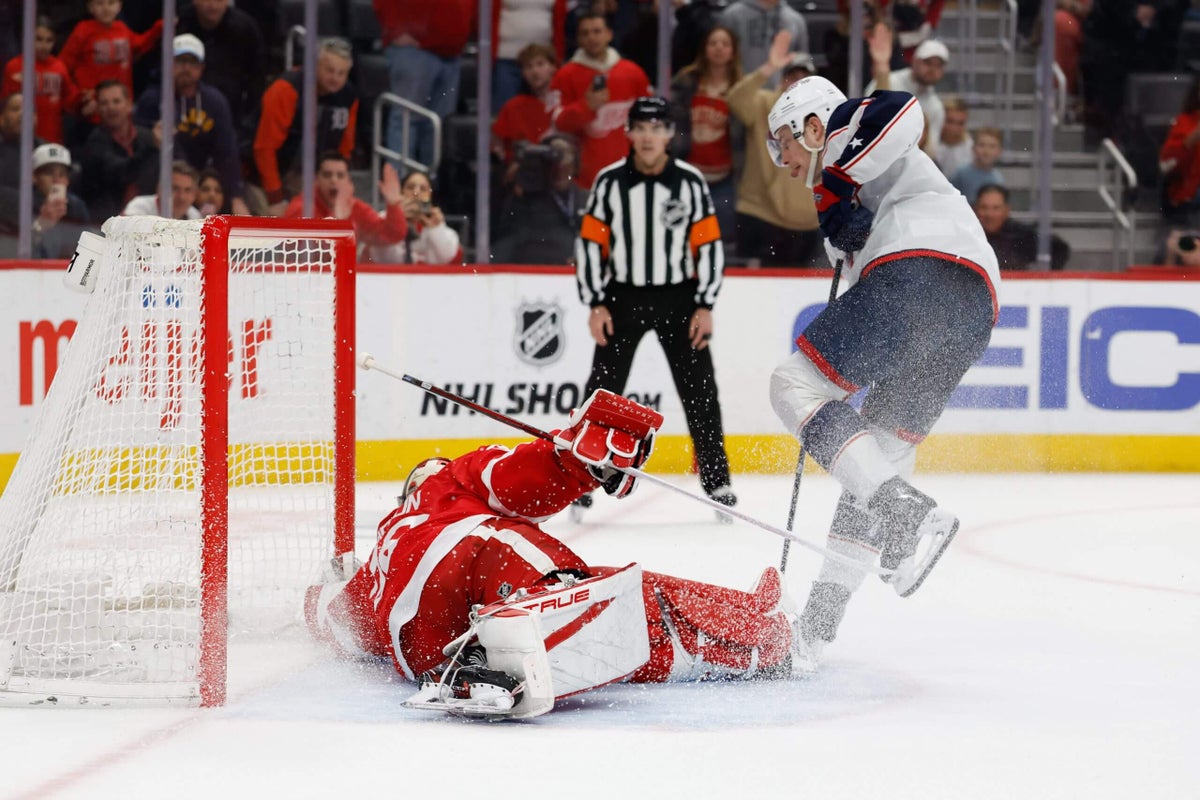
DETROIT — It was right there for the Detroit Red Wings: up 3-2, a defensive-zone faceoff and 21 seconds standing between them and a big regulation win over the Columbus Blue Jackets.
But, as has been the case so many times over the last five weeks, they just couldn’t get the finish. The Blue Jackets’ Sean Monahan won the draw to kick off a set play — up to the point, over to Adam Fantilli — that tied the game, and the latest Red Wings heartbreak was in motion. Five minutes of three-on-three overtime and five rounds of a shootout later, Columbus’ comeback was complete by way of a 4-3 victory.
If it happens a month ago, it’s a frustrating loss in a tight playoff race, but with the silver lining of an overtime point. Now, with just four games left in a derailing season, it’s hard to find any such solace.
“That’s a letdown,” Dylan Larkin said afterward. “And (in) tough fashion again. Played good 57 minutes, and a good overtime. Not much (positive) to say right now.”
This is the consequence for the games the Red Wings have lost much less competitively over the last two weeks. You can survive missing out on a (perhaps deserved) point if you take better care of your business on nights like the 4-1 drubbing by the New York Rangers, the brutal start in Pittsburgh or the three-goal deficits against the Minnesota Wild, Philadelphia Flyers and Ottawa Senators.
But when you let enough opportunities pass by, especially at home, it comes at a price. Right now, that price is this: the Red Wings are three points back of the Senators with four games to play, with no chance to reel in the regulation wins tiebreaker. That means their deficit is effectively four points, and as of late Tuesday night, Moneypuck had their playoff odds down to 6.3 percent.
That has been the trend for a while now, and it won’t surprise anyone who has watched. But the Red Wings’ more competitive showing Tuesday only twists the knife, reminding it didn’t have to be this way.
Here are five thoughts on what happened and where they stand:
1. A pair of key mistakes were the most notable parts of the Red Wings’ undoing on Tuesday.
Axel Sandin-Pellikka, one of the few bright spots from Detroit’s previous game, had an ill-advised turnover behind the Red Wings’ net just two minutes in, leading to an early deficit. And David Perron — Detroit’s only forward addition at the trade deadline — took a pair of second-period penalties, one of which set up a Columbus power-play goal.
Columbus led a large share of the run of play in the second period, but the Red Wings stood firm and survived it, still managing to lead in the final minute in what was a marked improvement in energy and game management from their prior two showings — and most of their games over the last two weeks.
“I liked our effort tonight,” head coach Todd McLellan said. “We didn’t like going down 1-0 that quick, but in the past few weeks when that has happened, we’ve gone away for a little while and all of the sudden it’s two or three. And I thought we performed well and got ourselves back into the game. Not a lot of complaints about the effort, the intensity — it felt like a pretty even game. A lot of battles, a lot of blocked shots. Those are all good signs for our team.”
They are, and the point they got means the Red Wings can’t be eliminated Thursday against the Flyers. But that counts for very little right now, mainly because of all the games they’ve left on the table.
2. Not to twist the knife on the final goal, but J.T. Compher had won two consecutive draws against Monahan on that final shift before the Blue Jackets tied the game. But after an icing, Monahan got just enough on the third try to win it.
Still, Detroit was ready for the play Columbus was about to make.
“It’s a play they do,” Larkin said. “They did it against Winnipeg the other night. Zach (Werenski) pump fakes and just chops it over, and it’s a bang-bang play, but we got opportunities to get the puck out, and do it the right way and have a little bit of poise when the net is empty, and put the game away. And we chopped it around. J.T. was so good on face-offs, and of course the one that we don’t get, it’s in the back of our net.”
Indeed, Compher won 63.6 percent of his faceoffs on the night. But when Columbus got its chance, it capitalized.
3. The Red Wings dominated puck possession in overtime, outshooting Columbus 7-3. That might even understate the amount of zone time they had. But when they couldn’t get it done at three-on-three, the game headed to an even more volatile means of breaking the tie.
Shootouts are not a strength of John Gibson’s game, with a .613 save percentage over the 36 in which he’s appeared. That ranks 85th out of 95 NHL goalies in the span of Gibson’s career.
Gibson has seen only two shootouts this season in Detroit, but he has allowed six goals on eight shots in them, a .250 save percentage that ranks 61st in the NHL.
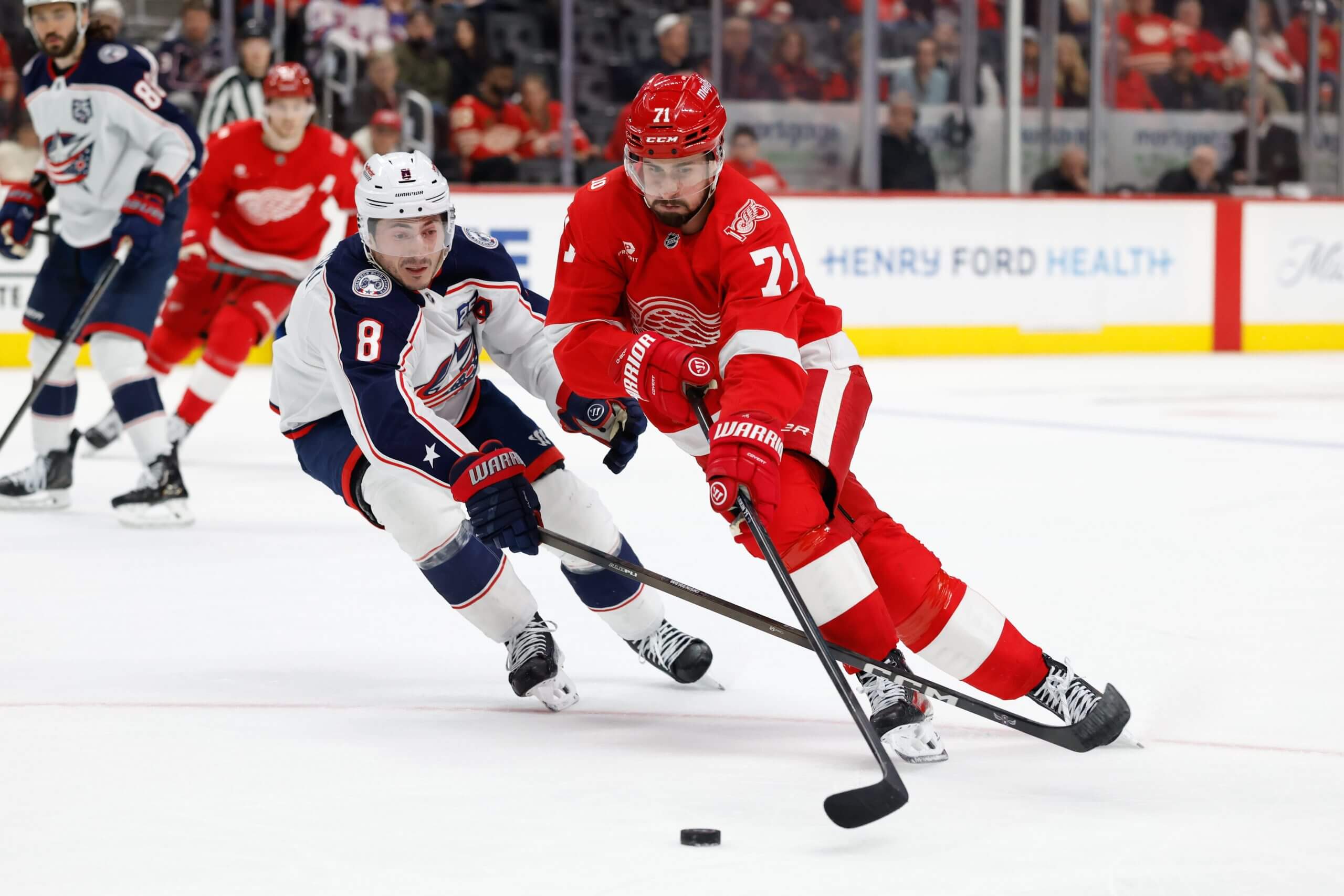
Dylan Larkin had a goal and an assist on Tuesday, looking closer to his usual self. (Rick Osentoski / Imagn Images)
4. A pair of Red Wings had their best games in a while Tuesday. Larkin and Justin Faulk combined for all three Detroit goals.
Larkin scored the Red Wings’ first goal on a power-play tally, which he has still done fairly regularly since returning from an apparent knee injury, but more noticeable was his jump. He still didn’t look close to 100 percent and there were some plays on which he appeared to be fighting it. But it was a step forward, and he finished with a goal, an assist, five shots on goal and four hits.
“I thought he moved better and had more of an impact on the game,” McLellan said. “He was taking pucks to the net, which is always a good sign. If he’s just playing on the outside and can’t get that acceleration and that drive to the net, that’s not the type of game he normally plays. But tonight he was doing that.”
Faulk scored twice, once on the rush when he split the Blue Jackets defense to give Detroit a 2-1 lead in the second period, and then from the point in the third. The veteran blueliner was brought in mainly to be a trustworthy piece to stabilize the second defense pair, and the results have been mixed at best next to Ben Chiarot. But he also offers the bonus of bringing some offense, and his first goal in particular was the kind of assertive play not seen often enough from Red Wings defensemen.
He and Chiarot also had the best underlying numbers of any Detroit defense pair, a much-needed development after Faulk had missed the previous two games with an injury.
“Huge lift for our team, him coming back in and playing that way,” Larkin said. “And even (Axel Sandin-Pellikka) coming back and making plays and having an impact last game. I think Faulker, just playing against him for so many years, the way he closes guys down … if he’s on you, you’re in trouble, and you better get rid of it quick, because when he closes, his stick, his feet, he’s all over you. It’s nice to have a defenseman like that, and it slots our D really nicely.”
That was certainly the vision when the Red Wings added Faulk. And while it hasn’t worked out that way as often as they’d preferred, they have him for another year. There is still runway for him to look like he did Tuesday night more consistently.
5. Between Patrick Kane’s late-game trip on Quinn Hughes Sunday that gave the Wild a power play on which they scored the game-winning goal in the final two minutes, and Fantilli’s tying goal Tuesday, the Red Wings lost at least two points in the final moments of their last two games.
That’s especially crushing right now as they stare at the three-point deficit.