
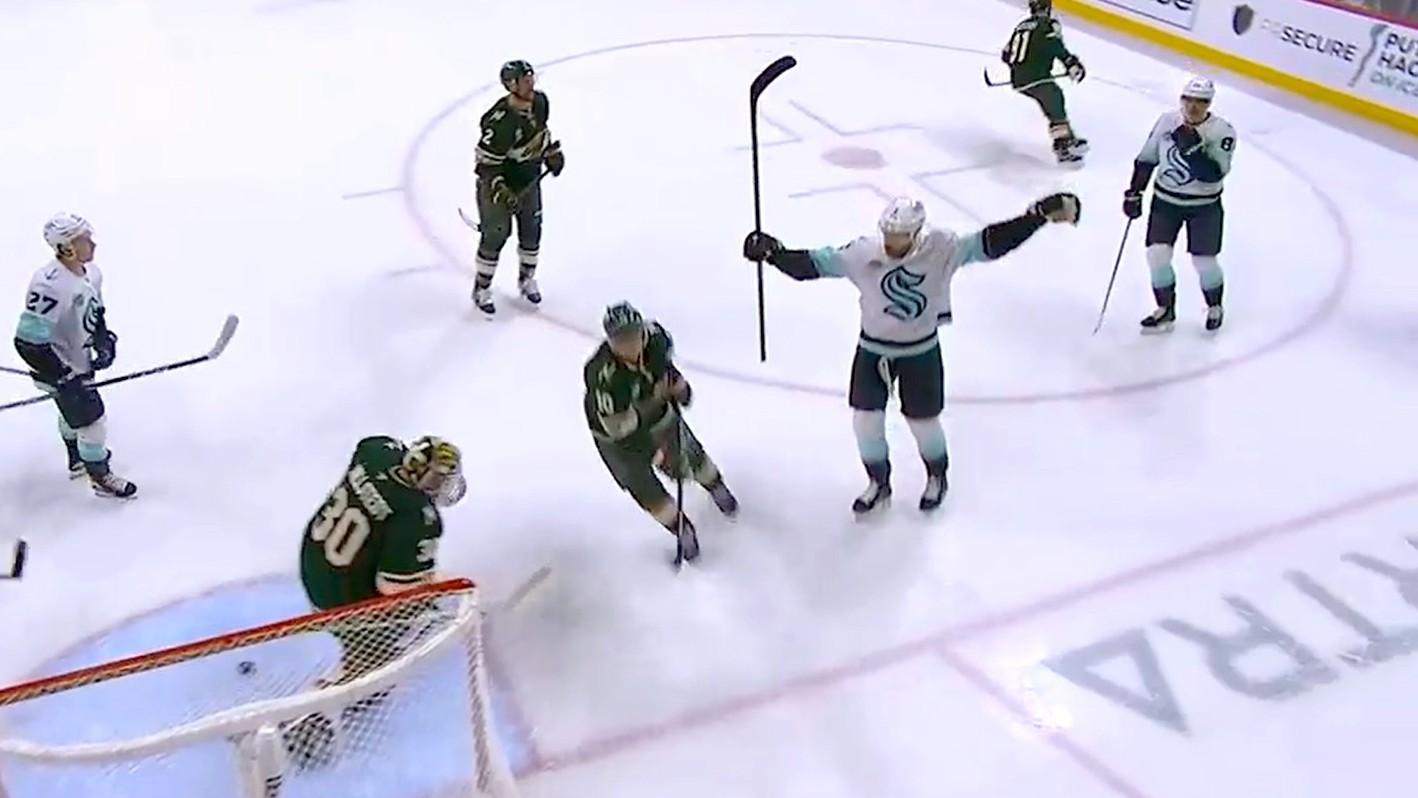
The Seattle Kraken are about to pay a high price for failed bets that they could stay relevant in the Western Conference. They are bets I first warned them against making more than two years ago.
In March, 2024, the Kraken suffered an embarrassing 6-2 home loss to the then-woeful Buffalo Sabres. On a podcast that night, I suggested Seattle should consider trading Jared McCann. Not because he was playing poorly – because he was playing great.
Fans had grown attached to their new heroes and intoxicated by playoff hockey, making such trades potentially unpopular. But hard choices built on long-term vision are what front offices get paid for.
Yes, McCann was compiling a 29-goal season; the previous year, he’d led the Kraken into the postseason by scoring a career-high 40. That made his stock high. But there’d be no playoff repeat in 2023-24. By the time Seattle contended again, drafted youngsters would be pushing veterans like McCann for playing time. The Kraken needed more of that, not likely-to-decline vets.
The next season, I offered broader unsolicited advice to then-general manager Ron Francis. The impetus was a 2024-25 Kraken season heading down the same non-playoff drain. “The fix, painful as it sounds,” I wrote in January, 2025, “can be found in the words of 1960s activist Jack Weinberg: ‘Don’t Trust Anyone Over 30.’ Unfortunately, this veteran core has proven – both last season and this one – unable to get the Kraken where they want to be.”
At the 2025 deadline, the Kraken did stockpile picks in exchange for 33-year-old forwards Brandon Tanev and Yanni Gourde, and Oliver Bjorkstrand, weeks from his 30th birthday. But the previous summer, they’d signed Chandler Stephenson and Brandon Montour, both 30, to seven-year free agent deals.
Kraken Decisions Didn’t Age Well
Of course, it’s not just about biological age; it’s more about the players tied to those birthdays. After all, two of the three NHL teams with an average age north of 30 are the Colorado Avalanche (30.3 years) and the Minnesota Wild (30.0 years). Both are capable of long playoff runs. The Kraken, according to Elite Prospects, are actually the 13th youngest club on average (27.8 years). Still, four Kraken veterans were set to be unrestricted free agents at the end of this season.
In the vain hope of maintaining playoff position, the Kraken stuck with captain Jordan Eberle (35), forwards Jaden Schwartz (33) and Eeli Tolvanen (26), and defenseman Jamie Oleksiak (33). Eberle was even rewarded with a new two-year deal.
Instead of fetching prospects or draft capital, each of the other three could walk without any return to the Kraken.
It was the hockey equivalent of deciding to hit on 18 in blackjack. The Kraken busted, winning just 3 of 16 games (3-11-2) after the Mar. 6 trade deadline. Most maddening, the Kraken haven’t made hay, going just 2-5-0 in that span, against teams that are out of the playoffs as of today.
Decisions Driven By Sonics & Empty Seats
As Simmer has astutely pointed out, we don’t know at what level these roll-the-dice decisions were made. It could have been GM Jason Botterill, promoted last summer. It could have been director of hockey operations Francis, kicked upstairs last summer to make room for Botterill. Or it could have been a decision made by the ownership group, led by Samantha Holloway and CEO Tod Leiweke.
We can speculate why. Home games have been greeted by swaths of empty seats at Climate Pledge Arena. Lagging demand convinced the club last summer to lower ticket prices, increase incentives for season-ticket holders, and offer other fan-friendly options.
Another spectre hanging over the franchise is the expected return of an expansion NBA franchise. If NBA governors vote later this year to create SuperSonics 2.0, this would necessarily divert the attention of the region’s sports fans. Such diversion would only be partially mitigated by the fact that Kraken ownership is widely expected to own the expansion Sonics as well.
Time For Kraken To Go Long
If these have been factors in prioritizing short-term gains, they shouldn’t. The best – really, the only – way to maintain the Kraken at front of mind among Seattle sports fans is for them to be a perennial contender.
This isn’t unique to the Pacific Northwest. That’s what the Florida Panthers had to do. That’s what the Dallas Stars and L.A. Kings had to do. That’s what the Arizona Coyotes were never able to do – which is why they now play in Salt Lake City. Sustainable contention is the only winning formula for NHL teams in most U.S. cities with a crowded sports marketplace.
What Seattle Kraken fans want isn’t a get-in-by-their-fingernails playoff berth followed by an inevitable quick exit. They want hope in a future, in a communicated vision, they can trust. That organizational mandate must be implemented from the very top.
Last summer, after the firing of coach Dan Bylsma and the shuffling of Botterill and Francis into their new roles, I asked Leiweke if it was fair to hold ownership accountable. To his credit, Leiweke answered, “It is fair.”
It still is.
Earlier Kraken:
— Wild Beat Kraken 5-1; Differences Glaring
Earlier Canucks:
— Canucks Simmer’s 9; Easter Monday Madness