
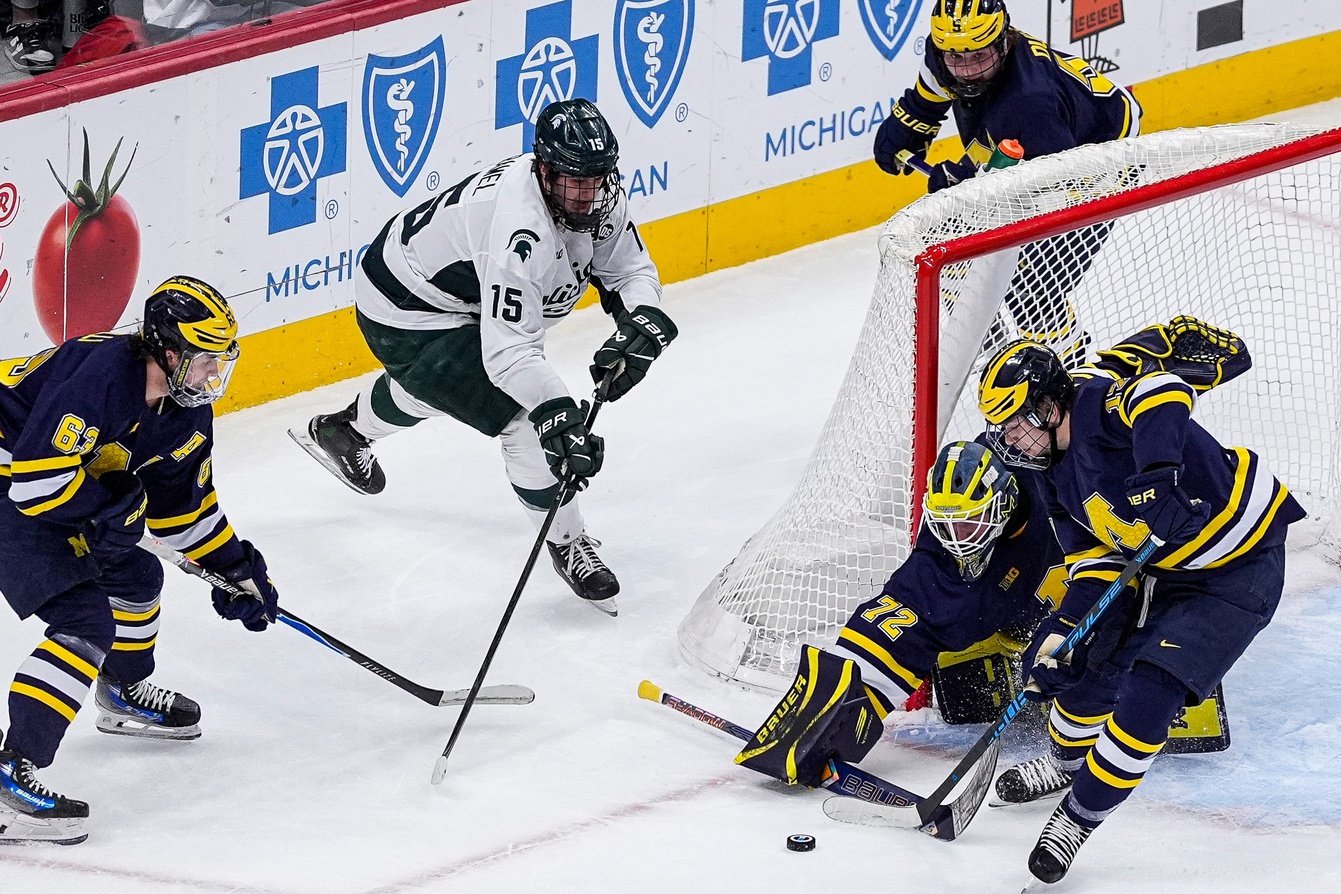
On Monday night, the Minnesota Wild signed 2023 first-round pick Charlie Stramel to an entry-level contract. Wild fans have already had to be patient with the big centerman. His sputtering start at Wisconsin required him to spend four years in college. But before breaking his ankle in the NCAA tournament, Stramel’s play at Michigan State put him in the conversation to take part in the Wild’s playoff run.
Stramel’s injury introduced some realism to that projection. The Wild are very cautious about throwing players straight from college into the NHL playoffs. Stramel has an NHL-ready body, but players like Nick Foligno boast the experience a coach like John Hynes will want to rely on.
Fans may want to get used to taking things slow with Stramel. There’s a chance Stramel impresses in training camp next year and immediately earns a spot in the Wild’s top-nine. Stramel could also spend a year in the AHL developing in a top role, only to get little more than a short stint in Minnesota. It’s important to be ready for both outcomes.
Well, those, and a third: That Stramel starts his NHL career slow. Like, really slow. Maybe to the tune of scoring 24 goals in his first 210 games.
After all, that’s what happened to Joel Eriksson Ek. Looking at their narratives coming out of the draft, the two centers have a lot in common. Both picks garnered immediate criticism stemming from drafting a two-way center over a skilled winger. In Eriksson Ek’s case, it was Brock Boeser; with Stramel, it was Gabriel Perreault.
At the end of the 2019-20 season — their age-22 seasons — Boeser was way ahead of Eriksson Ek. Boeser’s 75 goals in 197 games more than tripled Eriksson Ek’s output, and the Vancouver Canucks winger already had an All-Star appearance. Meanwhile, Eriksson Ek was looking like a fine third-line center, but with no offensive upside.
However, that began to change in the 2021 season, when Eriksson Ek embraced his net-front potential. Since then, the offensive gap between the two has closed dramatically. In this decade, Eriksson Ek is averaging 26.5 goals and 57.3 points per 82 games, while Boeser’s 82-game paces are 29.1 and 61.0, respectively. Throw in Eriksson Ek’s defensive value and playing a premium position, and you’d find few teams that would prefer Boeser over Eriksson Ek today.
Perreault has just 10 goals and 25 points in 50 career games with the New York Rangers, so he’s not overshadowing Stramel in the same way Boeser once did with Eriksson Ek. But it’s easy to see the same dynamic play out between these two young forwards. Perreault has played most of his minutes with Mika Zibanejad and Alexis Lafreniere on the rebuilding Rangers, and projects as a future power-play fixture. Stramel will likely be stuck behind Eriksson Ek and Danila Yurov on the depth chart, playing in a third-line role with few opportunities on the man advantage.
We’re even watching Yurov go through something similar right now, and his offensive upside is much more highly-touted than Stramel’s. But Yurov’s best contributions in his rookie season have come from the defensive side of the puck, using his speed and brain to limit opponents’ chances. Sometimes that defense translates into scoring opportunities, and sometimes it doesn’t. The path forward for Yurov will be finding more ways to translate his offensive toolkit to the NHL.
Stramel probably is NHL-ready defensively. Listed at 6-foot-3, 215 pounds, Stramel doesn’t just have size, but he’s willing to use it. In combination with his mobility, he’s got all the tools to hit the ground running as a shutdown third-line center.
There’s even good reason to believe the offense will come. Watching Stramel’s goals in college reveals how good his hands are, especially around the net. We’re not talking about Matt Boldy magic, but certainly good enough to create chances.
data:image/gif;base64,R0lGODlhAQABAPABAP///wAAACH5BAEKAAAALAAAAAABAAEAAAICRAEAOw==
But there aren’t easy goals in the NHL. It’s not diminishing Stramel’s accomplishments or growth at Michigan State to say that a 6-foot-3, 215-pound, 21-year-old college senior should dominate at the NCAA level. But it does give a bit of a reality check. A lot of the defensemen he’ll face in the NHL will be about his size. There will certainly be more forwards who can match up with him physically than there were in college.
Every player must make an adjustment. Eriksson Ek had to make it. Marco Rossi had to make it. Yurov is having to make it right now. In each case, these talented, first-round centers had to take time to make it. It’s exciting to have Stramel in the fold, but it’s important not to give up on him if things come slow. Patience has paid off with Stramel before, and we may have to wait once again to see the things Minnesota saw in him when they drafted him in the first round three years ago.
Think you could write a story like this? Hockey Wilderness wants you to develop your voice, find an audience, and we’ll pay you to do it. Just fill out this form.