
NEWARK, N.J. — When Jack Hughes and the New Jersey Devils practice, they aren’t the only ones preparing for an NHL game there.
The Prudential Center’s practice rink is now a training facility for new league ideas and technologies, as part of the newly opened NHL Innovation Lab powered by Verizon.
There is a dedicated working office space that houses Verizon servers and a 12-foot high-resolution LED display that was designed by KSS Architects and built by the Phelps Construction Group. But much of the work will take place on the practice ice and game rink, connected via Verizon’s private 5G network.
“We’re really able to go and stretch the art of the possible, both in the coverage of our game but also how we officiate it,” said Grant Nodine, NHL SVP of technology. “And then we can make sure that we are really dialed in on how we’re going to operationally support these new technologies in the field.”
SBJ first shared news of the Innovation Lab a year ago, and last week marked its grand opening, with partners and execs, including Sean Williams, NHL VP of innovation-technology partnerships; Evin Dobson, NHL SVP of U.S, partnership marketing; Brian Gorney, senior director of U.S. pro sports, Verizon Business Group; Sasha Puric, HBSE CTO; as well as media — SBJ included — invited for an open house, arena tour and champagne toast.
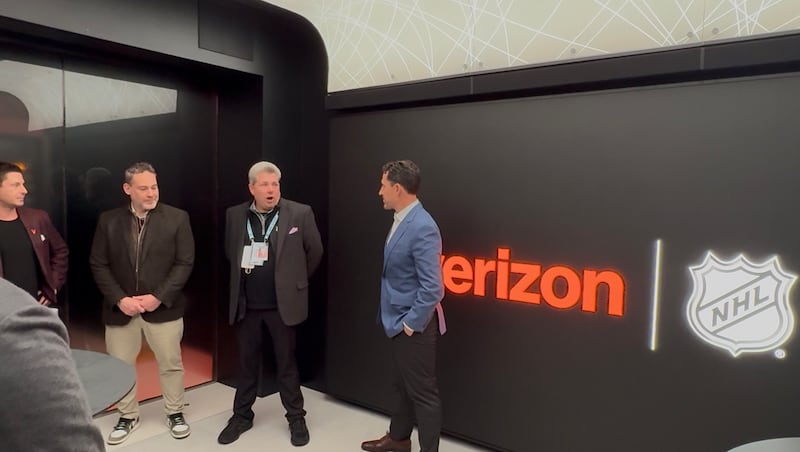 (l-r) Verizon’s Jake Kornblatt and the NHL’s John Frantzeskakis, Grant Nodine and Sean Williams discuss the vision for the Innovation Lab. Joe Lemire
Nodine described the Innovation Lab as a “prototype environment” designed to accelerate progress and iterations of new ideas that are otherwise hard to test.
In addition to the backend networking, opening the Innovation Lab included the installation of a Sony Hawk-Eye tracking system in the practice rink to creative a test environment for data collection.
John Frantzeskakis, NHL SVP of arena/game technology and operations, walked SBJ through a few R&D ideas being tested:
High sticking: Hockey players cannot raise their sticks above shoulder height to deflect the puck to a teammate. This is an area identified by NHL Commissioner Gary Bettman where Hawk-Eye cameras might be able to help automate the decision.
“Our goal is to bring high stick detection by the start of next season,” Frantzeskakis said. “That is an ambitious goal that we’re trying to get to.”
Timing and lighting: While officials now wear Apple Watches synced with the game clock and other notifications, players and coaches don’t have access to ice-level time reminders. The practice rink includes two configurations of the clock being built into the boards at either end, plus the possibility of LED lights signaling certain colors for end of period, coach’s challenge and more.
“You can imagine now, the game’s about to end, I’m down 2-1, and all of a sudden I don’t know how much time I have left — I have to look up,” Frantzeskakis said. “We don’t want that, right? We want to have a visual right in the corners.”
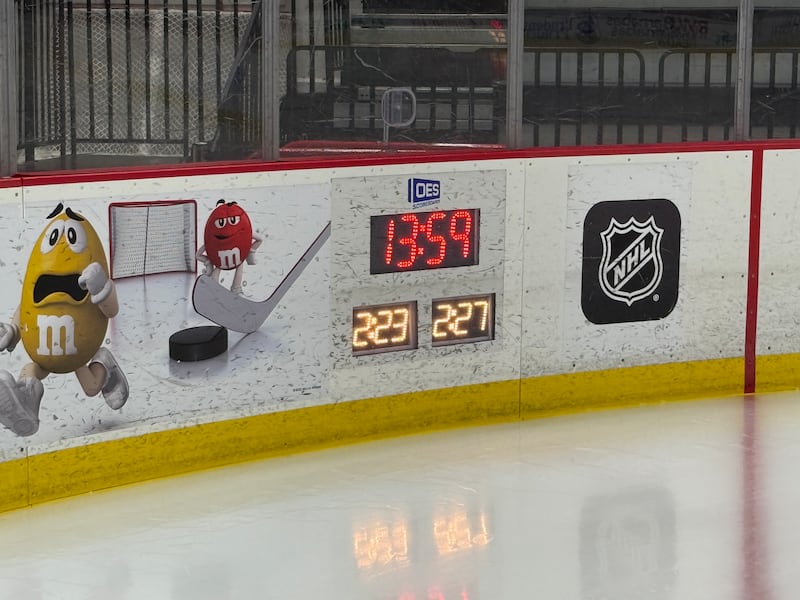 The NHL is testing clock placement in the boards at the Devils’ practice rink. Joe Lemire
Communications: The NHL is exploring ways for referees to communicate with the Situation Room in Toronto or even with each other across the ice through mics and earpieces. An exact implementation isn’t settled.
“We don’t know,” he said. “Our focus right now is, can we get the tech to work that way if we needed to?”
Tracking data integrations: The Edmonton Oilers last year asked to pair the NHL Edge tracking data with their lighting system so, for example, the spotlight can automatically follow a player who just scored a goal. That’s just one possible integration that the lab can test.
Immersive highlights: With Cosm’s C360 cameras in every arena providing 10.5K resolution, the NHL is looking into ways of using that content for personalized fan experiences.
As for why the Prudential Center was chosen, it is a modern building in close proximity to the NHL office in NYC and is one of only four arenas with the practice rink attached. The same networking infrastructure can power use cases early in the process on the practice rink and later in the testing protocols on the game ice.
“If you think about applications that require high reliability, low latency, maximum security, the network’s able to complete all those functions all the way throughout,” said Jake Kornblatt, Verizon Business Group VP.