
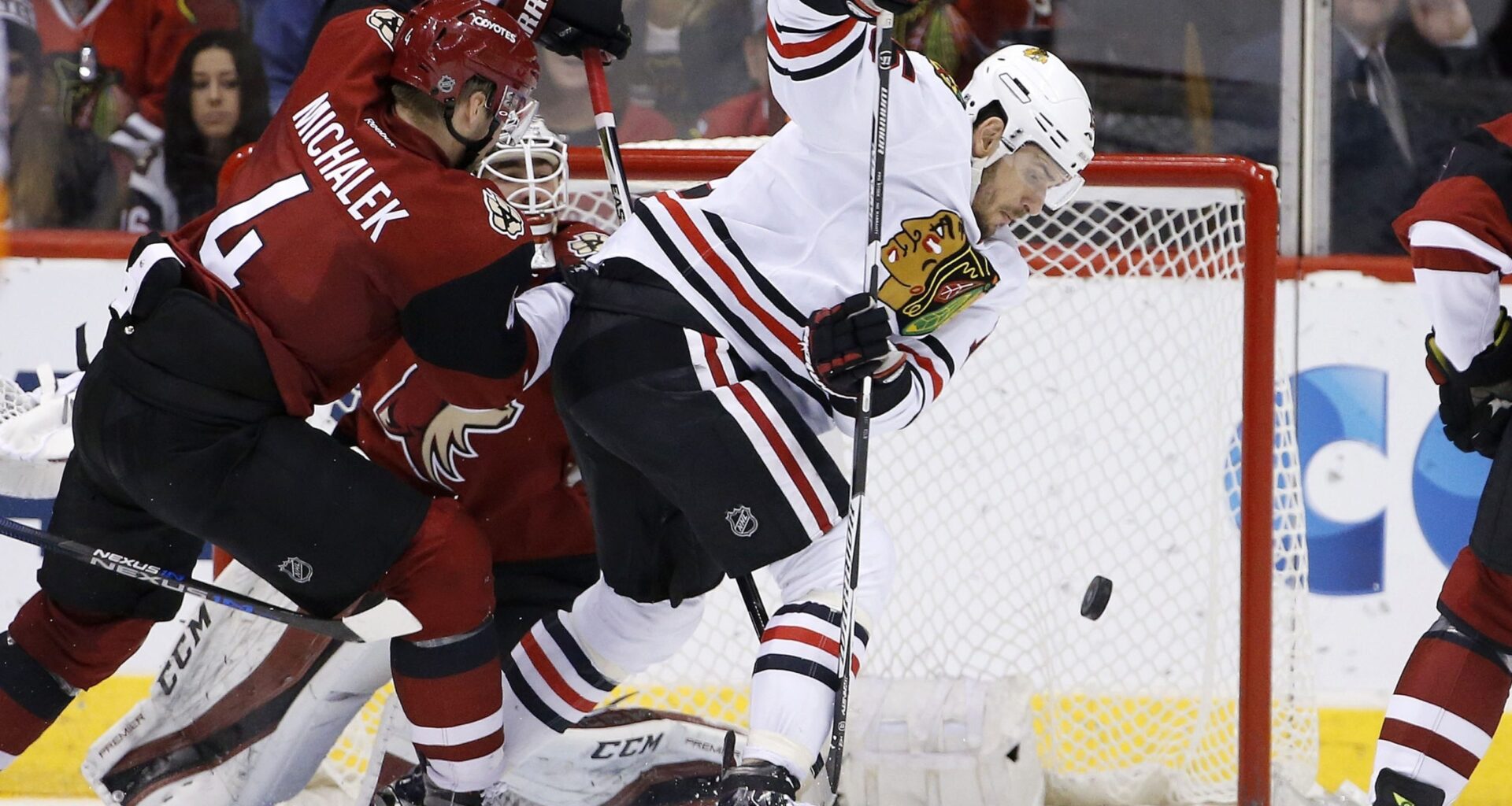
PHOENIX – Former NHL defenseman Zbyněk Michálek has an easy solution for ordering coffee. At Starbucks, he doesn’t use his real name. He just says “Mike.”
It’s quicker, avoids confusion and, until recently, it went unnoticed. That was before his daughter Lexi, 8, stepped in.
“She looks at me and says, ‘Your name is not Mike,’” Michálek said. “Everybody just started laughing.”
In a sport as international as hockey, players bring names rooted in Czech, Finnish, Swedish, French, German and countless other languages. But in North America, those names rarely appear in their full, authentic form. Diacritics, the accents and marks that guide pronunciation, indicate stress, or distinguish word meanings, are typically left off jerseys, media guides and broadcasts, reflecting long-standing conventions in the NHL.
While this has been the norm for decades, it is beginning to change. More names are now appearing with their original markings, signaling a gradual shift toward preserving the authenticity of players’ identities.
One of the earliest exceptions came with then-Montreal Canadien center (now Philadelphia Flyers general manager) Daniel Brière, who was among the first NHL players to have an accent included on their jersey when the Canadiens added an accent grave over the first e in his last name.
“I thought it would be cool to have it written the way my last name was meant to be but it wasn’t something I was adamant about having,” Brière said. “I usually am pretty laid back with those things. I appreciated the gesture, but to me it doesn’t change who I am as a person or player that fans cheer for.”
That same attention to names carries over behind the scenes, where equipment staff work to make sure everything is correct before a jersey ever hits the ice.
Jon Laughner, a former equipment manager for Arizona State and former assistant equipment manager for the San Jose Sharks, experienced much of that work up close.
“Getting the jersey names and numbers and taking care of those all the time,” Laughner said. “That was a huge portion of my job at both ASU and with the Sharks.”
Even with that focus, mistakes can happen.
“Every single jersey had the name spelled differently because accents were going in the wrong directions,” Laughner said of his time at ASU. “There were jerseys that didn’t have accents on them. You certainly have to proofread it when they come in.
“Just because it’s something that we don’t normally use in English doesn’t mean we shouldn’t force people to spell their name differently for us.”
The NHL has slowly moved toward preserving more of those original spellings. Players such as Ottawa Senators center Tim Stützle, New York Rangers winger Alexis Lafrenière and Vancouver Canucks winger Nils Höglander all have their names spelled correctly with accents and marks.
Most players, however, let it slide. With some names being difficult, they don’t expect others to pronounce them correctly and often don’t bother correcting people. That’s the case for former Arizona Coyote and longtime NHL player Mikkel Bødker.
“I let it go unless it’s completely wrong,” Bødker said. “If people ask, I say it the right way. In Denmark we have three letters that aren’t in the English letter system Æ – Ø – Å,” Bødker said. “In English the Æ equals AE – Ø equals OE and Å equals AA.”
Still, Bødker emphasized the importance of respecting names. It can differ from person to person, but a name is not something that can be changed.
“Your name is given to you by your parents and your family name is on the jersey so it’s important to respect that and also to become a known name,” he said. “It will be said on air many times and in many different situations so I do think the media has a responsibility to get it right.”
For others like Chicago Wolves defenseman Juuso Välimäki, pronunciation and spelling are simply part of the experience, something that, once he got used to it, does not affect him anymore.
“I don’t really care,” Välimäki said. “A lot of times in my life and in my career, I’ve been told that I’m almost too, too nice, rather than the opposite, but I’ve just been called ‘Juice’ a lot here. It’s kind of easier with nicknames.”
While diacritics may still be uncommon on NHL jerseys, their growing presence reflects a broader shift toward respecting players’ identities. For many, it’s a small detail that carries a larger meaning, recognizing where a player comes from and honoring the name they were given.
The game continues to become more global, and with that growth comes a greater push to get names right, whether that’s through proper spelling, accurate pronunciation or simply making an effort. While some players choose to let mistakes slide, others see it as a reminder that their names and their stories matter.
In a sport built on tradition, that balance between familiarity and authenticity is still evolving. But for players such as Michálek, Brière, Bødker and Välimäki, one thing is clear: their names are more than just letters on a jersey, they’re part of who they are.
“Obviously there are much, much bigger things in life than being called the right name at a given time,” Bødker said, “But at the same time it’s very important because — have you seen the movie “Molly’s Game?” She has an argument at one point with her lawyer over something and she says, ‘Because it’s my name.’ It’s the same for athletes.”
This <a target=”_blank” href=”https://cronkitenews.azpbs.org/2026/04/10/diacritics-nhl-players/”>article</a> first appeared on <a target=”_blank” href=”https://cronkitenews.azpbs.org”>Cronkite News</a> and is republished here under a <a target=”_blank” href=”https://creativecommons.org/licenses/by-nd/4.0/”>Creative Commons Attribution-NoDerivatives 4.0 International License</a>.<img src=”https://i0.wp.com/cronkitenews.azpbs.org/wp-content/uploads/2026/02/favicon1.png?resize=85%2C85&ssl=1″ style=”width:1em;height:1em;margin-left:10px;”>
<img id=”republication-tracker-tool-source” src=”https://cronkitenews.azpbs.org/?republication-pixel=true&post=102064″ style=”width:1px;height:1px;”><script> PARSELY = { autotrack: false, onload: function() { PARSELY.beacon.trackPageView({ url: “https://cronkitenews.azpbs.org/2026/04/10/diacritics-nhl-players/”, urlref: window.location.href }); } } </script> <script id=”parsely-cfg” src=”//cdn.parsely.com/keys/cronkitenews.azpbs.org/p.js”></script>
Canonical Tag:
Copy Tag
Article Content:
What’s in a name? Growing use of diacritics a sign of respect for NHL players
Cooper Krigbaum, Cronkite News
April 10, 2026
PHOENIX – Former NHL defenseman Zbyněk Michálek has an easy solution for ordering coffee. At Starbucks, he doesn’t use his real name. He just says “Mike.”
It’s quicker, avoids confusion and, until recently, it went unnoticed. That was before his daughter Lexi, 8, stepped in.
“She looks at me and says, ‘Your name is not Mike,’” Michálek said. “Everybody just started laughing.”
In a sport as international as hockey, players bring names rooted in Czech, Finnish, Swedish, French, German and countless other languages. But in North America, those names rarely appear in their full, authentic form. Diacritics, the accents and marks that guide pronunciation, indicate stress, or distinguish word meanings, are typically left off jerseys, media guides and broadcasts, reflecting long-standing conventions in the NHL.
While this has been the norm for decades, it is beginning to change. More names are now appearing with their original markings, signaling a gradual shift toward preserving the authenticity of players’ identities.
One of the earliest exceptions came with then-Montreal Canadien center (now Philadelphia Flyers general manager) Daniel Brière, who was among the first NHL players to have an accent included on their jersey when the Canadiens added an accent grave over the first e in his last name.
“I thought it would be cool to have it written the way my last name was meant to be but it wasn’t something I was adamant about having,” Brière said. “I usually am pretty laid back with those things. I appreciated the gesture, but to me it doesn’t change who I am as a person or player that fans cheer for.”
That same attention to names carries over behind the scenes, where equipment staff work to make sure everything is correct before a jersey ever hits the ice.
Jon Laughner, a former equipment manager for Arizona State and former assistant equipment manager for the San Jose Sharks, experienced much of that work up close.
“Getting the jersey names and numbers and taking care of those all the time,” Laughner said. “That was a huge portion of my job at both ASU and with the Sharks.”
Even with that focus, mistakes can happen.
“Every single jersey had the name spelled differently because accents were going in the wrong directions,” Laughner said of his time at ASU. “There were jerseys that didn’t have accents on them. You certainly have to proofread it when they come in.
“Just because it’s something that we don’t normally use in English doesn’t mean we shouldn’t force people to spell their name differently for us.”
The NHL has slowly moved toward preserving more of those original spellings. Players such as Ottawa Senators center Tim Stützle, New York Rangers winger Alexis Lafrenière and Vancouver Canucks winger Nils Höglander all have their names spelled correctly with accents and marks.
Most players, however, let it slide. With some names being difficult, they don’t expect others to pronounce them correctly and often don’t bother correcting people. That’s the case for former Arizona Coyote and longtime NHL player Mikkel Bødker.
“I let it go unless it’s completely wrong,” Bødker said. “If people ask, I say it the right way. In Denmark we have three letters that aren’t in the English letter system Æ – Ø – Å,” Bødker said. “In English the Æ equals AE – Ø equals OE and Å equals AA.”
Still, Bødker emphasized the importance of respecting names. It can differ from person to person, but a name is not something that can be changed.
“Your name is given to you by your parents and your family name is on the jersey so it’s important to respect that and also to become a known name,” he said. “It will be said on air many times and in many different situations so I do think the media has a responsibility to get it right.”
For others like Chicago Wolves defenseman Juuso Välimäki, pronunciation and spelling are simply part of the experience, something that, once he got used to it, does not affect him anymore.
“I don’t really care,” Välimäki said. “A lot of times in my life and in my career, I’ve been told that I’m almost too, too nice, rather than the opposite, but I’ve just been called ‘Juice’ a lot here. It’s kind of easier with nicknames.”
While diacritics may still be uncommon on NHL jerseys, their growing presence reflects a broader shift toward respecting players’ identities. For many, it’s a small detail that carries a larger meaning, recognizing where a player comes from and honoring the name they were given.
The game continues to become more global, and with that growth comes a greater push to get names right, whether that’s through proper spelling, accurate pronunciation or simply making an effort. While some players choose to let mistakes slide, others see it as a reminder that their names and their stories matter.
In a sport built on tradition, that balance between familiarity and authenticity is still evolving. But for players such as Michálek, Brière, Bødker and Välimäki, one thing is clear: their names are more than just letters on a jersey, they’re part of who they are.
“Obviously there are much, much bigger things in life than being called the right name at a given time,” Bødker said, “But at the same time it’s very important because — have you seen the movie “Molly’s Game?” She has an argument at one point with her lawyer over something and she says, ‘Because it’s my name.’ It’s the same for athletes.”
This article first appeared on Cronkite News and is republished here under a Creative Commons Attribution-NoDerivatives 4.0 International License.
Copy Content
Tracking snippet:
Copy Snippet