
Hockey is one of the most popular sports in the world, in part because of its distinctive sounds: sharp skates digging into the ice, big hits into the boards, goal horns blaring and fan reaction at lofty decibels.
For the deaf community, though, there’s no way to experience those adrenaline rushes other than through the images of the game. Signed interpretations of the announcers and closed captions can only convey so much.
Brice Christianson is trying to change that.
“I grew up in a very strong deaf community that were huge sports fans,” Christianson says. “It’s a huge pillar in the community, but there was never anything like, ‘Hey, we want more accessibility.’”
A child of deaf adults (CODA), Christianson is CEO of P-X-P, a company he founded in 2022 that advocates for access, inclusion and representation for the deaf community in sports.
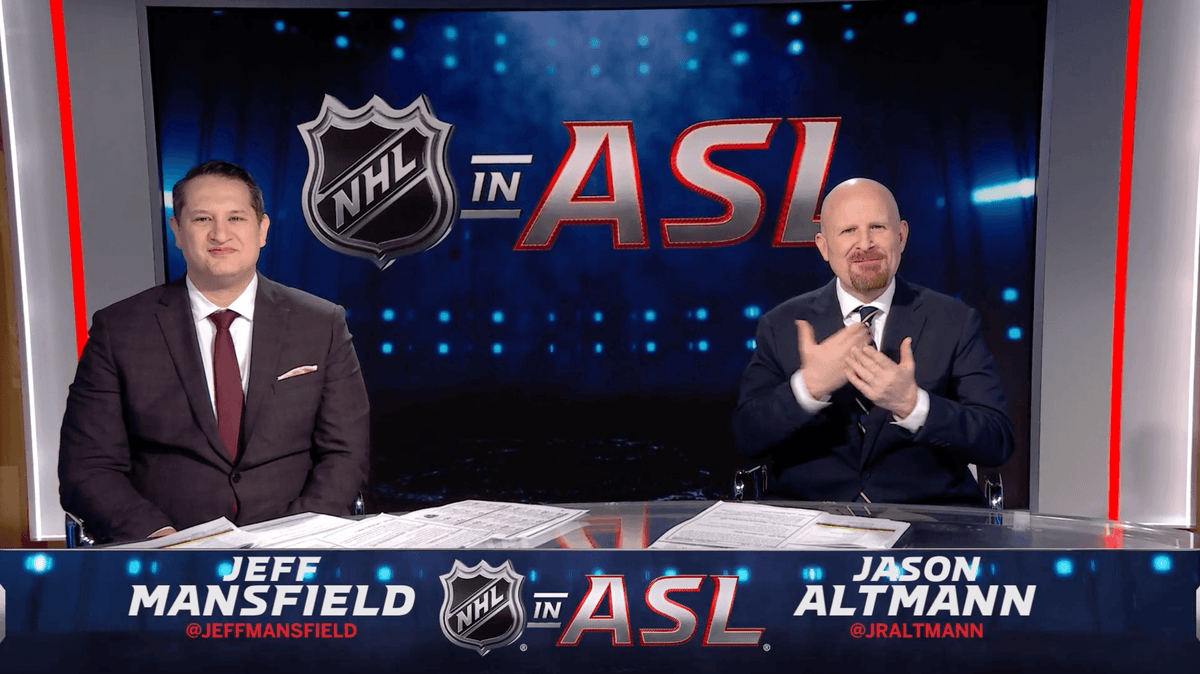
P-X-P has been working with the NHL, among other clients, to this end. What began with interpreting the national anthem in American Sign Language for games led to a partnership with the league called “NHL in ASL,” which produces alt TV broadcasts. In the last three years, it has streamed 18 showcase events, including the Stanley Cup Final, Winter Classic and Stadium Series.
On Tuesday, NHL in ASL will be breaking new ground with its first broadcast delivered to the deaf community at the local level: a matchup between the St. Louis Blues and Pittsburgh Penguins.
The game was chosen because St. Louis is hosting ASL Awareness Night, a result of the widespread success the Blues had last season with forward Jake Neighbours designing ASL-themed hats.
The Blues’ marketing department mentioned the theme night at a league business meeting last summer, which triggered the idea of assigning NHL in ASL to the game. The 7 p.m. Central puck drop will stream on the ESPN App for ESPN Unlimited subscribers, with P-X-P’s Jason Altmann and Jeff Mansfield, who are deaf, providing real-time play-by-play and color commentary in ASL.
“This is a really exciting evolution of this platform,” says Rachel Segal, a producer for NHL in ASL. “We thought long and hard about what we see the next step being so that we can reach more of an audience on the local level. We see this as our expansion and growth opportunity.”
There are approximately 33 million deaf and hard-of-hearing individuals in the U.S. and 4 million to 5 million in North America. ASL is used in both the U.S. and Canada, which is also where the majority of NHL fans reside.
So when Segal took a position with the NHL’s social impact department, the TV producer in her took note of the league’s relationship with P-X-P. She sent Matt Celli with NHL Productions a message asking, “What do you think of doing a broadcast for the deaf community?” Celli responded, “Let’s do it!” — and NHL in ASL was born.
“What excited us the most was being trailblazers in this space because there was no other broadcast in major sports where the talent is deaf and interpreting the game as they see it in their native language of ASL versus an interpretation of existing game calls,” Segal says. “So that was really exciting, but there was no blueprint of how to do it to make sure our audience felt like they were part of the game.”
The NHL and P-X-P had the production tools, but to produce a broadcast for the deaf community, they had to redefine the logistical process on the operational end. To make it authentic, it also needed talent. It had ideas for on-screen visuals, but had to choose the right ones.
The NHL brought Christianson into the mix to ensure it was being true to the community.
The 42-year-old thought back to his childhood, when there were no interpreters for his parent-teacher conferences, so he did it on his own. He always felt like the odd man out, navigating between a hearing world, a deaf world and a CODA world. He understood how much being unified would mean.
“One thing with the deaf community, if you build it, they will come,” Christianson says. “There’s just a curiosity of their language, their identity, their culture being represented by people that are from their community.”
P-X-P brought in Altmann and Mansfield, despite neither having TV experience. They needed training and have received it from top announcers on the NHL’s other networks, including TNT’s Kenny Albert.
“Kenny has educated Jason and Jeff on how to prep and how to rehearse and what to extract and what to elevate,” Christianson says.
The NHL in ASL’s first broadcast was Game 1 of the 2024 Stanley Cup Final between the Florida Panthers and Edmonton Oilers, and it did the entire seven-game series.
“To kick it off during the Final was really pressurizing, especially because our talent had never been on camera before,” Segal says. “We threw them on-air for our biggest games of the year, but they really rose to the occasion. We started off with a bang, that’s for sure.”
The broadcast was well-received, but if the NHL in ASL were to become a sustainable success, every element had to be evaluated.
“I knew the buy-in for the first Stanley Cup Final would be positive and impactful,” Christianson says. “The challenge is to continue getting that buy-in from the deaf community. At the end of the day, deaf fans are visual, so how do we elevate and enhance the game?”
Along the way, the NHL in ASL has adjusted the size of the boxes of the game and the commentators to make them more visible. It’s added other on-screen information, including a noise meter, time on ice and penalties.
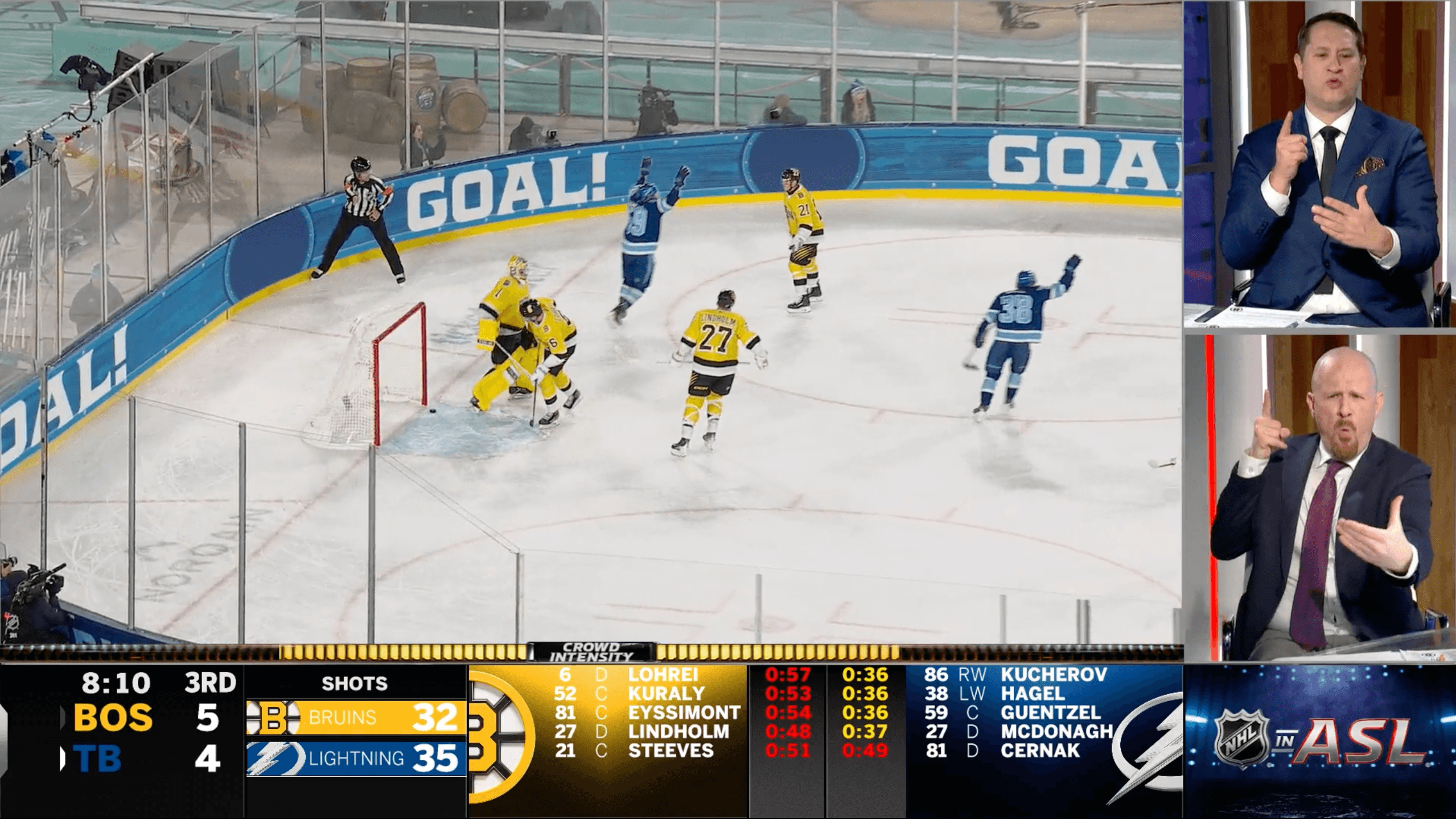
“We’ve done a lot of iterations, being more mindful of how much action is going on,” Christianson says. “We’ve continued to be innovative and allow the production to evolve. The current edition of the overlay is awesome.
“It’s a legitimate broadcast now.”
The crew also does video highlights, with Altmann using ASL to provide commentary and a “crowd intensity” bar in the picture.
In the last two years, the NHL in ASL has been nominated for three Emmys in the category of “Outstanding Interactive Experience: Sports,” including two this year. It wouldn’t be possible without today’s technology and the many outlet options.
“Where there was a barrier in regular broadcast cable television, streaming has allowed it to open up all these different avenues,” Christianson says. “The more buy-in we get, the more exposure, the more value we provide, the more it grows.
“The one thing that really means a lot to me is the people at the NHL that have had no exposure to ASL or the deaf community life, like I have, leaning in. They have consistently trusted our process and our vision.”
Another person leaning in is Neighbours.
His connection to the deaf community came from growing up in Calgary with the Wiesblatt family, whose mother, Kim, is deaf. He was friends with her children — including Ozzy, who now plays for the Nashville Predators — and took it upon himself to learn sign language so he could communicate with someone who became like a second mom.
Last season, in conjunction with the Blues, Neighbours helped produce a collection of ASL hats, which sold out both at the team store and online.
“How big it blew up was definitely a surprise and a great one at that,” he says. “Once that happened, it just reiterated to me how important this is and how much attention it hasn’t gotten.”
Neighbours was immediately on board to assist with this season’s ASL Awareness Night. He’s been promoting the event with a series of videos, which the Blues are posting on social media. He signed the entire message in ASL. He’s not fully fluent, so he called Ozzy Wiesblatt the night before the recording to do a little brushing up.
“I do a lot of (signs) through spelling,” Neighbours says. “I saw some people saying in the comments (under the video) that there’s a sign for ‘St. Louis’ and a sign for ‘Blues’ as well. I haven’t learned all that stuff yet, so I’m still spelling everything.”
The Wiesblatts were excited watching the video, which Neighbours calls the coolest part of his participation.
“They definitely feel the love,” he says.
Jake has a very special announcement to make…
🔗: https://t.co/EO8Et7oqXH pic.twitter.com/HPR5hQZr3n
— St. Louis Blues (@StLouisBlues) March 26, 2026
They weren’t the only ones. Neighbours received several messages of support from the deaf community.
“They feel like they’re involved,” he says. “They feel like they can go to a hockey game now, and a lot of the teams put the subtitles (throughout) the arena, so you can hear what the announcer is saying. Who scored the goal, that kind of stuff. I think hockey, specifically, is taking a big step in terms of making the deaf community more welcome at games and in our world. I truly do think it’s making a difference.”
Chris Zimmerman, CEO of the Blues’ business department, believes the best initiatives in sports are built organically, like Neighbours and ASL.
“Jake’s story is really classic and, quite honestly, I don’t know that we’re having this conversation (about ASL Awareness Night) without it,” Zimmerman says. “It’s an example of one young man, one athlete, having a connection. A lot of times, they grow out of personal touch and the recognition that, ‘Hey, maybe we can find a way to have an impact here.’
“I would say the interest (in the hats) was something that we didn’t expect, didn’t plan for. But in the case of Jake, that’s what’s been so powerful — both the organic and the authentic nature of connecting with this (deaf) community.”
Christianson doesn’t know Neighbours personally, but he’s thankful for his efforts.
“To see Jake want to learn sign language so he can communicate with his best friend’s mom, it’s touching,” Christianson says. “When you connect with the deaf community, that’s what they’re looking for. They have an apprehensive feel sometimes, where they’re like, ‘Are you exploiting us? Is this performative?’
“So it’s exciting to see players that don’t have deaf parents that are allies, and we need more allies that are hearing. The ripple effect is profound in the deaf community. It’s been an arduous process in sports, but the reaction has been overwhelmingly positive.”
The first NHL in ASL game at the local level will be another step in that direction.
Segal hopes it will be one of many, so that one day Kim Wiesblatt may be able to watch her son, Ozzy, play a game for the Predators that’s aired with ASL play-by-play and commentary.
“That’s the goal — all of that is the goal,” Segal says. “We are using the St. Louis alt cast as a template moving forward to show clubs, ‘Hey, you can also do this. You can collaborate with us on it.’ We’re really excited for the doors that this particular broadcast will open for us.”
That workload, though, will require more staff.
“This little crew can only do so many games, so we need some more talent in the mix, more producers in the mix,” Segal says. “That’s why hearing the feedback from deaf children is so incredible because they can now see themselves on TV and see themselves as sports broadcasters, when that was never a possibility before.
“So, the key here is not only are we doing good by serving an underserved community and one that has been overlooked for far too long, but we’re getting creative and being innovative in this space, and that’s going to make an impact on the future of broadcasting.”
The broadcast won’t be the only place to see the progress.
The Blues have a partnership with St. Louis-based DEAF, Inc., which has helped broaden the team’s awareness in the community. For those attending the game, there will be an anthem interpreter, as well as someone signing the goals and teaching fans to sign “Let’s Go Blues!” in ASL.
“It’s another step of delivering on the concept of ‘Hockey is for Everyone,’” Zimmerman says. “I won’t pretend that we’ve gone from zero to 60 (miles per hour). Is there more that can be done? Yep, always, without question. But we have a lot to be proud of, and certainly we’re going to learn through this first significant initiative around the hearing impaired.”
Christianson is encouraged by the commitment.
“I feel as we head into a club-themed NHL game, where it’s expanding even more, I can exhale a little bit,” he says. “It’s been an incredible journey, and if you would have told 8-year-old Brice this is what we’d be doing, I would’ve called you a liar.”