
With the Detroit Red Wings’ 2025-26 season over, another offseason is set to begin too soon.
Detroit’s playoff drought sits at 10 years, the longest in the NHL, after yet another late-season collapse. And that leaves some big decisions ahead.
There is the usual front-office business, of course — contract extensions, trade talks and all of the like — but before the Red Wings can get to any of that, there are a few big-picture questions the franchise must answer to set the framework for what its summer will entail.
These aren’t the only questions, mind you — but in some ways, they hold the key to the ones that will follow. Here’s what the Red Wings have to be pondering:
1. Is the front office remaining the same?
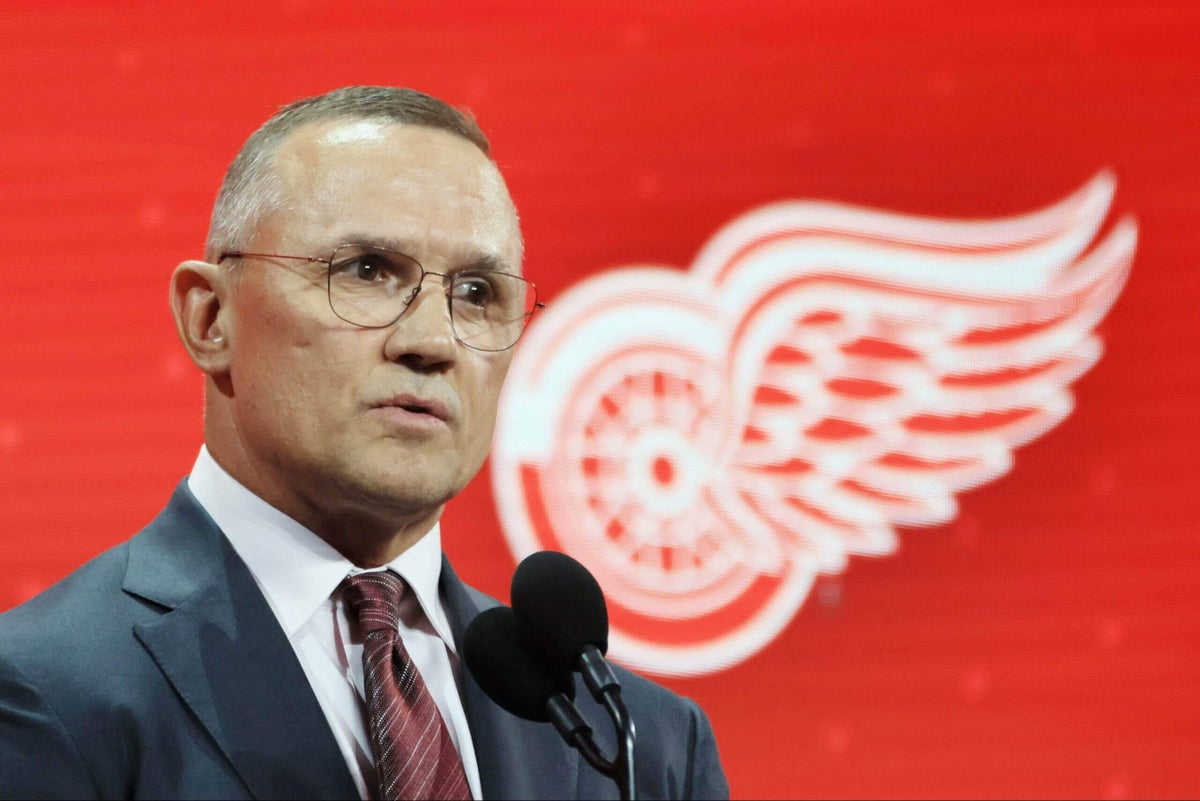
This, of course, starts with general manager Steve Yzerman, whose future has come into the public spotlight as the Red Wings’ late-season tailspin unfolded. That alone speaks to how frustrating this latest collapse was, considering Yzerman’s history and stature in the city. I would still expect Yzerman back next season, but even in that case, that doesn’t have to mean business as usual in the front office.
Could the brain trust benefit from adding some new voices? Many of the executives in player personnel roles came up together as players and have worked together through much of their post-playing careers. One wonders whether Detroit could benefit from adding some new perspectives to its decision-making group, whether it be a high-level hire with an analytics background or someone who has spent meaningful time in a decision-making role in another organization who could speak to processes and approaches.
There are aspects of the organization that appear to be working. Detroit’s AHL affiliate in Grand Rapids, managed by assistant general manager Shawn Horcoff, spent most of the year within reach of league records. Its amateur drafting, run by Kris Draper, has largely hit on its first-round picks and has started to find some success outside the first round in recent years, too — most notably with Emmitt Finnie breaking through in the NHL this season as a 2023 seventh-round pick, but also with 2026 Hobey Baker winner Max Plante (2024 second round) and Mike Richter Award winner Trey Augustine (2023 second round). Swedes Eddie Genborg (2025 second round) and Anton Johansson (2022 fourth round) have shown promise to outperform their draft slots as well.
But the Red Wings didn’t wind up in the place they are without areas for improvement, and if the existing front office indeed remains largely intact, it would be worth a thorough self-examination to identify what’s holding them back from reaching the next level. Detroit’s recent track record with NHL-level signings, specifically, comes to mind.
Does it have a well-rounded enough set of voices in the room? Are there enough people willing to disagree with, and make a case against, the top officials? These are the tougher questions the Red Wings’ front office should be asking itself.
2. Is Detroit committed to an imminent contention window?
This is the big, directional question that underpins the offseason.
Missing the playoffs yet again isn’t just frustrating because it tacks another year onto the drought. It’s also another year older for Dylan Larkin and Alex DeBrincat, Detroit’s two leading goal scorers, who are squarely in their prime — and won’t stay there forever.
Larkin will turn 30 this summer. DeBrincat will be 29 in December. They’re not old, and DeBrincat just set a career high in points, and Larkin in goals. But their peak also isn’t going to last forever, and that’s relevant with Larkin, because Detroit doesn’t have another true No. 1 center in the system.
That means Detroit’s window to maximize Larkin is now. The issue is, though some of the Red Wings’ top prospects and young players have begun arriving, most are not yet impact players at the NHL level. Simon Edvinsson looks like one. Marco Kasper showed flashes down the stretch last year, and after a sophomore slump this season, maybe he’ll take a leap next season. Finnie has demonstrated an ability to make rapid progress in his young career, too.
There are still a lot of “ifs” in that equation, and timing matters here. Detroit’s farm system is also short on real star power, making it fair to question the ultimate upside of what it has on the way.
It might be the Red Wings do not view the next four years as their true contention window. There’s a debate to be had on that topic, but if it were the case, it would change the calculus quite a bit.
The biggest issue, though, would be their long-term plan at No. 1 center — a position that is notoriously hard to fill. Think about how much Detroit has struggled when Larkin has been out in recent seasons, and how hard it has been to find even a consistent No. 2 center at times. Without drafting in the top five, it’s hard to see a clear path to finding another player like him (let alone better).
Meanwhile, Raymond and Seider are entering their own primes and are on team-friendly contracts. Does Detroit really want to risk wasting any more of these years — with its No. 1 center, a Norris Trophy-caliber defenseman, and multiple point-per-game-level wingers, all in their primes?
If not, then it might require getting bolder than it’s been to this point.
3. Does the roster philosophy need an update?
Coach Todd McLellan has talked about the need to get physically harder to play against. That’s not the first time we’ve heard that sentiment about the Red Wings — it’s been the case for years.
But in the past, when Yzerman has addressed the issue, he has hedged by saying, “that doesn’t necessarily mean I’ve gotta go out and get somebody 6-6, 250 to go out and beat people up.”
That comment is 3 years old, from the start of the 2023 offseason. But with the same issue still facing the Red Wings today, is it worth updating that philosophy a bit and looking for a more pounding type of player for their bottom six?
This year, the only forwards who registered 100 hits for the Red Wings were Kasper and Finnie. The division-rival Ottawa Senators had seven such forwards. The Boston Bruins had five. Those were the teams that earned the Eastern Conference’s wild-card bids.
It’s a problem in the bottom six, where there was no consistent identity throughout the year. J.T. Compher entered Wednesday’s game with 22 hits all season while also putting up only 28 points. Michael Rasmussen went from the 120-140-hit range in the past four seasons to just half that this year (64) — while also at the lowest per-game point production rate of his career (0.22). Free-agent signing Mason Appleton had 89 hits, more than he had a season ago with the Winnipeg Jets, but considering he had 3 points in his final 34 games, there wasn’t enough overall to move the needle.
This is not to say the Red Wings should fill their bottom six with nothing but fighters or mindless body-bangers next season. But they have too many lineup spots being filled by players who aren’t finding enough ways to contribute, and there is value in adding at least one of that bruising style of player — even just as a deterrent to the liberties opposing teams take with Detroit’s stars.
And it’s not just about physicality, either. The Red Wings have taken a couple of low-risk free-agent shots in recent years with players such as Jacob Bernard-Docker, who played well enough on the third defense pair this season to earn an extension, but they have tended to be more conservative in whom they’ve targeted on short-term deals, more often going for proven players at the tail end of their careers.
In fairness, there have been hits with that strategy, and players such as James van Riemsdyk and Patrick Kane have helped the Red Wings. But there have also been some big misses, such as Vladimir Tarasenko, and there has been little room for breakouts with lasting potential — such as the kind the Philadelphia Flyers got this year with Trevor Zegras, the Washington Capitals found with Dylan Strome or the Florida Panthers once saw with Sam Bennett.
All of those players were reclamation projects at the time. They weren’t sure things. And there are many more like them around the league who haven’t worked out.
But playing it safe hasn’t gotten Detroit where it wants to go, either. And in what’s shaping up to be a weak free-agent market, this could be the time to take a chance on a scuffling young player who might not be a known quantity but has the runway to move the needle if he figures it out.
This predicament is not solely the fault of the Red Wings’ front office. The blame for this season’s collapse, and those before it, is shared by the players and coaches as well.
But Yzerman and his staff, assuming they remain in place, are the ones who will be tasked with fixing it. And after years of seeing the same broad story play out, it’s time to examine the processes and philosophies that have led them here.