

For the first time in eight years (has it really been that long?), the Philadelphia Flyers and Pittsburgh Penguins will face each other in the Stanley Cup playoffs.
On one side is a roster littered with legends. On the other hand, it’s a young, promising group attempting to grow together.
What can we expect? Flyers writer Kevin Kurz and Penguins writer Josh Yohe talked it out.
Kurz: Alright, Josh, we’ve got Penguins-Flyers for the first time since 2018, just as we both predicted before the season. Some might call it the Battle of Pennsylvania. Others may refer to it as the Kevin Hayes revenge series. Whatever the label, it’s bound to be entertaining.
One similarity is that both teams are playing under coaches who took over this season. From my perspective, it sure seems like Dan Muse has done an incredible job with a club that most figured would be one of the league’s worst. How did he get them to the playoffs?
Yohe: He won over the future Hall of Famers, which was no small task. Sidney Crosby, Evgeni Malkin and Kris Letang absolutely love Mike Sullivan and weren’t happy when he was dismissed. Muse, it should also be noted, was brought in because of his previous success working with young players. This could have left the old men feeling left out.
Instead, Muse won them over. Also, he didn’t have to win Erik Karlsson over because he was already pleased with the coaching turnover. He let Karlsson fly like a bird, as is his natural habitat.
It wasn’t much about Xs and Os as it was getting personalities to mesh.
Bottom line: Muse is so likable that he could get anyone to play hard for him. And that has been the case. He’s a breath of fresh air.
Many Penguins already know the Flyers’ coach well, from his time here as an assistant coach from 2014-15 through 2016-17. How has Rick Tocchet helped them to take the next step in their rebuild?
Kurz: Tocchet and the Flyers’ season could basically be split up into thirds. The team immediately caught on to what he wanted them to do defensively and that part of their game was in a good place through December, before falling apart in January, and then recovering after the Olympic break when Tocchet made some systemic changes.
Offensively, it took some time for them to figure things out, and frankly, I think they were getting a little over-coached when it came to that side of the puck (something that Tocchet even acknowledged). That said, from March 17 on, the Flyers averaged 3.56 goals per game, fifth in the league. They’re trending in the right direction.
From an individual player standpoint, several Flyers benefited from Tocchet’s approach and affability. Trevor Zegras, Christian Dvorak, Noah Cates, Jamie Drysdale, Owen Tippett — all of them had the best seasons of their careers. It was bumpier with Matvei Michkov, as has been well documented, but Michkov finished the season on a high note, too.
Special teams were weak, though. That strikes me as a distinct advantage for the Penguins coming into the series, as they have both a top-10 power play and penalty kill. Right?
Yohe: You would think so!
However, the special teams, so spectacular all season, have slumped in recent weeks. The Penguins employ a galaxy of stars, so the power play is naturally potent. But make a note of this: The Penguins are wildly susceptible to allowing short-handed goals. Malkin and Karlsson love taking chances. Tocchet knows the Penguins’ power play very well. He is surely aware of this.
Blake Lizotte has missed the past month with a broken hand. He’s the Penguins’ best penalty killer. His availability is key. The Penguins deploy an aggressive PK approach and boast a number of forwards who specialize in this role. Handling some of the Flyers’ bigger forwards in front of the net could be an issue. The Penguins aren’t all that big on the blue line.
Kurz: Interesting. Still, to me, the only way the Flyers win this series is if they keep it at five-on-five as often as possible. From the Olympic break on, the Flyers were 11th in expected-goals share, according to Natural Stat Trick. Their late-season surge was not a fluke, if you buy the underlying numbers. Conversely, when it comes to special teams, their 32nd-ranked power play was a source of tremendous frustration for the fifth straight season, while their 22nd-ranked penalty kill was wildly inconsistent.
If there’s a reason for optimism, it’s that the power play did look a bit better late, after the return of Tyson Foerster and the addition of standout rookie Porter Martone. The Flyers were 7-for-28 over their final 11 games (25 percent). Martone factored in on four of those seven, with two goals and two assists.
But let’s get to the most important position on the ice – the goaltender. Who do you expect to start for the Penguins in Game 1, and how concerned should their fans be that the goaltending will hold up?
Yohe: I expect Stuart Skinner to get the call. Tocchet knows him well from the Vancouver-Edmonton series two years ago. Skinner is solid. He is big. He is experienced. But he’s also pretty unathletic. You beat him by making him move side to side, and make no mistake, Tocchet is aware of this. But do the Flyers possess the top-end skill to take advantage? That remains to be seen and I think it’s a pretty valid question.
Skinner is reliable enough, but the Penguins’ goaltending isn’t a strength. Goal prevention hasn’t been their thing since 1967. They hope to receive steady goaltending and ultimately outscore the Flyers. It’s a philosophy that has served them well all season.
It looks to me like Dan Vladar is peaking. How about it, Kevin?
Kurz: He’s inarguably been the Flyers’ MVP, from start to finish. To me, Vladar is the Flyers’ biggest advantage in the series. He showed late this season that he can handle a playoff-type grind and thrive in pressure situations. Vladar started the Flyers’ final six meaningful games in just an 11-day span, going 5-1-0 with a 1.81 goals-against average and .921 save percentage. Vladar’s numbers were already strong before those final couple of weeks, but he took his game to a new level when it mattered most.
Still, Vladar has never made a playoff start in his career, and it will be up to him to buoy what is a tremendously inexperienced team when it comes to the Stanley Cup playoffs. How do you think that might affect things, and are there any young guys on the Penguins to keep an eye on?
Yohe: The Penguins absolutely have an edge here. They have a veteran team, and plenty of guys who won’t be rattled by the playoff stage or by whatever Flyers fans have in store when the series shifts east for Game 3. Skinner has played in the past two Stanley Cup Finals. Crosby, Malkin and Letang were winning Cups almost two decades ago. The Penguins’ youngest player, 18-year-old Ben Kindel, is one of their most poised performers. He’s special and might be the type to thrive under the bright lights of the playoffs. He and Martone will go head-to-head for a long time. Crosby was in his first playoff series on the day Kindel was born. To say the Penguins have an edge experience-wise is putting it lightly.
Just how young are the Flyers?
Kurz: To say that the Flyers are light on playoff experience would be understating it. Among the forwards expected to start in the top nine, only Travis Konecny (22 games), Dvorak (14 games) and Tippett six games) have been in the postseason. On defense, Drysdale, Cam York, Emil Andrae and Rasmus Ristolainen (finally, after 820 regular-season games) will be making their Stanley Cup playoff debuts, too. Nick Seeler has five games of playoff experience, back in 2018 with the Minnesota Wild.
What gives hope that the young guys can thrive under pressure is that they just showed they can do so over the last few weeks. Michkov, Zegras, Cates, Martone, Tippett and Drysdale didn’t shrink as the games got harder and more important.
Let’s get a little more specific, though. Playoff series often swing on individual players rising to the occasion — or not. Who would you label as the Penguins’ X-factor in the series?
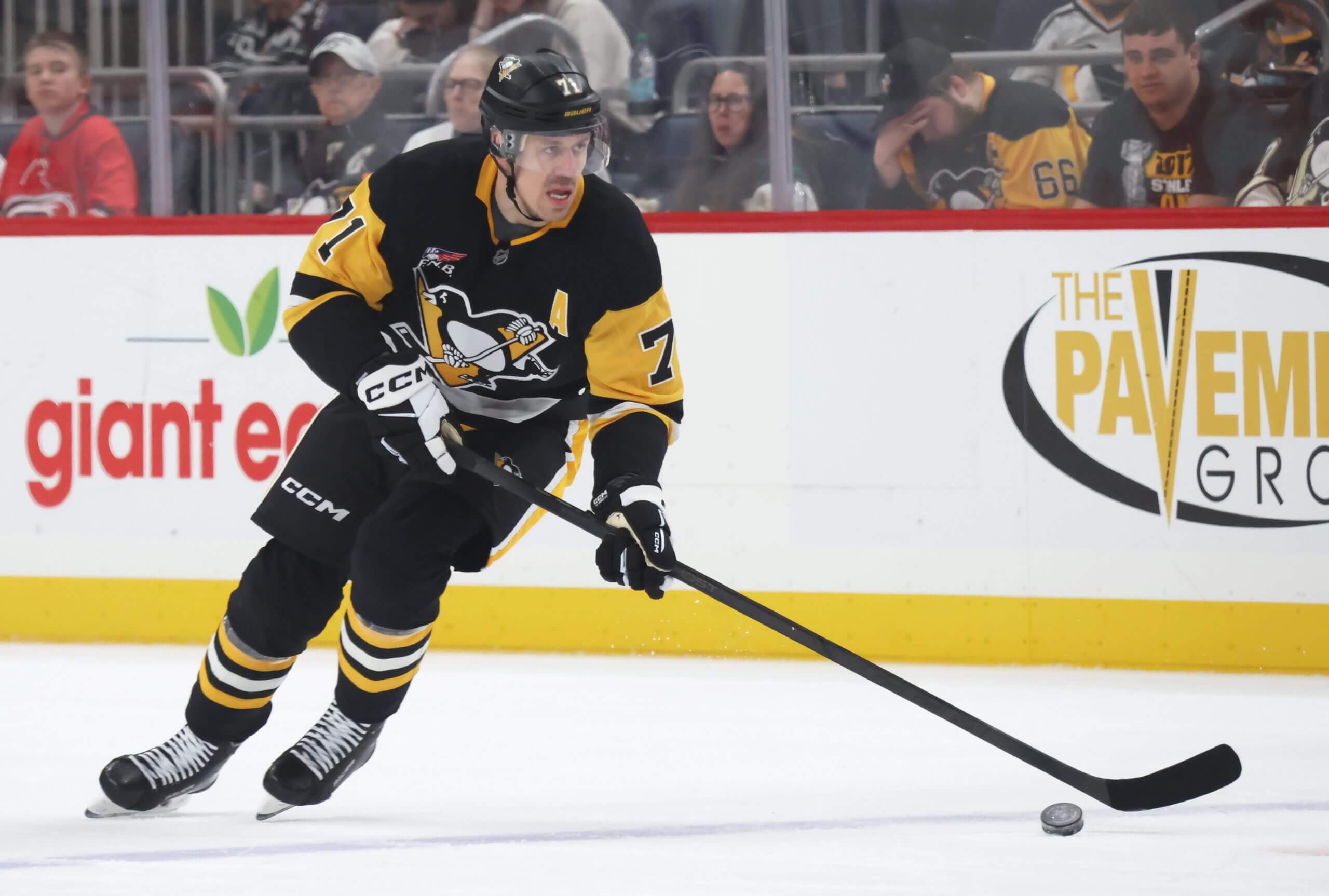
Evgeni Malkin could have a lot to prove in this playoff matchup. (Charles LeClaire / Imagn Images)
Yohe: I will go with Malkin. It’s generally a given that Crosby will perform well against the Flyers. He’s been mad at Ken Hitchcock and Derian Hatcher for 21 years and has been taking it out on Philadelphia ever since. I can’t see that changing.
But the Penguins need more than just him. They have very good scoring depth on their bottom six, led by the terrific season authored by Anthony Mantha. But they give up so many goals that they’ll need contributions from everyone. Malkin makes the difference. If he’s a point-per-game guy in this series — he was during the regular season, even at 39 — I suspect the Penguins’ high-scoring attack might indeed overwhelm the Flyers. Malkin looms large. He’s been a different player this season. He badly wants another contract but hasn’t received an offer yet. This series could serve as a message to Kyle Dubas that he remains an elite player. Or, we could be watching Malkin’s final days in Pittsburgh. He will run through a wall to win this series.
Might a talented Russian also be your Flyers pick?
Kurz: I could go with Martone here, who already looks like a star in the making. Konecny is another, because no one in the Flyers’ dressing room is looking forward to playoff hockey more, and who can drive an opponent silly with his ability and his agitating style.
But, as you suspected, I’m going with Michkov, who has been in the spotlight for much of the season, and not always for the right reasons. After a miserable first four months, Michkov was the Flyers’ leading scorer after the Olympic break, with 22 points (seven goals, 15 assists). He scored a pair of huge goals in the final week, in Winnipeg and against the Hurricanes, to help secure the final two wins the Flyers needed to punch their playoff ticket and showed a knack for the big moments. At the same time, Michkov’s decision-making and defense are still uneven, and he finished second in minor penalties among NHL forwards (32). He’s bound to have an impact, one way or another.