
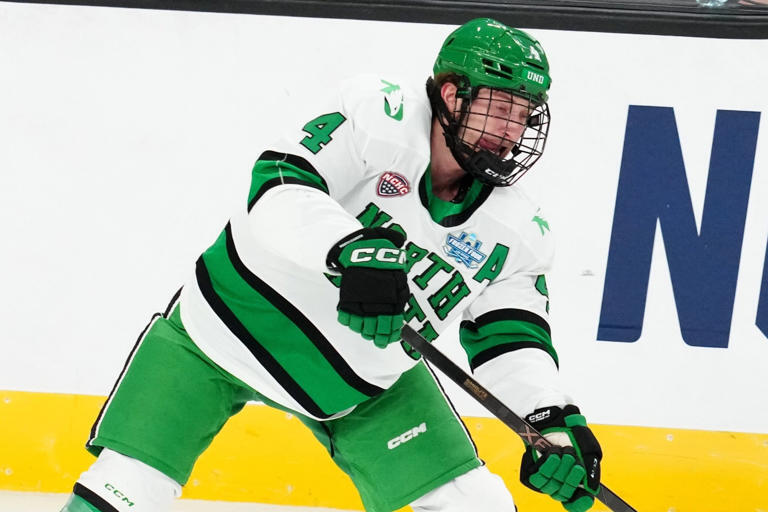
PHOENIX — When viewers tuned into the 2026 NCAA Men’s Frozen Four last weekend, they were greeted by an aerial view of Las Vegas. T-Mobile Arena, home of the NHL’s Vegas Golden Knights, was the host site for the coveted hockey event for the first time, signifying the growth of hockey in the Southwest.
As Wisconsin, North Dakota, Denver and Michigan made the trek to Las Vegas, a majority of the skaters may not have been accustomed to the sunny, 80-degree weather. Two of North Dakota’s players, junior defenseman Jake Livanavage and senior goaltender Gibson Homer, felt right at home.
Gibson spent three seasons at Arizona State. Livanavage, a Gilbert native, was just a five-hour drive from home, the easiest trip his family made all year to one of his games outside of North Dakota’s road series at ASU.
“Most of my family came out,” said Livanavage, now with the NHL’s Pittsburgh Penguins. “Whether it’s my aunts and uncles, grandparents, parents, my brother, they all came out. Past coaches and friends were in the arena, too, so it’s always fun getting to go back home and be there.”
The presence of both players was a reminder that hockey is still thriving in Arizona, but it was also a reminder of what the state recently lost when the Arizona Coyotes relocated to Salt Lake City following the 2023-24 season.
Fortunately for Coyotes fans, when the team left and was rebranded as the Utah Mammoth, many hockey fans in the Valley were able to shift their attention to Arizona State’s men’s hockey team. It’s been a boon for the program, as the Sun Devils have consistently packed Mullett Arena, averaging 5,023 per game in the 5,000-seat arena over the past two years, with ticket prices also rising significantly over the past few seasons.
As an example, goal line tickets rose from $425 in 2022-23 to $600 in 2025-26 under the program’s loyalty pricing noted on the official website.
During that span, ASU also became a member of the National Collegiate Hockey Conference, which has produced eight of the past 10 national champions. The Sun Devils’ popularity and the presence of Arizona-bred players on the national stage have filled the Valley hockey community with hope that the NHL will eventually return to the state.
“Arizona State is really picking up the torch and is the driver of high-level hockey in the state,” Phoenix Jr. Coyotes director of hockey operations Mike DeAngelis said. “Everybody loves going to those games and seeing them be successful. (ASU coach) Greg Powers has done a great job with the program, and the Sun Devil brand is huge.
“It’s great to continue pushing hockey in the Valley until hopefully someday soon, we’ll get another NHL franchise back.”
With college athletes now allowed to earn money based on their name, image and likeness, ASU is forced to fight an uphill battle as the only member of the conference that also has a Power Four football team. A majority of the NCHC programs treat hockey as their largest sport in terms of the funding they receive, forcing the Sun Devils to base more of their recruitment tactics on ASU’s surroundings: it’s sunny and warm year round, with a greater metro population of over 5.2 million.
“I loved all the support that the team received when I played in Arizona,” said Homer, who spent three years as a goaltender at ASU before transferring to North Dakota. “Just seeing a new tradition in the sport grow the way it did was great.
“Now, it’s exploded in ways that weren’t there at the start of the program’s history, or even my freshman year. I loved being a part of the growth of that tradition in the Southwest.”
Despite the departure of the Coyotes, hockey in the desert has continued to thrive. In the 2024-25 season, USA Hockey recorded 9,534 registered hockey players in Arizona, an increase from the 2018-19 season, when the Valley had just 8,983 registered players. Youth hockey is still developing through programs such as DeAngelis’ Jr. Coyotes, who compete at the AAA level.
While Arizona no longer has an NHL team, high-level talent is still making its mark on the younger generation who dream of turning pro. But as long as an NHL vacancy remains, the likelihood of the next generation losing interest in the sport increases. With former Coyotes such as Michael Grabner and Zbyněk Michálek supporting the move to lure a professional team to Arizona by coaching at the youth level, those who love the sport are doing their best to maintain a high interest level.
“A lot of former players are coaching in our program,” DeAngelis said. “We haven’t seen any dropoff yet, but I’m sure it may dip a little unless we get some good news about another NHL franchise coming back. Right now, we’re full with all our hockey programs all the way up to U18, so we’ve done real well with it and we continue to drive forward.”
A major aspect of the community’s support has come from the Arizona Kachinas, a program devoted to the growth and development of girls’ hockey. While the Coyotes were key to events such as Skatin’ for Leighton in remembrance of former Kachinas player Leighton Accardo, who died of cancer when she was 9 in 2020, the Kachinas have received support from the larger hockey community to continue the event for the past three years despite the Coyotes’ absence.
“That was the thing that was never broken here,” said Kachinas president Lyndsey Fry, a member of the 2014 US women’s Olympic hockey team at the 2014 Games in Sochi, Russia. “You can talk about all the arena challenges and all the things that made it so the team ended up getting relocated, but the connection between the players and the fans and the hockey community in general was never the challenge. That part was easy, that part was fun, and I think we’re seeing that now.”
There has never been a shortage of talent in the desert, either. Several NHL stars began their careers in Arizona, including Toronto Maple Leafs captain and 2022 Hart Trophy winner Auston Matthews. A Scottsdale native, Matthews is living proof to youth hockey players that succeeding in the desert is more than possible; they can thrive.
Along with Matthews, his teammate Matthew Knies, as well as Buffalo Sabres forward Josh Doan, son of former Coyotes captain Shane Doan, have been poster children for hockey in the Valley. While they may have been at a slight disadvantage in terms of resources and support from the community compared to other hockey towns, their determination to live out their dreams in the NHL has younger players wanting to follow in their footsteps.
“Auston Matthews was a huge torchbearer,” DeAngelis said. “His ability in the NHL to do what he’s done and being from Arizona has just been enormous. The players are there and they’re still showing the rest of the country that Arizona is a location for high-level hockey.”
One of Arizona’s greatest arguments to reinstate an NHL team is the recent success of hockey teams in the southern part of the U.S. Five of the past six Stanley Cups have been won by the Tampa Bay Lightning, Florida Panthers and Vegas Golden Knights — three cities known for sunshine, not snow. Given the NHL’s desire to expand south in the past three decades, the Valley receiving a second chance at a franchise seems a real possibility.
NHL deputy commissioner Bill Daly has noted that while other major pro sports leagues in North America have largely saturated the U.S. market, the NHL resides in only 25 U.S. markets, with seven teams playing in Canadian cities. That leaves room for expansion to cities such as Phoenix and Houston.
“It’s certainly clear that the sunbelt, sunny markets in the U.S. have had a lot of success,” DeAngelis said. “We’re just a bit frustrated that a city the size of Phoenix needs to have an NHL franchise back here. We hope that there can be some good news on the horizon.”
NHL commissioner Gary Bettman isn’t worried about support if he were to bring a team back to Arizona — even NHL players voted Arizona as the third-most preferred destination for an expansion team in an anonymous poll posted by The Athletic.
In the Coyotes’ final season, club president Xavier Gutierrez said that the team was losing more than $10 million in their final season, where home games were played in the intimate confines of Mullett Arena. Despite multiple reports hinting at plans to build a multi-billion dollar arena, nothing transpired. With his hands tied, Bettman was forced to move the team to a location that would house a team in a permanent home.
“Location and ownership is the only thing that matters right now,” former Coyotes player Ray Whitney said. “You can’t have success if you don’t have them building in the right spot. I think that is the main concern and legitimately the only concern.
“I don’t think you’d have to worry about doing a season ticket drive or anything like that. You just want the opportunity to have a building in the right spot, then the people will come.”
From 1996 to 2003, the Coyotes shared America West Arena (now Mortgage Matchup Center) with the NBA’s Phoenix Suns in downtown Phoenix before moving to Glendale Arena (now Desert Diamond Arena) for the next 19 years in Glendale. In The Athletic’s poll, the players made the message clear: If you’re going to bring hockey back to the desert, don’t go back to Glendale.
“Do it the right way: Put the arena in the right part of (Phoenix), and I think you’d have an NHL hotspot,” one player said.
“It’s still one of the largest markets in the US,” Whitney said. “There’s definitely a lot of people here, but unfortunately, you have to have a building and ownership that has a building in the right place. You have to have ownership that’s willing to be involved in bringing a good team here and keeping it here.”
This <a target=”_blank” href=”https://cronkitenews.azpbs.org/2026/04/16/ncaa-hockey-frozen-four-las-vegas/”>article</a> first appeared on <a target=”_blank” href=”https://cronkitenews.azpbs.org”>Cronkite News</a> and is republished here under a <a target=”_blank” href=”https://creativecommons.org/licenses/by-nd/4.0/”>Creative Commons Attribution-NoDerivatives 4.0 International License</a>.<img src=”https://i0.wp.com/cronkitenews.azpbs.org/wp-content/uploads/2026/02/favicon1.png?resize=85%2C85&ssl=1″ style=”width:1em;height:1em;margin-left:10px;”>
<img id=”republication-tracker-tool-source” src=”https://cronkitenews.azpbs.org/?republication-pixel=true&post=102239″ style=”width:1px;height:1px;”><script> PARSELY = { autotrack: false, onload: function() { PARSELY.beacon.trackPageView({ url: “https://cronkitenews.azpbs.org/2026/04/16/ncaa-hockey-frozen-four-las-vegas/”, urlref: window.location.href }); } } </script> <script id=”parsely-cfg” src=”//cdn.parsely.com/keys/cronkitenews.azpbs.org/p.js”></script>
Canonical Tag:
Copy Tag
Article Content:
Frozen Four in Las Vegas a reminder that hockey has a home in Southwest
Jake Sloan, Cronkite News
April 16, 2026
PHOENIX — When viewers tuned into the 2026 NCAA Men’s Frozen Four last weekend, they were greeted by an aerial view of Las Vegas. T-Mobile Arena, home of the NHL’s Vegas Golden Knights, was the host site for the coveted hockey event for the first time, signifying the growth of hockey in the Southwest.
As Wisconsin, North Dakota, Denver and Michigan made the trek to Las Vegas, a majority of the skaters may not have been accustomed to the sunny, 80-degree weather. Two of North Dakota’s players, junior defenseman Jake Livanavage and senior goaltender Gibson Homer, felt right at home.
Gibson spent three seasons at Arizona State. Livanavage, a Gilbert native, was just a five-hour drive from home, the easiest trip his family made all year to one of his games outside of North Dakota’s road series at ASU.
“Most of my family came out,” said Livanavage, now with the NHL’s Pittsburgh Penguins. “Whether it’s my aunts and uncles, grandparents, parents, my brother, they all came out. Past coaches and friends were in the arena, too, so it’s always fun getting to go back home and be there.”
The presence of both players was a reminder that hockey is still thriving in Arizona, but it was also a reminder of what the state recently lost when the Arizona Coyotes relocated to Salt Lake City following the 2023-24 season.
Fortunately for Coyotes fans, when the team left and was rebranded as the Utah Mammoth, many hockey fans in the Valley were able to shift their attention to Arizona State’s men’s hockey team. It’s been a boon for the program, as the Sun Devils have consistently packed Mullett Arena, averaging 5,023 per game in the 5,000-seat arena over the past two years, with ticket prices also rising significantly over the past few seasons.
As an example, goal line tickets rose from $425 in 2022-23 to $600 in 2025-26 under the program’s loyalty pricing noted on the official website.
During that span, ASU also became a member of the National Collegiate Hockey Conference, which has produced eight of the past 10 national champions. The Sun Devils’ popularity and the presence of Arizona-bred players on the national stage have filled the Valley hockey community with hope that the NHL will eventually return to the state.
“Arizona State is really picking up the torch and is the driver of high-level hockey in the state,” Phoenix Jr. Coyotes director of hockey operations Mike DeAngelis said. “Everybody loves going to those games and seeing them be successful. (ASU coach) Greg Powers has done a great job with the program, and the Sun Devil brand is huge.
“It’s great to continue pushing hockey in the Valley until hopefully someday soon, we’ll get another NHL franchise back.”
With college athletes now allowed to earn money based on their name, image and likeness, ASU is forced to fight an uphill battle as the only member of the conference that also has a Power Four football team. A majority of the NCHC programs treat hockey as their largest sport in terms of the funding they receive, forcing the Sun Devils to base more of their recruitment tactics on ASU’s surroundings: it’s sunny and warm year round, with a greater metro population of over 5.2 million.
“I loved all the support that the team received when I played in Arizona,” said Homer, who spent three years as a goaltender at ASU before transferring to North Dakota. “Just seeing a new tradition in the sport grow the way it did was great.
“Now, it’s exploded in ways that weren’t there at the start of the program’s history, or even my freshman year. I loved being a part of the growth of that tradition in the Southwest.”
Despite the departure of the Coyotes, hockey in the desert has continued to thrive. In the 2024-25 season, USA Hockey recorded 9,534 registered hockey players in Arizona, an increase from the 2018-19 season, when the Valley had just 8,983 registered players. Youth hockey is still developing through programs such as DeAngelis’ Jr. Coyotes, who compete at the AAA level.
While Arizona no longer has an NHL team, high-level talent is still making its mark on the younger generation who dream of turning pro. But as long as an NHL vacancy remains, the likelihood of the next generation losing interest in the sport increases. With former Coyotes such as Michael Grabner and Zbyněk Michálek supporting the move to lure a professional team to Arizona by coaching at the youth level, those who love the sport are doing their best to maintain a high interest level.
“A lot of former players are coaching in our program,” DeAngelis said. “We haven’t seen any dropoff yet, but I’m sure it may dip a little unless we get some good news about another NHL franchise coming back. Right now, we’re full with all our hockey programs all the way up to U18, so we’ve done real well with it and we continue to drive forward.”
A major aspect of the community’s support has come from the Arizona Kachinas, a program devoted to the growth and development of girls’ hockey. While the Coyotes were key to events such as Skatin’ for Leighton in remembrance of former Kachinas player Leighton Accardo, who died of cancer when she was 9 in 2020, the Kachinas have received support from the larger hockey community to continue the event for the past three years despite the Coyotes’ absence.
“That was the thing that was never broken here,” said Kachinas president Lyndsey Fry, a member of the 2014 US women’s Olympic hockey team at the 2014 Games in Sochi, Russia. “You can talk about all the arena challenges and all the things that made it so the team ended up getting relocated, but the connection between the players and the fans and the hockey community in general was never the challenge. That part was easy, that part was fun, and I think we’re seeing that now.”
There has never been a shortage of talent in the desert, either. Several NHL stars began their careers in Arizona, including Toronto Maple Leafs captain and 2022 Hart Trophy winner Auston Matthews. A Scottsdale native, Matthews is living proof to youth hockey players that succeeding in the desert is more than possible; they can thrive.
Along with Matthews, his teammate Matthew Knies, as well as Buffalo Sabres forward Josh Doan, son of former Coyotes captain Shane Doan, have been poster children for hockey in the Valley. While they may have been at a slight disadvantage in terms of resources and support from the community compared to other hockey towns, their determination to live out their dreams in the NHL has younger players wanting to follow in their footsteps.
“Auston Matthews was a huge torchbearer,” DeAngelis said. “His ability in the NHL to do what he’s done and being from Arizona has just been enormous. The players are there and they’re still showing the rest of the country that Arizona is a location for high-level hockey.”
One of Arizona’s greatest arguments to reinstate an NHL team is the recent success of hockey teams in the southern part of the U.S. Five of the past six Stanley Cups have been won by the Tampa Bay Lightning, Florida Panthers and Vegas Golden Knights — three cities known for sunshine, not snow. Given the NHL’s desire to expand south in the past three decades, the Valley receiving a second chance at a franchise seems a real possibility.
NHL deputy commissioner Bill Daly has noted that while other major pro sports leagues in North America have largely saturated the U.S. market, the NHL resides in only 25 U.S. markets, with seven teams playing in Canadian cities. That leaves room for expansion to cities such as Phoenix and Houston.
“It’s certainly clear that the sunbelt, sunny markets in the U.S. have had a lot of success,” DeAngelis said. “We’re just a bit frustrated that a city the size of Phoenix needs to have an NHL franchise back here. We hope that there can be some good news on the horizon.”
NHL commissioner Gary Bettman isn’t worried about support if he were to bring a team back to Arizona — even NHL players voted Arizona as the third-most preferred destination for an expansion team in an anonymous poll posted by The Athletic.
In the Coyotes’ final season, club president Xavier Gutierrez said that the team was losing more than $10 million in their final season, where home games were played in the intimate confines of Mullett Arena. Despite multiple reports hinting at plans to build a multi-billion dollar arena, nothing transpired. With his hands tied, Bettman was forced to move the team to a location that would house a team in a permanent home.
“Location and ownership is the only thing that matters right now,” former Coyotes player Ray Whitney said. “You can’t have success if you don’t have them building in the right spot. I think that is the main concern and legitimately the only concern.
“I don’t think you’d have to worry about doing a season ticket drive or anything like that. You just want the opportunity to have a building in the right spot, then the people will come.”
From 1996 to 2003, the Coyotes shared America West Arena (now Mortgage Matchup Center) with the NBA’s Phoenix Suns in downtown Phoenix before moving to Glendale Arena (now Desert Diamond Arena) for the next 19 years in Glendale. In The Athletic’s poll, the players made the message clear: If you’re going to bring hockey back to the desert, don’t go back to Glendale.
“Do it the right way: Put the arena in the right part of (Phoenix), and I think you’d have an NHL hotspot,” one player said.
“It’s still one of the largest markets in the US,” Whitney said. “There’s definitely a lot of people here, but unfortunately, you have to have a building and ownership that has a building in the right place. You have to have ownership that’s willing to be involved in bringing a good team here and keeping it here.”
This article first appeared on Cronkite News and is republished here under a Creative Commons Attribution-NoDerivatives 4.0 International License.
Copy Content
Tracking snippet:
Copy Snippet