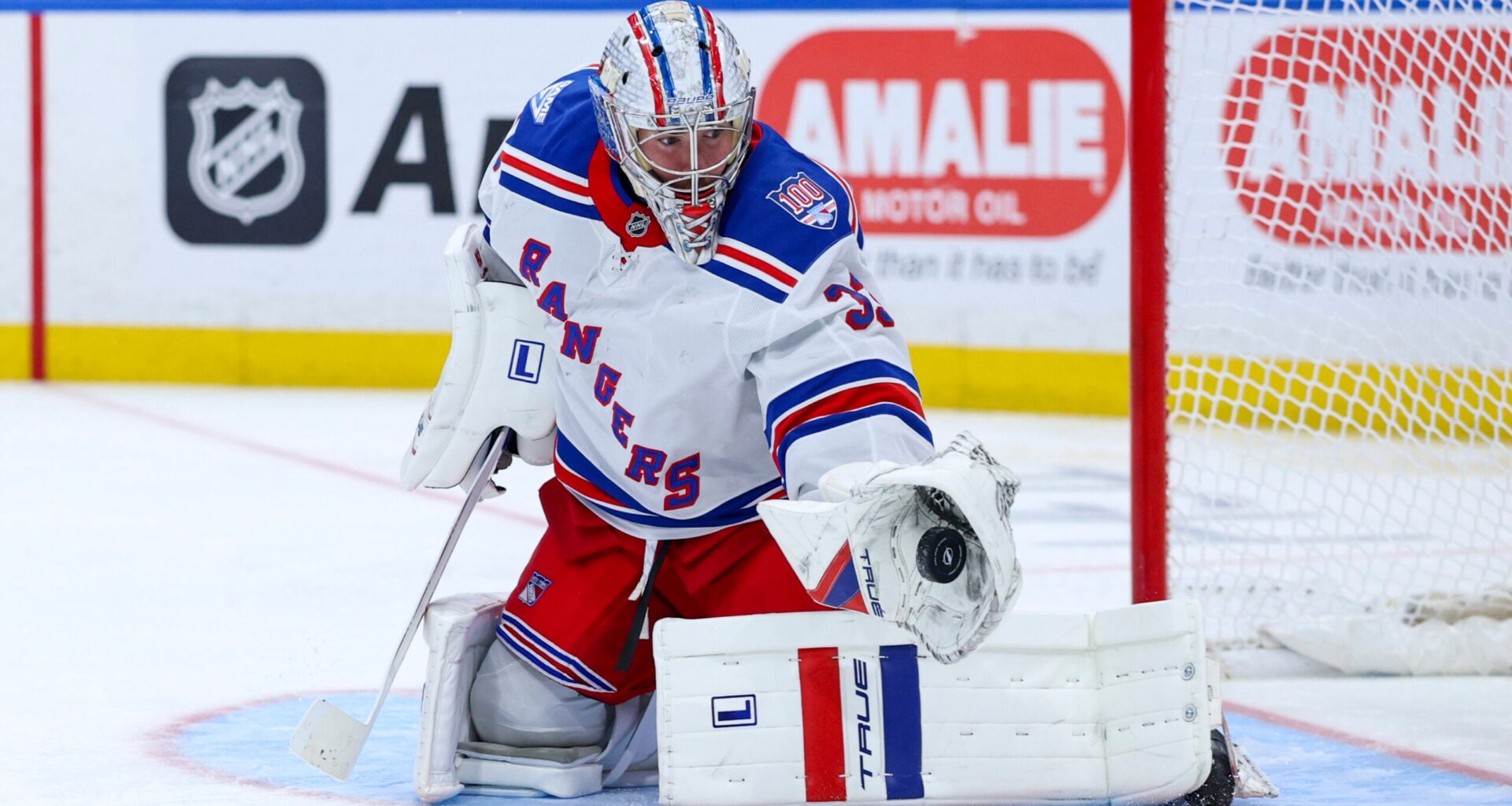

Rookie goaltender Dylan Garand closed out the New York Rangers’ dismal 2025-26 season Wednesday, turning in a third impressive performance in as many starts by stopping 29 shots in a 4-2 victory over the Tampa Bay Lightning.
Given Garand’s strong efforts in his first three NHL outings, it’s difficult to fathom why the Rangers didn’t give the 23-year-old more runway in a last-place season to find out whether he has an extended future on Broadway, or even if he’s ready to be Igor Shesterkin’s backup on Broadway next season.
Though the Rangers avoided a worst-case scenario Jan. 5, when Shesterkin escaped a season-ending injury after his left knee bent awkwardly during a 3-2 overtime loss to the Utah Mammoth at Madison Square Garden, he did miss 13 games.
While that was good news for the Rangers, they squandered a month to get a much more extensive look at Garand, when Shesterkin was sidelined. Deciding not to recall Garand at that time created what was avoidable uncertainty as the organization heads into the offseason needing to find a viable backup plan for Shesterkin for the first time since summer 2023.
Calling up Spencer Martin instead of Dylan Garand in January not best decision for Rangers
 Nathan Ray Seebeck-Imagn Images
With Jonathan Quick announcing his retirement Monday, closing out his 18-year career with three seasons as Shesterkin’s backup in New York, general manager Chris Drury and the front office face a decision on how to fill the spot behind one of the top netminders in the NHL next season. Garand might be the man for the job – but the organization didn’t do nearly enough when it had the chance this season to alleviate some of the question marks around the 2020 fourth-round draft pick.
That’s because rather than call Garand up from Hartford of the American Hockey League to back up Quick when Shesterkin was injured, the Rangers chose to recall veteran journeyman Spencer Martin. The 30-year-old ended up appearing in six games during that stretch, failing to impress at all.
Martin posted an .863 save percentage and 4.13 goals-against average in those contests. Quick wasn’t any better, making nine of the starts with Shesterkin out and recording an .853 save percentage and 4.33 GAA. Quick’s struggles with the increased workload exposed the fact that the 40-year-old was no longer a starting-caliber goalie, and could only be counted on for an occasional spot start or relief appearance. The Rangers lost 11 of 13 games without Shesterkin, fell out of the playoff race, and publicly announced a retool.
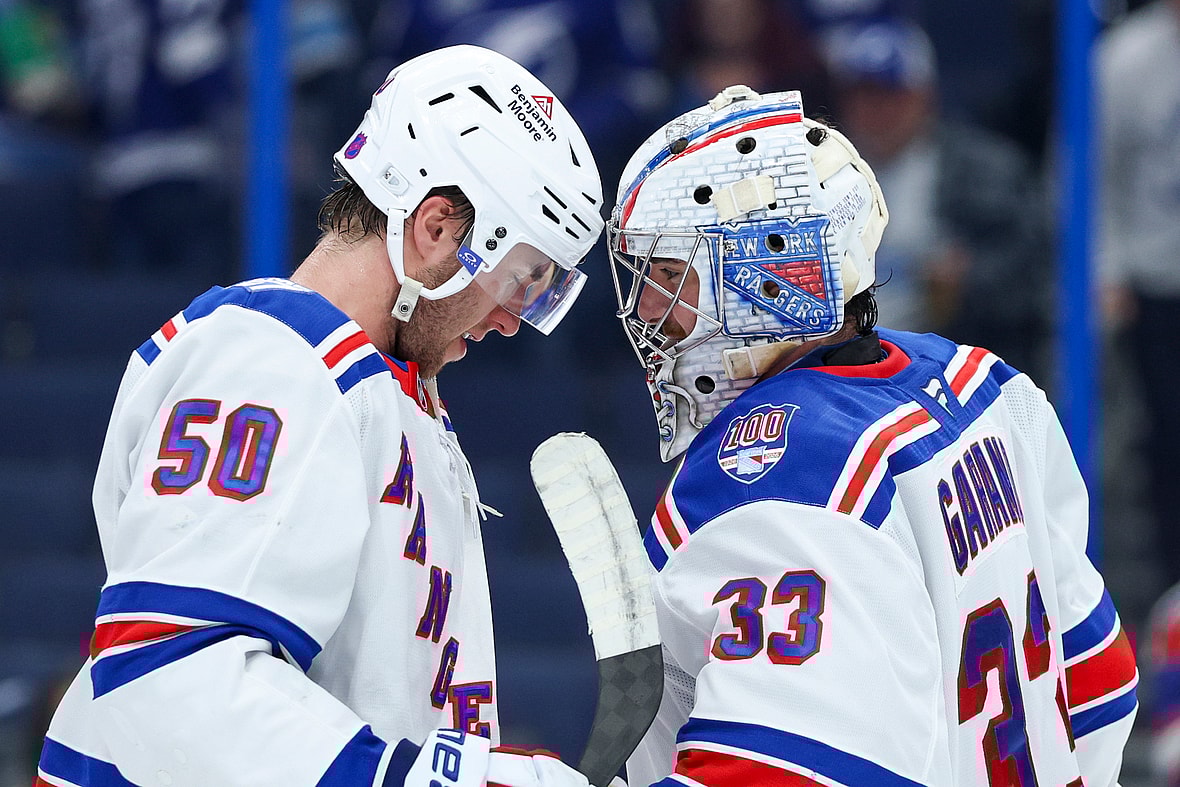
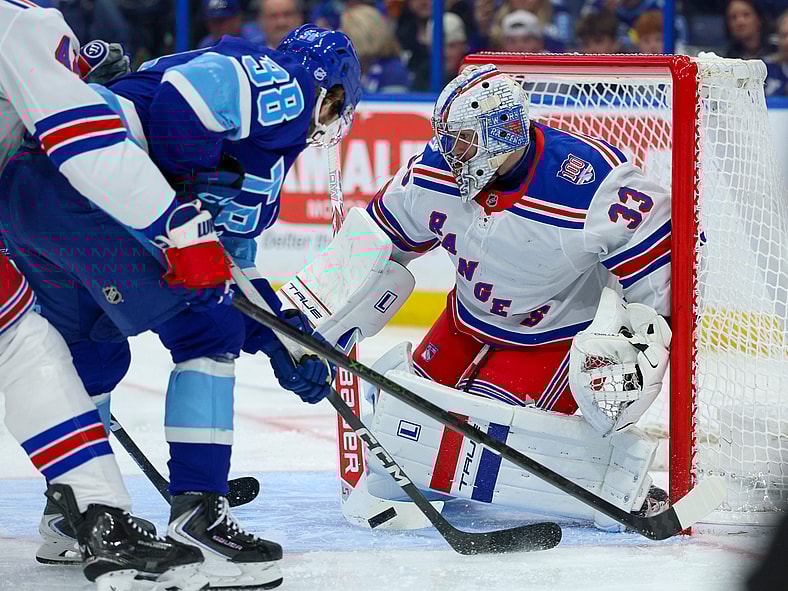
Garand, in the season finale against the Lightning, again flashed the traits that should have earned him more NHL minutes this season – a “quiet” presence in the net, strong positioning, excellent instincts, a quick glove hand, and apparent confidence that rubbed off on teammates. Ironically, he bested Lightning goalie Brandon Halverson, a Rangers second-round draft pick in 2014 who didn’t pan out.
“I thought he was solid again. He swallows a lot of pucks,” coach Mike Sullivan said postgame. “What really impressed me was his rebound control. … I thought he did a great job swallowing pucks and there were whistles and face-offs, and it just settles everything down when the goaltender has that type of rebound control, and he certainly had it tonight.
“He had three starts for us here late in the season, all three I thought he played extremely well.”
That made the decision to go with Martin over Garand, who was 2-0-1 with a 1.62 goals-against average and .948 save percentage in his three games, in January look overly conservative and short-sighted.
The Rangers felt they had their reasons. They likely didn’t want to put too much pressure on Garand to play savior with Shesterkin out and potentially wreck his confidence – especially with Quick struggling in an expanded role. And Garand ended up not playing well at Hartford in January after the organization went with Martin instead, giving up four or more goals four times in seven starts from Jan. 9-28. One could project that Garand’s struggles would be significantly magnified had he been facing NHL rather than AHL competition during that time.
Yet all of that reads like excuse-making now. Garand allowed two or fewer goals in five of his six starts just before Shesterkin’s injury. And the Wolf Pack, last in the Atlantic Division, are among the worst defensive teams in the AHL, with only two teams giving up more than their 3.5 goals per game on the season. It should go without saying that Hartford didn’t play too well in front of its goalies in 2025-26, perhaps leading to Garand’s rough January stretch.
The Rangers were also an improved defensive outfit in Sullivan’s first season, placing 15th in the League with 3.04 goals allowed per game. Better play and structure in their own end was noticeable. So it stands to reason that playing Garand wouldn’t have amounted to throwing him into a defenseless situation by any means, though the Rangers were far from their best in all facets of the game back in January.
Garand was finally called up March 20 and made his NHL debut two days later, opening eyes with a 35-save performance in a 3-2 shootout loss to the Winnipeg Jets at Madison Square Garden. He got his next start March 27, stopping 27 shots against the Chicago Blackhawks, a 6-1 victory, his first in the NHL.
Now, management must decide whether to pursue a veteran backup this summer with not nearly enough intel on whether the club already has a trusted NHLer in Garand to play behind Shesterkin. Perhaps the front office saw all it needed to see in three games, but that comes across as unrealistic.
“I never want to go back to the [AHL], honestly,” Garand said Wednesday. “I’m so hungry to be here. I want to be in this league and a part of this organization, and there’s nothing else like it, it’s the best thing in the world. So yeah, it’s been a great taste and definitely, going into this summer, very motivated to be back here.”
Rangers giving Dylan Garand only three NHL starts creates uncertainty in goal for 2026-27
 Nathan Ray Seebeck-Imagn Images
The Rangers, like any team, need to harbor confidence that their No. 1 goalie’s backup can step in for an extended period and hold the fort. While these Rangers weren’t a Stanley Cup contender this season and are in a formally-stated “retool,” that doesn’t lessen the need for known goaltending reliability off the bench.
Though the Rangers didn’t view Shesterkin’s injury as the right time to have Garand start his NHL career, one could argue that it was in fact the perfect opportunity. The Rangers weren’t in the playoff race for essentially the whole season, and they certainly didn’t harbor any postseason illusions by the time Shesterkin was hurt.
The Rangers instead went with Martin, a below-average veteran who’s spent most of his professional career in the AHL, and predictably received below-average play. With Martin not in the mix as a candidate to be Shesterkin’s backup next season, those six games feel pointless.
Certainly, the Rangers excel when it comes to finding and developing high-end NHL goalies, going back to the start of the 1980s. Perhaps they will do so again with Garand, who won’t be asked to be anything more, barring injury to Shsterkin, than an understudy in a Blueshirt. If that happens, however, it will be at least a partial surprise, given that the organization didn’t better utilize this season to gather more extensive information on what it has in Garand.

Tom grew up a New York Rangers fan and general fan of the NHL in White Plains, NY, and … More about Tom Castro
Add Forever Blueshirts as a Preferred Source on Google.