
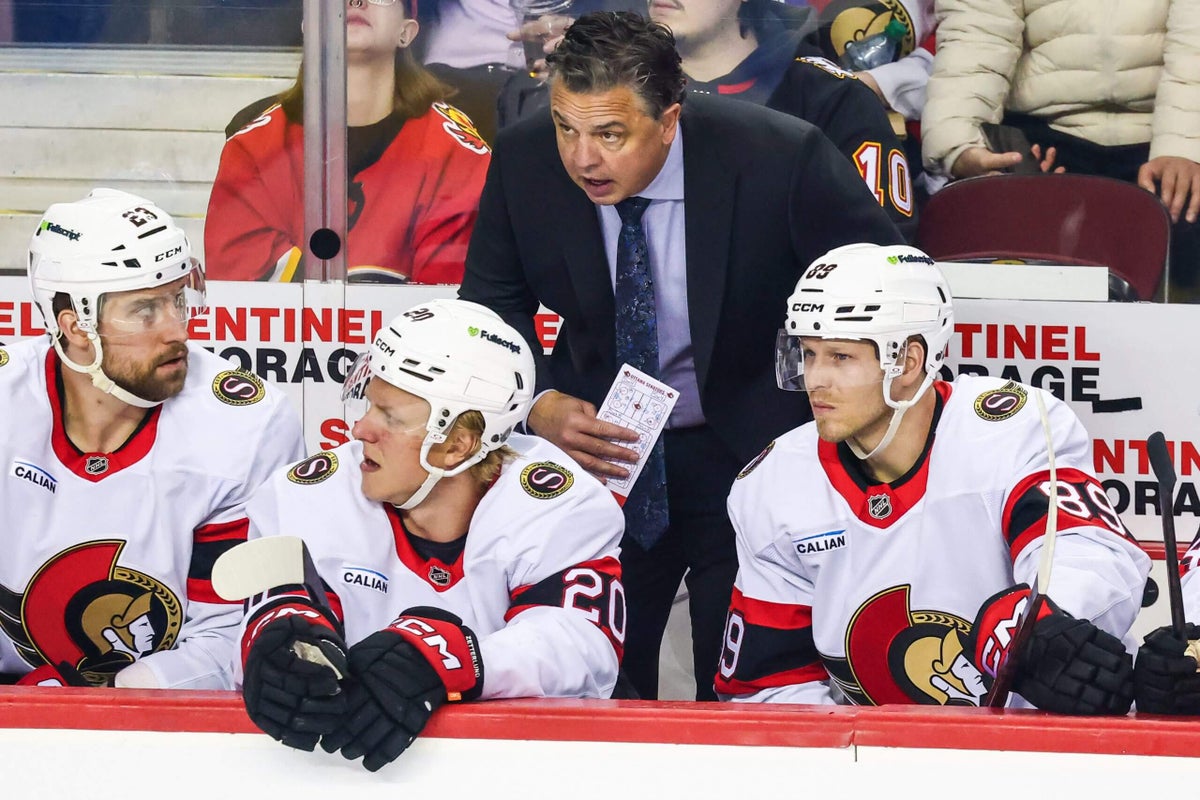
When longtime Ottawa Senators head coach Jacques Martin was named to the team’s Ring of Honour at the Canadian Tire Centre in January, he chose to highlight the work of the current coaching staff, led by head coach Travis Green. At the time, it was practically a public vote of confidence — weeks after Senators general manager Steve Staios gave his own.
It was months before Green’s Senators blitzed through the second half of their season, with the coach entering the discussion for coach of the year. The Senators were in the midst of their downward slide, out of playoff contention while handling Linus Ullmark’s absence.
Green wasn’t the reason for the Senators’ issues at the time. He was, however, still leading a team heading towards a disappointing season despite dominating teams at five-on-five by limiting opposing chances and generating high-quality ones of its own. The Senators just couldn’t overcome their porous goaltending and a league-worst penalty kill. Even their power play was spotty at times.
And when they struggled to score, their opponents cashed in and won. Some fans clamoured for changes to Green’s coaching staff, and a few wouldn’t have been upset to see him gone only partway through his second season. So, when Martin said he had never seen a coaching staff as “committed” and “dedicated” or that paid as much attention to detail, fans weren’t universally on his side.
“All this through the leadership of Travis Green,” said Martin, who also serves as a Senators senior adviser. “This team is in good hands with the coaching staff in place. I’ve had a chance to coach several of these players. And I can tell you this without hesitation: This organization cares. The ownership cares. Management cares. Coaches care. Players care. And they want to win, and they will win. This team is knocking on the door of a championship. I firmly believe it.”
Martin added, in French, before switching back to English: “And honestly, I believe that they are closer than people think.”
That night, the Senators lost 4-1 at the hands of the Carolina Hurricanes, furthering the team’s despair. But the next night, they walloped the Vegas Golden Knights, and Green delivered his famous “white noise” speech. It was the beginning of a successful 21-6-4 run that put the Sens in a playoff spot and earned them a first-round date against those Hurricanes starting Saturday.
“I honestly give a lot of credit to him,” defenceman Jake Sanderson said. “I think there was a lot of days, as players, where we’re just frustrated. And guys were going through injuries. We’re missing a lot of big pieces. I think there were some days where our mentality wasn’t great. But we’d go into the meeting room every morning, and (Green) would put on a brave face for us, I’d say.
“I don’t know if he felt that all the way. But he had all the belief in us.”
The Senators are wading through less turbulent waters, for now. But it wasn’t long ago that Green was seemingly keeping his cool through rougher times.
“You’re saying I was cool?” Green chuckled earlier this week when asked how he stayed levelheaded as the Senators endured their up-and-down regular season. “Sometimes, it’s like a duck; its legs are going 100 miles underwater. You don’t show anything.”
Green spent his first offseason as the Senators’ coach meeting with players and challenging them to be better. In training camp, Green and his coaching staff worked on implementing their tactics of hardworking, two-way play with forechecking and offensive-zone cycling combined with limiting opposing chances by taking away the middle of the ice. By November, though, Green had a new challenge: fighting against previous expectations and unhealed scars.
That month, the Senators were playing through a poor stretch that threatened to derail their season early. It was something the Senators had grown accustomed to during their near-decade-long playoff drought. Captain Brady Tkachuk’s leadership skills were also put into question around that time, prompting Green to stand up for him publicly and speak to his team privately, encouraging players to forget about previous seasons.
That was seen as the turning point — not just for the Senators’ season, but in understanding Green’s concepts and philosophy.
“We had a lot of looking in the rearview mirror — ‘Here we go again,’” Green said. “Personally, I didn’t really care about what happened in the past. I wasn’t part of it. And quite frankly, I couldn’t have cared less. But I felt like our team was living a little bit in the past.”
Fast forward a year later. As Sanderson remembers, the team was “in the s—.” The Senators played through a 10-game stretch from late November to early December in which they won only three times, and their goal scoring at five-on-five temporarily dried up. Tkachuk had just returned from a thumb injury, but Thomas Chabot was out with an upper-body injury. Green’s faith in his players didn’t waver, though, and they eventually won four consecutive games.
“He’s like, ‘Boys, we’re going to make it,’” Sanderson said. “‘We’re going to get (into the playoffs). We’re a good team.’ He believed that all year. And I think that kind of rubbed off on all the players, for sure.”
For Green, those positive reinforcements were necessary, as his team sometimes struggled to win consistently despite playing well. But he had to continue striking a balance between being positive and showing tough love, pushing players to complete drills and plays more effectively in practice or enforcing concepts in video meetings.
“He comes up with a new message every day,” Senators forward Nick Cousins said. “It’s usually what we need. Some days, we’re going to need to have video sessions or for him to come in and scream and yell at us. And there’s times where he needs to be calm and supportive, and he knows what buttons to push for our team.”
“I think they just stayed strong together as a group and played well,” Green said. “At the end of the day, you have to play good. Average doesn’t cut it in the NHL. You’ve got to perform.”
And of course, Green’s late-January speech about blocking out the “white noise” resonated with his group.
“I think when we were struggling, he had to emphasize it a little more,” Senators center Shane Pinto said. “Whatever noise it is, good or bad, I don’t think it serves us any justice to listen to it. If we’re playing good, people gas you up. And then, you’re not as good as you think you are. And then, you’re not as bad as you think you are. I think he does a good job of keeping us even-keeled.”
The Senators’ success and togetherness have resulted in one of the league’s stingiest teams when it comes to shots against, tied for the second-fewest shots allowed (24.4) with the Golden Knights. Ottawa trails only Carolina (23.9), a team that has been just as successful when looking at underlying numbers such as expected goals percentage.
A combination of solid underlying numbers and performances from their best players made it easy for Green to keep affirming his belief in his group, especially ahead of a crucial first-round matchup with aspirations of going beyond.
“We’re here to win. It’s all about winning and getting into the playoffs and competing for a Stanley Cup,” Green said. “We had to come a long way from January. It says a lot about our group, how they played, the belief and being a good teammate for each other. Those are the three things that we talked about a lot, and just sticking with it.”