
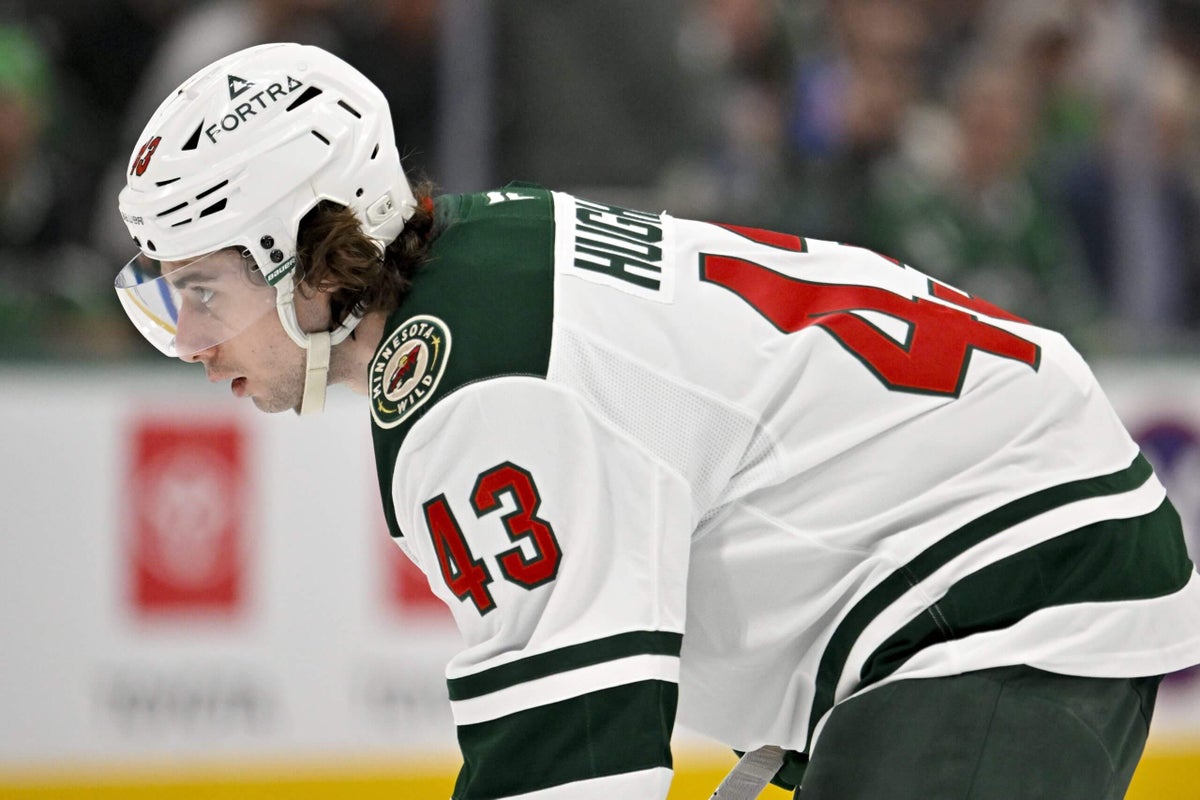
DALLAS — What started as a harmless neutral-zone faceoff turned into the Quinn Hughes Show.
It was last Thursday in Dallas, with the much-hyped showdown between the Minnesota Wild and Dallas Stars serving as a spicy preview for the upcoming first-round series. The Wild were down 1-0 midway through the first, but Hughes — the 2024 Norris Trophy winner — nearly singlehandedly changed that.
On a quick regroup at the Minnesota blue line, Hughes picked up speed as he started a give-and-go with Mats Zuccarello, who was positioned at the Stars blue line. Hughes then blew by several Dallas defenders, including one of the NHL’s best defenseman, Miro Heiskanen, on his way to beating Jake Oettinger bar down to tie the game.
The vision. The skating. The playmaking ability. All are elite.
“He’s one of one, almost, in the league,” Chicago Blackhawks star Connor Bedard says.
“I’ve never seen anything like it,” Vegas Golden Knights coach John Tortorella says.
“A difference-maker,” says Philadelphia Flyers coach Rick Tocchet, Hughes’ former coach with the Vancouver Canucks. “He’s a guy, in a seven-game series, that can tilt the series in your favor.”
And that’s precisely why Wild president of hockey operations and general manager Bill Guerin gave up a haul in a mid-December, franchise-altering blockbuster to acquire Hughes from the Canucks. Minnesota, which hasn’t won a playoff series in a decade, boasted arguably the best team in its 25 years in the league but needed another big swing to put itself over the top.
Playing in the same division as two other top teams, the Colorado Avalanche and Dallas Stars, many around the league believe Hughes could be an X-factor in the playoffs — much like Cale Makar is for the Avs and Heiskanen for the Stars.
Hughes, who wasn’t at Tuesday’s finale and didn’t take part in the Wild’s “Jersey off our backs” event, didn’t practice Thursday because he was sick, but is expected to be on the team’s flight to Dallas in the afternoon, where they hope he’ll be healthy enough to practice Friday.
“The Wild are a Stanley Cup threat, no doubt, because they’ve got Quinn Hughes,” says Cup winner Brian Engblom, who now does color for the Tampa Bay Lightning. “He’s the elite of the elite. That’s the one thing that really puts you over the top, is when you have a guy that can play 30 minutes. He’ll play 35 minutes in some of these games, and he’ll be in control 9 1/2 times out of 10. What’s the price on that? He’s fascinating to me.”
Why can Hughes be a series-swinger for Minnesota? The Athletic spoke to players and coaches around the league for their insight.
Nobody has the puck more than Hughes, and that’s not an exaggeration.
The Wild defenseman leads the league in puck possession time this season at 285 minutes, 34 seconds, far ahead of second-place Lane Hutson, who had the puck on his stick for 229:13, according to Sportlogiq. He’s a one-man breakout, a play-driver and a stabilizer who can get the team out of trouble.
“He reminds me of Bobby Orr,” Engblom says. “The way he skates, the way he thinks the game, the way he controls the game for 27 to 32 minutes. A guy can play that much and look like he’s not even sweating. He’s so easy. So much flow to his game. He knows instinctively what’s happening, where to put the puck. He’s a great passer. He has that sweeping, surfing style.
“Scott Niedermayer was a lot like that. He could completely disarm plays and take care of things defensively and turn it and go. His escapability is so much like Orr, too. They can’t even touch him. The guy is right there, and then he’s three steps behind. It’s just like that.”
Hockey IQ is Hughes’ superpower, with his instincts part innate, part earned.
He’s from a huge hockey family. Brothers Jack and Luke Hughes are both NHLers, and their parents, Jim and Ellen, are also heavily involved in the game. Their summer skates in Michigan, led by Jim, are legendary, featuring stars like Dylan Larkin, Zach Werenski, Kyle Connor, Connor Hellebuyck and Jake Sanderson. Hughes has meticulous preparation, which comes from being an admitted “hockey nerd.” He watches a ton of hockey.
His college coach at Michigan, Mel Pearson, saw it from the beginning.
“He thinks it 24/7,” Pearson says. “He takes great pride in it. He’s so competitive. He’s always thinking about the game, watching other teams. He’s got a love of the sport. Most of the great players love it, have passion for it. Some think they do, but they don’t really. As (former Michigan coach Red) Berenson would say, ‘Have that fire in your belly like Quinn does.’”
Tortorella says he focused on Hughes intently as his assistant coach on the U.S. Olympic team, paying attention to how Hughes prepared for practices and games.
“He’s all business,” Tortorella says. “He leads the way in understanding preparation and wanting more. He’s special, man.”
“He’s a killer,” says Stars defenseman Tyler Myers, Hughes’ teammate in Vancouver. “He’s really dissecting how to pick apart other teams each and every day.”
Tocchet recalls that when he first got the Canucks job, Hughes told him, “Tocc, I’m going to increase my shot velocity. There’s a couple things I want to try.”
“And he worked diligently, and he did,” Tocchet says. “I bet you he put 12 miles an hour on his shot and ended up scoring 20. He just did some stuff where you can tell it was reps and reps of stuff.”
Hughes doesn’t have the size of other shutdown defensemen, but he doesn’t need it with the way he plays.
“You can defend in other ways. Is he going to go flying in the corners and knock people around? No,” Tocchet says. “But he defends with his brain and his quickness. He would challenge me because he’d go, ‘Tocc, I want to be out there last minute.’ Sometimes we didn’t put him out there when I first got there, and he’d challenge us. I want to get out there last minute because he wants to be known as a defender. Little bit of a chip early on that, ‘Hey man, I can defend,’ and that’s what I love about him.”
For years, the Wild have been looking for a legit No. 1 center. Or a scoring winger.
The idea is to spark more offense. In previous playoffs, they’ve relied too much on Kirill Kaprizov and Matt Boldy.
Hughes didn’t fill either of those openings, but he did solve the problem. The Wild have been a more potent and balanced offense with him. Part of that is Hughes’ skills in breakouts and transitions, with his 13.4 zone entries per 60 minutes second to only Matthew Schaefer, per Evolving-Hockey. And Hughes does a tremendous job turning those into chances.
Before Hughes arrived in mid-December, Minnesota was 14th in the NHL in expected goals per 60 at five-on-five (2.69) and 31st in actual goals per 60 (2.07), per Evolving-Hockey. With Hughes, they’ve moved to seventh in expected goals for per 60 (2.98) and 10th in actual goals per 60 (2.80). Their power play got a big boost too, where the Wild went from middle of the pack to a top-five unit in goals, real and expected.
“Quinn Hughes changes the look and feel any time he touches the ice surface,” Blackhawks coach Jeff Blashill says. “They had a really good team before they got Quinn, but they’ve got a better team with him. There’s zero doubt. He’s just that kind of an impact player. Every time he’s on the ice, he’s super dangerous.
“I look back to one of the goals they scored late against us in Minnesota. I thought we defended him all right, but he still found a way to get the puck to the net. Next thing you know, it’s a tap-in goal. That’s what he can do. He’s an automatic breakout.
“Unreal competitor, unreal person and one of the very, very elite talents of our league.”
The Wild score 3.72 goals per 60 with him on the ice at five-on-five, which is tops in the league for everyday defensemen, per Evolving-Hockey. To put that in perspective, that’s a 1.05 goals per 60 increase relative to his teammates.
“He has the puck on his stick the whole time,” Lightning coach Jon Cooper says. “He can create offense. He defends. He’s a unique, dynamic player. There’s not many guys like him at all. So he’s clearly made them better.”
Ryan Hartman has played well as the team’s No. 1 center with Kaprizov and Zuccarello, and Joel Eriksson Ek is their top two-way, shutdown center who anchors the Boldy line. The fact that the Wild have play-driving wingers in Kaprizov and Boldy and now an elite puck-mover in Hughes has mitigated the need for the major acquisition up the middle.
Tocchet says that before a late-season game in Minnesota this season, 12 minutes of their 15-minute prescout was dedicated to Hughes.
“It’s a different game now,” Tocchet says. “You need four people in the rush. You need three or four people in the corner to squash plays.
“He’s a high-wire act when it comes to — there’ll be a winger on him, and somebody will come flying at him. Most D will just reset the puck behind the net. He’s like ‘No.’ He’ll take them on and beat somebody like a basketball guy.
“He doesn’t just defer to throw it away. He goes, ‘OK, I’ll go around you then,’ and then when he goes around you, he’s got a free lane to the net.”
Brock Faber has talked often about how playing with Hughes has significantly improved how he plays offensively. How he sees the game.
“There’s a lot of things that you learn from him in such a short period,” Faber says. “The way he sees the game is just different than 99 percent of the league.”
You can see it in how much more comfortable and confident Faber is moving the puck up the ice, creating offense, pinching. He’s shooting more. And he doesn’t have the burden of being the No. 1 guy. He can focus on his defending.
When they’re on the ice together, the Wild handily control the run of play, producing much more offense (3.94 goals per 60, per Evolving-Hockey) than with Faber and Jonas Brodin as the top pair (2.33).
“If you’re down a goal or down a couple goals, it doesn’t feel like you’re ever out of it,” Faber says. “(Hughes) can make two plays or a play like that, so quick, every shift, if he’s pushing for it. He wants to play in big games, wants the puck on his stick in big games.”
The Hughes-Faber combination has a trickle-down effect on the rest of the blue line. That means Brodin and captain Jared Spurgeon, who have so much chemistry together, can be a formidable shutdown pair. They combine for a plus-9.1 Defensive Rating and make up one of the top pairs in the league. The duo’s shot suppression is also elite, limiting opponents to 2.08 xG per 60 at five-on-five. And, boosted by their goaltending, Spurgeon and Brodin have allowed even fewer goals against (1.33 per 60).
The Stars are a very deep offensive team, so the Wild will need their top four to all play at a high level. Jake Middleton, no longer in a top-four role, has fit well with Zach Bogosian on the third pair.
Is Hughes 1B to Makar? Or vice versa?
“He’s 1A,” Pearson says. “Nothing against Cale Makar or Zach Werenski or these other defensemen, but he’s as good as any of them. On certain nights, he might have a better night. You talk about franchise defensemen who are all-world, and I put Quinn 1A.”
Stars goaltender Jake Oettinger has long admired Hughes from afar. When he saw Hughes traded to the Wild, he was happy for him but “also kind of mad, because I knew we were going to see a lot of him,” he says.
“He’s one of the best defensemen in the league,” Oettinger says. “And it’s not surprising how good he’s done for the Wild and how good they’ve been since they got him.”
As Engblom points out, just getting out of their own division will be extremely challenging for the Wild. But how the likes of Hughes, Makar and Heiskanen play can go a long way in determining who wins.
“Those guys know how to dominate in those situations, when you’re down by a goal or two goals and it’s late in the game, ‘Whatever you got to do, kid, do it,’” Engblom says. “The rest of us will figure it out and cover up. That’s the luxury you have when you have a guy like that.”
Hughes has been a big-game player, as shown in the Olympics, where he played more minutes than any skater. His overtime goal against Sweden will forever live in hockey lore in the United States.
“I just love the way he competes,” says Adam Foote, Hughes’ last Canucks coach. “You can sit there and talk about the tools he has and the skillset, but it means nothing if he doesn’t compete like he does. He wants to win. He wants to be on the ice. He wants to be in the big moments. You saw it in the Olympics. It’s who he is. He’s got a lot of swag, but it’s good swag.”
— Data via Dom Luszczyszyn, Evolving-Hockey and AllThreeZones. Shayna Goldman contributed to this story.