
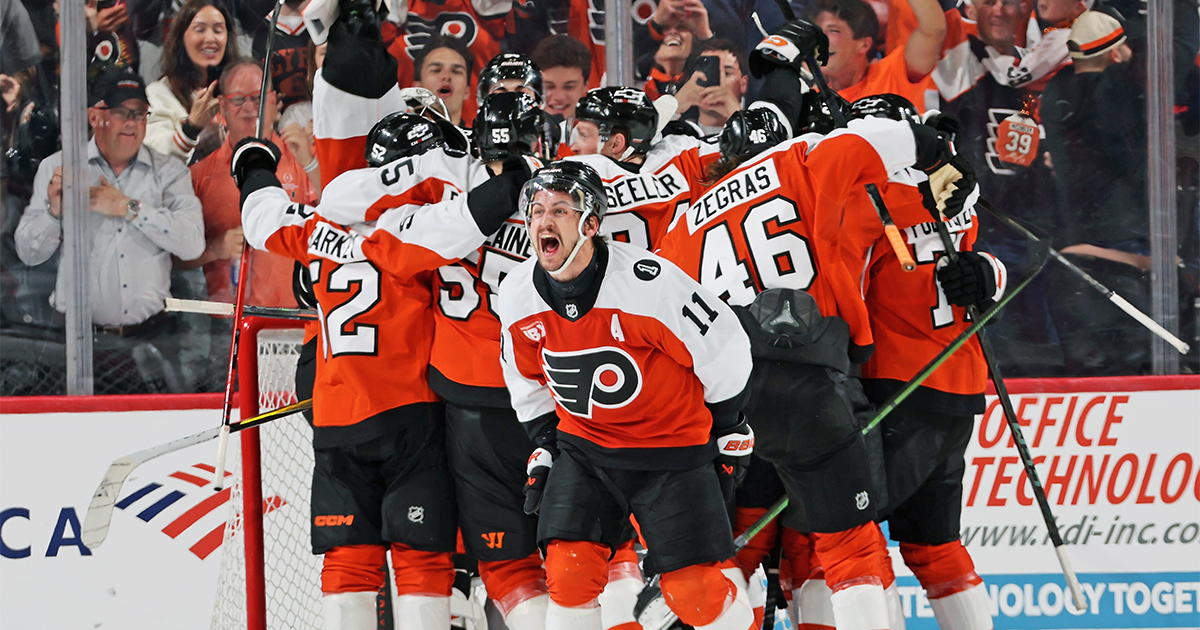
In a season full of ups and downs, first-year head coach Rick Tocchet and an unexpected core of rising stars has given the city’s most devoted fan base — and Bryce Harper — hope.
Get a compelling long read and must-have lifestyle tips in your inbox every Sunday morning — great with coffee!
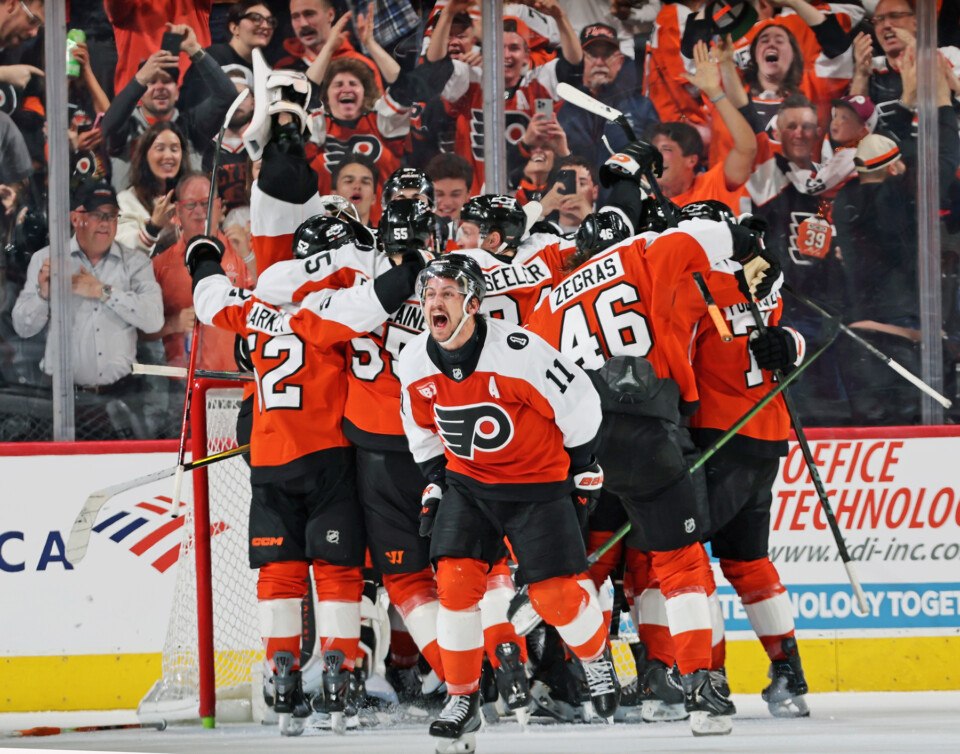
Travis Konecny of the Philadelphia Flyers leads the celebration with his teammates after defeating the Carolina Hurricanes 3-2 in a shootout at Xfinity Mobile Arena on April 13, 2026 to clinch a spot in the 2026 NHL Playoffs. / Photograph by Len Redkoles/NHLI via Getty Images
Here’s a sentence that has not been written in six years: The Philadelphia Flyers are in the Stanley Cup Playoffs.
Are they gonna win the Cup? Probably not. But having missed the playoffs every year since 2020, and 10 times since 2012 — when current captain Sean Couturier was a rookie living in the home of current general manager Daniel Briere — merely making them is huge.
The Flyers clinched the spot on Monday in a shootout win over the Carolina Hurricanes that ended, fittingly, with a save by Dan Vladar, the lanky Czech goaltender who had been a career back-up in Calgary, but whose play and confidence were so vital this season that he won the Bobby Clarke Award as the team’s MVP. Flames shot from beneath the scoreboard as a building full of people clad in Flyers jerseys from every decade since the ‘70s cheered, screamed, cried, hugged, and — let’s face it — exhaled in relief. Vladar pumped both his catching glove and stick hand in the air before his teammates spilled over the boards to mob him at the crease, with 19 year-old rookie winger Porter Martone the first to arrive.
Which was also fitting. Martone, the Flyers’ first-round pick in 2025 — he was playing for Michigan State as recently as March 28th — got the team back into playoff position on April 5th with his first professional goal, banging home his own rebound for a 2-1 overtime win against the Boston Bruins. The next night, Bryce Harper got on the bandwagon, concluding his post-game interview on NBC Sports Philadelphia with “Go Flyers!” By the time the Flyers start their first-round series against in-state nemesis the Pittsburgh Penguins on Saturday he will probably be wearing orange Gritty cleats. Oh, and by the way: Because the 2020 NHL playoffs were in the COVID-19 “bubble,” Games 3 and 4, to be played in South Philly next week, are also the Flyers’ first home playoff games since 2018. Yes, that’s right: Gritty has never seen a playoff game.
A team of destiny? Maybe. The season was not so much a rollercoaster as a hockey version of “the blind man and the elephant.” Depending on the game or week or month, the Flyers under first-year head coach and franchise legend Rick Tocchet were a pleasant surprise, a work-in-progress, a hard-luck injury story, overachievers, a team that fell to earth, a complete disaster, or a genuine contender. And depending on which corners of the hockey internet you favor, Briere has either been a patient, savvy roster-builder who enabled Tocchet to establish a winning culture with both veteran Flyers and a group of exciting younger players, or the GM blew the trade deadline while allowing Tocchet to mishandle the team’s most exciting younger player. (We’ll get back to that.)
What the team had billed “A New Era of Orange” began in June of 2023, with new Comcast Spectacor chairman Dan Hilferty hiring former Flyers player and broadcaster Keith Jones as President of Hockey Operations and Briere as general manager. This year, the slogan changed to “Brick By Brick,” which could have just as well been, “Yes, We’re Still Rebuilding.” Instead, Flyers fans got something even rarer than a championship — a South Philly renovation that’s ahead of schedule.
I covered the Flyers at various points this season from the press box and the locker room, but I’m also pretty much a lifelong fan; I like to say that I’m the same age as the team, which played its first game at the Spectrum in the fall of 1967. My clearest childhood memory of the Broad Street Bullies is neither a game nor a parade, but a gas station souvenir glass with a Flyers logo on the front and the names of every coach and player from the 1974 Stanley Cup champions on the back. From the ‘80s until now, I remember it all, which means I’ve also suffered every kind of playoff heartbreak, as well as a few triumphs prior to the heartbreak: Eric Lindros and the Legion of Doom sweeping the Rangers in 1995, Jeremy Roenick’s overtime goal against Toronto in 2004, and the 2010 team that came back from a 3-0 deficit against the Boston Bruins — I was at Game 4 — and then made the Stanley Cup Final. There’s no cheering in the press box, but as a jubilant Travis Konecny (one of just three current players who was on the last Flyers playoff team in 2020) joined Martone around Vladar to celebrate the team’s return to relevance, my grin was as huge as it was quiet.
Goodbye Cutter, Hello “Ziggy”
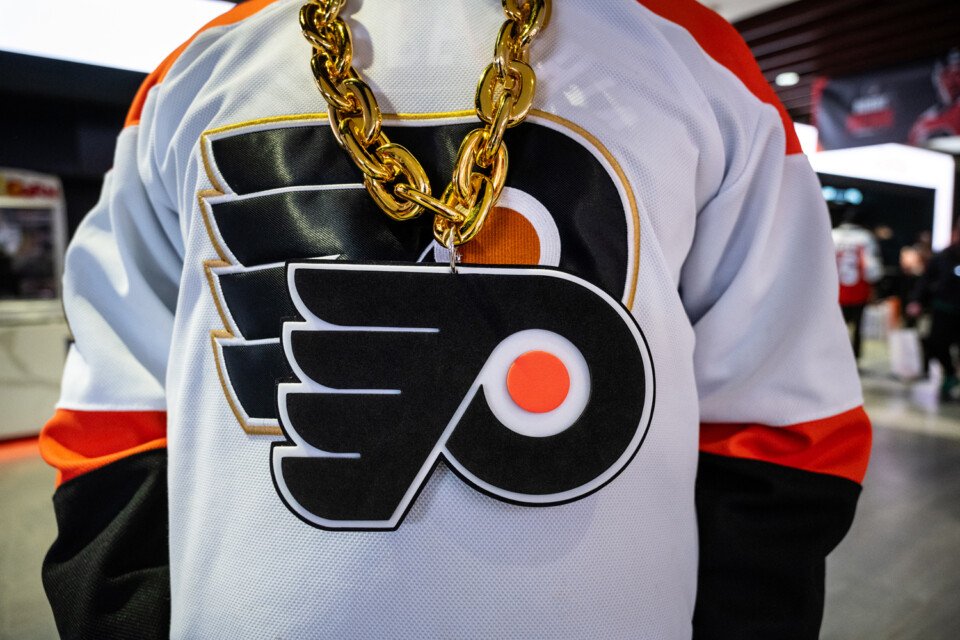
A fan shows off his style. / Photograph by Kyle Kielinski
It all seemed meant to be on January 6th, when the Flyers beat the Anaheim Ducks, 5-2. On what would have been team founder Ed Snider’s 92nd birthday, the Orange and Black gave fans at a sold-out Xfinity a night of Broad Street Bullies-worthy hockey — goals, a fight, big hits, an almost hat trick, another fight, more big hits — with the ecstatic crowd of 19,415 bringing all the noise, as well as the occasional profanity.
“Great atmosphere,” said defenseman Cam York afterwards. “It felt like a playoff game. It was really cool. Should maybe happen more than once a year, obviously.”
York was not exactly dissing the fans with that last comment, but rather, referencing why this particular game was not like any other. Because Philadelphia-Anaheim is not supposed to be a — sorry — heated rivalry. The Ducks are not the Rangers, Penguins, or New Jersey Devils. But they are the team with Cutter Gauthier. And he’s a player who will never feel love in the City of Brotherly Love.
Portions of the Flyers faithful already do their best to justify the Philly fan cliche, with de rigueur pre-game boos for both the opposition and the referees, plus a ritual “SUCKS!” coming out of the cheap seats in response to the announcement of each player in the road team’s starting line-up. But for Gauthier, the booing is both targeted and infinite. When he first steps on the ice. When he lines up for a face-off. When the puck is on his stick. When the puck is nowhere near him. The booing only stops to give way to chants of “FUCK YOU CUTTER.” clap clap clap-clap-clap. “FUCK YOU CUTTER.” Or just, “CUT-TER. CUT-TER.”
That’s because Gauthier is to the Flyers as J.D. Drew was to the Phillies: a much-ballyhooed high draft pick who refused to play in Philadelphia, for reasons that remain unclear. (Gauthier called it “a private matter.”) He was taken fifth overall in the 2022 NHL draft; in January of 2024, the Flyers traded him to Anaheim for defenseman Jamie Drysdale (the sixth overall pick in 2020) and a future second-rounder.
On this night Gauthier got the first laugh, giving the Ducks a 1-0 lead early in the game. Boos descended. But the Flyers owned the game from there, fueled by forward Trevor Zegras, who was playing for his own pride against a former team. A flashy goal scorer with 400,000 Instagram followers who’d begun to struggle with the Ducks, he was acquired by the Flyers prior to this season. “Ziggy” scored two goals four minutes apart to make it 2-1, with York getting the next one. They all came on the sort of plays there hadn’t been enough of in South Philly, the ones that both get you out of your seat and win you a big game.
“The boos were great, but the cheers were even better,” Zegras said during his live, on-the-bench post-game interview with former Flyer and NBC Sports Philly commentator Scott Hartnell. An irrepressible personality whose wild, sometimes curly, sometimes straight mane almost rivals Brandon Marsh’s, the 24-year-old celebrated his first goal by pretending to hang up the phone on Anaheim after they informed him of the trade. (“That’s about how quick the phone call was”). Zegras also had his very own Chase Utley moment when Hartnell asked him how it felt to score two goals against a team that gave up on him.
“Fucking amazing,” he said, “Fucking amazing.”
“Yeah,” Hartnell muttered in reply, no doubt thinking of his Comcast higher-ups.
“Oh yeah!” Zegras replied.
Last year, the 33-39-10 Flyers were the worst team in the Eastern Conference. But at that point under Tocchet, beating Anaheim was just another win, as the team improved its record to 22-12-7 at the season’s exact midpoint, while also holding down that third place Metropolitan Division spot. As York reiterated when asked about how physical the Ducks game was: “That’s playoff hockey. And we feel like we’re a playoff team.”
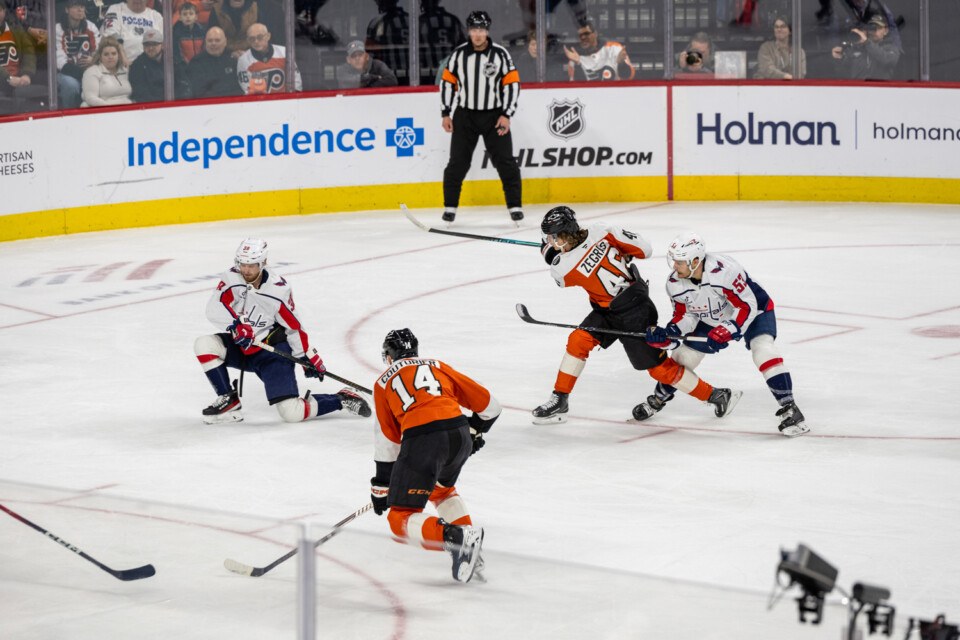
The Flyers in their 4-2 win versus the Capitals on February 3rd / Photograph by Kyle Kielinski
For the first time in a long time, even the most casual fans could get loud about something besides Gritty. “I’ve heard that,” Tocchet said after an earlier win against New Jersey. “I’ve lived it here. This crowd, when they get something to cheer about, it’s loud. You know they want to believe in our team, and that starts on the ice with us.”
The expectation Briere set before the current season was improvement, and, after last year’s spate of future-looking (and draft-lottery minded) white-flag trades, at least the possibility of battling for a playoff spot. “We expected to be competitive,” the GM said during a press availability before the Ducks game. “[This year’s team is] maybe a little better than I expected, to be honest with you. The funny part is, we can win two games and be in first place, or we could lose three and be in last place. It can change really quick.”
And so it did. Over the next month, as the NHL went into its Olympic break, the Flyers went 3-8-4, sinking all the way to 13th place in the Eastern Conference, with seven teams ahead of them for playoff spots. On January 7th, the hockey analytics website Money Puck gave the Flyers a 63.3 percent chance at the playoffs; by February 6th, that had dropped to 10.6 percent. “We knew that this team has not arrived yet — is not a Stanley Cup contender,” Briere told me on January 31st.
Injuries, too many games in too many nights (thanks a lot, Olympics) and three tough road trips played a part. And it probably should have been expected that one of the youngest teams in the league, adjusting to a brand-new coach, would have its growing pains. But the players didn’t want to make excuses.
“We sucked today,” were captain Sean Couturier’s first words after an especially dispiriting January home loss to the Rangers, one of the NHL’s worst teams. A few weeks later, Konecny, the team’s alternate captain and second-longest tenured player after “Coots,” also didn’t hold back his frustration. “I have been through this so many times,” Konecny said after a loss to Boston. “I am tired of missing the playoffs.”
Enter Rick Tocchet
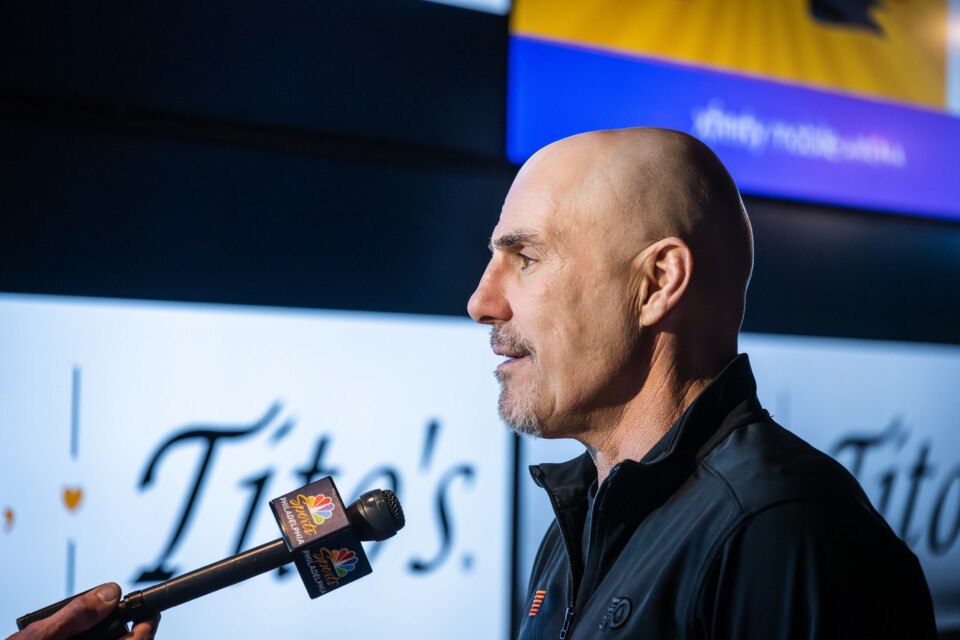
Rick Tocchet / Photograph by Kyle Kielinski
Rick Tocchet, inducted into the Flyers Hall of Fame in 2021, didn’t have to become head coach of the team to be present at most every game; there was always going to be someone in the stands wearing a #22 from his playing days. Presumably a few people also bought a crisp new version of the jersey after he was hired as head coach, too.
Neither thing was true of Katie Carr, a 29-year-old hairdresser who moonlights at Citizens Bank Park during Phillies season. I ran into her back in February at the Flyers Charities Carnival, one of the team’s signature events, where fans wait in 100-person lines all over the arena to get player and alumni autographs. The good vibes of the February 1 carnival came at a time when all the other vibes were bad. Carr was sporting a Tocchet jersey that had been turned into a jacket, complete with a full zipper. Obviously she didn’t grow up watching the 1980s Flyers; the jersey was a hand-me-down from a friend because it didn’t fit her. And when I asked Carr how she felt about him as the Flyers coach, her response was muted.
“Um … okay!” she said, with just a hint of a question, before adding that while she may have nitpicks about his coaching strategies, she also knows it’s just Year One. And while one common gripe about the franchise with more jaundiced fans is that it can’t stop hiring former Flyers, Carr doesn’t necessarily think this is a bad thing. “Flyers hockey is a different brand from the rest of the NHL,” she said. “You gotta [have] someone familiar with what the team and the city means.”
Indeed, Tocchet is a poster boy for, in his own words, “what it is to be a Flyer.” He wore the uniform 11 seasons — the first eight years of his career, and then again from 2000 to 2002. “Some of the closest teams I’ve ever played on, that won, were in this city,” he told me. “It’s a family. That’s what a Flyer is, being a family. I don’t think it’s cheesy at all. I really believe that.” A good employee, he was also quick to say that the environment which existed in the Snider era isn’t all that different under Comcast, including how well the players are taken care of both on and off the ice.
That starts with Hilferty, who got the job as Comcast Spectacor president because of his experience (and connections) in the business world, but is also a huge fan. As a young child, the now 69-year old actually used to watch the Jersey Devils — as in the Cherry Hill minor-league hockey team that existed from 1964 to 1973, not Josh Harris’s Newark NHL club. As a St. Joe’s freshman, he and a bunch of other students made their way to Broad Street for the second Stanley Cup championship parade. Now he’s the face of ownership, i.e. Comcast. He can’t be Ed Snider, but part of the job is to bond with both the players and the fans, just as Snider did and John Middleton does for the Phillies. Count Hilferty as someone who firmly believes it matters that Tocchet played here twice. “He has such a passion for — he calls it the crest,” Hilferty told me (and Tocchet did indeed say “it’s all about the crest” during our interview, as he has in others).
“He not only has a passion for the Flyers’ logo-slash-crest, but he has a passion for Philadelphia,” Hilferty continued. “I’m a homer, I admit to it. I’m always going to lean towards someone who gets us. And he not only gets us, he’s one of us.”
Once a green-but-ornery kid from Scarborough, Ontario, Tocchet holds an unofficial NHL record with 18 career “Gordie Howe hat tricks” — a goal, an assist and a fight — a mark that is unlikely to be broken given there are not as many fights these days, let alone fighters who can also put up points. Tocchet eventually had five seasons with 30 goals or more, including 45 for the Flyers in 1989. He also used to have an epic mullet, now supplanted by a shaved head and goatee.
Where some players, including several on the current Flyers team, come into the league with abundant natural talent that they have to harness and round out with improved defensive play and good decisions, Tocchet came into the NHL with nothing but, yes, here it comes — grit.
“I didn’t have the skill,” he said. “So I had to do certain things to survive in the NHL.” That was not just fighting, but tenacity and work ethic, both of which he got from his father. “My dad was a mechanic who worked 12 hours a day. I watched him go to work every day, six in the morning, come home at six, not even have dinner, and take me to the hockey rink.” At Flyers practices, you can still see Tocchet’s hockey lifer/rink rat side, as he wields the shovel to clean up snow build-up along the boards, or digs out all the pucks that have been shot into the net.
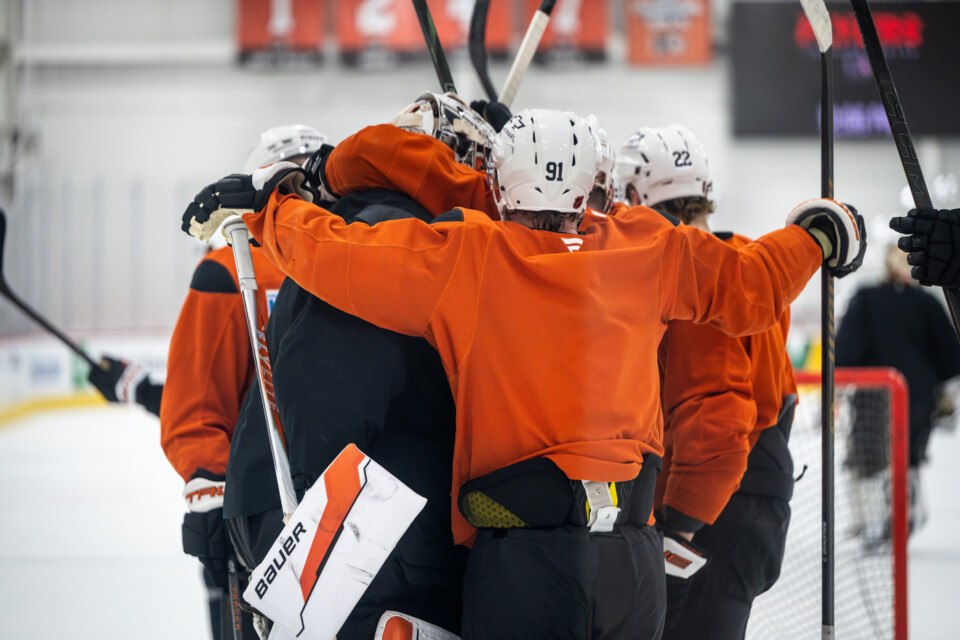
Flyers at their practice facility / Photograph by Kyle Kielinski
“He was the ultimate team guy,” said former Flyer and Toronto Maple Leafs head coach Craig Berube, who was not only Tocchet’s teammate in Philadelphia but spent 11 years coaching in the organization, including in the head job. “He was really helpful to me as a young guy coming in the league. He’d already been in the league a couple of years, took me in, and kind of just showed me the ropes. That’s the kind of guy he is, and guys like that end up becoming coaches.”
Tocchet was the NHL Coach of the Year with the Vancouver Canucks in 2024, when the team lost in the second round of the playoffs. Before that, he coached the Arizona Coyotes, where his .490 winning percentage and one playoff appearance over four seasons was considered overachievement for that star-crossed franchise (which is now the Utah Mammoth). His greatest claim to coaching fame was as an assistant with the Pittsburgh Penguins, where he worked closely with superstars and Flyers enemies Evgeni Malkin and Sidney Crosby, and won two Stanley Cups.
This year’s Flyers players have been self-critical and accountable to each other in a way that reflects Tocchet, who is no softie, but has a lighter touch than his predecessor John Tortorella (not hard to do). Early in the season players like Konecny and Zegras would sheepishly acknowledge their defensive mistakes, while vowing to erase them (or at least make fewer). Tocchet saw his biggest job this year as building culture; “I’m a culture guy,” he’s said more than once since being hired. And not just any culture.
“The values of being a Flyer,” he says. “What a Flyer does. How does he prepare himself every day? When I first became a rookie, that’s what I was taught right from the beginning.” It was also surely no coincidence that Briere signed two free agents who had previously played for Tocchet, one of whom, center Christian Dvorak, had a career-best season and has since been signed to a five-year extension.
Tocchet’s culture-building bona fides were tested at the Flyers Charity Carnival, when, during an interview with the All PHLY podcast, he mentioned that 21 year-old Russian forward Matvei Michkov, who starred for the team as a rookie last year, had reported for this season out of shape, which is why he wasn’t getting as much ice time. This was not new information. Michkov (who only speaks to journalists occasionally through an interpreter) had said himself he didn’t skate all summer, in part due to an injury, and his play had clearly suffered, but it had a throw-him-under-the-bus quality coming directly from the coach’s mouth. It was bombshell news for Flyers fans on social media (many of whom had been complaining about Michkov’s reduced ice time), as well as national news in Canada.
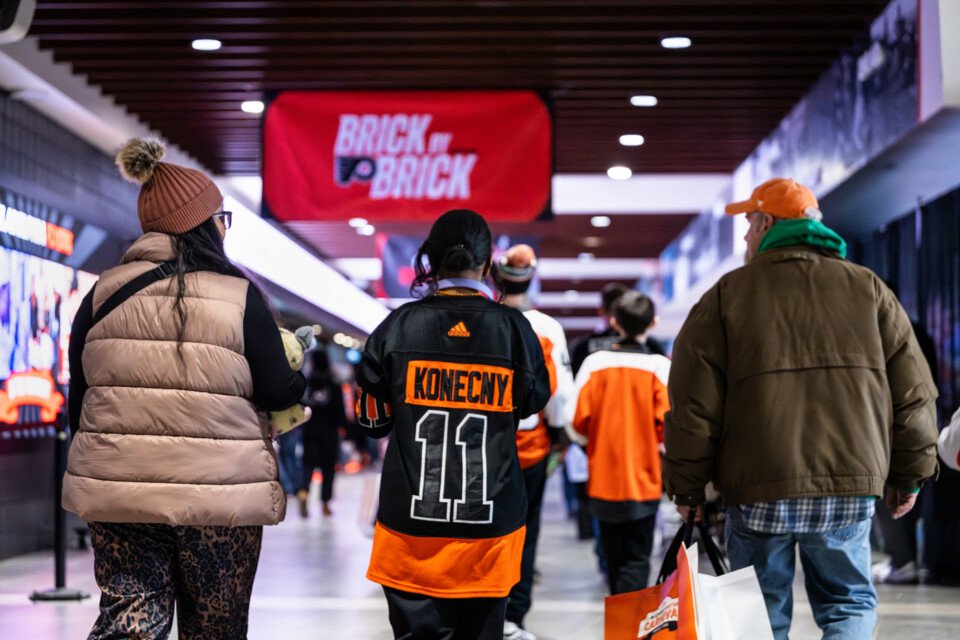
Flyers fans at Xfinity Mobile Arena / Photograph by Kyle Kielinski
“Is Tocchet going to get fired?” a friend of mine in Vancouver jokingly texted me before the next game, which was preceded by a hastily called Briere press conference to reiterate his commitment to both the player and his coach, as well as their ability to work together. The GM said that he himself had gone through similar rocky times that ultimately made him better, as have many All-Star players. In that moment, it seemed like things would either blow up worse or just blow over, but not until the off-season.
Instead, Michkov actually did get better. He used the Olympic break to ramp back up his training, was moved back to his preferred position (right wing instead of left) and has led the team in points (seven goals and 15 assists) since then, with key goals in both the Carolina clincher and a crucial 7-1 win over Winnipeg two nights before. “He’s done a nice job,” Tocchet said as the season wound down. “I think he’s really taken the information and applied it.”
It was one of many things that went right in March and April, including minor system changes, revamped line combinations, often-otherworldly play from Owen Tippett (the team’s leading goal scorer with 28) and, perhaps most satisfyingly, the return of reasons to chant “COOOOOOOOOTS” at the arena, as Sean Couturier also turned around his season.
Couturier, who had inherited the title of Philly’s longest-tenured athlete from Brandon Graham, has been everything a hockey captain should be, from doing the so-called “little things” you can’t see in a box score to facing the media after a bad loss. But he also didn’t score a single goal between December 7th and February 28th, and after spending 14 years as one of the best players on some mostly not-great Flyers teams, it was starting to look as though he wouldn’t be a big part of the future. Essentially demoted to the fourth line while still taking faceoffs, killing penalties, and switching between wing and center (in tandem with underrated waiver pick-up Luke Glendening), Couturier has been as big a part of this as anyone, including on the scoresheet: three goals in five games at the end of March, and two huge ones in that win over Winnipeg.
“All year, but especially after the break, he’s just [been] like, ‘Whatever you need me to do, I’ll do,” Tocchet said before the Hurricanes game. “He’s just doing whatever it takes to win. That’s the culture we’ve tried to inspire here, and that’s what he’s doing. He’s been a Flyer.”
The March 6th trade deadline was also a big turning point, in the sense that was undramatic. Briere neither gave up on the roster nor went all-in. His decision to hold on to veteran defenseman Rasmus Ristolainen proved to be correct, and trading away Bobby Brink from a crowded group of wingers created opportunities for others. The lack of any major moves also seemed to prompt the players to say to themselves, collectively: Okay, this is who we are. And who we are is plenty.
The Flyers’ playoff hopes were still on life support as recently as March 11th, when Moneypuck gave them just a 4.2 percent chance of making it, even after a 5-2 post-Olympics start. They went 7-2-1 in March from there, and still only got that number up as high as 26.1 percent—not great odds. No one outside of the Flyers locker room believed that it would happen. Or even that it had to happen. The fans and the front office might have been content with the fact that every game still mattered. That merely chasing a playoff berth was enough. A cool experience — and a learning experience — in and of itself.
And then the cavalry arrived.
The Final Brick?
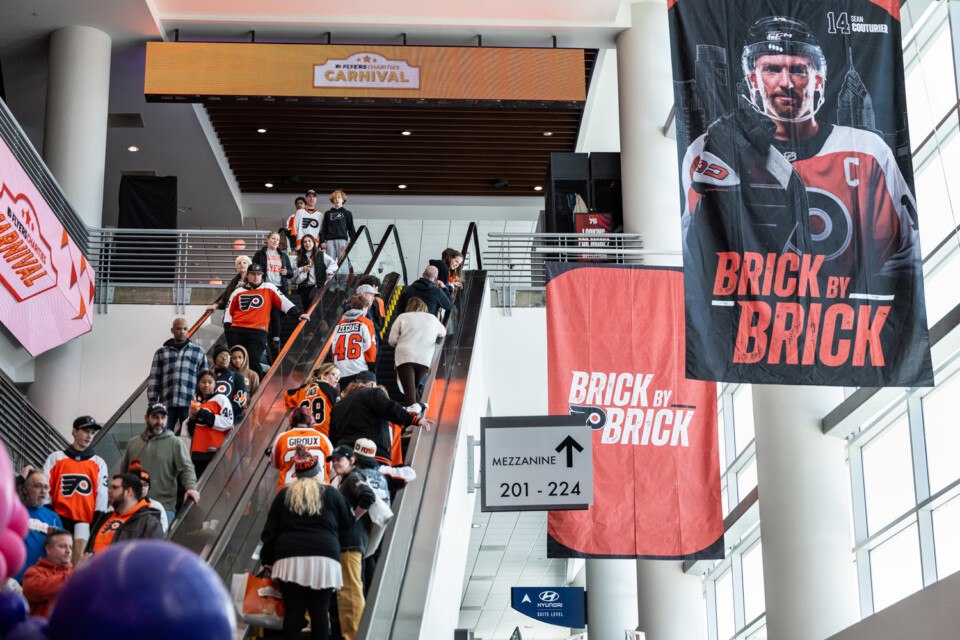
Fans at the Flyers Charities Carnival / Photograph by Kyle Kielinski
Another fan I met at the Flyers Charities Carnival back in February was Shane Donahue, who I approached because he was wearing the jersey of Nolan Patrick, a player the Flyers took when a bit of lottery luck got them the second pick in the 2017 draft. Like too many Flyers (Eric Lindros, Keith Primeau, Chris Pronger) he struggled with head injuries, except much earlier in his career. He was traded to Las Vegas in 2021, and retired one year later.
“Does it break your heart a little?” I asked Donahue of the jersey.
“It breaks my heart almost every time I wear it,” Donahue replied.
Patrick’s was gonna be the jersey Donahue could wear for years to come, as well as one of the players who was gonna help the Flyers win for years to come. Now Donahue is still trying to decide which player he might “invest” in next.
“It’s probably going to be a Zegras jersey,” he said. “Or maybe Martone”
Yes, Porter Martone. Porter Martone. His teammates call him “Marty,” but Philadelphians are better off with the full name. “I feel like this could be an all-time Philly name,” Bluesky user and Flyers fan “Steph G” wrote last summer. “Hoagiemouth implications aside, it’s plausible that an actual Martone has lived on Porter St.”
Martone would not even have joined the Flyers, at least not for a while longer, had Michigan State not been bounced out of the NCAA hockey tournament early. A junior hockey and college star, the Ontario native nevertheless grew up as a Flyers fan, and had already played with Konecny and Travis Sanheim on Team Canada at the IIHF World Championships last season. Prior to his home debut against the Red Wings on April 2nd, I spotted a tall young fan outside the Flyers merch store wearing what was surely one of the first Martone #94 Flyers jerseys to be sold; he peeled it off so an NBC Sports Philadelphia staffer could get a shot of him putting it on, for possible pregame footage. Conventional wisdom would have said that anything Martone provided would be a bonus; instead, his size (6’3”) and net-front presence boosted the Flyers’ offense, and, especially, its generally league-worse power-play. The kid wound up with 10 points (four goals and six assists) in just nine games.
He wasn’t the only surprise addition to the roster. Tyson Foerster, the team’s leading goal scorer this season before suffering what was thought to be a season-ending injury December 1st, returned to the line-up and scored a goal in his first game back. It was also Foerster who scored the winning shootout goal against the Hurricanes, before Vladar made it official with that final save.
Photograph by Kyle Kielinski
In the coming seasons, the Flyers still need better players. Maybe a center, maybe a defenseman, maybe both. During these recent lean years — dating back to the team trading away former captain Claude Giroux — the team has lacked for stars, something illustrated by what I like to call the Cure Auto Insurance Corollary. We’ve all seen the New Jersey company’s charmingly cheesy commercials (and completely unrealistic portrayals of sports journalism) with Saquon Barkley, Kyle Schwarber, and Tyrese Maxey. Cure even sponsors the Flyers’ pre- and post-game shows on NBC Sports Philly. But as far as I can tell, no Flyer has been in one since Wayne Simmonds, who has not been on the team since 2019.
Before this season, I would have said the next great Flyers player to be Cure-worthy was probably playing for another team (i.e., a future trade or free agent). But stars are also made by playing well. And by being in the playoffs. Suddenly this team has at least four or five guys with the charisma, skill and — let’s use it again — grit to capture Philadelphia. Zegras, Vladar, Martone, Konecny, Tippett — they could all sell you insurance. A clever copywriter might even work in Michkov and some Russian speaking “journalists.”
Not every team gets to walk together forever, as Fred Shero said about the Broad Street Bullies. And this Flyers team could also lose in the first round, and/or need a few more years to be a repeat Stanley Cup contender. But the playoffs are their own season, of two weeks or a month or two months. If the Flyers team of the past six weeks keeps playing like it has, who knows? The 2010 team almost didn’t make the playoffs (beating out the Rangers head-to-head, in a shootout, for a berth on the season’s very last day) and had no business being in the Stanley Cup Final, either. “Going through the playoffs and having the whole city rally behind you, there’s not too many better places than this,” said Briere, who was on that team.
It’s been a successful season either way. The team stayed patient and deliberate while exceeding expectations. Or maybe expectations were much higher all along. After the Hurricanes game, Dan Vladar revealed that Briere’s private comments were much different from his public statements.
“Maybe he doesn’t say it to media, but he told us at the beginning of the year — I hope he’s not gonna get mad at me — but he said the goal was to make playoffs,” the goalie said. “So there was always a belief in this room. Since day one.”
So much for “Brick by Brick.” Time to put in the Tofani door and roof deck.