
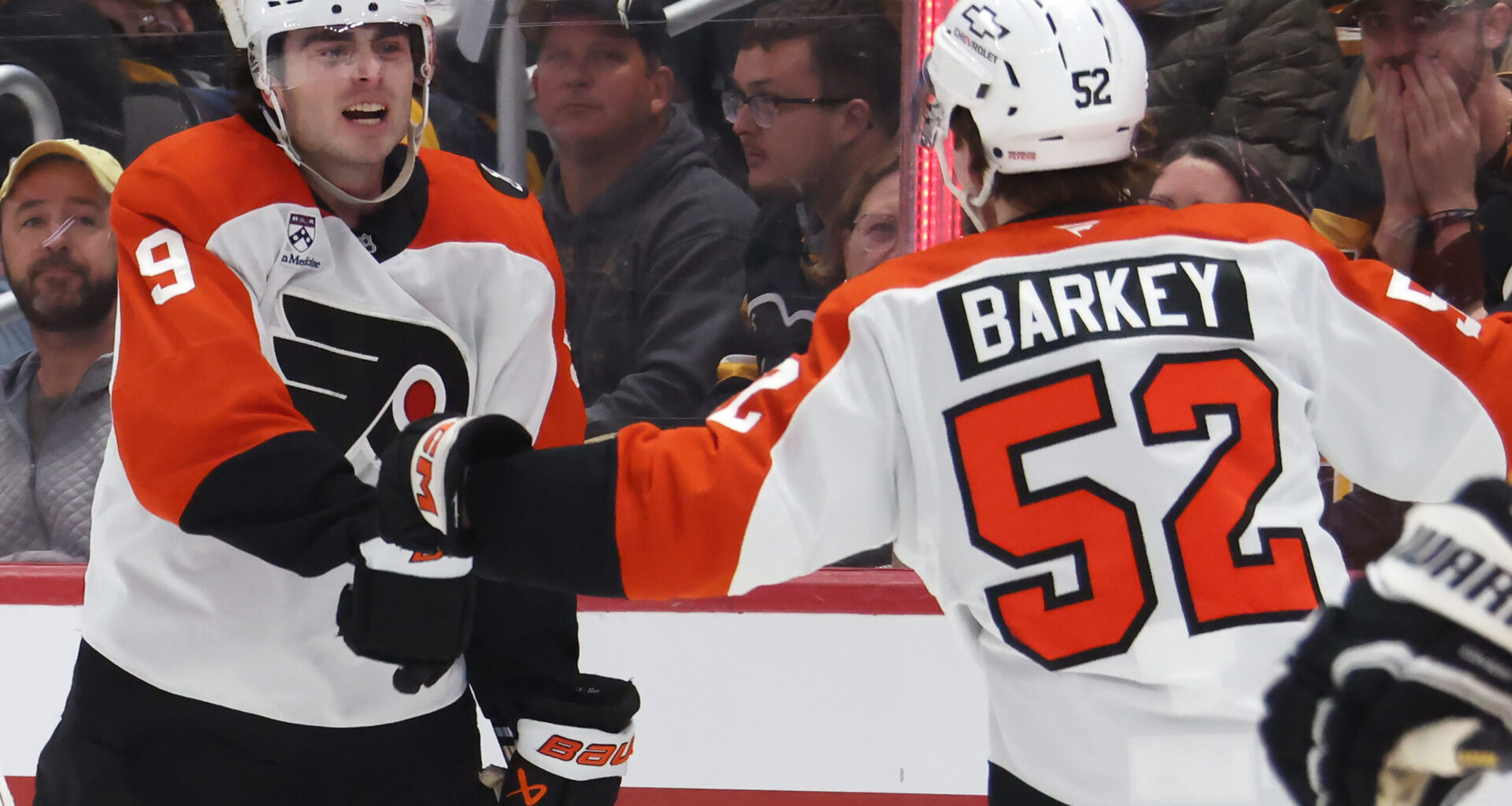
The Philadelphia Flyers lead their first round series against the hated Pittsburgh Penguins 1-0 because of a significant 3-2 win in Game 1. It was just about all you could hope for but the prize of it all — the reason that we can sit back and think about how the Flyers have won the opening game of this series is because of a team-wide commitment to squeezing the life out of everyone wearing black and gold.
Coming into this series, this was one of the key advantages that the Flyers had over the decrepit roster of the Penguins. All season long, they have been producing fantastic defensive metrics and grading out to be one of the best in the league at suppressing shots, keeping chances to the perimeter, and generally being able to control play from their own end as the priority to then hopefully translate that to the other end of the ice. It’s not the most pleasing hockey to watch, but it has been effective and we clearly see it worked during the Flyers’ own playoff push.
They didn’t sacrifice their morals to edge a step closer to loosening the defensive structure to then make the playoffs. It was an injection of pure top-six talent that coincided with a tactical change to be more offensively leaning but still, and again, not weakening the foundation that head coach Rick Tocchet has mixed and poured himself over the last several months.
It all came to fruition in the Flyers’ gutsy Game 1 victory.
Flyers’ stingy defense gave them well-earned Game 1 win
If you just take a glance at some of the numbers from Game 1, it doesn’t seem like a win earned by being the superior team defensively and that carrying over to impressive offensive moments.
The total shot attempts at 5-on-5 were 35-32 in the Penguins’ favor and the registered scoring chances were just 14-13 in the Flyers’ favor — two of the main metrics people look at to peek under the hood of a game, read as a fairly even matchup. But just diving a teeny tiny bit deeper and it paints a much more beautiful and gritty and hard picture.
At 5-on-5, the Flyers had a 28-19 advantage in unblocked shot attempts and considering that they actually lost the overall shot attempt battle, it is obvious that they were committed team-wide to get in front of the puck and not let anything even remotely come close to the middle of the ice. And then even closer, the Flyers had a 15-11 advantage in 5-on-5 shots on goal, which reads the same way.
But what is maybe even better, is taking the step into the expected goals category with the Flyers having a 60.1 percent share of the expected goals at 5-on-5 during Saturday night’s win, according to Natural Stat Trick. And just by looking at where both teams had their unblocked shot attempts from — the real, actual scoring chances — it is clear exactly why the number was a win for the Flyers.
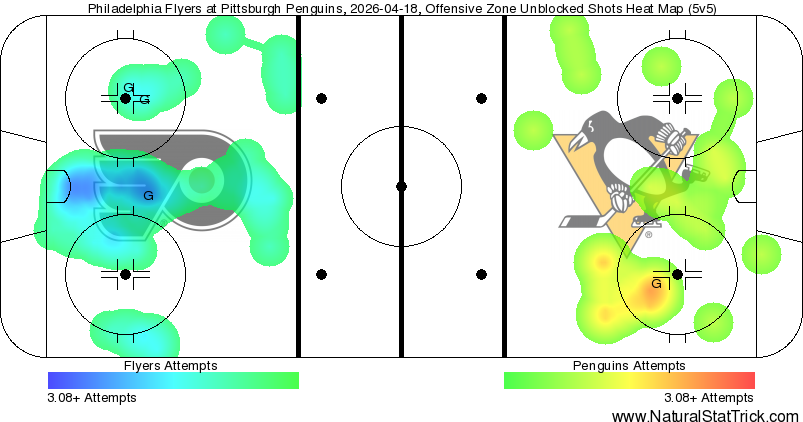
Just look at that. Take a real gander at just see how the majority of the Penguins’ real scoring chances were limited to that right face-off circle. Not even in the good part of it, but beyond the dot in an area that is theoretically not very dangerous, and that ended up being where Malkin scored the Penguins’ only 5-on-5 goal in the game. Outside of that area in the zone, there was just a smattering of attempts — the Flyers had a controlled and concentrated effort to limit chances in those key areas, barely giving the Penguins any breathing room to be able to get their shot off in actual meaningful spots.
And while we’re not really pointing out the Flyers’ offense, but in stark contrast, the Flyers had the overwhelming majority of their scoring chances from right in front of Stuart Skinner, as the Penguins let them waltz into that home plate area and fire off a chance. There was only one goal scored from there — Travis Sanheim’s tally where he was able to pull of a little feint move to quickly get into that prime scoring area from the blue line — but it is all about the chances that are available to you.
It was almost an example from the Penguins on what not to do in a potentially series-establishing game — to let your blue line collapse in a way that makes you seem extremely amateur and easily beat. Frankly, it was kind of embarrassing to see a team who supposedly finished second in a division in the National Hockey League be that porous in such an important game. Couldn’t be our favorite hockey team.
This also comes down to individual efforts from the Flyers.
Jamie Drysdale and Cam York appeared to set to carve out their own path and start their first playoff experience in the best way possible. They controlled play so extremely well by keeping the puck moving up the ice, getting in passing lanes against the top Penguins talent, and using all the physicality that they possess to push any opposing attacker to the perimeter.
According to hockeystats.com, that young pairing was on the ice together, the Flyers had 82.8 percent of the expected goals share while outshooting the Penguins 7-2. And while the top pairing did just fine — Travis Sanheim and Rasmus Ristolainen earned a 60.5 expected goals for percentage at 5-on-5 — it was evident with York and Drysdale that they were much more active than passive in their defense; making the right reads on a consistent basis rather than letting the attack come to them and then having to react.
It’s games like this that make you believe that something can happen, some sort of magic can happen for the Flyers.
Again, it’s not the most beautiful style of hockey but is it ever effective and it was executed extremely well in Game 1. It may take a flash of elite offensive talent from someone like Porter Martone or Trevor Zegras to end up with the well-deserved win, but that is all it will take as then the Flyers can choke the Penguins until their eyes bulge out of their head and the entire concept of producing any offense on the ice is completely foreign to them.