
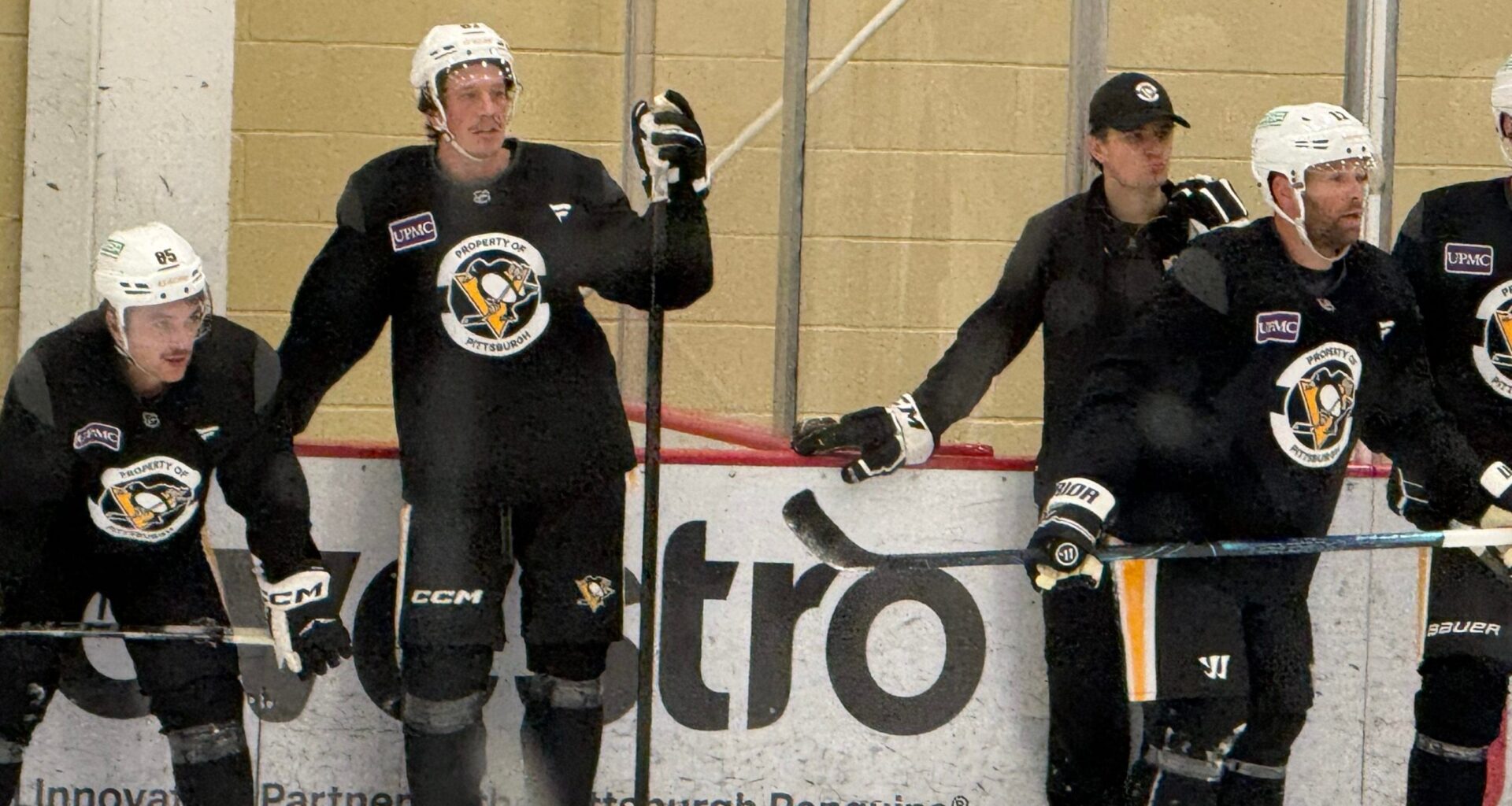
CRANBERRY, TWP., Pa. — It seems the second verse will be the same as the first for the Pittsburgh Penguins lineup. Same Penguins lines, same rotation as Game 1. The players will remain the same, but their game may not.
In advance of Game 2 against the Philadelphia Flyers, Penguins coach Dan Muse did not put the players through a high-intensity workout Sunday but focused on a couple of the pressing issues which sunk the Penguins’ effort in Game 1.
Muse, with assistant Todd Nelson, watched closely as they worked the top power play units for a significant portion of the 30 minute practice. The Penguins were 0-for-2 on the power play with just one shot on goal.
During practice Friday, the team worked on a high-zone cycle. It did not work well in practice against the Penguins’ aggressive penalty kill, and it was equally ineffective in the game. The play did not figure prominently Sunday as the Penguins are trying to figure out how to exploit the Flyers’ lowly ranked PK (22nd).
However, coaches put the Penguins through drills with line rushes designed for a simple tactic with many names, usually referred to as chip-and-charge or dump-and-chase. The line rushes didn’t focus on controlled zone entries and pretty finishes on the rush.
“It’s been a big part of their game for a long stretch now. Especially since (the Olympic) break, they’ve been a top defensive team in the league. (What they did) shouldn’t come as a surprise. There are some things that we could have done better in terms of just working through that. And we’ve seen it. We saw it there last night. We’ve seen with other teams throughout the (season),” Muse said. “Sometimes you’ve got to play a little bit more of a patient game. And by patient, I don’t mean a smaller game. You can’t get frustrated or surprised that they had those numbers back. They’ve been doing this
for a while now.”
Nay, the Penguins’ line rushed up the ice and dumped the puck into the zone. Nothing pretty. Nothing fancy. They worked on where to dump the puck, chasing it, and the subsequent puck support.
However, despite the continuation of the same lineup, Muse doesn’t seem to do so out of habit but trying to get certain players, such as Egor Chinakhov and Sidney Crosby, to mesh.
“We obviously didn’t generate as a team (in Game 1). If you go back before, I thought we had good offensive depth throughout the lineup, a balance that all lines were chipping in, creating, and creating in different ways. Anytime that you mix the lines up, each guy has personal strengths that they can bring, and some of those strengths are different from others,” Muse said. “With Chinakhov, where the question comes from, I think that his speed and his ability to push the (other) team back a little bit, or push the defense back and create space underneath. He’s also a guy that on the defensive side, he does a really good job in terms of the ability to track and bring pucks back in the offensive zone and keep it on the offensive side of the ice.”
If Muse makes changes, especially if it involves Chinakhov, or as some fans have posited, reuniting Rickard Rakell with Crosby, there would be a cascading effect of other changes as well. In short, one change would beget more.
And it appears that Stuart Skinner will remain in the Penguins’ net. He exited practice well before Arturs Silovs. Even though Skinner stopped only 17 of 20 shots, far too many of those were breakaways, odd-man rushes, and Grade A scoring chances.
Penguins Lines
Egor Chinakhov-Sidney Crosby-Bryan Rust
Tommy Novak-Rickard Rakell-Evgeni Malkin
Elmer Soderblom-Ben Kindel-Anthony Mantha
Connor Dewar-Blake Lizotte-Noel Acciari
Defense
Parker Wotherspoon-Erik Karlsson
Sam Girard-Kris Letang
Ryan Shea-Connor Clifton
Newbie Struggles
The Penguins had several players make their Stanley Cup Playoffs debut in Game 1. Ben Kindel and Chinakhov were the forwards who had never experienced the heightened intensity and pressure.
Perhaps not coincidentally, neither forward earned high marks in the postgame PHN report card. Chinakhov especially seemed to be blunted by the Flyers’ neutral zone trap and will have to adjust his game because the Flyers’ strategy is specifically designed to limit the speed game and puck control at which he excels.
Echoing many of the players’ postgame laments and eagerness to correct, Chinakhov knew exactly what he needed to change for Game 2.
“I think more simple plays, and then just play in our structure,” said Chinakhov
Tags: Penguins lines Penguins Practice Pittsburgh Penguins
Categorized:Penguins Notebook Penguins Practice