
The Pittsburgh Penguins carried an air of impenetrable confidence into Game 1, and even after it. Perhaps they had far too much as their second performance for the first 40 minutes of Game 2 seemed to be improved but still dipped in incredulity.
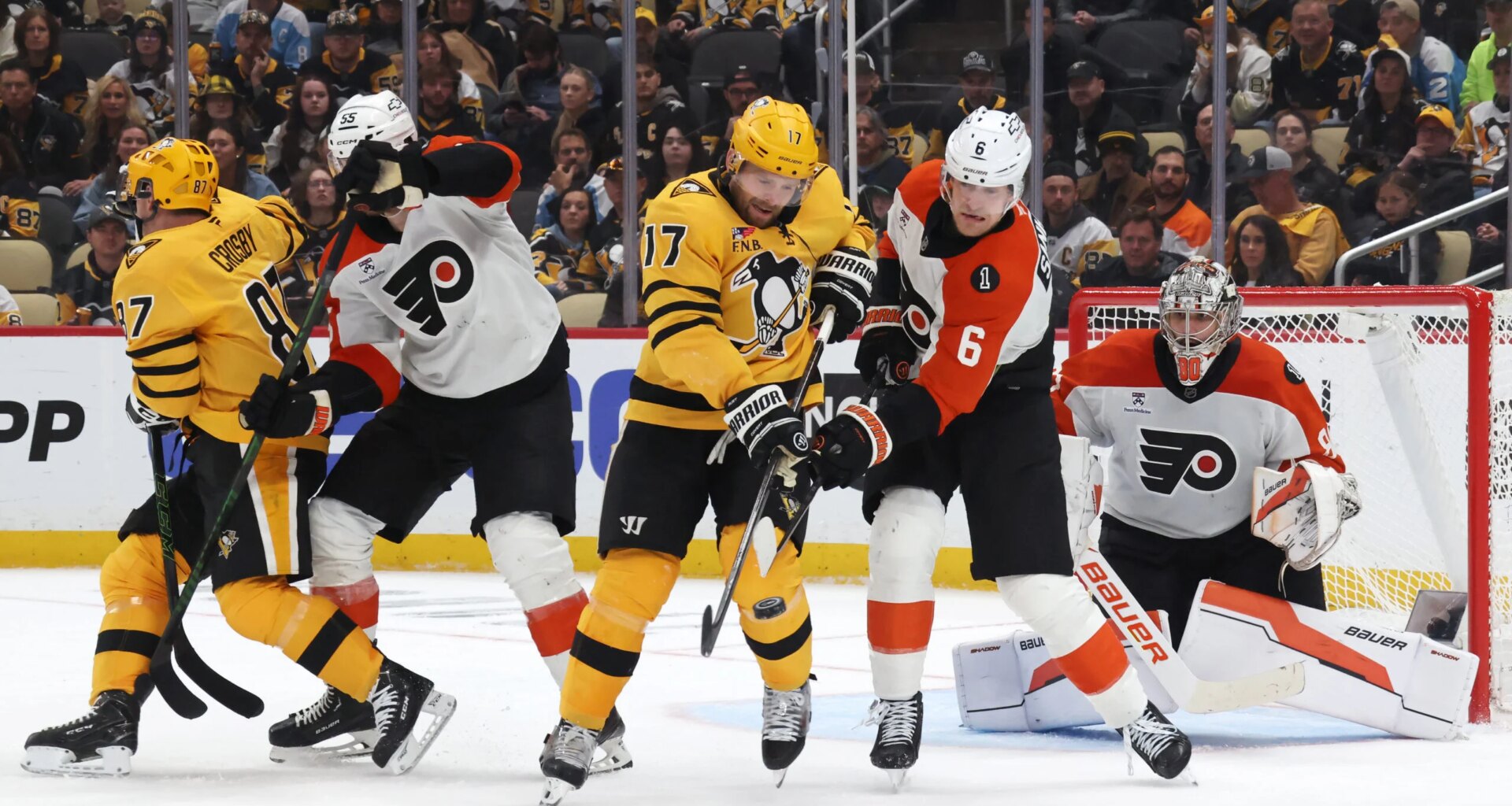
The Penguins had more than TWICE as many shots attempts as the Philadelphia Flyers, yet almost none were net in the first (20 attempts, two shots on goal), and they had agonizingly few high-danger scoring chances. They finished with 75 shot attempts but only 27 on goal and none in the net. The Flyers had 23 shots and 35 attempts.
And a late in the second period, the Penguins’ power play submitted what can only be described as a shocking indifference to a pair of shorthanded rushes, leading to a Flyers’ shorthanded goal, a 3-0 loss at PPG Paints Arena Monday, and a 2-0 series deficit.
The glass behind the Flyers’ net was covered in puck marks and Penguins’ disappointment.
“Obviously, when you’re down and out, they took two games in our bar, and so we’re not going to let that go easy. That’s where our fight comes in,” said goalie Stuart Skinner. “And we’re trying to get some juice going in this room and show ourselves, show them, show the fans, show everybody that it’s not going to be easy. It’s not going to be easy beating us.”
Make no mistake, this series is careening toward a transformative franchise moment. A quick series loss while being squelched on the scoreboard will cost players’ new contracts. It could also mean the end of one or more long Penguins careers.
Yes, the next few games are that important.
Yes, the Flyers’ simple and flawless execution of a defensive scheme is keeping the Penguins off balance, but much of that rests upon the Penguins’ inability to accept the game and execute the simple plays required.
“I think there should be frustration. (We) should be frustrated. We just lost two games at home, and so I think with frustration, comes, ‘how are you going to respond? How are we going to respond?’ And so I would hope every single guy in that room, entire staff–nobody’s happy right now,” said coach Dan Muse. “Nobody should be (happy) tomorrow. We’re gonna have to make a decision–are we gonna stay with it? Stay with what we want to do, get to our game, which we haven’t gotten to in two games, or are we gonna let frustration continue to boil over into the next one?”
“And so that’s gonna be a choice we, together, all of us, including myself, are going to have to make here over the next 24 hours.”
In Game 2, the Penguins did a better job of breaking the Flyers’ neutral zone structure, but could not get through the mass of bodies that collapsed around the net. The Penguins tried, but they never got their sticks on a second puck near the net, and their offensive pressure was largely contained to the perimeter.
Penguins winger Bryan Rust spoke with PHN after the game. He sounded an optimistic tone on the Penguins’ third-period push, though the negative details mounted throughout the conversation.
“They’re having a lot of guys at the line. They’re getting numbers back, and we’ve got to just get in there. There were times where I thought we did a really good job of that,” said Bryan Rust. “We had some sustained O-Zone time. We had some chances. I think against a team like this, we got to work even harder to get our offense.”
The reasons and how the Penguins lost, again, are many. In part, credit their opponent. But in part, lay the blame on too many players not carrying their weight and a team not determined to play the game their opponent insisted by unflinchingly taking away what the Penguins like to do.
The quite promising Penguins season that flipped the script on doubters, promoted depth players to main stage actors, and made general Kyle Dubas look like a genius with an unquestioned string of successes is perilously close to ending in ignominy.
A playoff series loss is one sort of disappointment; getting dominated by the Flyers is a humbling that will linger for years and call into question the very construction of the team.
While the Flyers command the ice with a suffocating defensive structure, the Penguins are flailing about, seemingly unsure of what was happening to them. The self-assured Penguins are close to having their balloon popped as they could nary muster a shot, even on the power play.
In fact, the power play that served them so well all season and finished seventh in the NHL became the sword that cut them.
A furious early third period rally showed what the Penguins were indeed capable of, but so much of their season will come down to what happens in Game 3.
Penguins Analysis
Ultimately, beating a defensive trap requires winning an extra puck. Playing low and crashing the net while still maintaining defensive responsibility.
The Penguins finally got to something resembling their game in the third period. Sidney Crosby looked strong in the third period; he used his base to hold the puck and keep offensive zone possession. The Penguins finally sustained heavy pressure, but that glorious chance and thus that first goal remained elusive.
Tactically, Penguins coach Dan Muse installed a few wrinkles from the puck drop. The Penguins’ breakouts and zone entries were appropriately simple. The Penguins used an extra change of direction between the defensemen–instead of the strong side defensemen pushing the puck forward, the weak side D slipped to the center for a quick D-to-D pass, then up the middle.
The little change moved the two front forecheckers of the 1-1-3. The second part of the breakout plan was a forward, usually a center, posted in the middle of the ice near the blue line like a bumper.
In the first period, it worked well, but … there’s always a but … the Penguins did not do enough once in the offensive zone. They were confined, or perhaps confined themselves to the perimeter, or they missed the net badly with a defender between them and the net.
“You think of some of the little things that you can do to create higher-quality chances, we need to do better and so from one game to the next, and so maybe (we did) a little bit more tonight at certain points in the game, but you’ve got to get pucks to the inside. Can’t just be on the outside the whole time.”
The power play was abysmal. No analysis is necessary because little semblance of competence. The Penguins had two power play shots in just under eight minutes of power play time, little momentum and fewer still chances.
“There’s a lot more to it than (not shooting),” said Rust. “We aren’t making aren’t making tape to tape passes. We aren’t making the right reads. We’re not doing the things that made us successful or that make us successful. And we got to take a hard look in the mirror, and we got to correct that fast.”
Penguins Report Card
Team: D
A team with 75 shot attempts should have over 27 shots on goal. There is an element of the Flyers’ game that is taking away much of the game the Penguins WANT to play. Muse made the adjustments, but he can’t force the players to win the extra battle or get the shots on net and get there for a rebound.
Stuart Skinner: A+
Skinner stopped Owen Tippet’s penalty shot. He denied a second-period two-on-none. Skinner has been the Penguins’ best player. He’s on his game and stopping high-danger chances to give his team a chance.
Power Play: F
Flyers coach Rick Tocchet alluded to making a few tweaks to the lowly ranked Flyers penalty kill. The PK has been aggressive, but that doesn’t account for the flatfooted, lethargic, slow power play that lacks urgency as both PP1 and PP2 chuck the puck around the perimeter. A healthy dose of blame goes to Erik Karlsson and Kris Letang for not opening the top of the zone or getting pucks on net, but further blame still for Crosby, Evgeni Malkin, and the forwards for playing slowly and with their feet close to the wall.
Help Wanted
The Penguins’ star players have been well confined by the Flyers, who are playing appropriately scared of the results if they allow Crosby, Evgeni Malkin, Karlsson, Chinakhov, Anthony Mantha, or even Bryan Rust an inch of space.
One of the Penguins’ primary players must break free. What the Penguins want to do is not available, thus the stars must figure out how they can thrive until they open the Flyers’ shell.
If the Penguins continue to “try to get to their game,” before they solve the Flyers game, they will lose and lose the series quickly.
It would be fair to deliver failing grades to nearly all the Penguins’ top players. It is they who must adjust to the muddy track which the Flyers have created. It is they who must lead in adjusting to the greasy game the Penguins must play. And it is they who must put the puck into the net.
Tags: Penguins Analysis Philadelphia flyers Pittsburgh Penguins
Categorized:Penguins Analysis