
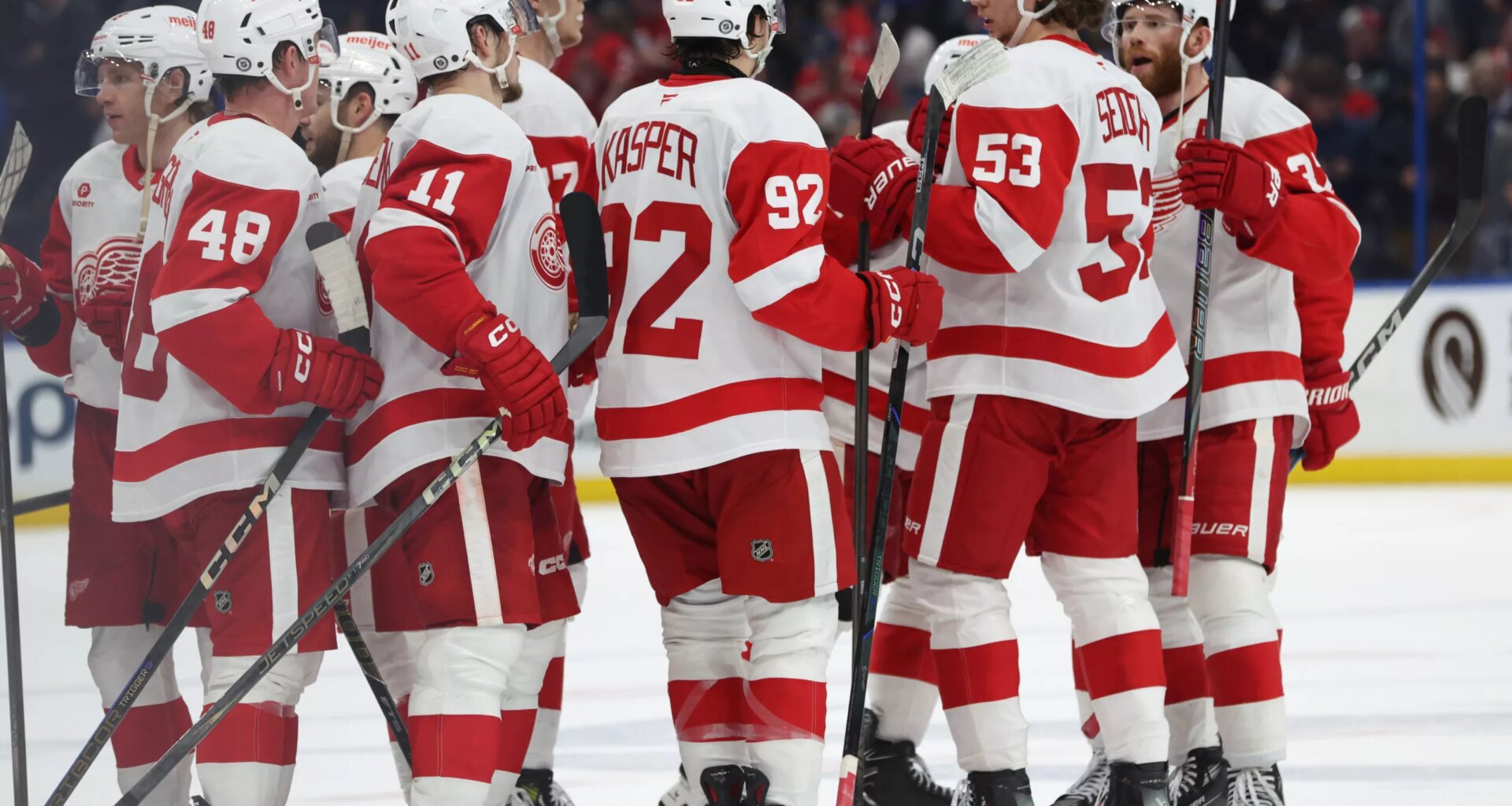
The Detroit Red Wings defencemen were a solid mixture of younger players and seasoned veterans in 2025-26. Like the forwards group, they must get deeper moving forward. This unit wasn’t good enough to catapult the Wings into the 2026 Stanley Cup Playoffs, especially down the stretch.
Detroit Red Wings Defencemen Showed Improvement and Potential
Still, with one of the best blueliners in hockey leading the way, paired with two high-upside up-and-comers, this rotation may be one player away from inflicting serious damage. There are surefire top-four-calibre youngsters, role and niche players, and veteran voices. They at least gave the Red Wings an incredible foundation to build on.
Credit Image: © Dirk Shadd/Tampa Bay Times via ZUMA Press Wire
Which players more than held their own in 2025-26, and where do they still need to improve? Check out the player reviews and rankings below, discover who will stay in a Winged Wheel for 2026-27, and who may be on their way out.
8 – Travis Hamonic
It was a head scratcher for the Red Wings to bring in Travis Hamonic. Hamonic had underperformed for the Ottawa Senators, and Wings fans got exactly the same thing in Hockeytown. He appeared in just 26 games, logged two points, played low-end third-pairing minutes, and provided zero help anywhere else but occasionally in the defensive zone.
Hamonic played with an edge, landing 32 body checks and 41 blocks. But he was on the ice for 19 goals against at even strength, and his on-ice save percentage was just 88.8. That said, there was hardly a reason to get excited over Hamonic’s play.
Unless the Wings surprise us, Hamonic is likely one-and-done and won’t return. If injuries hit the Wings blueliners in 2026-27 and Hamonic is still available, they may bring him on. But that’s a big “if,” considering his forgettable play.
7 – Albert Johansson
The coaching staff trusted Albert Johansson enough for him to appear in all 82 games. He grinded out third-pairing minutes, blocked 93 shots, and ended the year with 11 points, including three goals. But Johansson proved he’s best suited for a sixth or seventh defenceman role at the NHL level, considering his lack of improvement across the board.
His Corsi For at even strength was just 45.7 despite 47.8 percent of his starts coming in the offensive zone. Besides the highlight-reel goal he scored against the Minnesota Wild and a few select moments, Johansson didn’t do much for the Wings in the offensive zone. They scored just 7.7 percent of the time when he was on the ice at even strength.
Everyone knew Axel Sandin Pellikka would struggle through an up-and-down season. He hardly played in North America until 2025-26, so it wasn’t easy to make the immediate jump to the NHL. Still, he ended the year with 21 points and seven goals and a 10.3 shooting percentage in 68 contests. Throw in time on the power play, and Sandin Pellikka showed flashes as an offensive defenseman.
He must bring up his defensive game, and that’s a challenge for young blueliners with an offensive mindset. Sandin Pellikka will return for the full 82-game slate in 2026-27. Expect better defence before he comes into his own in 2027-28. Once Sandin Pellikka fully develops as a three-zone player, his play will be lights out.
Some will scoff at a player who logged just five points in 63 appearances landing at number five. But Jacob Bernard-Docker played his role well. He was your stereotypical defensive defenceman when skating limited minutes. Yet he blocked 87 shots, landed 66 hits, and watched just 24 goals end up in the Red Wings net at even strength.
Bernard-Docker will never be a factor in the offensive zone. But when the Wings need an additional layer of solid and sometimes spectacular defence, Bernard-Docker is always ready to skate into the role.
If that wasn’t the case, he wouldn’t have signed an extension. Come 2026-27, he would ideally rotate third-pairing minutes with Albert Johansson. Bernard-Docker’s more consistent play, however, could even entice the Wings to slot him over Johansson and give him another 50-plus games.
4 – Ben Chiarot
Ben Chiarot has polarized this fan base. Some have pointed to his skating and lack of productivity in the offensive zone for the Red Wings to move on. Still, Chiarot can step up and play top-four minutes when needed. He plays with a mean streak, and more than holds his own in the defensive zone.
Heading into his age-35 season in 2026-27, the Red Wings should acquire enough defensive depth for Chiarot to drop into a third-pairing role. Pair him with a younger player like Albert Johansson or Jacob Bernard-Docker for a year, and he should thrive.
Best yet, hanging onto Chiarot for potentially another three seasons gives the Wings another veteran voice in the locker room. Until they make the playoffs, Detroit can’t have enough veteran voices.
3 – Justin Faulk
The Red Wings trade acquisition played as advertised over the final five games of the year, logging three goals and five points. Overall, he finished with eight points in 17 games in the Winged Wheel, but most of that production came too late.
Faulk logged a Corsi For of just 44.8 and watched 18 goals land in the Red Wings net. That performance led some to question why the Wings gave up so much to acquire him. But his productivity in those final five games indicated he started figuring things out. That’s a major plus for an experienced player who has another year left on his contract.
With a full offseason and training camp in Faulk’s not-so-distant future, he’ll play like he belongs in the system beginning on opening night. Wings fans can expect to see the version of Justin Faulk they got in those final five games this season.
2 – Simon Edvinsson
Simon Edvinsson didn’t make a major jump in production with nine goals and 25 points in 72 games. But he made up the second half of a strong defensive pairing alongside Moritz Seider, and averaged 22:21 of ice time. Those factors indicate the coaching staff has thrown its trust behind Edvinsson.
He took just 42.0 percent of his starts in the offensive zone at even strength, but ended with a 51.2 Corsi For. Edvinsson was also on the ice at even strength for 72 goals, which shows off his overall impact in the offensive zone.
The 2026-27 season should give him even more ice time, and he may even log a career high in points. That kind of production will leave fans wondering just how formidable a Seider-Edvinsson pairing could get.
1 – Moritz Seider
Moritz Seider may be the Red Wings most valuable player. He finished the year with a career-high 60 points and 10 goals, and averaged 25:40 of ice time. Seider also kept up his bruising style, albeit to a lesser extent. But with Edvinsson coming into his own, Seider didn’t need to land 200-plus body checks.
Like Edvinsson, he didn’t take as many starts in the offensive zone at even strength at 43.1 percent. As for his Corsi For? 53.1 percent. That’s sheer elite play. And it’s why you will see the best version of Seider coming in 2026-27 as one of the Wings undisputed cornerstones.
If he’s not a surefire contender for the Norris Trophy this season, he will be one next year. Expect Seider to be in the running for the Norris throughout his prime years. Bonus points if he keeps his ironman streak going.
Main Photo Credit: Kim Klement Neitzel-Imagn Images