
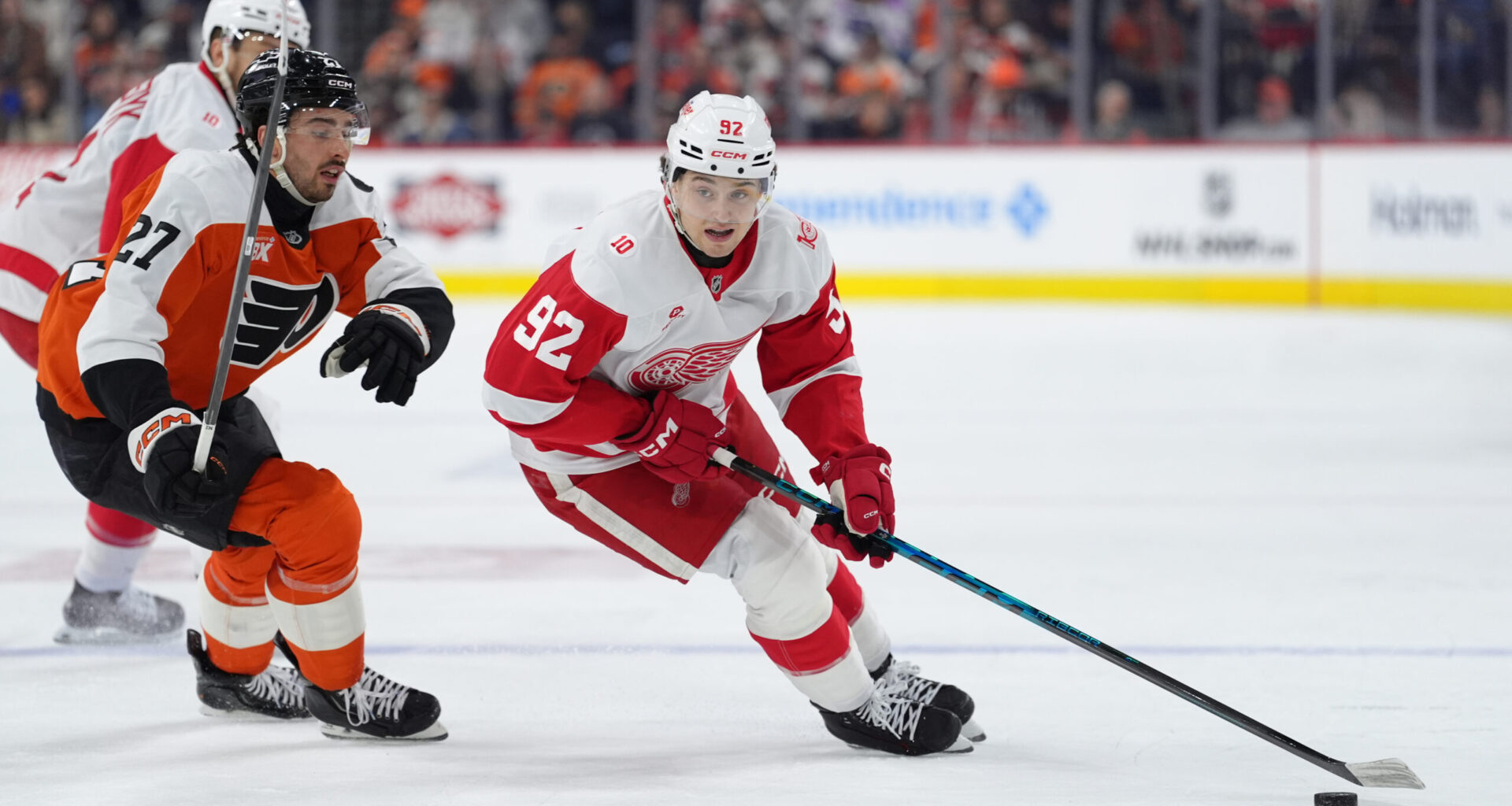
When Marco Kasper scored 19 goals in his rookie season with the Detroit Red Wings, the fan base went all Charles Dickens in celebration of the event.
There were great expectations for Kasper everywhere you looked.
Maybe even between Kasper’s ears, wondered Red Wings coach Todd McLellan.
“I do believe when he goes home in the summer, his mind is thinking, ‘You know, that way it’s going to be a 25-goal year (next season),’” McLellan said.
We know by now it wasn’t. Not even close.
The sophomore jinx came down on top of Kasper like a ton of bricks.
“It’s hard as a sophomore to come back and really understand what’s going to happen,” McLellan said. “You have to experience it a little bit.”
Boy, did Kasper ever experience it.
The Austrian forward counted one point, a goal, through his first 10 games. Despite mostly playing at center, Kasper went 30 games before collecting his first assist of the season. He endured a 36-game goalless drought.
At season’s end, Kasper’s totals were a dismal nine goals and 19 points in 81 games. His minus-20 rating was the worst of any Red Wings forward.
“It’s been kind of a frustrating year for me personally, especially not scoring much,” Kasper said. “I think chances have been there. I mean, obviously, you gotta find a way to put it more in the back of your head to execute more and even create more, so that you even have more opportunities and it’s progress.”
McLellan does believe that Kasper let his struggles overwhelm his psyche at times this season.
“I don’t know if he could let go of it sometimes when he had to,” McLellan said. “But he wasn’t pouting, he wasn’t sulking, he didn’t get lazy. He probably held onto it a little bit too much.”
Red Wings Expecting More From Kasper
On the one hand, McLellan doesn’t think that the real Kasper was the one who tabulated points so effortlessly during the second half of the 2024-25 season.
“I’m not sure he had a complete rookie year,” McLellan said. “I think from Christmas on, he, or maybe even January on, he started to really click.
“We looked at his analytics, his stats. I think his shooting percentage from the point of the coaching change to the end of the year was 36% or something like that. It’s very unrealistic that anybody’s going to stay at that pace. It’s never happened.
“So we knew that he would come back down to earth.”
They didn’t think that Kasper would come down to earth with such a thud, though.
“Offensively, I think there’s more in Marco,” McLellan said.
That being the case, the last thing the coach wanted to do was pressure Kasper about increasing his offensive output.
“We appreciate him for what he’s done, and he did score more since we quit asking those questions (about his lack of offense) or trying to get it out of him,” McLellan said.
“He looked more comfortable, more confident. He was physical. He’s a more effective player that way. Yes, he has to do those things, and he’ll get his chances and his goals. If he goes out onto the ice thinking the other way, well, then it doesn’t quite work for him.”
There were indications of improvement in the second half of the season. Seven of Kasper’s nine goals came during Detroit’s final 32 games.
“Regardless, he’s mature now,” McLellan said. “He’s grown up. He’s been through some really good times and some bad times. And, based on the way he carries himself and his drive, it should allow him to be a better player in the future.
“He’s fought his way through. He’s given us some good games, and we know he’s going to be a big part of our future.”
“He does a lot of things really well for our hockey club, and we’re lucky to have him.”