
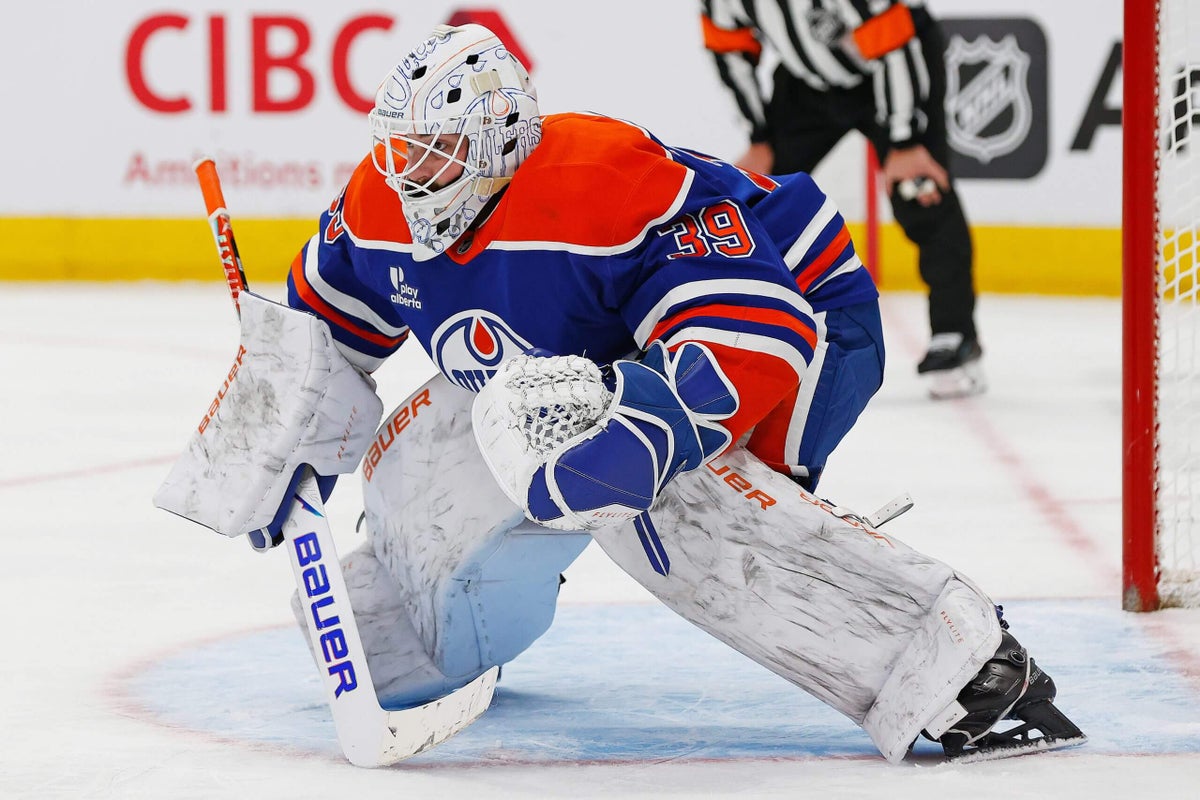
EDMONTON — A few minutes after his Edmonton Oilers closed the book on a 4-3, playoff-opening win over the Anaheim Ducks on Monday night, Connor Ingram, the most unlikely starting goaltender in the Stanley Cup playoffs, had to admit the truth.
This wasn’t a late-April game against the Vancouver Canucks. It wasn’t front of 5,851 people in Bakersfield, Calif., or at a glorified college rink in Tempe, Ariz. Ingram had just played 60 minutes of high-stakes hockey, in front of a sold-out, tooth-rattling sea of orange, and he’d done it well, with 25 saves on 28 shots.
Ingram’s hockey life — 161 AHL games, five NHL franchises, time spent in Sweden, challenges throughout — has been marked by an even-keeled approach to his work that, for the last month, has served the Oilers exceedingly well. Now, after he battled his way through Game 1 against the Ducks, the Oilers will need Ingram to fall back on that long history of resilience to overcome a young Anaheim team that looks competitive.
“My job doesn’t change, no matter what we’re doing,” Ingram said the day before Game 1. “It’s just another hockey game. My friends and family, we don’t talk a lot of hockey. That’s kind of a rule around our household. This is my job, so when I leave, I want to do something else.”
After the game, he was ready to alter his stance.
“It was awesome,” he said. “It’s loud in there. It was fun. After the anthem, I was just kind of smiling and taking it all in. That was one today where I was like, ‘This is cool.’”
Long before Ingram became the Oilers’ dark-horse playoff starter, he was a self-described “shot in the dark” for the Nashville Predators. They threw him into the crease for just his fourth career NHL start during the 2022 playoffs against the Colorado Avalanche, and Ingram delivered one of the best goaltending performances forgotten to time.
Nashville was heavily overmatched in that first-round series against the eventual Stanley Cup champions, and had seen starter Juuse Saros go down to injury before No. 2 man David Rittich was blitzed 7-2 in the series opener.
That left the Predators to go with Plan C — Ingram — and they saw him deliver a heroic effort on the road at Ball Arena. He stopped 49 consecutive shots, sandwiched around goals by Nathan MacKinnon and Cale Makar, and put his team in position to steal a game it had absolutely no business winning before ultimately falling 2-1 in overtime. Colorado went on to sweep Nashville.
That overtime game was proof, for one night anyway, that Ingram could hold his own under an onslaught from some of the game’s best — although the confidence he drew from the experience is tied as much to MacKinnon’s goal as to his impressive stat line.
“I think about letting in that first goal a lot now,” Ingram told The Athletic. “If it ever happens to me, I can look back and say ‘Well, f—, you ripped out 49 straight, why can’t you just go do it again?’ It’s one of those games that I kind of go back to and build off of, you could say.”
Ingram is now back in the playoffs, four years later, and the memories from that night were on his mind before his first playoff start in Edmonton because teammate Mattias Ekholm brought it up in a discussion with him on Monday morning.
They were briefly teammates in Nashville before reuniting with the Oilers this season, and all these years later, Ekholm sees a guy who remains unchanged despite the stops and starts that have marked his career in the interim.
“He was the same back then, right?” Ekholm said. “He was such a calm guy and it almost seems like he — how do I put this, it’s not like he doesn’t care, but it’s like he’s got a bigger perspective on life in some areas. He just goes out and does his best, and that’s it. Sometimes for a goaltender that’s best. You saw it that game, it can be really beneficial for him.
“I love that mindset for him.”
Three seasons before Ingram’s big night for the Predators, the Tampa Bay Lightning had drafted him with the No. 88 pick in 2016.
Ingram followed that by earning a spot on Canada’s 2018 World Junior Championship roster and finishing his junior career with a .927 save percentage for the Kamloops Blazers of the Western Hockey League.

Connor Ingram long has been known to keep an even temperament in hockey. (Perry Nelson / Imagn Images)
In 2018-19, with Tampa Bay’s American Hockey League affiliate in Syracuse, N.Y., Ingram stood out in a few ways. His solid, sharp sense of humor manifested in a high-end, hockey-centric impression of Zach Galifianakis in the “Between Two Posts” interview series with his teammates, for one. He also showed big-picture perspective that was uncommon for a 21-year-old hockey player, said former NHL defenseman Cameron Gaunce, an alternate captain for the Crunch that season.
“He’s a wonderful human,” Gaunce said. “He cares about his family. He cares about his teammates as people.”
It made for an approach that Gaunce appreciated, then and now — and one far enough afield from the typical athlete to leave others confused.
“You hear his answers now, where he talks about it being a job,” Gaunce said. “Well, when you’re a younger guy saying those things, it sometimes comes across as you not caring. Some people needed to try to figure him out, and it was hard for him because he had that mindset. (Playing hockey) is what he wants to do, but he had to figure out how to get that across to people without sounding like he didn’t care.
“Emotional intelligence in hockey isn’t exactly something that has come to the forefront yet. So to hear someone who’s as well-balanced and as understanding of perspective, and where their perspective lies with hockey compared to the rest of their lives, is a bit foreign to people.”
On the ice, Ingram made the AHL All-Star team, putting up a .922 save percentage and a 14-7-0 record. Where he shined in particular, Gaunce said, was in his predictability and in his ability to read the game.
It made it easier for the Crunch’s penalty-killers, for example, to commit to blocking the far side of the net with the puck on the half wall. They knew that Ingram would have the short side and middle of the net covered.
“You knew where he was blocking. You knew what he was saving,” Gaunce said. “As long as I did my job, I didn’t have to worry about that. You need to know what’s happening around you to be as decisive as you possibly can.”
Despite that, Ingram couldn’t break through to the Lightning’s NHL roster, and Nashville acquired him in June 2019 for a seventh-round pick. That season, he put up a .933 save percentage in 33 games for the AHL Milwaukee Admirals. In most NHL organizations, that’d get a goaltender a call-up. The presence of Saros and Pekka Rinne, though, meant that Ingram spent the entire 2019-20 season with Milwaukee.
His 49-save game was still two years away.
Ingram wound up playing just 15 games during the COVID-19-impacted season of 2020-21, split between Sweden’s IF Björklöven and the AHL’s Chicago Wolves. In January 2021, while serving as the Predators’ taxi-squad goaltender, he voluntarily entered the NHL’s player assistance program and was diagnosed with obsessive-compulsive disorder.
Ingram said he had shown signs of OCD since childhood, but they most acutely manifested during the pandemic. In the years since, Ingram has spoken extensively about OCD and the importance of therapy. He’s also maintained that hockey, before his diagnosis and after, has been a positive force in his life while also only taking up a few hours of his day.
In 2021-22, Ingram’s first season after seeking treatment, he again showed himself to be a high-end AHL goaltender, putting up a .915 save percentage in 54 games with Milwaukee and making three spot starts for Nashville ahead of the 2022 playoffs.
That summer, despite Ingram’s moment against the Avalanche, the Predators chose Kevin Lankinen — a former starter with the Chicago Blackhawks — as Saros’ backup to start the 2022-23 season. The Arizona Coyotes pounced and claimed Ingram off waivers in October, and he established himself, for the first time, as a NHL goaltender. He put up a .907 save percentage in each of his first two seasons with the franchise, making 77 appearances in all, including 37 at Mullett Arena, the Arizona State arena where the Coyotes played before they relocated to Utah.
In 2024-25, after 22 games as the starter for what was then known as the Utah Hockey Club, Ingram took a leave of absence to spend time with his mother, who later died of breast cancer in December. In March, he re-entered the player assistance program.
“I am once again privileged to have access to their network of world class health professionals to hopefully avoid long-term effects of putting your health second,” Ingram wrote in an Instagram post.
When the rest of the league reported for training camp last September, Ingram was absent. He was in hockey limbo after agreeing to part ways with the Mammoth, and he passed through waivers unclaimed before being sent to Edmonton in an Oct. 1 trade that brought back nothing in return, only “future considerations.”
Even more telling was that Utah agreed to lower his cap charge to $1.15 million by retaining the other $800,000 owed on his contract — giving Edmonton the ability to bury Ingram in the minors without penalty.
Had Oilers starter Tristan Jarry not gone down with an injury a week before Christmas, it’s entirely possible Ingram would still be playing for the AHL Bakersfield Condors today. He gave up seven goals in his last AHL start for them at Tucson on Dec. 13, as sure a sign as any that his call-up to Edmonton came out of necessity, rather than performance.
Ingram’s play improved after he pulled on an Oiler sweater, particularly as the playoffs approached and he had taken full control of the starting job. In his final eight regular-season games, he put up a .923 save percentage (10th in the NHL from March 23 on) and saved 0.7 goals above expected per 60 minutes (eighth). In seven starts, he allowed more than two goals twice. Jarry, by comparison, had put up an .857 save percentage and saved fewer goals than expected in 13 of 19 appearances after Edmonton acquired him from Pittsburgh, according to Hockeystats.
“It’s been a wild year,” Ingram said.
When the playoffs finally arrived, at 8:22 p.m. Mountain time on Monday, he remained steady through a wild night. The Ducks brought havoc to Ingram’s crease, seeing a potential Tim Washe goal taken off the board after he backed hard into the goaltender. They also put three pucks behind him during the second period to pull ahead.
But in a frenzied atmosphere that bore little resemblance to anything he’d experienced previously – Ducks counterpart Lukáš Dostál said he didn’t even realize the Rogers Place crowd repeatedly chanted his name because it was so loud – Ingram stopped Beckett Sennecke at the end of a dangerous two-on-one rush to keep Edmonton’s deficit at one goal with a little less than nine minutes to play.
Seconds later, they tied it up.
“That was a game-changer,” teammate Ryan Nugent-Hopkins said.
Ingram had done his job.
In a city where goaltending is forever under the microscope, all the Oilers are asking is that he consistently give them a chance. And having already seized his own chance to push forward with his career, there was a measure of satisfaction to be found in his first career NHL playoff victory.
“Yeah, it took me four tries, but I made it,” Ingram said. “It means a lot. It’s pretty cool. It’s exciting to do it here.”