
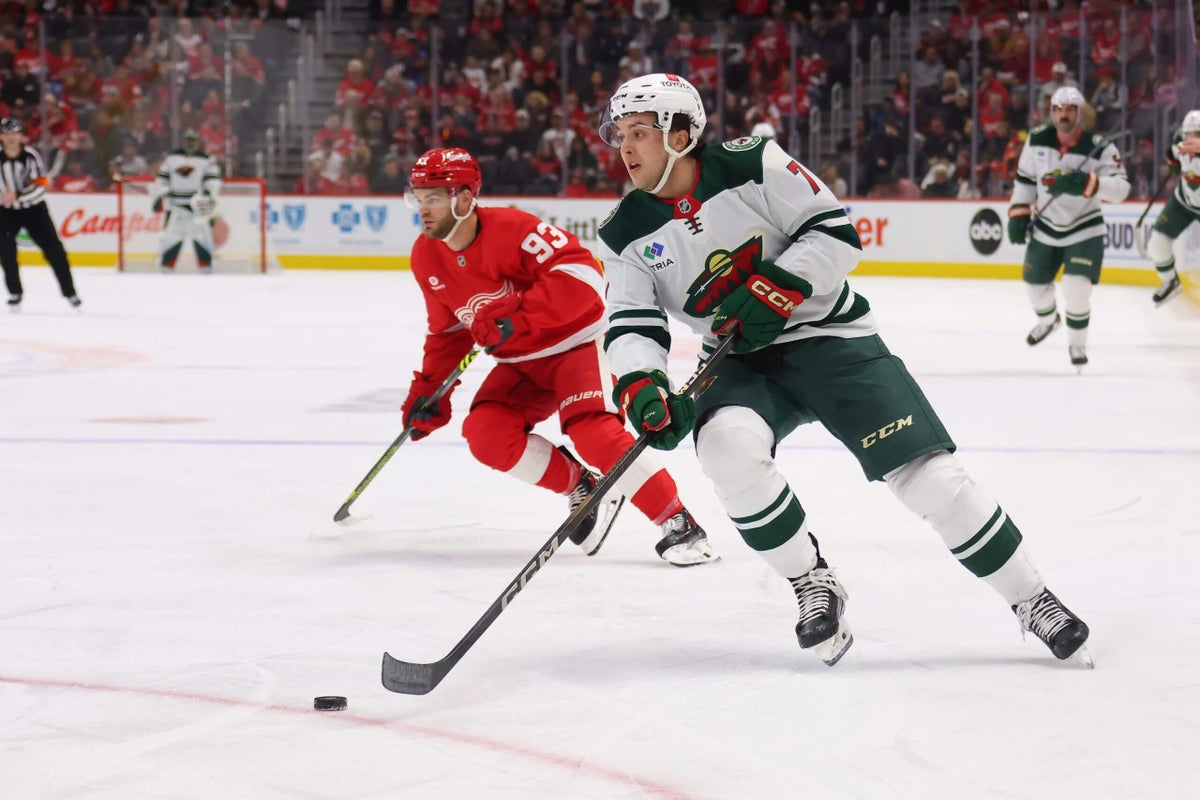
You could see the frustration on the faces of the Detroit Red Wings, and you certainly heard it in their words.
“We all know it, right? Marches and late seasons … when it gets tight, we come up short,” Dylan Larkin said on the night the Red Wings were officially eliminated from playoff contention for the 10th straight season. “We talked about it. We tried different things. Then it happened again this year.”
The Red Wings are stuck. There’s no other conclusion after a 10th straight year outside the playoffs, and a third straight collapse in March. They haven’t been good enough to get into the postseason, and haven’t been bad enough for a few years now to have the silver lining of a high draft pick.
So, what do they do about it? That’s the big question as the offseason begins. And while there’s no easy answer here — if there were, they wouldn’t be stuck to begin with — there are some recent examples of what works, and what doesn’t.
Today, we examine four such examples of other “stuck” teams, how their situations turned out, and what lessons they can offer.
Toronto Maple Leafs
The parallels: The Leafs were obviously more successful in the regular season than the Red Wings have been, but once the playoffs arrived every year, they couldn’t find a way to elevate enough to make a deep run. Basically, it was a luxury version of the Red Wings’ struggles in March.
The outcome: Toronto spent years trying to find the right supporting cast around its core of Auston Matthews, Mitch Marner, William Nylander, John Tavares and Morgan Reilly. The Leafs tried a stylistic change, they brought in toughness and experience, they fired coaches and executives. Yet in the end, they topped out with just two first-round series wins.
When the frustration over those playoff woes boiled over, the angst and toxicity in the market rose to a level that effectively ran off a hometown star in Mitch Marner — a move that immediately sent the Leafs spiraling to a bottom-five finish this season.
It remains to be seen if Toronto can rebound in the years to come. But the outlook now is even bleaker than during those repeated first-round exits.
The takeaway: “Blowing up the core” is just as likely to prompt a new rebuild as it is to solve the key issues.
Now, an important distinction here is that Marner’s departure came with him on the doorstep of unrestricted free agency, meaning Toronto didn’t get any real value back for him. They traded him to Vegas for Nicolas Roy on the eve of free agency, and tried (unsuccessfully) to use the cap space to replace his impact in the aggregate. If Detroit made a change to its core, the Red Wings would have more leverage in a potential trade and could certainly get a superior return. Still, they likely wouldn’t be getting back equivalent talent in the present, leading to a step back of some kind.
Another key difference between the Leafs of last season and the Red Wings of this year (besides Toronto’s far-superior regular-season success): the Red Wings have a farm system full of young players on the way, while Toronto did not. That’s notable too. It’s certainly not a one-for-one comparison.
But the principle here is that it’s a whole lot easier to get worse when losing a star than it is to get better. And there’s a real chance that doing so simply creates a much bigger hole.
Some Red Wings fans would be OK with that, or even prefer it to the way things are. But with frustration at a boiling point with a 10-year playoff drought, going backward would be a hard sell for many others.
Vancouver Canucks
The parallels: Vancouver underwent a long stretch outside the playoffs that yielded a collection of impressive young talent, but never amounted to enough success together.
Between Bo Horvat, Elias Pettersson, Quinn Hughes, J.T. Miller and Brock Boeser, Vancouver had a strong group of scoring forwards, a dynamic star defenseman and even a high-level goaltender in Thatcher Demko. But the Canucks could not consistently turn that core talent into winning seasons, with a lack of depth and balance around them.
The outcome: The Canucks made playoff appearances in 2020 and 2024, both times making it to Game 7 in the second round. But it would be hard to say they lived up to the potential of their best players. It unraveled slowly, but all of Horvat, Miller and Hughes are now elsewhere, and Pettersson has regressed substantially.
Not all of that is Vancouver’s fault. The Pettersson fall-off has been staggering, and the saga that led up to Miller’s exit is its own story altogether. But all the hope that surrounded that prime-aged core nonetheless dissolved due to organizational dysfunction and short-sighted decisions — including bridging Pettersson out of his ELC (leading to the now-ugly extension signed in 2024), not maxing out on term with Hughes (who signed for six years) and trading away a top-10 pick (which became Dylan Guenther) for Oliver Ekman-Larsson, Conor Garland and the ability to clear cap space from Louis Eriksson, Jay Beagle and Antoine Roussel.
In theory, this was done in the name of competing in the short term. And the flat cap exacerbated all of the issues. But the end result was a team whose window to find success became shorter than it needed to — and never really delivered much.
Last week, after finishing the season dead last in the NHL, Vancouver fired general manager Patrik Allvin, though team president Jim Rutherford remains in place.
The takeaway: Even a strong core is not enough to overcome mismanagement.
As with Toronto, the Canucks are not a perfect analogue for the Red Wings, nor are they a perfect analogue for anyone else, really. They never fully embraced a true rebuild to begin with, and few teams have dealt with the level of internal chaos the Canucks have, at least not publicly.
But Detroit has nonetheless had its own share of scrutinized front office decisions in recent years. Did the Red Wings try to exit their rebuild a bit too soon? It’s certainly possible. Did they overpay for redundant players and leave their lineup without requisite balance? It would be hard to argue otherwise. And the Jake Walman saga, in which the Red Wings attached a draft pick to move Walman to San Jose only to see him land the Sharks a first-round pick in a trade later that season, screams of asset mismanagement.
The Red Wings still have some room to maneuver as of now, but they nonetheless face the question of whether they can properly steer the ship out of no-man’s land better than Vancouver did.
Minnesota Wild
The parallels: The Wild have been somewhere in between the Red Wings and Maple Leafs for the last decade. Minnesota’s core has evolved over that time, but for most of the span, the team has been the picture of “good, not great.” The Wild have made the playoffs in eight of the last 10 seasons (before this year), but have hit a wall in the first round of the playoffs year after year.
The Wild haven’t won a playoff series in a decade, despite four 100-plus point seasons in that span. That has made them an NHL avatar of being stuck in the middle.
The outcome: Realistically, the Wild’s story isn’t done yet, currently tied 1-1 in a heavyweight first-round series with the Dallas Stars. But after some big decisions in the past five years, they finished the regular season with 104 points, the third most in the Western Conference and seventh most in the NHL. It’s not actually their best regular season of the era we’re covering here (they had 113 points in 2021-22) but the Wild do look like legitimate Stanley Cup contenders — if they can emerge from the loaded Central Division.
Their transformation into this current form started with the arrival of forwards Kirill Kaprizov in 2020 and Matt Boldy in 2021, but it really ramped up after the Wild bought out aging veterans Zach Parise and Ryan Suter in 2021, then traded Kevin Fiala for defense prospect Brock Faber in 2022. And it reached a crescendo this season with the blockbuster trade for Quinn Hughes, one of the top defensemen in the NHL.
The Wild still lack what many would consider a “true” No. 1 center, but in Joel Eriksson Ek and Ryan Hartman, they have multiple playoff-style pivots, and major star power on the blue line, on the wing and in goal. This tough series against the Stars will determine if they can finally break through the first-round wall, but the feel of the organization and its ceiling has been transformed.
The takeaway: Escaping the middle takes some bold moves.
The Hughes trade is the most recent example, and one that is certainly relevant to the Red Wings. But don’t forget the less obvious moves that paved the way for it.
Moving on from Suter and Parise had steep salary cap consequences, but it kick-started the Wild’s transformation. The Fiala trade saw a point-per-game 25-year-old forward go out the door, but in Faber, a do-it-all defenseman, the Wild got the better end of the deal. And of course, in Hughes, Minnesota got a true game-changer on the blue line.
Time will tell if it all results in a Stanley Cup, and who knows what the narrative will be if the Stars emerge from this first-round series. But as of today, the Wild no longer feel synonymous with “the mushy middle.”
The Red Wings have made some key trades, most notably when they acquired 40-goal scorer Alex DeBrincat and goalie John Gibson, and they traded a first-round pick at this year’s trade deadline for Justin Faulk. And you can’t swing big every time — there aren’t enough assets to go around that way.
But time is not on Detroit’s side for incremental progress. That means some bolder moves may be required.
Buffalo Sabres
The parallels: Before the Red Wings owned the NHL’s longest active playoff drought, it was the Sabres’ mantle to carry. For 14 years, Buffalo toiled through multiple iterations of rebuilds, acquiring top talent but still ending up on the outside looking in.
The outcome: It depends on which stretch of the Sabres’ history we’re talking about here. The version that built around Jack Eichel and Sam Reinhart didn’t go anywhere, ending with Buffalo trading each of the top picks, who went on to win Cups elsewhere. Same with Ryan O’Reilly and Brandon Montour.
But the more recent Sabres core, built around Rasmus Dahlin, Tage Thompson, Owen Power, Bowen Byram and Alex Tuch? That version finally broke through this year, winning the Atlantic Division on the back of a midseason awakening. What prompted that surge, beginning in mid-December, is hard to pin down. It came around the time the Sabres fired general manager Kevyn Adams, but can that really explain the same group of players seemingly figuring it all out?
Crucially, though, some key moves in the past two seasons helped them do so — moves that were not met with universal praise at the time.
Buffalo dipped into a deep prospect pool and traded away 2022 top-10 pick Matthew Savoie for 24-year-old center Ryan McLeod, who had never topped 30 points. It swapped 2019 top-10 pick Dylan Cozens for oft-injured (albeit potent-scoring) Josh Norris. Then, this past offseason, the Sabres traded 68-point winger JJ Peterka for unproven two-way winger Josh Doan and big right-shot defenseman Michael Kesselring.
Not every aspect of those moves worked out. Cozens has outperformed Norris since being dealt to Ottawa, and Kesselring has even been a healthy scratch at times. But McLeod and Doan have given the Sabres more balance without sacrificing scoring, as both have really popped offensively since arriving. Doan outproduced Peterka this season. McLeod had a second consecutive 50-point season. And while Norris only played 44 regular-season games, he scored at a .77 points per game rate, the second best of his career.
Meanwhile, veteran Jason Zucker has been a revelation since signing in Buffalo in 2024, and defenseman Mattias Samuelsson had a monster breakout season at age 25, while goaltenders Alex Lyon and Ukko-Pekka Luukkonen formed a highly capable tandem in net.
The takeaway: Sometimes the best moves aren’t the biggest splashes.
McLeod and Doan are the precise kind of players the Red Wings may need to find going forward: young players with untapped potential and runway remaining, who can provide a playoff brand of offense while also being hard to play against. Zucker was an older, more veteran version of a similar profile. And none of those acquisitions were widely lauded at the time they happened. They were scouting victories for the Sabres, and they helped create this season’s breakthrough.
Of course, the Sabres’ success is also a product of successful development stories such as Samuelsson, Zach Benson and Jack Quinn. But the Red Wings have young players like them on the team and on the way. What they need now is the right finds from outside the organization to both change their on-ice identity and help accelerate the slow, winding timeline of development.
Detroit may not be in the same situation as the Sabres were — or as any of these four teams, for that matter. No two NHL teams are wholly alike.
But how each of these four teams managed, or mismanaged, similar ruts and obstacles can nonetheless be instructive for the Red Wings as they move forward into what looks like a crucial offseason.